
Most people think crypto taxes are just about filling out a form and paying what they owe. But if you’ve traded, mined, staked, or even received crypto as payment, you’re already in a legal gray zone-and the IRS knows it. Since 2014, the IRS has treated cryptocurrency as property, not currency. That means every trade, every swap, every airdrop could trigger a taxable event. And since 2019, the IRS has forced every taxpayer to answer a simple but dangerous question on Form 1040: "At any time during [the taxable year], did you receive, sell, send, exchange or otherwise acquire any financial interest in any virtual currency?" Answer "yes," and you’re on their radar. Answer "no," and you’re risking fraud charges. This isn’t about being careful. This is about survival.
Waiting Until the IRS Knocks Is Too Late
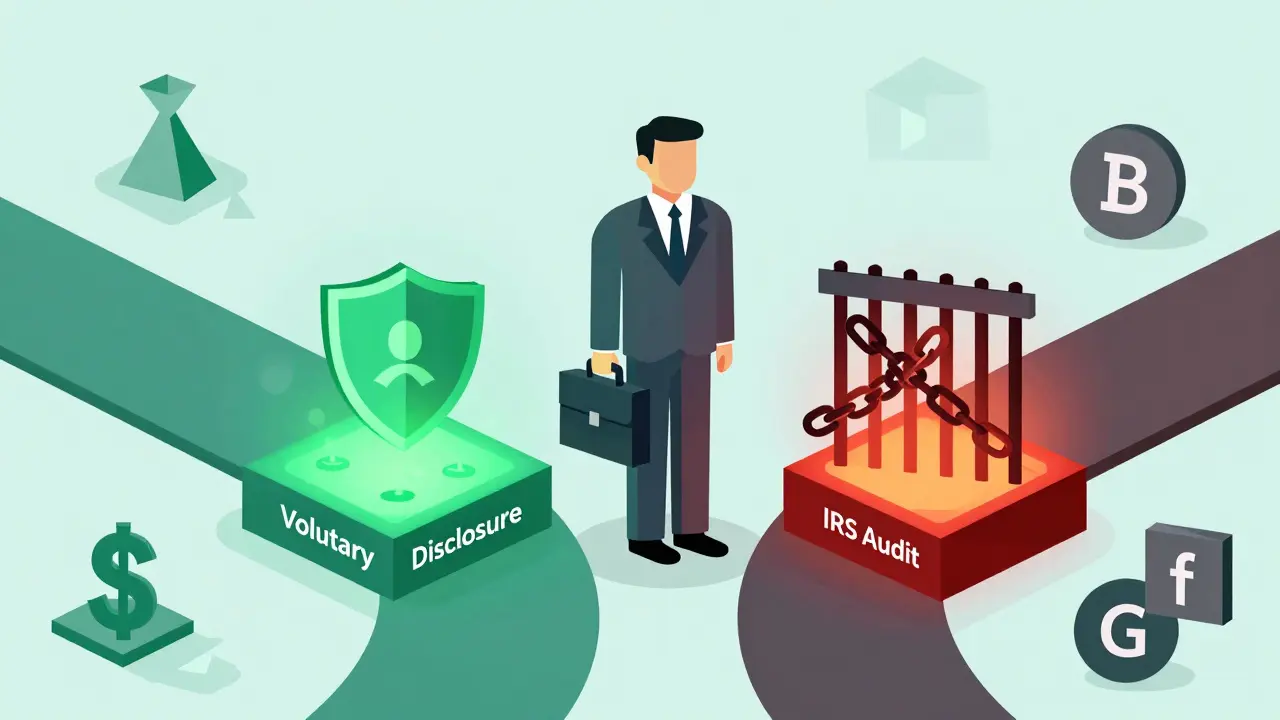
If you haven’t reported crypto gains in past years, don’t wait for a letter. The IRS doesn’t send warnings. They send notices. And if you’ve done more than a few trades, odds are you’ve made mistakes. Maybe you didn’t track the fair market value of Bitcoin when you bought it in 2020. Maybe you sold Ethereum for USDT and assumed it was tax-free. Maybe you mined 5 ETH in 2022 and never reported it. These aren’t small errors. They’re red flags. And the IRS has tools to trace every transaction on the blockchain.By the time you get an audit notice, you’ve already lost control. The clock starts ticking. Penalties pile up. Interest compounds. And if the IRS thinks you intentionally hid income, you could face criminal charges. That’s why the best time to talk to a crypto tax lawyer is before the IRS contacts you. Early legal help can get you into a Voluntary Disclosure Program, slash penalties by 80%, and keep you out of court. Waiting until the audit starts means you’re reacting. You’re defending. You’re no longer in charge.
When You’re Not Just Taxing-You’re Running a Business
If you’re mining crypto, running a node, operating a DeFi protocol, or launching an NFT collection, you’re not just a trader. You’re a business. And businesses have different rules. The IRS doesn’t care if you call yourself a "hobbyist." If you’re making money off crypto consistently, you’re self-employed. That means you owe self-employment tax on top of capital gains. You need to track expenses. You need to file Schedule C. You need to set up proper accounting.And if you’re accepting crypto as payment for goods or services? Every transaction is taxable income at the moment you receive it. The value is locked in based on the USD price at that second. If you don’t record that, you’re underreporting income. That’s fraud. A crypto tax lawyer who also has CPA credentials can help you build a system that tracks every purchase, sale, and transfer. They’ll show you how to use accounting software that integrates with blockchain explorers. They’ll help you separate business and personal wallets. They’ll make sure your records hold up if the IRS comes knocking.
ICO, Airdrops, and Token Sales: Legal Minefields
If you’ve ever participated in an Initial Coin Offering (ICO), received a token airdrop, or created your own token, you’re in a completely different league. The SEC doesn’t treat all tokens the same. Some are securities. Some are utilities. The difference? One can land you in federal court. The other might just get you a 1099 form.Let’s say you launched a token and sold it to 100 people. You claimed it was a "utility token" so you didn’t register with the SEC. But if buyers expected profits based on your team’s efforts, the SEC may classify it as an unregistered security. That’s a violation of federal law. You could face civil penalties of millions-or worse, criminal charges for securities fraud.
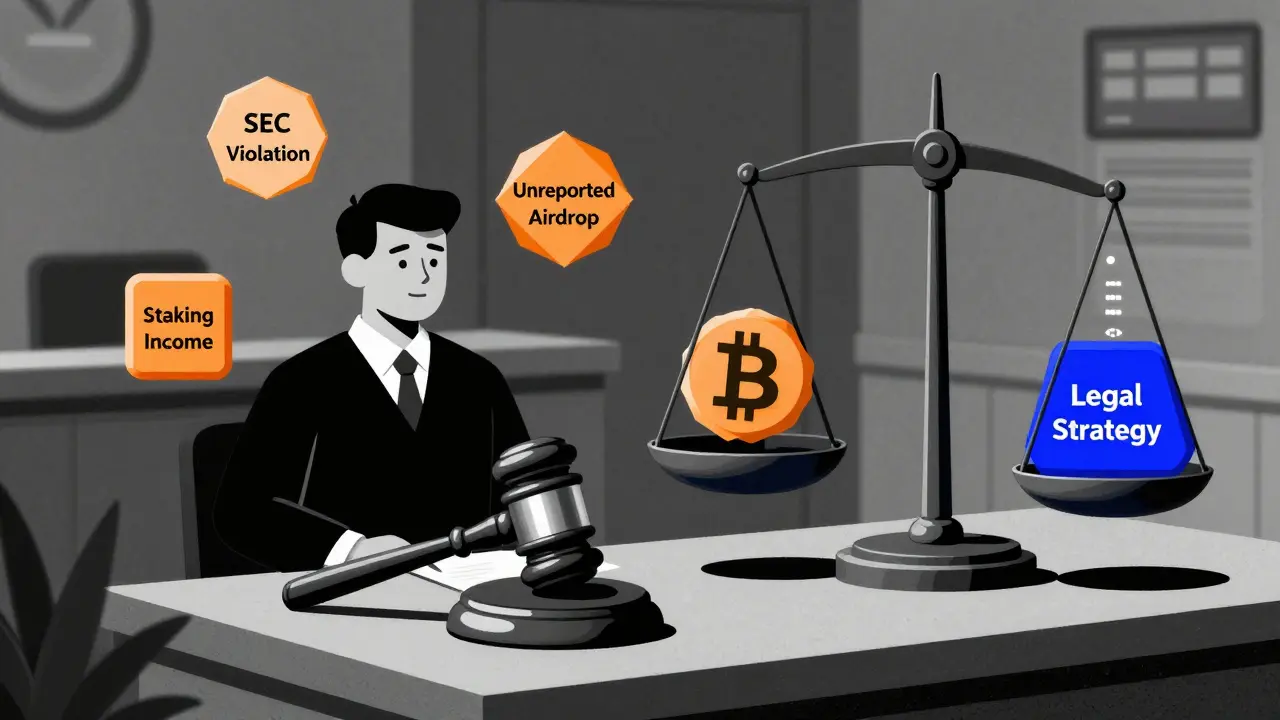
Same goes for airdrops. If you received tokens from a project you didn’t invest in, the IRS says that’s taxable income. The value is based on what the token was worth when you received it. But if you didn’t track it, you can’t report it. And if the project later gets shut down by the SEC, you’re left holding worthless tokens with a tax bill you can’t pay. A good crypto lawyer will help you understand the legal status of every token you touch. They’ll tell you which ones are safe to report as income and which ones could trigger an SEC investigation.
Staking, Yield Farming, and DeFi: The Tax Trap No One Warns You About
Staking Ethereum? Yield farming on Uniswap? Lending crypto on Aave? These aren’t passive investments. They’re active income streams. And the IRS treats them like wages or interest.When you earn staking rewards, the IRS says you owe income tax on the USD value of those rewards the moment they hit your wallet. Same with liquidity pool rewards. Same with interest from lending protocols. But most people don’t track it. They just see their wallet balance go up. They assume it’s "unrealized." It’s not. The IRS doesn’t care if you didn’t sell it. You owe tax on the reward itself.
And if you’ve used decentralized exchanges to swap tokens? Every swap is a taxable event. You’re selling one asset to buy another. You need to calculate the gain or loss on each trade. If you did 50 trades in a year, you have 50 taxable events. Most people don’t track that. They use CoinTracker or Koinly, but those tools aren’t legal advice. They’re estimates. A crypto tax lawyer will tell you if your software’s calculations are legally defensible. They’ll help you reconstruct missing data. They’ll show you how to use blockchain analytics to prove your cost basis-even if your exchange shut down.
How to Choose the Right Legal Counsel
Not every tax lawyer understands crypto. And not every crypto expert understands tax law. You need someone who does both. Look for attorneys who are also Certified Public Accountants (CPAs). These dual-qualified professionals have the training to calculate capital gains, interpret IRS guidance, and navigate federal investigations. They’ve seen what happens when people guess wrong.Ask them these questions:
- Have you handled cases involving the IRS’s Voluntary Disclosure Program for crypto?
- Do you have experience with SEC enforcement actions related to token sales?
- What crypto tax software do you use to reconstruct transaction histories?
- Can you explain how staking rewards are taxed under current IRS guidance?
- Have you represented clients in crypto-related audits?
Avoid anyone who says, "I know everything about crypto." That’s a red flag. The rules change every year. The best lawyers don’t claim to know it all-they know how to find the answer. Check their online reviews. Ask for references. Look for firms that have published white papers or spoken at blockchain conferences. Experience matters. You need someone who’s been doing this since 2017, not someone who took a Coursera course last month.
What Happens If You Do Nothing?
The IRS has a crypto task force. They’re using blockchain analytics firms like Chainalysis and Elliptic to trace transactions. They’re cross-referencing exchange data with tax returns. They’re auditing high-volume traders. In 2024, the IRS collected over $2.3 billion in crypto-related penalties and back taxes. And that’s just the beginning.If you ignore your crypto tax obligations, you’re not saving money. You’re gambling. And the odds are stacked against you. Civil penalties for underreporting can be 75% of the unpaid tax. Criminal charges for tax evasion carry up to five years in prison. The IRS doesn’t need to prove you stole money. They just need to prove you knew you owed tax and didn’t pay it.
There’s no magic fix. There’s no loophole. The only way out is compliance-and the only way to do it safely is with legal help.
Don’t Wait for a Letter
Crypto isn’t the Wild West anymore. It’s a regulated financial system. And if you’re involved in it, you’re subject to the same rules as banks, brokers, and accountants. The IRS isn’t bluffing. They’re watching. And they’re ready.If you’ve traded crypto, earned rewards, or run a business with digital assets, you owe yourself a consultation. Not next year. Not after your next trade. Now. The sooner you act, the more control you have. The less you pay. The fewer risks you take. A good crypto tax lawyer won’t scare you. They’ll give you a plan. And that plan might just save your finances-or your freedom.
Tara Marshall
December 7, 2025 AT 04:43Just filed my 2023 crypto taxes using a CPA who specializes in blockchain. Took 3 weeks to gather all the data from 4 different wallets and 87 transactions. The software flagged 12 swaps I didn’t even realize were taxable. Lawyer helped me file an amended return under the Voluntary Disclosure Program. Penalties cut by 82%. Worth every penny.
Don’t wait. The IRS already has your data.
Mariam Almatrook
December 8, 2025 AT 15:07One must earnestly contemplate the ramifications of noncompliance within the context of contemporary fiscal jurisprudence, wherein the conflation of digital assets with tangible property constitutes a foundational tenet of U.S. tax policy. To presume exemption is not merely erroneous-it is an affront to the sanctity of fiscal accountability. The IRS, in its infinite wisdom, has delineated the parameters of this obligation with surgical precision. To ignore them is to court fiscal annihilation.
Regina Jestrow
December 9, 2025 AT 20:25I used to think staking rewards were just ‘free money’ until I got hit with a $4,200 tax bill for 1.8 ETH I earned in 2022. I didn’t even cash out. I just held it. The IRS doesn’t care. They saw the transaction on-chain. Now I track every single reward in a spreadsheet with timestamps and USD values at receipt. It’s insane how much you overlook until it’s too late.
And don’t even get me started on DeFi swaps. I did 147 in one year. My accountant cried.
Cristal Consulting
December 10, 2025 AT 15:15You got this. Seriously. The first step is just gathering your transaction history. Don’t panic. Don’t delete anything. Start with your exchange exports and wallet addresses. There are free tools to help you organize it. Then find a crypto-savvy CPA. They’ll walk you through it. You’re not alone. Thousands have been here. You can fix this.
One step at a time. You’re stronger than your tax fear.
Elizabeth Miranda
December 12, 2025 AT 01:00My cousin in Austin got audited last year after trading NFTs. She thought since she didn’t sell for fiat, she didn’t owe anything. Turned out swapping one NFT for another triggered a capital gain. The IRS had her on Chainalysis. She lost $18k in penalties before she got a lawyer. Now she’s terrified of crypto.
It’s not about being rich. It’s about being informed.
Chloe Hayslett
December 13, 2025 AT 04:06So let me get this straight. We’re supposed to pay taxes on digital ghosts that don’t even exist in the real world? Meanwhile, my neighbor gets paid under the table in cash and never files a thing. But I gotta track every damn Satoshi? This is why I hate this country.
Jonathan Sundqvist
December 14, 2025 AT 15:40Bro. I mined 10 BTC in 2017. Never reported. Just sat on it. Now I’m looking at $1.2M in gains. I’m not gonna pay that. The IRS ain’t gonna find me. I moved my keys to a hardware wallet and never touched an exchange since 2019. They can’t trace it. Stay off the grid. It’s not that hard.
Annette LeRoux
December 15, 2025 AT 08:47Life is weird 😅
I used to think crypto was about freedom. Now I’m tracking every swap like it’s a spreadsheet of sins. The IRS didn’t take my money. They took my peace of mind. But hey-at least I know now. Maybe that’s the real crypto lesson.
Jerry Perisho
December 16, 2025 AT 15:08Most people don’t realize that if you swap BTC for ETH, you’re selling BTC and buying ETH. That’s two taxable events. CoinTracker says you owe $800. But if you didn’t document the exact USD value at the time of the swap, the IRS can assume the highest price you held it at. That’s how you get a $5k bill for a $800 gain.
Document everything. Even if it’s ugly.
Manish Yadav
December 16, 2025 AT 16:53This is why America is failing. People think they can cheat the system. You work hard. You pay taxes. You don’t hide money. If you made money from crypto, you owe. No excuses. Just pay and be done with it. Stop playing games with the law.
Noriko Robinson
December 17, 2025 AT 09:43I’m still figuring this out. I got 500 USDT from an airdrop last year and thought it was free. Now I’m scared to file because I don’t know what to report. I don’t even know who to trust. I’ve read 10 articles and they all say different things. Is there a place where you can just get a free consultation? I’m not rich. I just want to do the right thing.