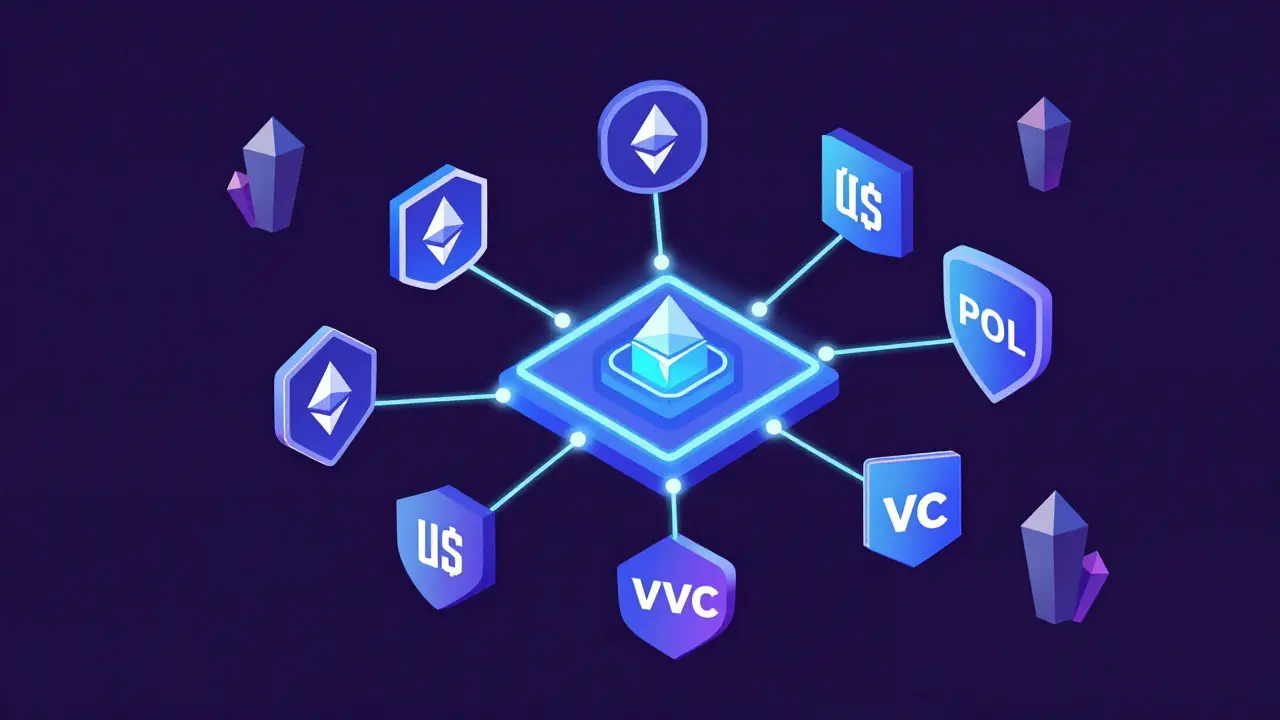
When you hear "crypto exchange," you probably think of Binance, Coinbase, or maybe Uniswap. But what if there’s a new player, built on top of one of the most promising Layer-2 networks, trying to do something different? Enter Velocore - a decentralized exchange that’s not just another clone. It’s built on zkSync Era, uses a tweaked version of Solidly’s ve(3,3) model, and has this weirdly smart way of managing its own liquidity. But is it actually useful - or just another shiny project with no users?
What Exactly Is Velocore?
Velocore isn’t a centralized exchange like Kraken or Coinbase. It’s a decentralized exchange - a DEX - meaning you never hand over your keys. You trade directly from your wallet. It launched in 2023 and runs entirely on zkSync Era, which is a Layer-2 scaling solution for Ethereum. That means faster trades, way cheaper fees, and still the same security as Ethereum mainnet. Its core innovation? A modified version of the ve(3,3) tokenomics model. Originally created by Solidly, this system uses three types of tokens to keep liquidity flowing. Velocore didn’t just copy it - they fixed the parts that broke. The result? Better capital efficiency, less impermanent loss for liquidity providers, and a protocol that actually owns some of its own liquidity. That’s called Protocol Owned Liquidity, or POL. Most DEXes rely on users to provide liquidity. Velocore uses its own funds too. That’s rare.How Does Velocore Work?
Think of it like this: on Uniswap, you deposit ETH and USDC into a pool. You earn fees when people trade between them. But if the price moves too much, you lose money - that’s impermanent loss. Velocore’s ve(3,3) model tries to fix that by locking up voting power (veVC tokens) to steer where liquidity goes. The more you lock, the more influence you have - and the more rewards you get. But here’s the twist: Velocore doesn’t just rely on you. The protocol itself holds liquidity. That’s POL. It means when the market dips, Velocore can inject funds to keep pools balanced. That’s not just smart - it’s a structural advantage over older DEXes that leave everything to the community. To use it, you need a Web3 wallet like MetaMask or WalletConnect, connected to the zkSync Era network. You can’t trade VC tokens on your phone app. You need to move ETH or USDC from a centralized exchange (like KuCoin or Bitget) into your wallet, then swap for VC on Velocore’s interface. Slippage settings matter. Gas fees are low, but you still need some ETH for transaction costs.The VC Token: Price, Supply, and Where to Buy
The native token is VC. It’s not listed on every exchange. Right now, you’ll find it on KuCoin, Bitget, and BTCC. But here’s the problem: the price doesn’t match. On KuCoin, VC trades around $0.0139. On Bitget, it’s $0.0024. That’s an 83% difference. That’s not normal. It means either one exchange has bad data, or liquidity is super thin. Either way, it’s a red flag. If you’re buying, check multiple sources. Don’t trust one price. The token has no official market cap ranking in the top 1000. CoinMarketCap lists it at #7372. That tells you something: it’s tiny. Not because it’s bad - but because it’s new and unknown. Volume is low. You won’t find deep order books. This isn’t Bitcoin. You’re trading a niche asset in a niche ecosystem.
Why Velocore Stands Out (And Why It Might Not)
Let’s be honest - the DEX space is crowded. Uniswap does $2 billion a day. Curve handles billions in stablecoin swaps. Velocore? It supports only 6 trading pairs and 4 coins as of 2023. That’s not enough for most traders. So why even look at it? Because of what it’s trying to do. Most DEXes are like open markets - anyone can set up a stall. Velocore is trying to be a curated, self-sustaining economy. The POL mechanism is the key. If it works, it could reduce slippage, attract long-term liquidity providers, and create a flywheel where rewards keep users locked in. Experts from Cryptorank call it a "game changer" in DeFi. That’s strong language. But here’s the catch: no one’s really tested it at scale. There are no big institutional users publicly saying they’re dumping millions into Velocore pools. No major DeFi aggregators like 1inch or Paraswap have integrated it yet. It’s still early. Too early for some.Who Should Use Velocore?
You should consider Velocore if:- You’re already using zkSync Era for other DeFi apps (like SyncSwap or Mute.io)
- You want to support a project that’s trying to fix real problems in DEX design
- You’re comfortable with high-risk, low-liquidity tokens
- You’re not looking for quick profits - you’re looking for long-term DeFi participation
- You want to trade BTC, ETH, or major altcoins - it doesn’t support them
- You’re new to crypto and don’t know how to connect a wallet
- You need high trading volume or tight spreads
- You expect the VC token to pump tomorrow
The Real Risk: Being Too Early
Velocore’s biggest enemy isn’t Uniswap. It’s time. If zkSync Era never takes off, Velocore dies with it. If the ve(3,3) model doesn’t attract enough locked capital, the POL mechanism fails. If users don’t see rewards, they’ll leave. Right now, it’s a bet. A smart bet, maybe - but still a bet. The tech is solid. The team has clearly studied what went wrong with Solidly. The architecture is clean. But none of that matters if no one uses it. The price swings between exchanges? That’s not volatility - that’s uncertainty. It means nobody knows what VC is worth. And that’s the biggest risk of all.
How to Get Started (Step by Step)
If you’re still interested, here’s how to dip your toes in:- Buy ETH or USDC on a centralized exchange like KuCoin or Coinbase.
- Transfer it to your Web3 wallet (MetaMask, Rabby, or Argent) connected to zkSync Era.
- Go to app.velocore.xyz and connect your wallet.
- Swap your ETH or USDC for VC tokens. Set slippage to 1.5%-2% to avoid failed trades.
- Optionally, stake your VC tokens to earn veVC and boost rewards.
Final Verdict: A Quiet Experiment With Big Potential
Velocore isn’t the next Binance. It’s not even the next Uniswap. It’s a quiet experiment - one that’s trying to fix the broken incentives in decentralized trading. The tech is real. The idea is bold. The execution is promising. But right now? It’s a lab. Not a marketplace. If you’re a DeFi nerd who loves tinkering with new models, it’s worth a small stake. Put in $50. See how the POL mechanism holds up. Watch how rewards change over time. See if the community grows. If you’re looking for a safe, liquid place to trade - keep looking. Velocore isn’t there yet.Frequently Asked Questions
Is Velocore safe to use?
Yes, as long as you use it correctly. Velocore is a non-custodial DEX, meaning you control your keys. It runs on zkSync Era, which has been audited and is backed by Matter Labs. But like all DeFi platforms, you’re exposed to smart contract risk. Always check the official website (app.velocore.xyz) before connecting your wallet. Never click random links.
Can I earn rewards on Velocore?
Yes. You earn fees from trades when you provide liquidity. But the bigger reward comes from locking VC tokens to get veVC. veVC gives you voting power and boosts your share of protocol rewards. The more you lock and the longer you lock, the more you earn. It’s designed to encourage long-term commitment.
Why is the VC token price so different on KuCoin and Bitget?
Because liquidity is extremely thin. With only a few thousand traders and low volume, even small buy or sell orders can swing the price. One exchange might have a few large holders moving the market, while another has almost no activity. This isn’t a bug - it’s a sign the token is still in early trading. Don’t assume one price is "right."
What coins can I trade on Velocore?
As of 2023, Velocore supports only four tokens: VC (its native token), ETH, USDC, and zETH (zkSync’s wrapped ETH). That’s six trading pairs total. You won’t find SOL, DOGE, or SHIB. This isn’t a general-purpose exchange - it’s focused on the zkSync ecosystem.
Is Velocore better than Uniswap?
Not for most people. Uniswap has thousands of trading pairs, millions in daily volume, and deep liquidity. Velocore has none of that. But if you’re trading within the zkSync ecosystem and care about capital efficiency, ve(3,3) mechanics, and protocol-owned liquidity, then Velocore offers something Uniswap can’t - a more sustainable, self-funded model. It’s not better overall - it’s better for a specific use case.
What happens if zkSync Era fails?
Velocore collapses with it. The entire platform is built on zkSync’s Layer-2 infrastructure. If zkSync loses users, gets hacked, or gets abandoned, Velocore has no fallback. It’s not a standalone product - it’s a child of zkSync. That’s its strength and its biggest vulnerability.
Abhisekh Chakraborty
January 2, 2026 AT 22:02bro this is just another zkSync shill farm lmao
Jake West
January 3, 2026 AT 00:326 trading pairs? lol. i spent 20 mins just trying to find VC on my wallet and now i’m stuck paying $0.80 in gas to trade $5 of USDC. this isn’t DeFi, it’s a crypto fever dream.
Khaitlynn Ashworth
January 3, 2026 AT 15:43oh wow another ‘quiet experiment’ that’s gonna change everything. yeah right. next they’ll tell us the founder is a 19-year-old from Bangalore who coded this in his dorm room using ChatGPT. the VC token price difference between exchanges? that’s not a red flag, that’s a flashing neon sign screaming ‘scam’.
Andrea Stewart
January 5, 2026 AT 02:56Actually, the ve(3,3) model here is pretty clever. Solidly’s original design had too much volatility because liquidity was entirely user-driven. Velocore’s POL is a real innovation - it’s like the protocol itself becomes a market maker. That reduces slippage and gives retail LPs more stability. It’s not perfect, but it’s a step beyond Uniswap v2’s ‘hope and pray’ model.
Shawn Roberts
January 6, 2026 AT 05:45if you’re not in this yet you’re sleeping on the next big thing 🚀💎
Willis Shane
January 8, 2026 AT 01:33The disparity in VC pricing across exchanges is not merely indicative of thin liquidity - it is a structural failure of market integrity. One cannot reasonably assess the valuation of an asset when bid-ask spreads are functionally nonexistent and arbitrage opportunities are suppressed by exchange-specific siloing. This is not market inefficiency - it is market illegitimacy.
prashant choudhari
January 8, 2026 AT 15:58Velocore’s POL mechanism is the only reason to pay attention. Most DEXes are just liquidity farms. This one actually stakes its own capital. That’s rare. But the tokenomics need more time to prove themselves. Don’t rush in. Monitor for 30 days.
Daniel Verreault
January 8, 2026 AT 16:50you guys are missing the forest for the trees. yeah the price is all over the place but that’s because no one’s traded more than $20k in a day. that’s not a bug - it’s a feature. it means there’s room to move. if you think this is dead money you’re not thinking like a builder. the team’s been quiet but they’ve been building. zkSync is gaining traction and Velocore is the only DEX on it with actual governance and POL. i’ve been in since week 2. i’ve lost money on the token but my veVC rewards are compounding. this isn’t a trade - it’s a stake in the future of L2 DeFi. if you’re not in it yet you’re just watching from the sidelines while the real players get positioned.
SUMIT RAI
January 10, 2026 AT 14:35LOL why is everyone so serious 😂 this is just a meme coin with a fancy contract address 🤷♂️🚀
Gavin Hill
January 11, 2026 AT 13:00It’s interesting how people dismiss this as too early without considering that every major protocol was once dismissed as too early. Uniswap was a toy. Curve was a niche stablecoin tool. The question isn’t whether Velocore is ready - it’s whether the infrastructure it’s built on will outlast the hype. zkSync is backed by serious players. That’s the real bet.
Kevin Gilchrist
January 12, 2026 AT 03:20they’re not just building a DEX - they’re building a self-sustaining DeFi organism. the POL isn’t just liquidity - it’s a living breathing reserve that reacts to market stress like a immune system. imagine if every DEX had that. imagine if the protocol itself had skin in the game. this isn’t just innovation - it’s evolution. i’m not just holding VC - i’m betting on the next phase of DeFi. and yeah the price is messy - but that’s because the market hasn’t caught up yet. the whales are quietly accumulating. you’re not late - you’re just not paying attention.
surendra meena
January 12, 2026 AT 04:35THIS IS A SCAM!!! I LOST MY ENTIRE PORTFOLIO ON THIS!!! THE TEAM IS RUNNING AWAY WITH THE FUNDS!!! THEY’RE ALL FROM RUSSIA AND THEY’RE USING FAKE IDENTITIES!!! THE CONTRACT IS A BACKDOOR!!!
dina amanda
January 12, 2026 AT 21:15why is no one talking about how this is just a CIA front to track crypto users? zkSync is owned by the NSA and Velocore is the trap. they want you to think it’s decentralized but your wallet is being monitored. i saw a guy on youtube say he got flagged after staking 50 VC. they’re coming for us.
Emily L
January 13, 2026 AT 14:06why does everyone keep acting like this is some genius invention? it’s just a copy-paste job with extra steps. if it was so great, why is it stuck on 6 pairs? why is the dev team ghosting discord? i’ve seen this movie before - it ends with a rug pull and a medium post titled ‘we’re pivoting to AI’.
Jacky Baltes
January 14, 2026 AT 09:47The real question isn’t whether Velocore will succeed - it’s whether the incentive structures it introduces can survive the inevitable decay of human behavior in open systems. The ve(3,3) model assumes rational actors with long-term alignment. But humans are short-term optimizers. They’ll game the system. They’ll front-run rewards. They’ll exit before the protocol stabilizes. The POL mechanism is elegant - but elegance doesn’t prevent collapse when incentives misalign. The real test isn’t technical - it’s behavioral.
Josh Seeto
January 15, 2026 AT 09:32so you’re telling me the protocol owns liquidity… and that’s supposed to impress me? wow. next they’ll tell us the moon is made of cheese and they’ve got the fork. congrats, you’ve invented a centralized exchange with a fancy whitepaper and a 10% slippage fee. i’ll stick with Uniswap, thanks.