STO Regulation: What You Need to Know About Security Token Compliance
When you hear STO regulation, the legal framework governing Security Token Offerings that treat digital tokens as financial securities. Also known as security token compliance, it’s what separates legitimate token projects from scams that pretend to be investments. Unlike utility tokens, which give you access to a service, security tokens represent ownership—like shares in a company, real estate, or a fund. That’s why governments treat them like stocks or bonds, not just digital collectibles.
Security tokens, digital assets backed by real-world value and subject to securities laws can’t just be sold to anyone, anywhere. In the U.S., the SEC requires issuers to register or qualify for exemptions like Regulation D or Regulation A+. In the EU, MiCA rules now force STOs to follow strict disclosure and investor protection standards. Even in places like Singapore or Switzerland, where crypto is more welcoming, you still need to prove your token isn’t just a gamble—it’s a verified asset.
That’s why so many projects either avoid STOs entirely or hire lawyers before they even launch. You can’t just mint a token and call it a security. You need audits, legal opinions, KYC/AML checks, and a clear roadmap showing how investors will get returns. And if you’re selling to people in the U.S., Canada, or Australia? You’re locked into their rules—even if your company is based elsewhere.
Meanwhile, tokenized assets, real-world property like real estate, art, or private equity turned into blockchain-based tokens are becoming the main use case for STOs. Think of it like fractional ownership: instead of buying an entire building, you buy 0.1% of it as a token. But here’s the catch—those assets still need appraisals, title transfers, and legal documentation. Blockchain doesn’t erase paperwork; it just makes it harder to fake.
And let’s be real: most people still don’t get it. You’ll see crypto influencers pushing "STOs" like they’re the next meme coin. But if there’s no prospectus, no licensed broker, and no way to verify the underlying asset? It’s not an STO—it’s a trap. The STO regulation exists because too many people lost money pretending digital tokens were stocks without the rules.
What you’ll find below isn’t theory. It’s real cases: how Bangladesh cracked down on crypto trading under anti-money laundering laws, how China’s ban made even legal token sales impossible, and how privacy coins like Monero are being pushed out of exchanges because regulators demand transparency. You’ll see how enforcement is shifting from banning crypto to controlling how it’s used—and how STOs are becoming the only path forward for serious projects.
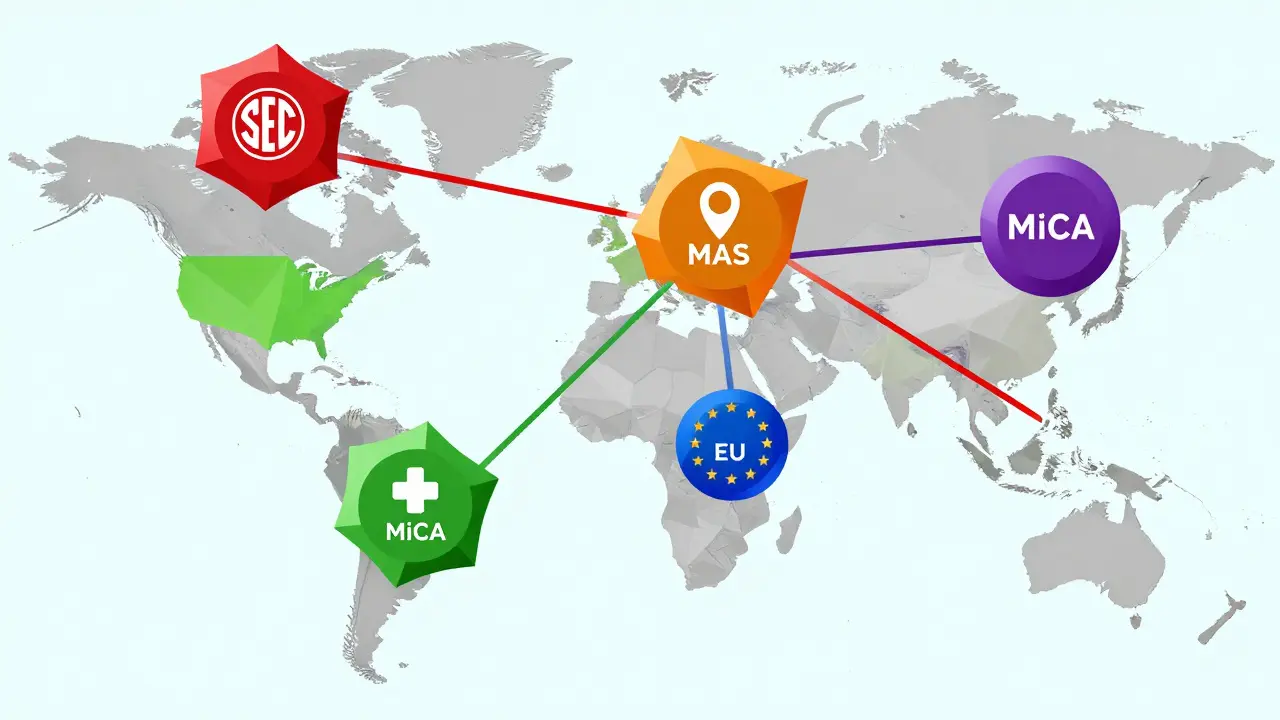
Regulatory Framework for Security Tokens: Global Rules in 2025
In 2025, security tokens are regulated differently across the globe. Learn how the SEC, MAS, MiCA, and others govern tokenized assets, what technical rules apply, and why compliance is now built into the code.
learn more