Trading cryptocurrency on the TRON blockchain has never been more accessible, but finding a reliable platform can still feel like navigating a maze. If you are holding TRC-20 tokens and looking to swap them without handing over your keys to a centralized company, SunSwap v2 is the leading decentralized exchange (DEX) on the TRON network. But does it live up to the hype in 2026? After analyzing its performance, security, and user experience, here is the honest truth about whether this platform deserves a spot in your digital wallet.
Quick Takeaways
- SunSwap v2 is the primary decentralized exchange for the TRON ecosystem, offering non-custodial trading of TRC-20 tokens.
- It uses an Automated Market Maker (AMM) model, meaning trades happen instantly via liquidity pools rather than order books.
- The platform requires a TronLink Wallet connection; no other wallets are currently supported for seamless interaction.
- Fees are fixed and go directly to liquidity providers, ensuring transparent costs for traders.
- While highly secure and easy to use, beginners may find the lack of customer support chat and multiple web addresses slightly confusing.
What Exactly Is SunSwap v2?
To understand why SunSwap matters, you first need to look at its history. Originally launched as JustSwap in 2020, the platform was acquired by SUN.io in October 2021. It then evolved into SunSwap under the management of the SUN Genesis Mining group. This transition wasn't just a rebranding exercise; it marked a significant technical upgrade. SunSwap v2 represents the second iteration of the protocol, designed specifically to handle the growing volume of transactions on the TRON network.
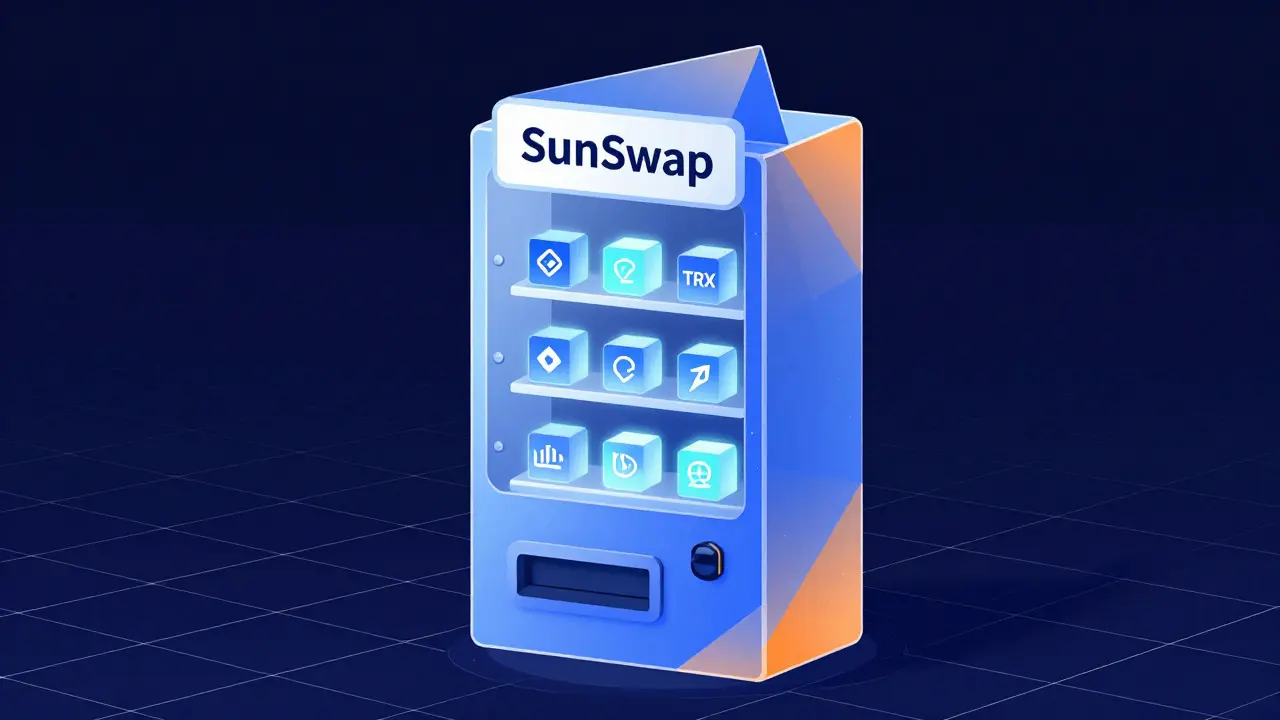
Unlike traditional exchanges where you deposit funds into a company-controlled account, SunSwap is a non-custodial DEX. This means you maintain complete control of your assets until the exact moment you execute a trade. The platform relies on smart contracts-self-executing code stored on the blockchain-to facilitate these swaps. Think of it as a vending machine: you put in one token, and the machine automatically dispenses another based on pre-set rules, with no human intervention required.
The core technology behind this is the Automated Market Maker (AMM) model. Instead of matching buyers and sellers through an order book (like the New York Stock Exchange), SunSwap uses liquidity pools. These pools are filled by users who deposit pairs of tokens, such as USDT and TRX. When you trade, you are swapping against this pool, and the price adjusts automatically based on supply and demand dynamics governed by mathematical formulas.
How SunSwap v2 Works: A Step-by-Step Guide
One of the biggest criticisms of decentralized finance (DeFi) is that it is too complex for regular people. SunSwap v2 fights back against this stereotype with an interface that is genuinely simple. Here is how you actually use it:
- Set Up Your Wallet: You must have a TronLink Wallet. This is the only wallet interface fully supported for seamless operations on SunSwap. If you don't have one, download the browser extension or mobile app and create a new wallet. Keep your seed phrase safe-it is the only way to recover your funds if you lose access.
- Connect to SunSwap: Navigate to the official SunSwap website. Click the "Connect Wallet" button and approve the connection request in your TronLink popup.
- Select Your Tokens: Choose the token you want to sell (e.g., TRX) and the token you want to buy (e.g., USDT). The platform will automatically calculate the exchange rate based on current liquidity pool depths.
- Approve and Swap: Enter the amount you wish to trade. You will see the estimated output, including the fee. Confirm the transaction in your wallet. Within seconds, the smart contract executes the swap, and the new tokens appear in your wallet.
Notice there is no Know Your Customer (KYC) verification. No email sign-ups, no ID uploads. This anonymity is a double-edged sword: it offers privacy but also means there is no customer support team to call if you make a mistake. Double-check every address and amount before confirming.
Fee Structure and Costs
When trading crypto, fees can eat into your profits faster than market volatility. SunSwap v2 employs a fixed fee structure, which makes calculating your potential profit or loss straightforward. Unlike some platforms that charge variable fees based on network congestion or token rarity, SunSwap’s fees are consistent.
All trading fees paid by users go directly to the liquidity providers. These are the individuals or entities who deposited capital into the pools to enable trading. By receiving a portion of each trade fee, they are incentivized to keep the pools funded and stable. For you as a trader, this means the cost is transparent and predictable. There are no hidden spreads or surprise charges added at the last second.
However, remember that you are still paying gas fees to the TRON network itself. While TRON’s gas fees are notoriously low compared to Ethereum, they are not zero. During periods of high network activity, these minimal fees might spike slightly, but they rarely exceed a few cents per transaction.
Security and Reliability
In the world of DeFi, security is paramount. Since SunSwap is non-custodial, the risk of a centralized exchange hack (where millions of dollars are stolen from a hot wallet) is virtually eliminated. Your funds stay in your TronLink wallet unless you explicitly authorize a transfer.
Expert analysis from sources like MarketplaceFairness.org has rated SunSwap positively for reliability. Tests involving various token swaps, including BTC to TRX conversions, showed no obvious errors or slippage issues beyond standard market expectations. The platform boasts a near-perfect security track record since its launch.
That said, "perfect" is a strong word in crypto. The smart contracts powering SunSwap have been audited, but code vulnerabilities can theoretically exist anywhere. The best defense is diversification: don’t keep life-changing amounts of money on any single DEX interface. Use SunSwap for active trading and move long-term holdings to a hardware wallet or a different storage solution.
User Experience and Interface
Let’s talk about the actual feeling of using the site. SunSwap’s UI is clean, dark-mode friendly, and intuitive. Even beginners report that they can navigate the platform effectively without reading extensive documentation. The layout focuses on the swap box, keeping distractions to a minimum.
However, there is a minor friction point: the existence of multiple web addresses. Some beginner traders get confused between the old JustSwap URLs and the new SunSwap domains. Always ensure you are on the official site to avoid phishing scams. Bookmarking the correct URL after your first visit is a pro tip that saves headaches later.
Customer support is essentially non-existent in the traditional sense. There is no live chat widget. If you run into issues, you rely on community forums, Reddit discussions, and the broader TRON ecosystem resources. This is typical for DEXs but can be frustrating if you are used to calling a help desk at Coinbase or Binance.
Market Performance and Popularity
Is anyone actually using SunSwap? Yes, and in large numbers. As of 2025, the platform processed over 6 million transactions alone, maintaining steady weekly counts despite market volatility. Historically, it has surpassed 16 million total transactions since its inception.
In terms of organic traffic, SunSwap ranks competitively among cryptocurrency exchanges. Monthly data shows around 21,761 organic visits, with a bounce rate of 39%. This indicates that most users land on the site, perform their trade, and leave-a sign of efficiency rather than disinterest. The average session duration is just over a minute, which aligns perfectly with the quick nature of token swaps.
The types of tokens being traded are also evolving. While WTRX and USDT dominate activity, newer entrants like LMTV, SUNDOG, and JST are gaining traction. Recently, the listing of the TRUMP token tied to US political narratives attracted significant attention, showing SunSwap’s ability to adapt to trending market interests.
| Feature | SunSwap v2 (DEX) | Centralized Exchange (CEX) |
|---|---|---|
| Custody of Funds | User-controlled (Non-custodial) | Exchange-controlled (Custodial) |
| KYC Required | No | Yes (usually) |
| Supported Network | TRON (TRC-20) | Multiple networks |
| Fees | Fixed, goes to LPs | Variable, goes to exchange |
| Customer Support | Community-based | Dedicated support teams |
| Security Risk | Smart contract bugs | Hacks, insolvency |
Pros and Cons of Using SunSwap v2
No platform is perfect. Before you start swapping, weigh these factors carefully.
Pros:
- Ease of Use: The interface is described by users as "simply effortless." Connect, swap, done.
- Privacy: No KYC means your identity remains private.
- Speed: Trades execute almost instantly on the TRON network.
- Low Fees: Fixed fees and low network gas costs make small trades viable.
- Earn Passive Income: You can become a liquidity provider and earn a share of trading fees.
Cons:
- Limited Wallet Support: Only works seamlessly with TronLink. Other wallets may require bridging or additional steps.
- No Direct Support: If something goes wrong, you are on your own.
- Confusing URLs: Multiple web addresses can lead to phishing risks for the uninitiated.
- Mixed Reviews: While expert reviews are positive, third-party user reviews vary, often due to user error rather than platform failure.
Who Should Use SunSwap v2?
SunSwap is ideal for traders who already hold TRC-20 tokens and want to swap them quickly without leaving the TRON ecosystem. It is particularly suited for those who value privacy and dislike the bureaucratic hurdles of centralized exchanges. If you are a liquidity provider looking to earn yield on idle TRX or stablecoins, SunSwap offers a robust mechanism for passive income.
However, if you are a complete beginner to cryptocurrency, you might find the concept of managing private keys and interacting with smart contracts intimidating. In that case, starting with a user-friendly centralized exchange to buy your first coins, then moving them to TronLink for DeFi activities, might be a smoother learning curve.
Future Outlook
The future looks bright for SunSwap v2. With TRON’s network growing to 2.5 million active addresses, the demand for efficient decentralized trading tools is increasing. SunSwap’s consistent transaction volumes and successful integration within the TRON DeFi ecosystem position it strongly for long-term viability. Strategic token listings and adaptability to market trends suggest that SunSwap will remain a cornerstone of TRON’s financial infrastructure in 2026 and beyond.
Regulatory considerations remain a wildcard. As governments worldwide grapple with how to regulate DEXs, SunSwap’s non-custodial nature may offer some protection, but clarity is needed. Until then, it operates as a vital piece of the decentralized finance puzzle.
Is SunSwap v2 safe to use?
Yes, SunSwap v2 is considered safe because it is non-custodial, meaning you retain control of your funds. However, always verify the website URL to avoid phishing sites and ensure your TronLink wallet seed phrase is kept private.
Do I need KYC to trade on SunSwap?
No, SunSwap does not require Know Your Customer (KYC) verification. You can connect your wallet and start trading immediately without providing personal identification documents.
Which wallet do I need for SunSwap?
You need a TronLink Wallet. It is the primary and most seamlessly integrated wallet for interacting with SunSwap v2 on the TRON network.
How much are the fees on SunSwap?
SunSwap uses a fixed fee structure. The fees are relatively low and go directly to liquidity providers. Additionally, you pay minimal gas fees to the TRON network for processing the transaction.
Can I earn passive income on SunSwap?
Yes, by becoming a liquidity provider. You deposit pairs of tokens into liquidity pools and earn a portion of the trading fees generated by other users swapping those tokens.
Why are there mixed reviews for SunSwap?
Mixed reviews often stem from beginner confusion regarding multiple web addresses or user errors in transactions. Expert analyses generally rate the platform highly for reliability and ease of use.