
Imagine buying a lottery ticket every single day for five years. Now imagine the odds are so steep that you might not win once in that entire time. That is what solo mining Bitcoin feels like for most people today. On the flip side, pool mining is like joining a syndicate where everyone chips in, and if anyone wins, the prize gets split up. You get paid regularly, even if it is just enough to cover your electricity bill.
The debate between solo mining and pool mining isn't just about technical preference; it's a fundamental question of risk tolerance and capital. As of late 2026, with network difficulty at historic highs, choosing the wrong path can drain your bank account before you ever see a profit. Let’s break down exactly how these two methods differ, who they are actually for, and why the math has changed dramatically since the 2024 halving.
What Is Solo Mining?
Solo mining means you run your own hardware-usually an Application-Specific Integrated Circuit (ASIC)-and try to find the next block on the blockchain entirely by yourself. You don’t share your hash rate with anyone. If you solve the cryptographic puzzle first, you keep the entire block reward plus all transaction fees. No middlemen, no fees, no splitting.
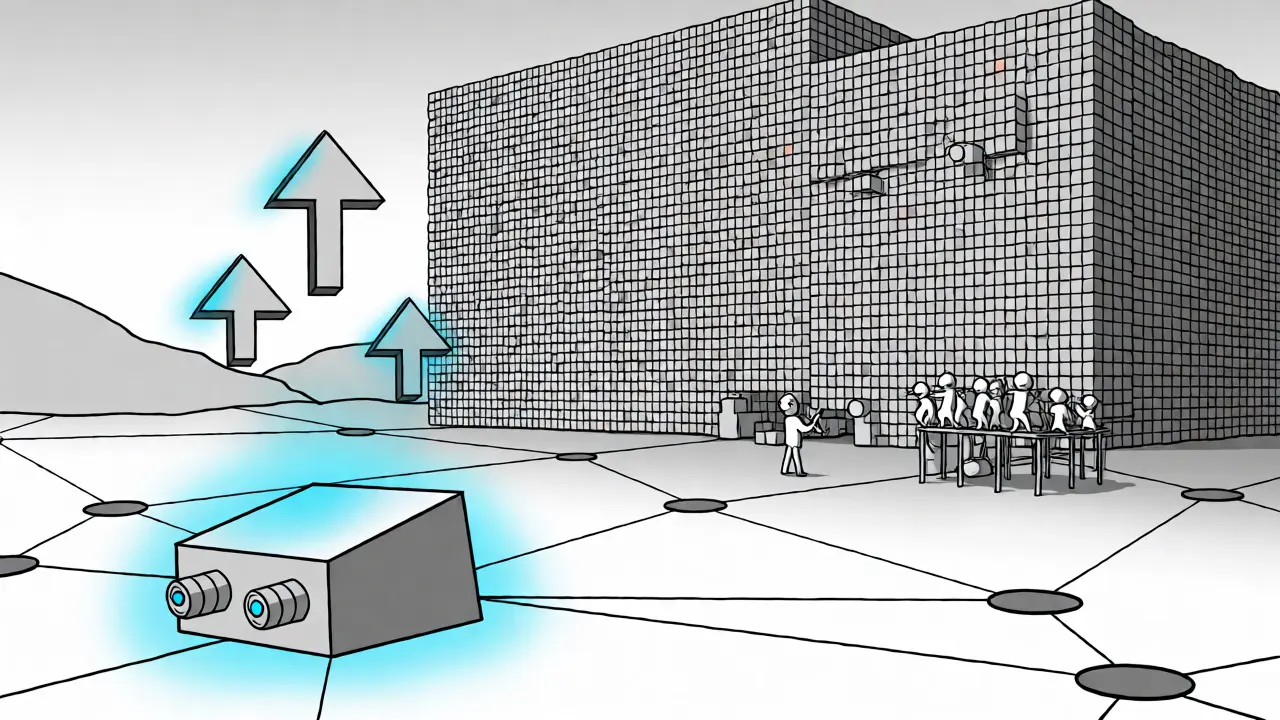
This sounds ideal until you look at the numbers. Bitcoin’s network difficulty adjusts every 2,016 blocks (roughly two weeks) to ensure new blocks are found every ten minutes. With the global hash rate hovering around 600 EH/s (exahashes per second), the competition is fierce. To have a realistic chance of finding a block within a year, you need significant power. Industry calculators suggest that unless you control at least 0.5% of the network’s total hash rate, you are statistically likely to go months or even years without finding a block.
For context, a single modern rig like the Antminer S21 delivers about 336 TH/s (terahashes per second). At current difficulties, one such machine operating solo would take, on average, several decades to find a block. This extreme variance makes cash flow management nearly impossible for small operators. You pay for electricity daily, but your income arrives unpredictably-or not at all.
How Does Pool Mining Work?
In contrast, pool mining aggregates the computational power of thousands of miners. Instead of each miner trying to hit a needle in a haystack alone, everyone works together to search different sections of the haystack simultaneously. When the pool finds a block, the reward is distributed among participants based on their contribution.
The most common payment models are PPS (Pay Per Share) and PPLNS (Pay Per Last N Shares). In PPS, you get paid for every valid share you submit, regardless of when the block is found. The pool operator takes on the risk of variance. In PPLNS, you only get paid for shares submitted during the period leading up to a block discovery. This rewards long-term loyalty but introduces slight variance again. Most major pools like Foundry USA, AntPool, and F2Pool use variations of these models.
Pool mining smooths out your income. Instead of waiting years for one big payout, you receive small payments daily or weekly. For a miner with 100 TH/s of hash rate, this translates to consistent earnings that help cover operational costs immediately. It transforms mining from a lottery into a steady, albeit low-margin, business.
| Feature | Solo Mining | Pool Mining |
|---|---|---|
| Risk Profile | High (Extreme variance) | Low (Stable income) |
| Payout Frequency | Unpredictable (Years/Months) | Daily/Weekly |
| Fees | 0% | 0.5% - 3% |
| Minimum Hardware | High (Needs massive hash rate) | Low (Single ASIC or GPU) |
| Technical Skill | Advanced (Node management) | Beginner Friendly |
| Decentralization Impact | Supports full node operation | Centralizes hash rate |
The Economic Reality After the 2024 Halving
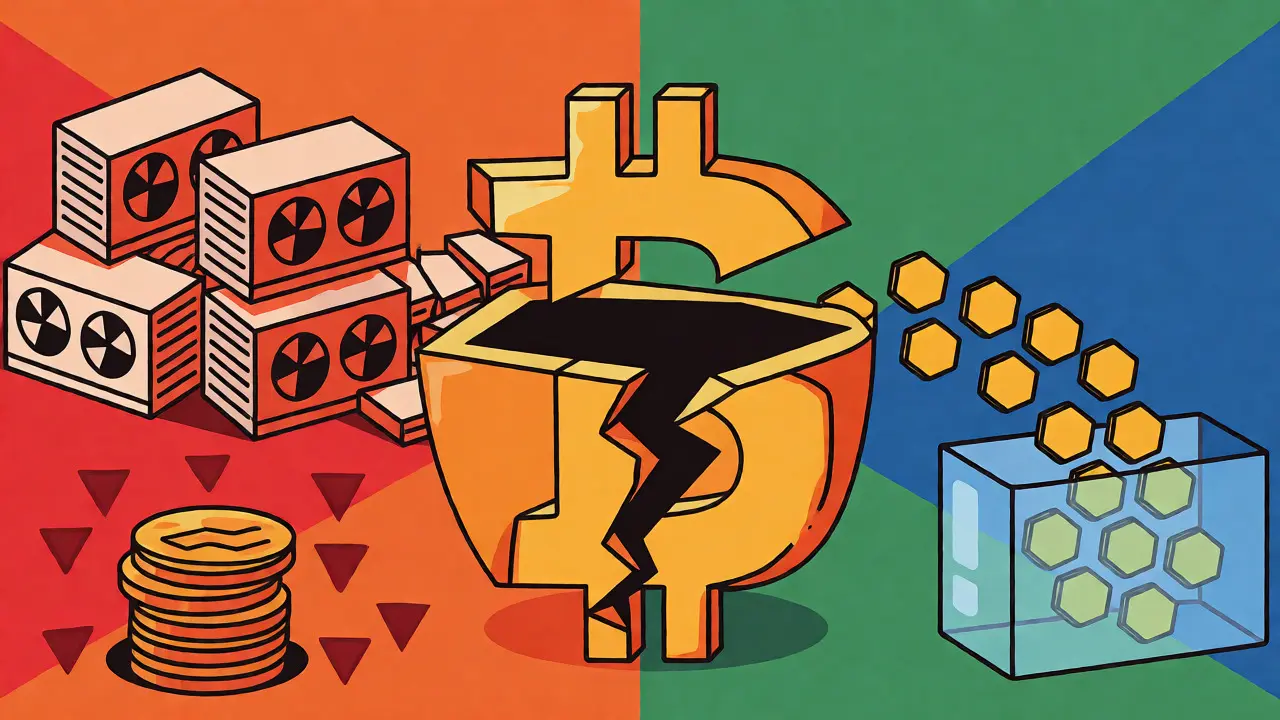
The April 2024 Bitcoin halving cut the block reward from 6.25 BTC to 3.125 BTC. This event fundamentally altered the economics of solo mining. Previously, a lucky solo miner could offset months of zero income with one large payout. Now, the smaller reward size means the "lottery" pays out less, making the wait even harder to justify financially.
Consider the break-even point. A mid-sized operation running 10 PH/s (petahashes per second) needs roughly 150 high-end ASIC units. At current market prices, that is over $1 million in hardware alone. Add monthly electricity bills of $15,000-$20,000 depending on your location’s energy rates. If this operation goes six months without finding a block-a statistically normal occurrence-they burn through $100,000 in cash reserves just keeping the lights on. Most individuals cannot survive that kind of volatility.
Pool miners, however, see their revenue drop proportionally with the halving but remain predictable. If your daily payout was $12.50 before, it drops to roughly $6.25 after, assuming constant difficulty and price. You still know exactly what you will earn tomorrow. This predictability allows for better financial planning and loan repayments.
Who Should Choose Solo Mining?
Despite the odds, solo mining hasn't disappeared. Who sticks with it? Primarily, large institutional players and ideological purists.
- Institutional Miners: Companies like Marathon Digital or Riot Platforms often operate as pseudo-solo entities or manage their own internal pools. They have the capital to absorb variance and the scale to find blocks frequently enough to maintain cash flow.
- Bitcoin Maximalists: Some miners prioritize decentralization over profit. By running a full node and mining solo, they validate transactions independently, reducing reliance on centralized pool operators. They accept lower expected returns as the cost of supporting network health.
- Luck-Seekers: Occasionally, hobbyists with spare capacity mine solo hoping for a windfall. It’s akin to buying a lottery ticket where the ticket costs electricity. If you have free electricity (e.g., stranded gas or solar surplus), solo mining becomes viable because your marginal cost is near zero.
Why Pool Mining Dominates for Individuals
For 95% of individual miners, pool mining is the rational choice. The barrier to entry is significantly lower. You can start with a single used ASIC or even a gaming PC for altcoins. Setup is straightforward: download the mining software, enter your pool URL and worker name, and start hashing. There is no need to sync a full Bitcoin node, which can require hundreds of gigabytes of storage and days of processing time.
Moreover, pool operators provide infrastructure benefits. They handle orphaned blocks, manage stratum servers, and offer user-friendly dashboards. Support teams are available to troubleshoot connectivity issues. While you pay a fee (typically 1-2%), you are essentially paying for insurance against variance and for convenience.
However, pool mining isn't without risks. You are dependent on the pool operator’s honesty and uptime. Historical incidents, such as the 2014 Eligius outage or various controversies regarding hidden fees, remind miners to choose reputable providers. Always check community feedback and audit reports before committing your hardware to a specific pool.
Key Factors in Your Decision
To decide which method suits you, ask these three questions:
- Do I have sufficient capital to survive long periods without income? If losing $5,000 in electricity costs over four months would ruin you, choose pool mining.
- Is my electricity cost close to zero? If you have excess renewable energy, solo mining maximizes value since you don't need immediate cash flow to pay bills.
- Do I care more about decentralization or profit efficiency? Solo mining supports a decentralized network structure. Pool mining optimizes for predictable ROI.
Remember, the goal of mining is to acquire cryptocurrency efficiently. If solo mining causes you stress or financial strain, it defeats the purpose. Pool mining lets you accumulate coins steadily, allowing you to focus on other aspects of your crypto strategy, like trading or holding.
Future Outlook: Will Solo Mining Return?
As we move deeper into 2026, technological advancements may shift the balance. Newer ASICs like the anticipated Antminer S25 promise higher efficiency (lower Joules per Terahash). More efficient machines mean lower electricity costs, which slightly improves the viability of solo mining for mid-tier operations. Additionally, if Bitcoin transaction fees rise significantly due to increased network usage, the portion of miner revenue coming from fees (rather than block subsidies) grows. Higher fees benefit solo miners more because they capture 100% of those fees, whereas pool miners share them.
Yet, network difficulty tends to rise alongside hardware efficiency. The arms race continues. Unless there is a sudden drop in global hash rate-which is unlikely given industrial adoption-pool mining will remain the dominant force for retail participants. Solo mining will likely persist as a niche activity for whales and true believers.
Is solo mining profitable for beginners?
Generally, no. Beginners usually lack the substantial hash rate required to find blocks consistently. The statistical probability of earning a return on investment within a reasonable timeframe is extremely low, leading to potential losses on electricity and hardware depreciation before any rewards are earned.
What are the typical fees for pool mining?
Most reputable pools charge between 0.5% and 3% of your mined rewards. These fees cover server maintenance, bandwidth, and operator services. Some pools also charge withdrawal fees, though many waive these for larger amounts.
Can I switch from pool mining to solo mining later?
Yes, you can switch at any time. You simply change the configuration settings in your mining software to point to your local full node instead of the pool server. However, switching back requires ensuring your node is fully synchronized and stable.
Does solo mining support decentralization?
Yes, solo mining contributes directly to decentralization because each miner runs their own full node and validates transactions independently. This reduces the concentration of hash power controlled by a few large pool operators, enhancing the network's resistance to censorship.
What happens if the pool goes offline?
If your pool server goes offline, your miners stop receiving work units, meaning you stop earning rewards temporarily. Once the server reconnects, mining resumes. Frequent outages can reduce overall profitability, so choosing a reliable pool with good uptime history is crucial.
Sean J Fortune
October 24, 2026 AT 17:45It is frankly astonishing that in this day and age, with the sheer volume of technical literature available to the average consumer, we are still forced to endure these rudimentary comparisons between solo and pool mining as if they were complex philosophical quandaries rather than simple arithmetic problems. The fact that anyone with a modicum of financial literacy would even consider solo mining without possessing industrial-scale capital suggests a profound lack of understanding regarding probability distributions and variance management. To suggest otherwise is to ignore the fundamental laws of large numbers which dictate that small sample sizes yield erratic results, whereas aggregated hash power smooths out these statistical anomalies into predictable revenue streams. It seems that many individuals confuse hope for strategy, believing that their personal luck will override the cold, hard reality of network difficulty adjustments which occur every two thousand and sixteen blocks regardless of their personal desires or bank account balance. This article correctly identifies the risk profile but perhaps underestimates the sheer incompetence displayed by those who attempt to compete against multi-billion dollar institutional miners with a single rig in their garage.
Anshu Raj
October 26, 2026 AT 11:13pools are just centralized honeypots designed to extract fees while hiding the true cost of energy infrastructure from retail users
the data flow is monitored and manipulated to ensure maximum profit extraction for operators who claim decentralization but act like banks
Dr. Abhishek Upadhyay
October 27, 2026 AT 07:13The absolute terror of staring at a dashboard showing zero income for three months while electricity bills pile up is something only a solo miner truly understands!!!
It is not just about the math; it is about the psychological toll of betting your livelihood on a cryptographic puzzle that might take decades to solve!!!
Pool mining saves your sanity because you get paid for effort, not just for luck!!!
Tony Byrne
October 29, 2026 AT 04:48I think it’s really important to remember that everyone has different comfort levels with risk... and that’s totally okay!! If you enjoy the thrill of the lottery ticket aspect, then solo mining can be fun, even if it isn’t the most efficient way to build wealth.
We should encourage beginners to start small and learn the ropes before making big decisions, rather than discouraging them entirely.
Every journey is unique, and there is no shame in choosing stability over volatility.
Mark Regan
October 29, 2026 AT 09:55Oh please, spare me the 'psychological toll' nonsense!!! You know what causes real stress? Paying 2% fees to a pool operator who does absolutely nothing but run a server while you do all the heavy lifting!!!
And don't get me started on the 'stability' argument... Stability is for people who are afraid of freedom!!!
If you can't handle the variance, maybe you shouldn't be in crypto at all!!!
Dr. Abhishek Upadhyay
October 30, 2026 AT 11:05Freedom doesn't pay the electric bill when the block hasn't been found in six months!!!
Variance isn't a badge of honor; it's a financial liability that can bankrupt small operations!!!
You're romanticizing poverty while ignoring the practical reality of cash flow management!!!
Drew Lemmy
November 1, 2026 AT 04:48Thank you for sharing your perspective, Tony. I appreciate the empathy shown towards those who prefer the predictability of pool mining. From my experience working with international teams, I have found that clear communication and setting realistic expectations are key to maintaining morale in any venture, including mining. Whether one chooses solo or pool depends heavily on local energy costs and personal financial reserves. It is a personal decision that requires careful consideration of one's own circumstances.
Ankush Goyal
November 1, 2026 AT 23:00It is morally wrong to exploit decentralized networks for pure profit without contributing to their health!!!
Solo miners validate transactions independently and support the core ethos of Bitcoin!!!
Pool miners are essentially parasites feeding off the work of others!!!
They centralize power and weaken the network!!!
Manish Pudasaini
November 3, 2026 AT 14:39The assertion that pool miners are parasites is grammatically precise but logically flawed. Pool miners contribute hash rate, which increases the overall security of the network. Without aggregation, the network would be more vulnerable to attacks due to higher variance in block discovery times. Furthermore, the fee structure supports infrastructure maintenance, which is essential for accessibility.
Ellie Probus
November 4, 2026 AT 08:58OMG THE DRAMA!!! You guys are fighting over pennies while the whales are eating everything!!!
Who cares if you pay 1% or 0% if you never find a block anyway???
Just pick a side and stop whining!!!
Samantha McClafferty
November 4, 2026 AT 21:05Let's keep the conversation constructive! We all want the same thing: successful mining operations. Instead of attacking each other's choices, let's share tips on how to optimize hardware efficiency or reduce energy costs. That is where the real value lies!
Raman Tiwari
November 5, 2026 AT 02:50I completely agree with the need for constructive dialogue!!! It is fascinating to see how diverse perspectives shape our understanding of mining economics!!! Maybe we could explore hybrid models where miners switch between pools and solo based on current difficulty metrics??? That sounds incredibly promising!!!
Conor McLaughlin
November 5, 2026 AT 10:57While hybrid models sound nice in theory, the switching overhead and potential downtime often negate the benefits. Plus, managing multiple configurations adds complexity that many hobbyists aren't equipped to handle. Stick to what works for your specific situation, whether that's steady pool payouts or the high-stakes gamble of solo mining. :)