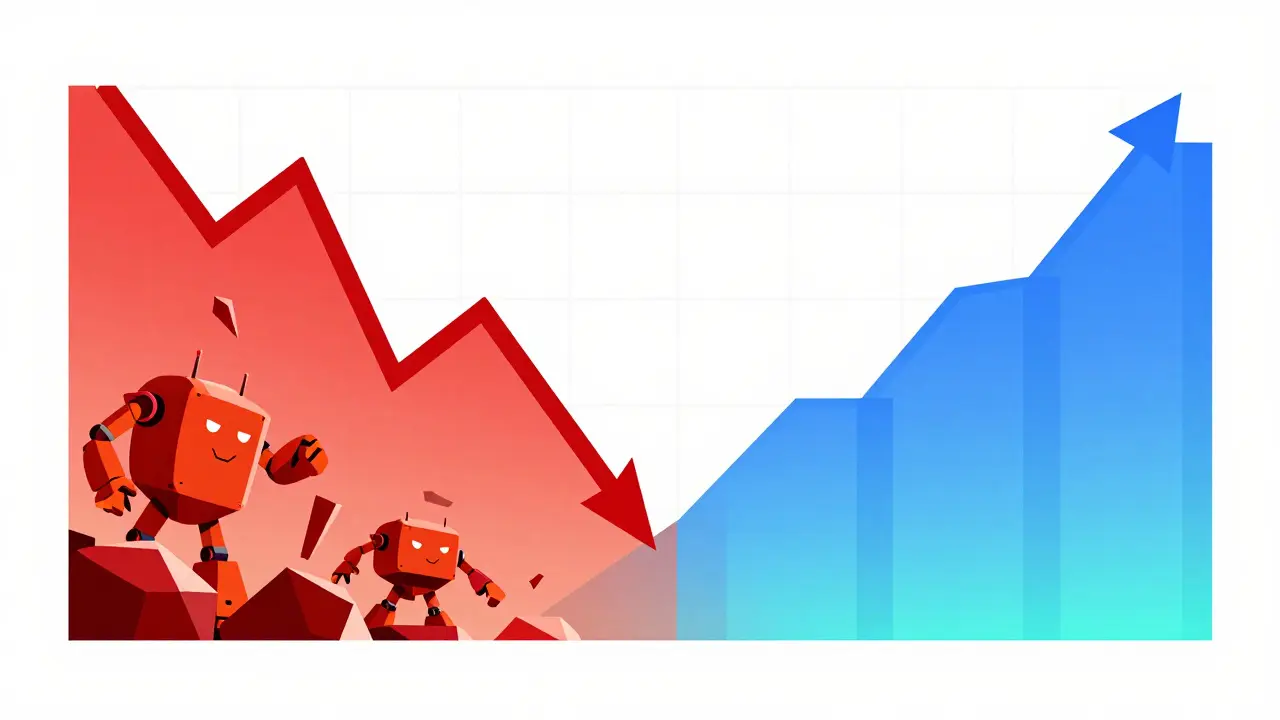
Most decentralized exchanges are built for speed. You want to swap your tokens instantly, get out, and move on. But what happens when you need to move millions of dollars? If you try to dump a massive amount of tokens into a standard pool all at once, you crash the price. You eat huge slippage fees, and predatory bots front-run your trade. This is the problem Fraxswap v2 is designed to solve.
Fraxswap isn't just another copy of Uniswap. It is the native decentralized exchange of the Frax Finance ecosystem, but with a secret weapon: the Time-Weighted Automated Market Maker, or TWAMM. While it looks like a standard swap interface on the surface, under the hood, it allows users to spread large trades over hours or even days. This simple change makes it a powerful tool for DAOs, treasuries, and serious traders who care more about execution quality than instant gratification.
What Is Fraxswap v2?
To understand Fraxswap v2, you first need to know what it sits on top of. At its core, it uses the same constant-product formula ($x \cdot y = k$) that made Uniswap V2 famous. This means if you just want to swap 100 USDC for FRAX quickly, the experience feels familiar. You connect your wallet, pick your pair, and click swap. The gas costs are similar to other Ethereum-based AMMs, and the interface is clean.
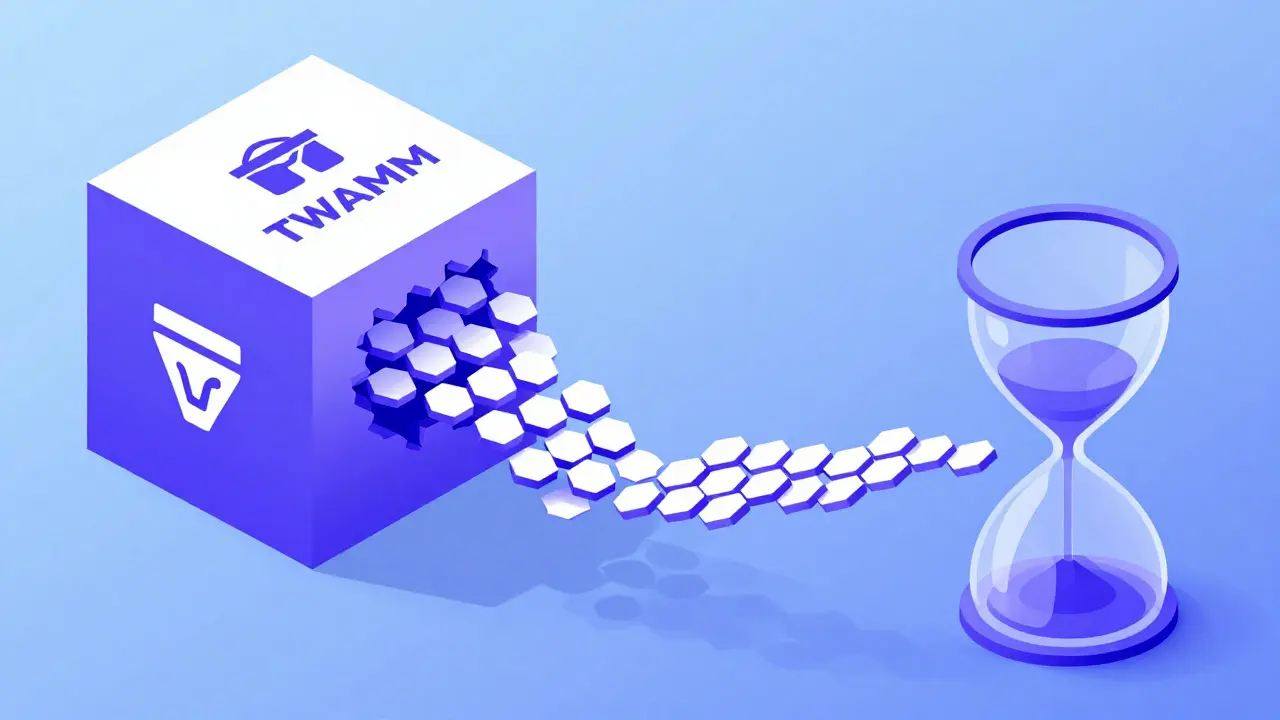
However, the "v2" label signals a major architectural shift. Fraxswap integrates a TWAMM module directly into its smart contracts. Unlike traditional limit orders that sit in an order book waiting to be filled by a market maker, a TWAMM order is executed gradually by the protocol itself. You set a start time, an end time, and the total amount you want to sell. The contract then sells small chunks of your asset every block until the order is complete.
This design was inspired by research from Paradigm, a leading crypto research firm. By approximating their original TWAMM formula, Fraxswap ensures these long-term orders run efficiently on-chain without draining your wallet with excessive gas fees. For the average user, this might seem complex. For a DAO managing a $50 million treasury, it’s a lifesaver.
The Power of TWAMM: Why Time Matters
Let’s look at a real-world scenario. Imagine you are the treasurer of a protocol holding 1 million FRAX stablecoins. You need to convert them to ETH to pay for operations. If you swap all 1 million FRAX at once on a standard pool, you will likely move the price significantly against yourself. You’ll end up with less ETH than the current market rate suggests, and arbitrage bots will have already bought ETH before your transaction hit the mempool.
With Fraxswap’s TWAMM, you can set an order to execute over 24 hours. The smart contract breaks your 1 million FRAX into thousands of tiny micro-swaps, executing one per block. To the market, this looks like natural, organic trading volume rather than a whale dumping assets. The result? A much better average price for you and far less volatility in the pool.
This feature positions Fraxswap not just as a retail trading platform, but as critical infrastructure for DeFi governance and protocol-owned liquidity. It reduces the reliance on off-chain solvers or centralized venues for large moves, keeping value within the decentralized ecosystem.
Integration with the Frax Ecosystem
Fraxswap doesn’t exist in a vacuum. It is tightly woven into the broader Frax Finance modular ecosystem. Founded by Sam Kazemian, Frax Finance is known for its hybrid algorithmic-collateralized stablecoins. Fraxswap serves as the primary liquidity hub for these assets.
Here is how the pieces fit together:
- FRAX & FRXUSD: These are the core stablecoins. Fraxswap provides deep liquidity pairs for swapping between them and other assets like WETH or USDC.
- FPI: The Inflation-Indexed Stablecoin. As FPI gains adoption, Fraxswap becomes the go-to venue for hedging against inflation using crypto assets.
- frxETH: Frax’s liquid staking token. Users often use Fraxswap to rebalance their portfolios between frxETH and other yield-bearing assets.
- FXS: The governance token. Fees generated from swaps on Fraxswap accrue to FXS holders, creating a direct economic incentive for the community to support the exchange’s growth.
Because Fraxswap is the native DEX, other Frax products like Fraxlend (the lending platform) often use it for liquidations and collateral management. This internal circulation of capital keeps the ecosystem efficient and reduces dependency on external competitors like Curve or Uniswap for core operations.
Fee Structure and Costs
When it comes to fees, Fraxswap keeps things straightforward. Following the Uniswap V2 model, the default fee tier is typically 0.30% per swap. Of this amount, 0.25% goes directly to liquidity providers (LPs) as rewards for taking on impermanent loss risk, while 0.05% may be collected by the protocol to support development and buybacks.
While 0.30% is standard for volatile pairs, it might seem high compared to specialized stablecoin swaps on Curve, which often charge 0.04%. However, Fraxswap offers flexibility. Some pools may have different fee structures depending on the asset volatility. For stablecoin pairs like FRAX/USDC, lower fee tiers might be introduced in future updates or via concentrated liquidity features planned for later versions.
Don’t forget gas fees. Since Fraxswap operates on Ethereum mainnet, you will pay network gas for every interaction. Initiating a TWAMM order requires one transaction, but the subsequent micro-swaps happen automatically within the contract state, so you don’t pay gas for each individual block execution. This is a crucial optimization that makes TWAMM viable on Ethereum.
Fraxswap vs. The Competition
How does Fraxswap stack up against the giants? Let’s break it down.
| Feature | Fraxswap v2 | Uniswap V2/V3 | Curve Finance |
|---|---|---|---|
| Core Model | Constant Product + TWAMM | Constant Product / Concentrated Liquidity | StableSwap Curve |
| Best For | Large, time-distributed trades; Frax assets | General purpose swaps; High volume pairs | Low-slippage stablecoin swaps |
| Liquidity Depth | High for Frax ecosystem; Moderate overall | Highest across industry | Very high for stablecoins |
| TWAMM Support | Native, on-chain | No (requires third-party tools) | No |
| Concentrated Liquidity | d>Planned for future updates | Yes (V3) | No |
If you are trading obscure meme tokens, Uniswap is still king due to its sheer number of pairs. If you are swapping USDT for USDC and want the absolute lowest slippage, Curve is usually the better choice. But if you are moving significant amounts of FRAX, FRXUSD, or frxETH, or if you need to execute a large order without spooking the market, Fraxswap is arguably the superior tool.
Security and Trust
In DeFi, security is everything. Fraxswap benefits from standing on the shoulders of giants. Because its base architecture mirrors Uniswap V2, it inherits years of battle-tested code and security audits. The Uniswap V2 contracts have handled billions of dollars in volume since 2020 with no major exploits.
The TWAMM logic, however, is new. Frax Finance has worked closely with security firms to audit these specific extensions. The team has emphasized gas optimization and safety in the TWAMM implementation to prevent edge-case vulnerabilities. Additionally, because Fraxswap is non-custodial, your funds never leave your control until the swap executes. Even with a TWAMM order, the tokens remain in the smart contract until they are swapped, meaning there is no counterparty risk of a central exchange going bankrupt.
That said, always remember that smart contracts carry inherent risks. Bugs can happen. It is wise to only interact with the official Fraxswap interface and to verify contract addresses before approving any transactions.
Who Should Use Fraxswap v2?
Not everyone needs TWAMM. Here is a quick guide to help you decide if Fraxswap is right for you:
- Retail Traders: If you are swapping small amounts (under $1,000) occasionally, Fraxswap works fine for accessing Frax assets. The UI is intuitive, and the fees are standard.
- Yield Farmers: If you provide liquidity to Frax pools, you earn trading fees. Using Fraxswap ensures you are contributing to the ecosystem where your capital is deployed.
- DAOs and Treasuries: This is the sweet spot. If you manage large reserves, use TWAMM to rebalance your portfolio smoothly over time.
- Developers: If you are building a bot or integrating Frax assets into your dApp, the Uniswap V2-compatible router makes integration easy. You can reuse existing libraries with minor tweaks.
Future Outlook: What’s Next for Fraxswap?
Fraxswap v2 is just the beginning. The roadmap includes plans to introduce concentrated liquidity, similar to Uniswap V3. This would allow liquidity providers to deposit funds within specific price ranges, dramatically increasing capital efficiency. Imagine getting the low slippage of Curve with the flexibility of Uniswap, all powered by TWAMM for large orders.
Furthermore, Fraxswap has expanded beyond Ethereum to Fraxtal, Frax’s own Layer-2 network. On Fraxtal, gas fees are negligible, making TWAMM orders even more attractive for smaller traders who previously couldn’t justify the Ethereum gas costs. As Frax Finance continues to grow its stablecoin market share, Fraxswap will likely see increased volume and deeper liquidity, reinforcing its position as a key pillar of decentralized finance.
Is Fraxswap safe to use?
Fraxswap uses audited smart contracts based on the widely trusted Uniswap V2 architecture. However, like all DeFi protocols, it carries smart contract risk. Always use the official website and verify contract addresses. The TWAMM feature adds complexity, so ensure you understand how time-weighted orders work before using them.
What is TWAMM and why do I need it?
TWAMM stands for Time-Weighted Automated Market Maker. It allows you to split a large trade into many small transactions over a set period (e.g., 24 hours). This minimizes slippage and prevents your large order from crashing the market price. It is ideal for institutional investors or anyone moving significant capital.
Can I use Fraxswap on networks other than Ethereum?
Yes. While Fraxswap launched on Ethereum, it is also available on Fraxtal, Frax Finance’s Layer-2 solution. Fraxtal offers lower gas fees, making it more cost-effective for frequent traders. The same TWAMM technology works on both networks.
How do fees work on Fraxswap?
The standard fee is 0.30% per swap, consistent with Uniswap V2. Most of this goes to liquidity providers. There are also network gas fees, which vary based on Ethereum congestion. On Fraxtal L2, gas fees are significantly lower.
Is Fraxswap better than Uniswap?
It depends on your needs. Uniswap has more trading pairs and higher overall volume. Fraxswap is better if you are trading Frax ecosystem assets (FRAX, FRXUSD, frxETH) or if you need to execute large, time-distributed trades using TWAMM. For general-purpose swapping of random tokens, Uniswap remains the leader.