
Imagine owning a piece of a luxury hotel in Dubai or a high-rise in London - not with millions in savings, but with just $50. That’s the reality tokenized real estate makes possible. Instead of buying an entire building or waiting years to save up for a down payment, you can buy a digital token that represents a tiny slice of a property. These tokens live on the blockchain, making ownership transparent, instant, and available to anyone with an internet connection. This isn’t science fiction. It’s happening right now, and the numbers prove it: by 2035, over $4 trillion in real estate is expected to be tokenized, up from just $300 billion in 2024. That’s a 13-fold increase in just over a decade.
How Tokenized Real Estate Works
Tokenized real estate turns physical property into digital assets. Here’s how: a property owner - maybe a developer or a real estate fund - partners with a blockchain platform to divide ownership into thousands of small tokens. Each token is a digital claim on the property, backed by legal documentation and recorded on a public ledger. These tokens are then sold to investors worldwide. You don’t need to be an institution or a billionaire to get in. Platforms like Propy and Maticz let you buy as little as one token, often costing under $100. Once you own a token, you’re legally entitled to a share of any rental income, property appreciation, or sale proceeds - just like owning shares in a company.
The magic happens through smart contracts self-executing code on the blockchain that automatically handles ownership transfers, rent distribution, and compliance rules without human intervention. No lawyers, no escrow agents, no paperwork delays. When rent is collected, the smart contract instantly sends your share to your digital wallet. When someone buys your token, the transfer is finalized in minutes, not months.
Lower Barriers to Entry
Traditional real estate has always been a game for the wealthy. A single apartment in New York might cost $1 million. A commercial building? $10 million or more. That locks out 99% of the population. Tokenization breaks that barrier. With fractional ownership, you can invest in premium properties you’d never afford otherwise. Want a stake in the St. Regis Aspen resort? Elevated Returns raised $18 million by tokenizing it - and everyday investors bought in with as little as $50. That’s the power of democratization. You’re no longer limited by geography, income, or net worth. If you have a smartphone and a crypto wallet, you can own part of a property on another continent.
Increased Liquidity
Real estate has always been called an “illiquid” asset. That means once you buy a house or building, you’re stuck. Selling it takes months - maybe longer if the market’s slow. With tokenized real estate, you can sell your tokens anytime, 24/7. Think of it like trading stocks. Platforms host secondary markets where tokens are bought and sold continuously. Need cash? Sell a few tokens. Want to rebalance your portfolio? Do it in minutes. This liquidity is a game-changer. It turns real estate from a long-term, lock-it-up investment into something flexible, responsive, and dynamic. You’re no longer at the mercy of market cycles or buyer availability.
Global Access and Diversification
Before tokenization, investing in overseas property meant navigating foreign laws, currency risks, and local agents. Now, you can buy tokens representing properties in London, Tokyo, or Miami with the same ease as buying a stock. This opens up portfolio diversification like never before. Instead of putting all your money into one local house, you can spread it across ten different properties in five different countries. A small apartment in Berlin, a warehouse in Singapore, a retail center in Dallas - all accessible with a few clicks. This kind of diversification reduces risk. If one market dips, your other holdings can balance it out.

Lower Costs and Faster Transactions
Traditional real estate deals are expensive. Legal fees, broker commissions, title insurance, transfer taxes - they add up fast. In some cases, these costs eat up 5-10% of the transaction value. Tokenization cuts that dramatically. By automating everything with smart contracts self-executing code on the blockchain that automatically handles ownership transfers, rent distribution, and compliance rules without human intervention, you eliminate middlemen. No need for a realtor. No need for a notary. No need to wait weeks for bank approvals. Transactions settle in hours. Studies show transaction costs can drop by up to 30%. That means more of your money goes into the property - not into paperwork.
Transparency and Security
Blockchain is built on public ledgers. Every token issuance, transfer, and payment is recorded permanently and can be verified by anyone. There’s no hiding who owns what. No forged documents. No double-selling. No hidden fees. If a property generates $100,000 in rent, every token holder can see exactly how much they’re owed - and when it’s paid. This level of transparency is unheard of in traditional real estate, where records are often siloed, paper-based, or controlled by a few intermediaries. Plus, blockchain’s encryption makes it nearly impossible to alter records. Once a transaction is confirmed, it’s locked in. Fraud becomes exponentially harder.
Stronger Returns and Passive Income
Tokenized real estate isn’t just convenient - it’s profitable. Average yields for tokenized properties hover around 11%, higher than the typical 4-6% from traditional rental properties. Why? Because smart contracts cut out layers of fees, and the ability to buy into high-value assets (like luxury hotels or office towers) boosts overall returns. Rental income is automatically distributed to your wallet. No chasing landlords. No delays. No missed payments. You get paid on schedule, every time. And because these assets are often in high-demand markets - think central London, downtown Dubai, or Silicon Valley - appreciation potential is strong.
Who’s Investing?
This isn’t just a trend for small investors. Institutions are jumping in fast. A 2023 EY survey found that 80% of high-net-worth individuals and 67% of institutional investors are either already invested in tokenized assets or planning to be. By 2026, institutions expect to allocate 5.6% of their portfolios to tokenized real estate. High-net-worth individuals aim for 8.6%. Why? Because it’s efficient, scalable, and offers exposure to premium assets without the capital lock-up. Real estate funds, pension plans, and family offices are now using tokenization to diversify holdings, reduce friction, and unlock new revenue streams.
What’s Next?
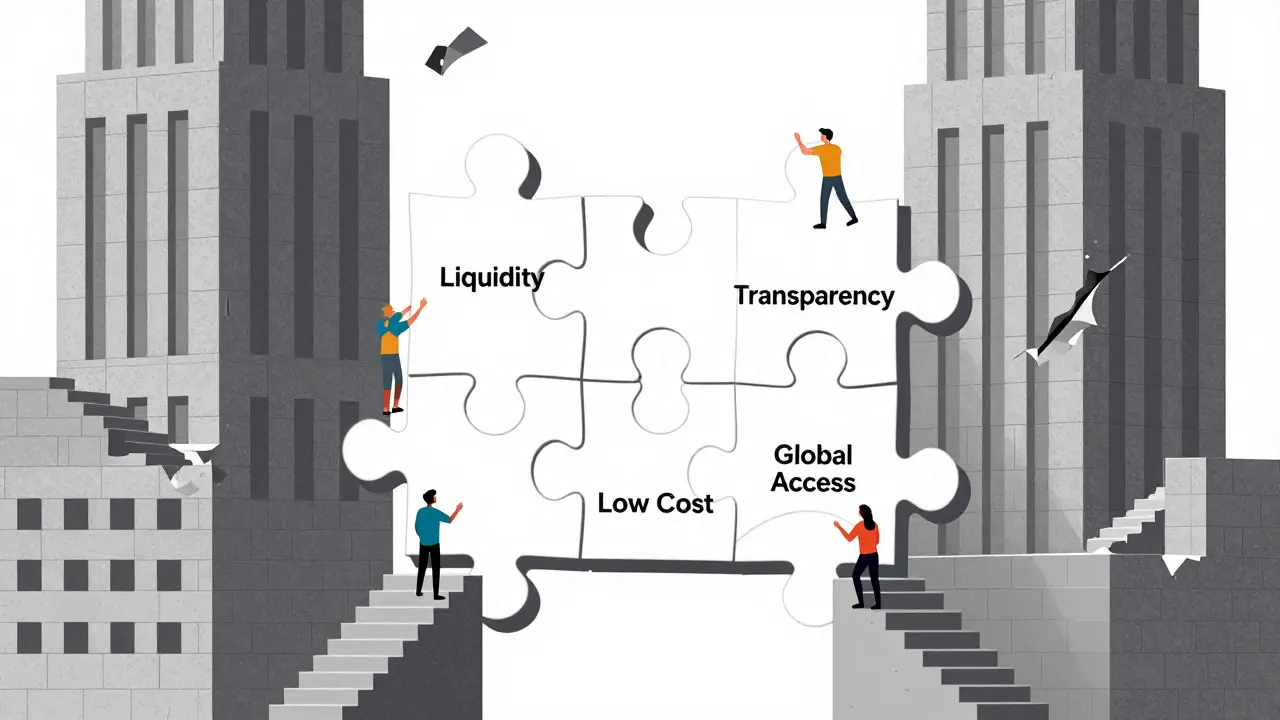
The growth curve is steep. From $300 billion in 2024 to $4 trillion by 2035 - that’s a 27% compound annual growth rate. More platforms are launching. Regulators are starting to clarify rules. Major cities are piloting blockchain-based property registries. The technology is maturing. And as more people see how easy, transparent, and profitable it is, adoption will accelerate. Tokenized real estate isn’t replacing traditional ownership - it’s expanding it. It’s letting ordinary people access what was once reserved for the elite.
Real-World Examples
Take the St. Regis Aspen resort. Through tokenization, it raised $18 million from over 1,500 investors - many of them first-time property owners. Or look at London’s prime office buildings, now being tokenized by platforms that let investors from Nigeria, Canada, or Indonesia buy into them. Even undeveloped land in Spain or Portugal is being split into tokens, letting investors fund construction projects early and profit from future value. These aren’t experiments. They’re real deals, happening now.
| Feature | Tokenized Real Estate | Traditional Real Estate |
|---|---|---|
| Minimum Investment | $50-$100 | $100,000+ |
| Liquidity | 24/7 trading, instant sales | Months to sell, limited buyers |
| Transaction Time | Hours | 30-90 days |
| Costs | Up to 30% lower | 5-10% in fees |
| Global Access | Yes - buy anywhere | Difficult, requires local agents |
| Transparency | Public blockchain ledger | Private records, opaque |
| Average Yield | ~11% | 4-6% |
Is It Safe?
Like any investment, there are risks. Not all platforms are regulated. Some tokens lack legal backing. Always check if the issuer is compliant with local securities laws. Look for platforms that partner with licensed custodians and provide legal documentation (like deeds or equity agreements) tied to the tokens. Avoid anything that promises guaranteed returns - that’s a red flag. Stick to established names like Propy, Maticz, or platforms backed by real estate funds with track records. Do your homework. But when done right, tokenized real estate is one of the most secure, transparent, and accessible ways to invest in property today.
Getting Started
Start small. Pick one platform that’s transparent, regulated, and offers real properties - not just speculative land. Look for clear documentation: what asset are you buying? Who owns the legal title? How is income distributed? Begin with $100. Buy one token. See how the system works. Watch your wallet for rent payments. Track the token’s value. Then, if it makes sense, add more. You don’t need to go all-in. Just get your foot in the door.
Can I really invest in real estate with $50?
Yes. Tokenized real estate allows fractional ownership, meaning you can buy a small slice of a property - like 0.01% of a building - for as little as $50. Platforms like Propy and Maticz enable this by dividing property value into thousands of digital tokens, each representing a proportional share. This makes premium properties accessible to everyday investors.
Are tokenized real estate investments legal?
In most developed countries, yes - but only if the platform follows securities regulations. In the UK, EU, and US, tokenized real estate is treated as a security, meaning issuers must register with financial authorities and provide investor disclosures. Always choose platforms that are transparent about compliance, use licensed custodians, and provide legal documentation linking tokens to actual property ownership.
How do I get paid from tokenized real estate?
Rental income is automatically distributed to your digital wallet via smart contracts. Payments are typically made monthly or quarterly, depending on the property’s lease agreements. You’ll receive crypto or stablecoins directly - no bank transfers, no delays. The system handles everything: collecting rent, calculating shares, and sending funds to each token holder.
Can I sell my tokens anytime?
Yes. Unlike traditional real estate, which takes months to sell, tokenized real estate trades on blockchain platforms 24/7. You can list your tokens for sale like you would a stock. Buyers can be anywhere in the world, and transactions settle in minutes. Liquidity depends on the platform’s trading volume, but most major platforms have active secondary markets.
What happens if the property is sold?
If the property is sold, proceeds are distributed to token holders based on their ownership percentage. The smart contract automatically calculates and sends funds to each investor’s wallet. You may also have the option to reinvest in a new tokenized asset offered by the same platform. All transactions are recorded on the blockchain, ensuring transparency and fairness.
Is tokenized real estate better than REITs?
Tokenized real estate offers more direct ownership than REITs. With REITs, you own shares in a company that owns property - not the property itself. With tokenized real estate, you hold a digital claim on the actual asset, often with direct access to rental income and sale proceeds. Tokenization also offers lower minimums, better transparency, and global trading - making it more flexible than traditional REITs.
Tokenized real estate isn’t just a new way to invest - it’s a new way to think about ownership. It’s removing gatekeepers. It’s opening doors. It’s letting people who’ve never had the chance to own property - whether because of cost, location, or background - finally get in. And as the technology grows, so will the opportunities. The future of real estate isn’t just bricks and mortar. It’s code, contracts, and coins - and it’s already here.
Sriharsha Majety
February 24, 2026 AT 17:40Tabitha Davis
February 26, 2026 AT 03:37Vishakha Singh
February 27, 2026 AT 01:08Don B.
February 27, 2026 AT 20:27Leslie Cox
March 1, 2026 AT 19:56Derek Sasser
March 2, 2026 AT 07:37Neeti Sharma
March 3, 2026 AT 15:34Nadia Shalaby
March 3, 2026 AT 22:24Fiona Monroe
March 4, 2026 AT 23:44Molley Spencer
March 5, 2026 AT 17:16John Fuller
March 7, 2026 AT 11:33Lucy Simmonds
March 7, 2026 AT 12:52Dana Sikand
March 8, 2026 AT 10:51Nicki Casey
March 9, 2026 AT 17:13Jessica Carvajal montiel
March 9, 2026 AT 19:01maya keta
March 11, 2026 AT 18:25