Imagine trying to spend US dollars in a country that only accepts Euros. You can’t just hand over the greenbacks; you need an exchange to convert them first. In the blockchain world, this problem is even more rigid. Bitcoin cannot talk to Ethereum. Solana cannot interact with Polygon. They are isolated islands of value. This fragmentation breaks the promise of a unified digital economy.
Enter wrapped assets and bridge mechanisms. These technologies act as the currency exchangers of the crypto world. They allow you to take an asset from one blockchain and use it on another without selling it. If you want to use your Bitcoin in an Ethereum lending protocol, you don’t sell it for ETH. You wrap it. This article explains how these mechanisms work, why they are risky, and where the technology is heading in 2026.
The Core Problem: Blockchain Fragmentation
To understand wrapped assets, you first have to accept a hard truth about modern blockchain infrastructure: it is fragmented. Each blockchain operates on its own consensus mechanism, programming language, and rule set. Bitcoin uses Proof-of-Work and a simple scripting language. Ethereum uses Proof-of-Stake and supports complex smart contracts via Solidity.
Because their underlying architectures differ, they cannot natively recognize each other’s assets. A Bitcoin transaction is invisible to an Ethereum node. This isolation creates a major bottleneck for decentralized finance (DeFi). DeFi thrives on liquidity-the ability to move money quickly between lending, borrowing, and trading platforms. If billions of dollars in Bitcoin are stuck on the Bitcoin network, they cannot participate in the vibrant DeFi ecosystem built on Ethereum or Layer 2 networks like Arbitrum or Optimism.
Wrapped assets solve this by creating a proxy. Instead of moving the actual Bitcoin across chains (which is technically impossible without breaking the chain), we create a digital receipt on Ethereum that represents that Bitcoin. This receipt is the wrapped token. It behaves exactly like the original asset in terms of value, but it lives on a different blockchain.
How Wrapped Assets Work: The Lock-and-Mint Model
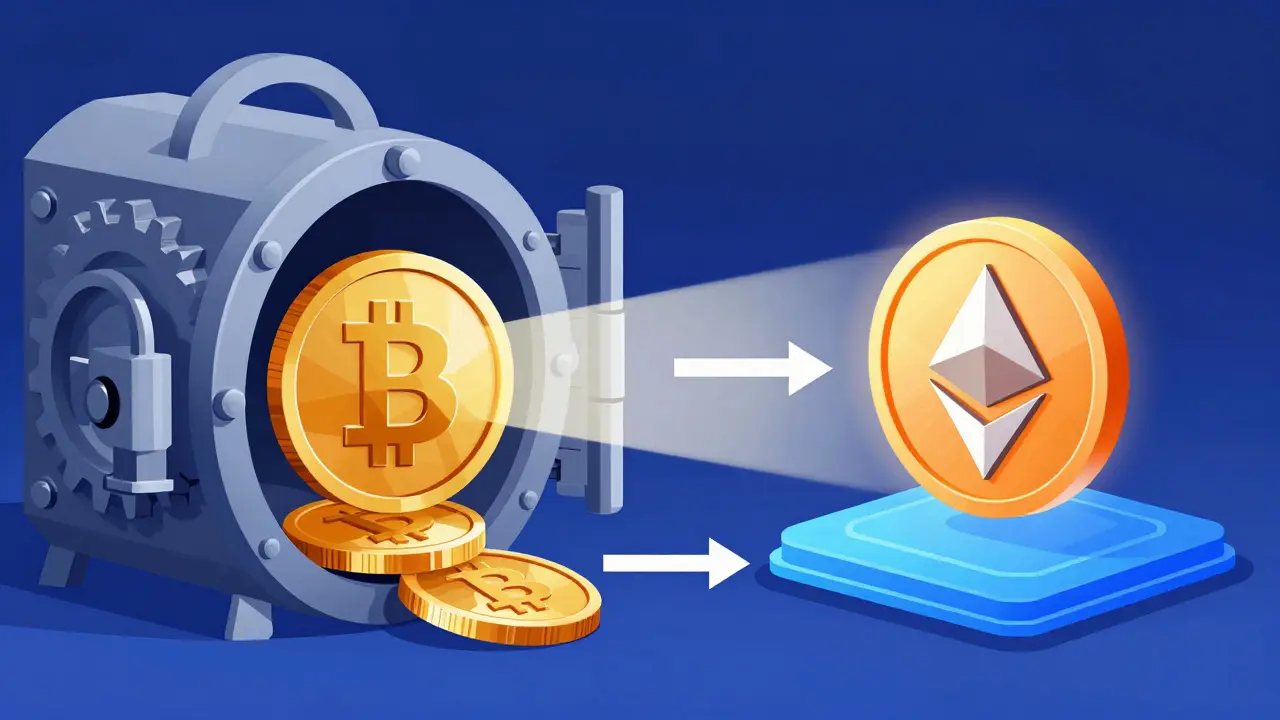
The most common method for creating wrapped assets is the lock-and-mint model. This process involves several distinct steps and relies heavily on trust in specific actors. Here is how it typically unfolds:
- Deposit: You send your native asset (e.g., BTC) to a secure collateral reserve. This reserve is often managed by a custodian or a group of signers.
- Verification: The custodian confirms that the funds have arrived and are locked in a digital vault. No one can access these funds while they are locked.
- Minting: Once the deposit is verified, the system mints an equivalent amount of wrapped tokens (e.g., WBTC) on the target blockchain (e.g., Ethereum). These tokens follow the ERC-20 standard, making them compatible with any Ethereum wallet or DeFi app.
- Circulation: You now hold WBTC in your Ethereum wallet. You can lend it, trade it, or stake it just like you would with regular ETH.
- Burning: When you want your original Bitcoin back, you send the WBTC to a burn address. This destroys the wrapped tokens, removing them from circulation.
- Redemption: The custodian sees the burn event and releases the original BTC from the vault, sending it back to your Bitcoin address.
This cycle ensures a 1:1 peg. For every unit of WBTC in existence, there should be one unit of BTC locked in a vault. The integrity of the entire system depends on this balance remaining intact.
| Feature | Wrapped Token (e.g., WBTC) | Synthetic Asset (e.g., Synthetix sBTC) |
|---|---|---|
| Backing | 1:1 backed by real assets in custody | Backed by collateral pools and algorithms |
| Custody | Centralized or multi-sig custodians hold the original asset | No direct custody of the underlying asset |
| Purpose | Move native assets across chains | Gain price exposure without ownership |
| Risk Profile | Custodial risk (hack/theft of vault) | Smart contract and de-pegging risk |
The Role of Bridge Mechanisms
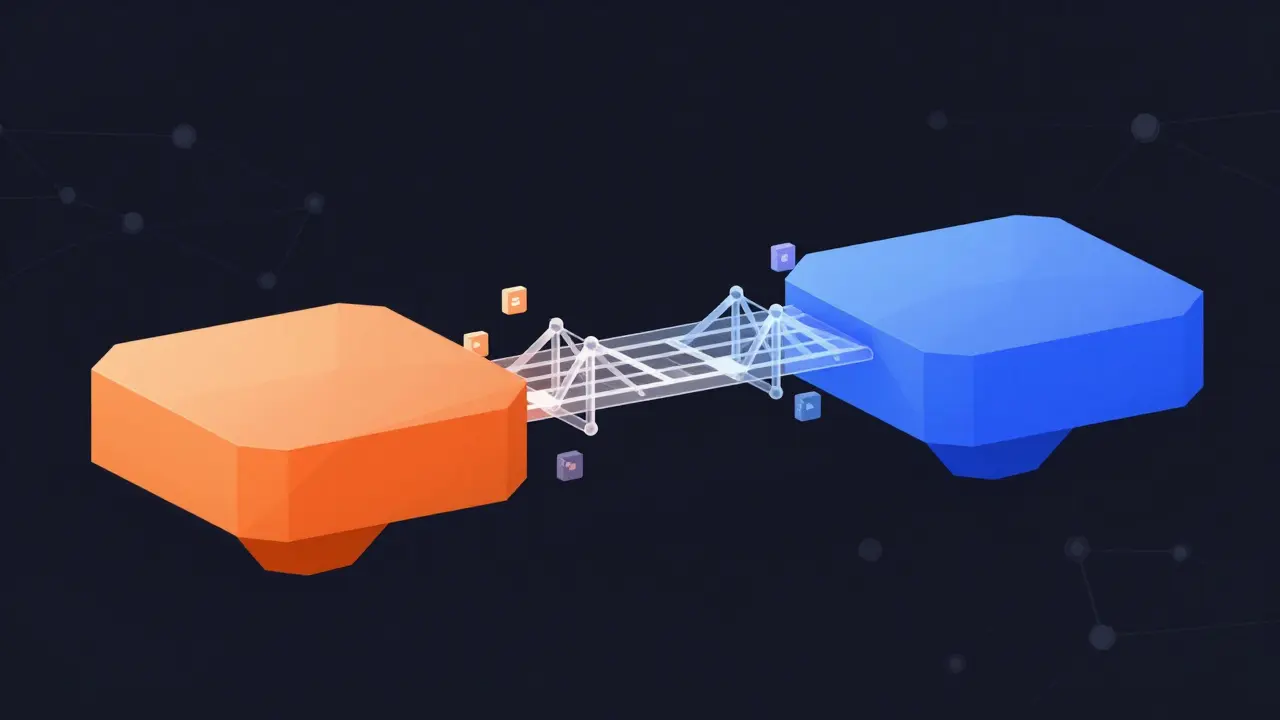
If wrapped assets are the currency, bridges are the banks and ATMs that facilitate the exchange. A blockchain bridge is a protocol that connects two separate blockchains. Bridges enable the communication necessary for the lock-and-mint process to happen securely.
There are two main types of bridges: trusted and trust-minimized.
Trusted Bridges rely on a central authority or a small group of validators to confirm transactions. For example, early versions of WBTC relied on a federation of companies to manage the Bitcoin vaults. While efficient, this introduces a single point of failure. If the key holders collude or get hacked, the entire supply of wrapped tokens could be compromised. This was the reality behind several high-profile exploits in previous years, where millions of dollars were drained from bridge protocols.
Trust-Minimized Bridges aim to remove this human element. They use cryptographic proofs and decentralized oracle networks to verify transactions. For instance, Chainlink’s Cross-Chain Interoperability Protocol (CCIP) allows developers to build applications that can communicate across chains without relying on a centralized custodian. Instead of trusting a company to say "I have your Bitcoin," the bridge uses mathematical proof to show that the Bitcoin was indeed locked. This shift toward trust-minimization is critical for the long-term security of the multi-chain ecosystem.
Security Risks and the Custodian Dilemma
The biggest weakness in the wrapped asset model is the custodian. In a truly decentralized system like Bitcoin, no one controls your keys but you. With wrapped assets, you are handing control to a third party. This creates a "trust gap."
Users must believe three things:
- The custodian actually holds the underlying assets (Proof of Reserves).
- The custodian will not steal or freeze the assets.
- The smart contracts managing the minting and burning are bug-free.
History has shown us that these assumptions can fail. Smart contract vulnerabilities have led to massive losses in bridge hacks. Additionally, regulatory pressure is increasing. Governments may demand greater transparency from custodians, potentially forcing them to implement stricter KYC (Know Your Customer) rules, which goes against the ethos of privacy-focused crypto users.
To mitigate these risks, many projects now use multi-signature wallets. This means that multiple independent parties must approve any movement of funds from the vault. It makes theft harder, but it doesn’t eliminate the risk entirely. As we move through 2026, the industry is shifting away from single-custodian models toward decentralized autonomous organizations (DAOs) that govern the reserves, spreading the risk among a larger community.
Use Cases in Decentralized Finance (DeFi)
Why go through all this trouble? Because the utility is immense. Wrapped assets unlock the full potential of DeFi.
Consider a Bitcoin holder who wants to earn yield. On the Bitcoin network, options are limited. But on Ethereum, there are hundreds of lending protocols like Aave or Compound. By wrapping BTC into WBTC, the user can deposit it into these protocols and earn interest, all while retaining exposure to Bitcoin’s price movements. Similarly, traders can use wrapped ETH (WETH) on other chains like Binance Smart Chain or Avalanche to access faster and cheaper transactions, then unwrap it later if needed.
Wrapped assets also enable cross-chain arbitrage. If the price of WBTC on Ethereum is slightly higher than BTC on the Bitcoin network, traders can buy BTC, wrap it, and sell WBTC for a profit. This activity helps keep the prices aligned across different markets.
The Future: Native Interoperability vs. Wrapping
Is wrapping a permanent solution? Many experts view it as a necessary compromise for today, but not the final answer. The ultimate goal is native interoperability-where blockchains can talk to each other directly without needing wrapped proxies.
Protocols like Polkadot and Cosmos are building ecosystems designed for native cross-chain communication. However, these are still niche compared to the dominance of Ethereum and Bitcoin. Until those giants adopt universal interoperability standards, wrapped assets will remain essential infrastructure.
In 2026, we are seeing a maturation of Layer 2 networks. As more users move to scaling solutions like Arbitrum, Base, and zkSync, the demand for wrapped assets increases. These L2s often require wrapped versions of ETH and other tokens to function within their local economies. The trend is clear: the more fragmented the ecosystem becomes, the more vital bridges and wrapped assets become.
However, innovation continues. Newer wrapping mechanisms are becoming more automated and less reliant on manual custodians. Some projects are experimenting with atomic swaps, which allow direct peer-to-peer exchanges across chains without intermediaries. While not yet mainstream, these technologies hint at a future where "wrapping" might become obsolete, replaced by seamless, native asset transfer.
What is the difference between WBTC and BTC?
BTC is the native cryptocurrency of the Bitcoin blockchain. WBTC (Wrapped Bitcoin) is an ERC-20 token on the Ethereum blockchain that represents BTC. One WBTC is always intended to equal one BTC in value. The key difference is usability: BTC stays on the Bitcoin network, while WBTC can be used in Ethereum-based DeFi apps, smart contracts, and wallets.
Are wrapped assets safe?
Wrapped assets carry more risk than holding native assets. You are trusting a custodian to hold your original coins and a smart contract to manage the wrapped version. If the custodian is hacked or the smart contract has a bug, you could lose your funds. Always research the audit history and custodian reputation of any wrapped token before using it.
How do I unwrap my tokens?
To unwrap tokens, you typically send them to a designated burn address on the destination chain. This triggers a verification process. Once confirmed, the custodian releases the original native asset from the vault and sends it to your address on the source chain. This process can take anywhere from a few minutes to several days, depending on the bridge's efficiency.
What is a trust-minimized bridge?
A trust-minimized bridge reduces reliance on centralized custodians by using cryptographic proofs and decentralized networks (like Chainlink CCIP) to verify transactions. Instead of trusting a company to say they have your assets, the math proves it. This significantly lowers the risk of insider theft or collusion.
Can wrapped tokens lose their peg?
Yes. While wrapped tokens are designed to maintain a 1:1 value with the underlying asset, market panic, custodian insolvency, or technical failures can cause the wrapped token to trade at a discount. This is known as de-pegging. It is rare for major assets like WBTC but has happened with lesser-known wrapped tokens.
stalin brian
June 1, 2026 AT 01:55so basically we trust some random company with our btc again lol. the whole point of crypto was not having to trust banks or middlemen but now were just bringing them back in a fancy wrapper. its kinda ironic if you ask me
Dana Rapoport
June 2, 2026 AT 19:09The philosophical underpinning here is quite profound when you consider that trust is merely a social construct we are trying to digitize. We replace institutional trust with cryptographic proof, yet wrapped assets reintroduce human fallibility into the equation. It forces us to question whether true decentralization is even possible without sacrificing usability.
Hadleigh Edwards
June 3, 2026 AT 00:51I have to say that while I understand the skepticism surrounding these centralized custodians and the inherent risks involved in trusting third parties with your digital assets, it is absolutely crucial to recognize that this technology represents a monumental leap forward in the evolution of decentralized finance because without these bridges and wrapped tokens, the entire ecosystem would remain fragmented and isolated, preventing users from accessing the vast array of opportunities available on different blockchains, which ultimately stifles innovation and limits the potential for widespread adoption, so perhaps we should view this as a necessary transitional phase rather than a permanent flaw in the system, acknowledging that as the technology matures and new protocols emerge, we will likely see a shift towards more secure and decentralized solutions that mitigate these risks while preserving the benefits of cross-chain interoperability, allowing us to enjoy the best of both worlds in terms of security and functionality.
Diana Morris
June 3, 2026 AT 08:18stop whining about risk. you want yield you take risk. if you cant handle the fact that wbtc might get hacked then stay in cold storage and rot. the market doesnt care about your feelings. use the tools or get left behind
Dianne Wright
June 4, 2026 AT 17:19you guys really think chainlink ccip is magic? its still code written by humans who get paid to write it. i know better than most here how these smart contracts fail. every time someone says trust minimized they mean trust shifted to another set of insiders who are harder to sue. wake up sheeple. the peg breaks when the music stops and youll be holding worthless receipts while the devs cash out
Debbie Lewis
June 4, 2026 AT 20:40i just use weth for trading on arbitrum because gas fees on mainnet are insane. havnt had issues yet but i keep amounts small enough that if something goes wrong it wont ruin my life. seems like a fair tradeoff for the convenience honestly
Christina Pearce
June 4, 2026 AT 21:10its interesting how the article mentions the shift toward DAOs governing reserves. i think that could actually work if the governance tokens are distributed widely enough. right now most bridge governance is held by early investors who have no skin in the game once the protocol is live. we need a model where the people using the bridge have real voting power over the multisig signers
trisya hazriyana
June 4, 2026 AT 22:16the jargon heavy reality is that atomic swaps are vaporware for mainstream volume. latency kills arb strategies. until we have native interop via shared security models like eigenlayer restaking providing liquidity to bridges, wrapping is the only viable vector for capital efficiency. sarcasm aside the math checks out for now
Eric Grosso
June 6, 2026 AT 03:38did anyone else notice how the table compares synthetic assets to wrapped ones? synthetix sBTC is backed by collateral pools which feels way sketchier than actual BTC in a vault. why would anyone choose that unless they are trying to hide their tracks from regulators?
Sam Dashti
June 7, 2026 AT 07:06look at it this way: the blockchain landscape is a colorful tapestry of isolated islands, each with its own vibrant culture and rules. wrapped assets are the little boats ferrying goods between them. sure, the boats can sink, and the captains might be scoundrels, but without them, the islands starve. we need more robust vessels, perhaps powered by zero-knowledge proofs, to sail these treacherous waters safely.
Edith Mair
June 8, 2026 AT 23:58the regulatory pressure mentioned in the post is the real elephant in the room. if governments force KYC on custodians, the privacy aspect of crypto dies. we are walking a tightrope between utility and surveillance capitalism. i am watching this space closely to see which projects comply and which fight back