
Imagine trying to play a game of poker with five friends over the phone. No dealer, no camera, just voices in your ears. How do you know someone isn't cheating? How do you agree on who won the hand? Without a shared rulebook and a way to verify everyone's cards, the game collapses into chaos. This is exactly the problem that Consensus Mechanisms are the protocols that allow decentralized networks to agree on the state of data without a central authority solve for cryptocurrency.
If you have ever wondered why Bitcoin doesn't crash every time someone tries to spend the same coin twice, or how thousands of strangers can trust each other with billions of dollars, the answer lies here. These mechanisms are not just technical jargon; they are the invisible glue holding the entire digital asset economy together. Without them, blockchains would be nothing more than messy spreadsheets prone to fraud and manipulation.
The Core Problem: Trusting Strangers
In traditional finance, we rely on banks. When you send money via wire transfer, a central server checks your balance, deducts the amount, and adds it to the recipient's account. It’s simple because one entity controls the truth. But cryptocurrencies were built to remove that single point of control. So, if there is no bank, who decides if a transaction is valid?
This challenge is known in computer science as the Byzantine Generals' Problem is a classic distributed computing problem where multiple parties must agree on a plan despite potential traitors or communication failures. In short, how do you get independent nodes (computers) to agree on the correct version of history when some might lie, fail, or act maliciously? Consensus mechanisms provide the mathematical and economic rules to ensure that honest participants always win, making it nearly impossible for bad actors to rewrite history.
How Consensus Actually Works
You don’t need a degree in cryptography to understand the flow. Think of it as a group vote with strict verification steps. Here is the typical lifecycle of a transaction under a consensus protocol:
- Proposal: A user initiates a transaction, or a node proposes a new block of transactions.
- Broadcast: This proposal is sent out to all participating nodes in the network.
- Validation: Each node checks the proposal against the network’s rules. Is the signature valid? Does the sender have enough funds?
- Voting/Agreement: Nodes communicate to reach a majority agreement. Depending on the mechanism, this might involve solving puzzles or staking assets.
- Finalization: Once a sufficient threshold (usually >66% or >50%) agrees, the block is added to the ledger.
- Propagation: The updated ledger is synced across the entire network, ensuring everyone sees the same history.
This process ensures that no single person can dictate what happens next. It creates a system where the truth is determined by collective agreement rather than corporate decree.
Three Reasons Why They Are Non-Negotiable
Why does this matter to you, whether you are an investor, a developer, or just a curious observer? Consensus mechanisms address three critical flaws that plague centralized systems.
1. Preventing Double Spending
In the physical world, you can’t hand someone two $20 bills at once. In the digital world, copying data is easy. If I send you a file, I still have it. With money, this is catastrophic. Consensus mechanisms create an immutable ledger. Once a transaction is confirmed and buried under subsequent blocks, reversing it requires redoing all the work that came after it. This makes double-spending economically unviable and technically improbable.
2. Eliminating Trusted Third Parties
Banks charge fees and impose restrictions because they bear the risk of managing the ledger. By distributing this responsibility across thousands of nodes, consensus mechanisms remove the middleman. You don’t need to trust Visa or Chase; you trust the math and the code. This lowers costs and increases accessibility for anyone with an internet connection.
3. Ensuring Network Security
Centralized servers have single points of failure. Hack them, and the whole system goes down. Decentralized networks powered by consensus are resilient. To take down Bitcoin, you wouldn’t just hack one server; you’d need to overpower the computational power of tens of thousands of machines worldwide simultaneously. That level of redundancy provides security that traditional institutions struggle to match.

The Major Players: PoW vs. PoS
Not all consensus mechanisms are created equal. Different approaches offer different trade-offs between security, speed, and energy usage. Understanding these differences is crucial for evaluating any cryptocurrency.
| Mechanism | How It Works | Pros | Cons | Key Examples |
|---|---|---|---|---|
| Proof of Work (PoW) | Miners compete to solve complex mathematical puzzles using computational power. | Extremely secure; proven track record since 2009. | High energy consumption; slower transaction speeds. | Bitcoin, Litecoin |
| Proof of Stake (PoS) | Validators are chosen based on the amount of cryptocurrency they 'stake' as collateral. | Energy efficient; faster finality; lower barriers to entry. | Potential for wealth concentration ('rich get richer'). | Ethereum, Cardano |
| Delegated Proof of Stake (DPoS) | Token holders vote for delegates who validate transactions on their behalf. | Very high throughput; scalable. | Less decentralized; relies on elected representatives. | EOS, TRON |
| Byzantine Fault Tolerance (BFT) | Nodes exchange messages to reach agreement, tolerating up to 1/3 faulty nodes. | Fast finality; good for private/permissioned chains. | Does not scale well to large public networks. | Hyperledger Fabric, Solana (hybrid) |
Proof of Work, used by Bitcoin, is like a gold rush. Miners invest in expensive hardware and electricity to solve puzzles. The first to solve it gets to add the block and earns a reward. This cost acts as a deterrent: attacking the network would require spending millions in hardware and power, making it irrational for attackers.
Proof of Stake, adopted by Ethereum in its "Merge" update, changes the game. Instead of burning electricity, validators lock up their coins as a security deposit. If they act honestly, they earn rewards. If they cheat, their stake is "slashed" (destroyed). This method is far more environmentally friendly and allows for higher transaction volumes, which is why many newer projects prefer it.
Economic Incentives: Keeping Honest People Honest
Technology alone isn’t enough. You also need economics. Consensus mechanisms are designed around human behavior. They incentivize cooperation and punish greed.
In PoW, the incentive is the block reward plus transaction fees. In PoS, it’s the interest earned on staked assets. These rewards align the self-interest of participants with the health of the network. If a miner or validator wants to make money long-term, they must keep the network running smoothly. If they try to attack it, they risk losing their investment or being cut off from future rewards. This creates a self-policing ecosystem where honesty is the most profitable strategy.
Scalability and The Blockchain Trilemma
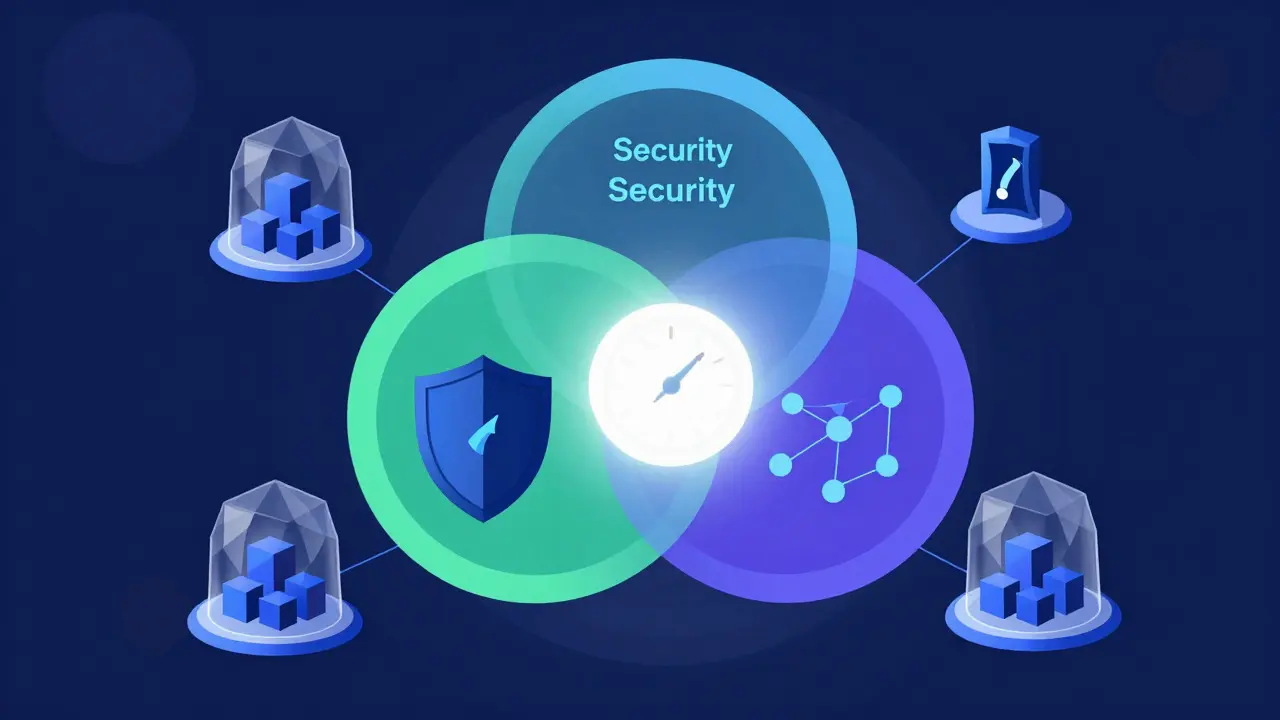
No system is perfect. Developers often face the "Blockchain Trilemma": the idea that you can only optimize for two of the following three attributes: Security, Scalability, and Decentralization.
- Security: How hard is it to attack the network?
- Scalability: How many transactions per second (TPS) can it handle?
- Decentralization: How many independent nodes control the network?
Bitcoin prioritizes security and decentralization, sacrificing scalability (it processes about 7 TPS). Ethereum’s move to PoS improved scalability and energy efficiency while maintaining strong security. Newer solutions like Layer 2 networks (e.g., Arbitrum, Optimism) sit on top of these base layers to handle high-volume transactions cheaply, relying on the underlying consensus for final settlement.
What’s Next for Consensus?
As of 2026, the industry is moving beyond basic PoW and PoS. Researchers are exploring hybrid models that combine the security of PoW with the efficiency of PoS. There is also significant growth in Cross-Chain Consensus refers to protocols that allow different blockchain networks to communicate and verify transactions with each other, enabling seamless transfers between Bitcoin, Ethereum, and other chains without centralized bridges.
Regulatory scrutiny is also shaping development. Energy-intensive PoW faces pressure in regions with strict environmental laws, pushing more projects toward sustainable alternatives. However, the core principle remains unchanged: as long as we want trustless, decentralized value transfer, we need robust consensus mechanisms to make it possible.
What happens if a consensus mechanism fails?
If a consensus mechanism fails, the network may experience a "fork," where the blockchain splits into two separate versions. This can lead to confusion, loss of funds, or temporary downtime. However, major networks like Bitcoin and Ethereum have redundant safeguards and community governance to resolve such issues quickly. A total failure usually implies a fundamental flaw in the code or a massive coordinated attack, which is rare in well-established networks.
Is Proof of Stake truly more secure than Proof of Work?
Security depends on the context. Proof of Work is secured by physical energy expenditure, making it resistant to certain types of attacks but vulnerable to 51% hash rate dominance. Proof of Stake is secured by economic value; attacking the network devalues the attacker's own holdings. While PoW has a longer track record, PoS is considered theoretically secure and offers additional protections like slashing conditions. Both are highly secure when implemented correctly.
Can I participate in consensus without mining?
Yes. If you hold cryptocurrencies that use Proof of Stake, you can often "stake" your coins to help validate transactions and earn rewards. Many platforms allow you to delegate your stake to professional validators if you don’t want to run your own node. This is much easier and cheaper than setting up mining hardware for Proof of Work.
Why does Ethereum switch from PoW to PoS?
Ethereum switched to reduce energy consumption by over 99% and to improve scalability. PoW was becoming too resource-intensive and limited the number of transactions the network could handle. PoS allows for faster block times and enables future upgrades like sharding, which will further increase capacity.
What is the Byzantine Generals' Problem in simple terms?
It’s a scenario where multiple groups must coordinate an action (like attacking a city) without a central leader, and some messengers might be lying or intercepted. In blockchain, it means getting computers to agree on the truth even if some are broken or malicious. Consensus algorithms are the solution to this coordination puzzle.