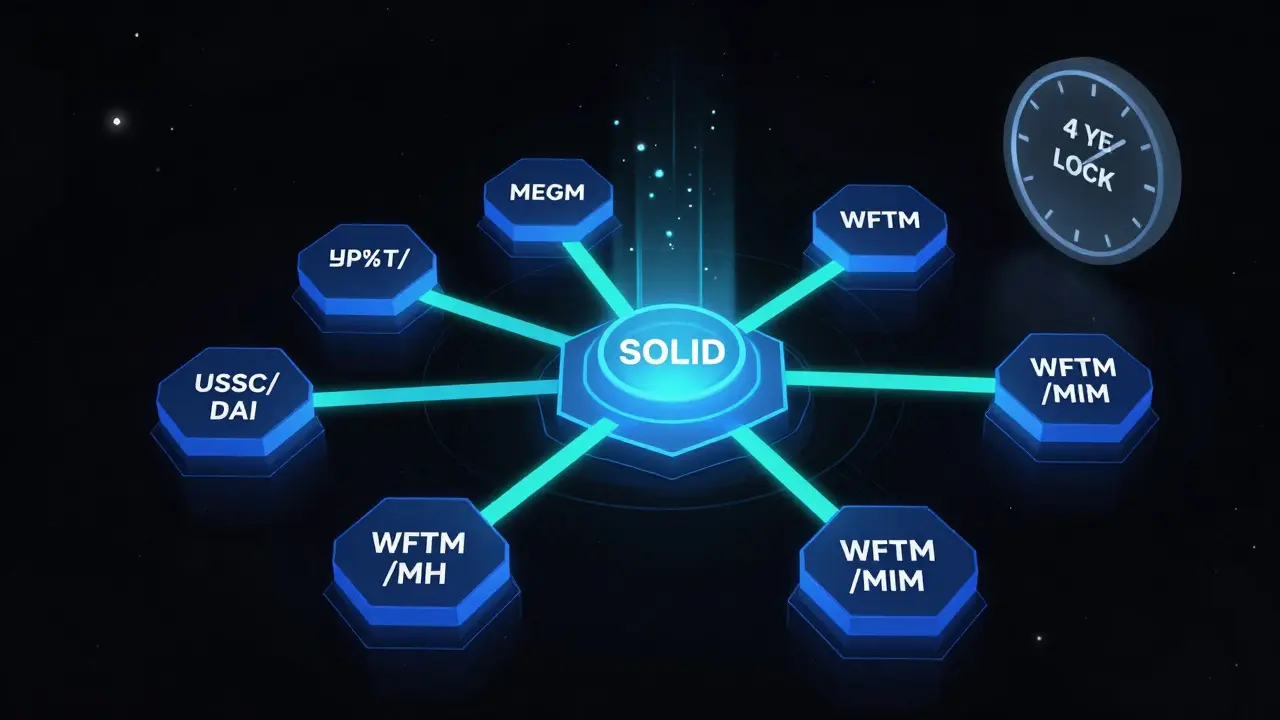
When you hear "Solidly" in crypto, you’re not just hearing about another coin. You’re hearing about a whole new way to trade tokens without middlemen - and how the token behind it, SOLID, keeps the system running. Unlike most crypto projects that chase price spikes, Solidly was built to fix a real problem: how decentralized exchanges (DEXs) waste money and reward the wrong people.
What Exactly Is Solidly?
Solidly is a decentralized exchange - meaning it lets you swap one cryptocurrency for another without a company in the middle. But it’s not built on Ethereum or Binance Chain. It runs on the Fantom a high-speed blockchain designed for fast, low-cost transactions network. That’s important because it means trades cost pennies and finish in under a second.
It started in February 2022, created by Andre Cronje - the same developer behind some of the earliest DeFi tools. But after a rough start, a small team took over in late 2022 and rebuilt it from the ground up. Their goal? Make the most efficient DEX ever. Not the one with the most money locked in. Not the one with the biggest marketing budget. The one that actually works well for traders and long-term holders.
How Solidly Works: The Math Behind the Magic
Most DEXs like Uniswap use a simple formula: x*y=k. It’s easy to understand, but it’s terrible for swapping stablecoins. Imagine trying to swap $1 USDC for $0.99 DAI. On Uniswap, you’d pay 1-2% in slippage - that’s a $0.02 fee on a $1 trade. That’s ridiculous.
Solidly changed that. It uses a new equation: x³y + y³x = k. Sounds complicated? Here’s what it does: it makes trading between similar assets - like stablecoins or wrapped tokens - almost free. Slippage drops to 0.01% or less. That’s 100x better than Uniswap v2. Traders love it. And when traders come, fees go up.
The SOLID Token: More Than Just a Coin
The SOLID token is the heartbeat of the system. But it doesn’t work like Bitcoin or Ethereum. You can’t just hold it and wait for it to rise. SOLID has two jobs:
- Governance: You vote on what pools get rewards, what fees change, and even which projects get to join.
- Revenue: You earn a share of every trading fee generated on the platform.
But here’s the twist: you can’t earn rewards just by holding SOLID. You have to lock it up.
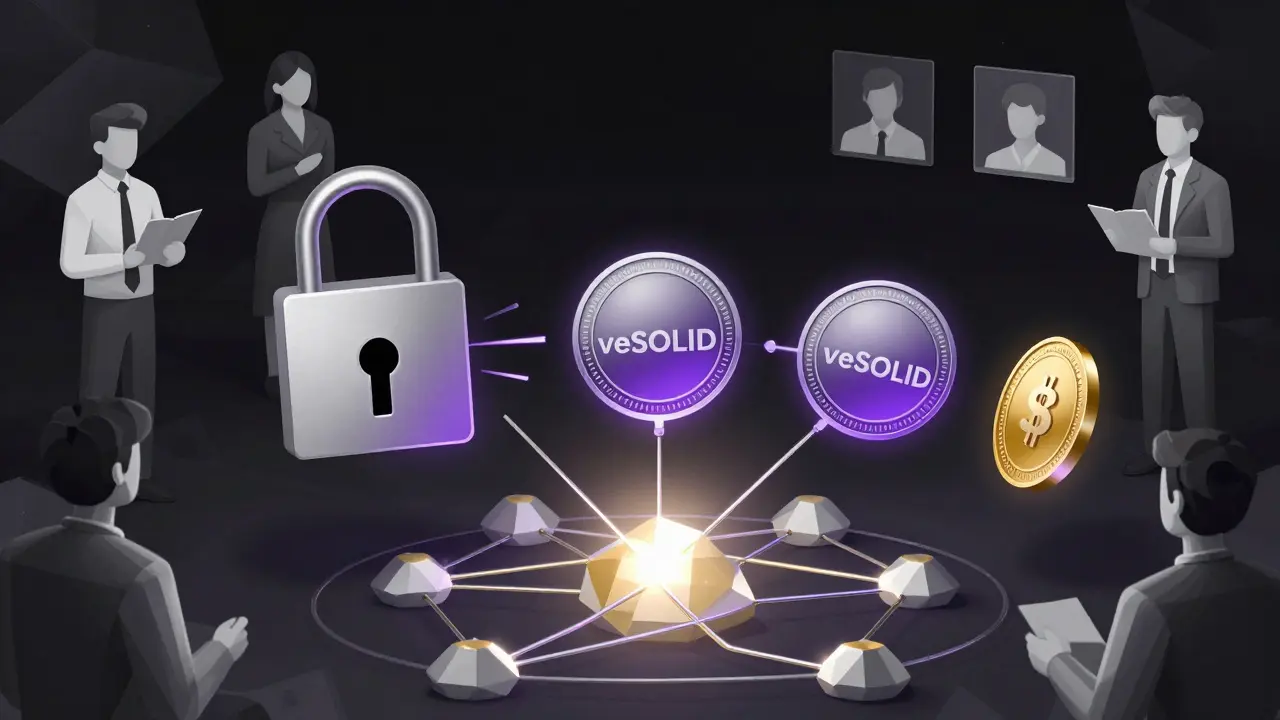
When you lock SOLID, you get veSOLID vote-escrowed SOLID, a token that represents your voting power and reward share. The longer you lock, the more veSOLID you get:
- 6 months = 0.125 veSOLID per SOLID
- 2 years = 0.5 veSOLID per SOLID
- 4 years = 1.0 veSOLID per SOLID
That’s right - locking for four years gives you full voting power. It’s designed to stop short-term speculators from taking over. This isn’t a pump-and-dump coin. It’s a long-term system.
How SOLID Emissions Work: No Inflation Trap
Most crypto projects flood the market with new tokens every week. That’s why early holders get diluted. Solidly does the opposite.
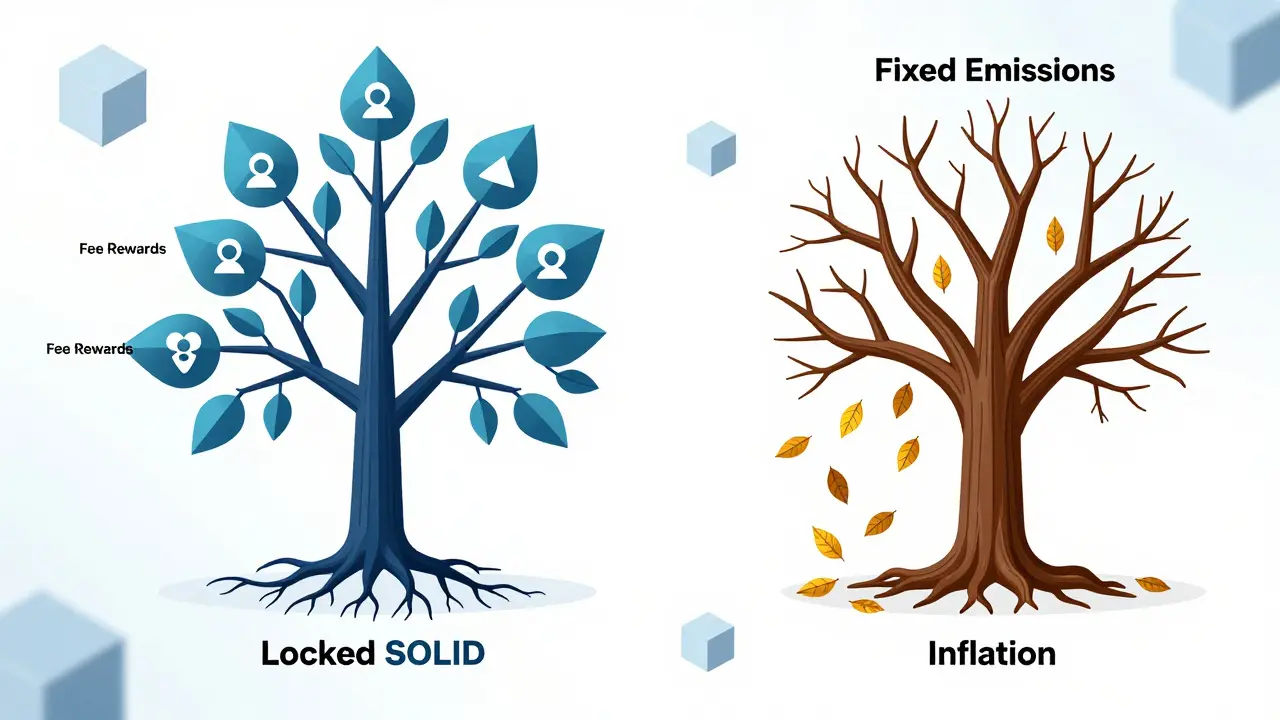
At launch, the total supply of SOLID was capped at 300 million. Weekly emissions start at 20 million tokens - but only if nobody locks their SOLID. The more people lock, the less gets issued. If everyone locks all 300 million, emissions drop to zero.
This is called an anti-dilution model. It means if you lock your SOLID, your share of rewards doesn’t shrink. In fact, if more people join and lock, your slice gets bigger. It’s the opposite of most tokens - where your ownership gets eaten away by new supply.
veNFTs: Locking Tokens That Can Be Sold
Here’s where Solidly gets wild. When you lock SOLID, you don’t just get veSOLID. You get a veNFT a non-fungible token representing your locked position, which can be traded or used as collateral.
That means you can:
- Sell your veNFT on a marketplace
- Use it as collateral to borrow money
- Split it into smaller pieces
So if you need cash, you don’t have to unlock your SOLID and lose your voting power. You just sell part of your veNFT. No one else has this feature. Not Curve. Not Uniswap. Just Solidly.
How Fees Flow: You Get Paid Only If You Vote
On most DEXs, liquidity providers get a cut of fees no matter what. Solidly flips that. Only veSOLID holders who vote for a specific trading pool get the fees from that pool.
Example: You lock SOLID and vote for the USDC/DAI pool. You get 100% of the fees from that pool. You didn’t vote for the WFTM/MIM pool? You get nothing from it. That forces everyone to pick the best pools - not just the ones with the most money.
This creates a feedback loop: better pools attract more traders → more fees → more rewards for voters → more people lock SOLID → better pools. It’s a self-improving system.
What Makes Solidly Different From Uniswap or Curve?
Let’s break it down:
| Feature | Solidly | Uniswap v2 | Curve Finance |
|---|---|---|---|
| Price Curve | x³y + y³x = k (optimized for stablecoins) | x*y=k (high slippage for similar assets) | Custom curve (good for stablecoins) |
| Locking Mechanism | veSOLID with veNFTs (sellable, collateralizable) | None | veCRV (non-transferable) |
| Fee Distribution | Only to voters of specific pools | All LPs get equal share | All CRV holders get equal share |
| Token Emissions | Decreases as more is locked | Fixed weekly emissions | Fixed weekly emissions |
| Primary Goal | Fee generation over TVL | Liquidity growth | Liquidity growth |
Solidly isn’t trying to be the biggest. It’s trying to be the smartest.
Who Uses Solidly Today?
As of March 2026, Solidly is still active on Fantom. It supports over 60 trading pairs, including:
- USDC, DAI, MIM (stablecoins)
- WFTM (wrapped Fantom)
- TOMB, BEETS, SCREAM (Fantom-native tokens)
Projects use it because it’s cheap, fast, and gives them real control. You can create your own liquidity pool in minutes - no permission needed. Then you can bribe veSOLID holders with your own tokens to vote for your pool. It’s called a “bribe market,” and it’s how smaller tokens compete with giants.
Derivatives like Solidex a protocol that offers liquid versions of locked SOLID positions have also emerged, letting users earn yield on locked tokens without giving up liquidity.
Is SOLID a Good Investment?
Price-wise, SOLID has been volatile. As of March 2026, it trades between $0.017 and $0.032. That’s down from its peak, but that’s not the point.
If you’re looking for a coin to flip in a week - walk away. SOLID rewards patience. If you lock 10,000 SOLID for four years, you’re not betting on price. You’re betting on the protocol’s success. You’re earning a share of every trade made on Solidly. You’re helping design its future.
It’s not a stock. It’s not a bond. It’s a stake in a decentralized system that pays you for being part of it.
How to Get Started With Solidly
If you want to try it:
- Get some Fantom the blockchain network where Solidly operates (FTM) from a centralized exchange like Binance.
- Use a wallet like MetaMask or Binance Web3 Wallet and connect it to the Fantom network.
- Go to the official Solidly app (solidly.finance) and swap FTM for SOLID.
- Lock your SOLID to earn veSOLID and start voting.
- Choose which pools to support. The system will show you which ones are earning the most fees.
Don’t rush. The best returns come from locking long-term. Even 6 months gives you a real edge over holders who just trade in and out.
What is the current price of SOLID?
As of March 2026, SOLID trades between $0.017 and $0.032, depending on the exchange and market conditions. Prices vary because it’s not listed on major exchanges like Coinbase or Binance spot - it’s mostly traded on DEXs like Solidly itself or through wrapped versions on Fantom. Always check live data on CoinGecko or CoinMarketCap for real-time updates.
Can I buy SOLID on Binance?
You can’t buy SOLID directly on Binance’s main spot market. But you can buy it using Binance Web3 Wallet on the Fantom network. You’ll need to switch your wallet to Fantom, connect to Solidly’s platform, and swap FTM for SOLID. Some third-party DEXs on Fantom also list SOLID directly.
Is Solidly safe to use?
Solidly’s code has been audited multiple times, and its smart contracts are live on Fantom with no major exploits. However, like all DeFi protocols, you’re exposed to smart contract risk. Never invest more than you can afford to lose. Always use a non-custodial wallet like MetaMask, and never share your seed phrase. The protocol is decentralized - there’s no customer support if something goes wrong.
What happens if I unlock my SOLID early?
If you unlock your SOLID before the lock period ends, you lose all your veSOLID voting power and stop earning fee rewards. You get your SOLID back, but you forfeit any future earnings tied to that lock. The system is designed to discourage early unlocks - it’s meant for long-term participants.
Why does Solidly use Fantom instead of Ethereum?
Fantom offers transaction fees under $0.01 and confirmation times under 1 second. Ethereum’s high gas fees would make small trades unprofitable. Solidly’s goal is to enable efficient, low-cost trading - especially for stablecoins. Fantom’s speed and low cost make it the perfect home for this kind of protocol.
How are veNFTs different from regular tokens?
veNFTs are non-fungible, meaning each one is unique and tied to your lock duration and amount. Unlike regular tokens, you can sell them, use them as collateral, or split them into parts. This gives you liquidity without sacrificing your governance rights - something no other DeFi protocol offers.
Solidly didn’t become popular because it had a flashy website or a celebrity influencer. It grew because it solved real problems - for traders, for liquidity providers, and for long-term holders. It’s not the biggest DEX. But in terms of smart design, it’s one of the most elegant.
Steven Lefebvre
March 6, 2026 AT 23:52Christina Young
March 8, 2026 AT 21:37nalini jeyapalan
March 10, 2026 AT 07:10Drago Fila
March 12, 2026 AT 01:58Jane Darrah
March 13, 2026 AT 22:23jack carr
March 14, 2026 AT 00:45Olivia Parsons
March 14, 2026 AT 13:40Bill Pommier
March 16, 2026 AT 07:14Eva Gupta
March 18, 2026 AT 03:06Ken Kemp
March 18, 2026 AT 09:38Denise Folituu
March 18, 2026 AT 14:16Jonathan Chretien
March 20, 2026 AT 12:46prasanna tripathy
March 21, 2026 AT 06:11Nick Greening
March 22, 2026 AT 02:09Leah Dallaire
March 22, 2026 AT 11:44Julie Potter
March 23, 2026 AT 16:04James Burke
March 24, 2026 AT 20:30