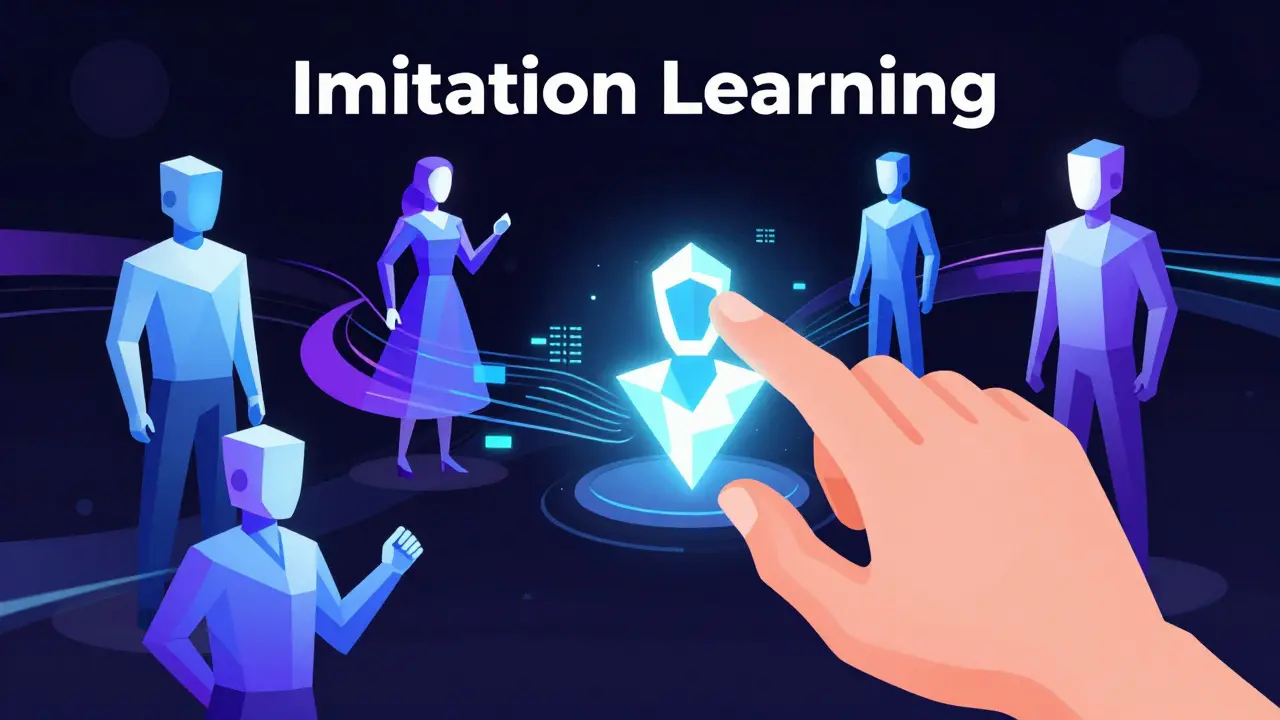
Imagine a video game where your character gets smarter every time you play. You don't just press buttons; you teach an artificial intelligence how to fight, strategize, and win. That is the core promise of AI Arena, a blockchain-based platform developed by ArenaX Labs. But what powers this digital ecosystem? The answer is Neuron (NRN), the native utility token that fuels training, trading, and competition within the game.
If you have stumbled upon NRN on a crypto exchange or heard whispers about "AI gaming tokens," you might be wondering if it’s worth your attention. It isn’t Bitcoin, and it certainly isn’t Ethereum. It is a niche asset tied to a specific project with unique mechanics. In this guide, we break down exactly what Neuron is, how it works in practice, and whether it fits into your portfolio strategy.
The Core Concept: Where AI Meets Gaming
To understand Neuron, you first need to understand the product it supports. AI Arena is not a standard shooter or RPG. It is a competitive gaming platform built on the Arbitrum blockchain. The twist? The characters you control are non-fungible tokens (NFTs) powered by artificial intelligence.
Here is how the loop works:
- Imitation Learning: When you play as a human, the AI observes your moves. It learns from your strategies, mistakes, and successes. This process is called imitation learning.
- NFT Characters: These AI agents are minted as NFTs. They belong to you. You can sell them, trade them, or upgrade them.
- Neuron as Fuel: Every step in this process costs energy. That energy is Neuron (NRN). You spend NRN to train your AI, enter tournaments, and merge characters.
This structure places NRN squarely in the GameFi sector, specifically blending elements of Play-to-Earn and Artificial Intelligence. Unlike passive holding coins, NRN is designed to be spent actively within the ecosystem.
Tokenomics: Supply and Distribution
When evaluating any cryptocurrency, supply dynamics are critical. For Neuron, the numbers are fixed and transparent, which helps prevent inflationary shocks later on.
| Attribute | Value |
|---|---|
| Total Supply | 1,000,000,000 NRN |
| Max Supply | 1,000,000,000 NRN (Hard Cap) |
| Circulating Supply | ~450,000,000 NRN (Approx. 45%) |
| Blockchain | Arbitrum (Ethereum Layer-2) |
| Token Type | Utility / ERC-20 Compatible |
The hard cap of 1 billion tokens means no more NRN will ever be created. Currently, roughly 45% of these tokens are in circulation. This suggests that while a significant portion is available for trading, a large chunk remains allocated for future ecosystem growth, rewards, and operational needs. This distribution model is common in early-stage GameFi projects to ensure long-term liquidity for players and developers.
How Do You Actually Use Neuron?
Holding NRN doesn’t just mean watching a number go up or down on a chart. To extract value from the token, you engage with the AI Arena platform. Here are the primary use cases:
- Training AI Models: This is the most direct utility. Players and researchers burn NRN to compute training sessions for their AI characters. The better you train, the stronger your NFT becomes.
- Entering Competitions: AI Arena hosts two main types of events: Gaming Competitions (esports-style battles) and Research Competitions (focused on AI development). Entry fees are paid in NRN.
- NFT Marketplace Transactions: Want to buy a pre-trained AI character? Or sell one you’ve nurtured? The marketplace uses NRN as the primary currency for these trades.
- Merging Pool: Advanced users can combine multiple weaker AI NFTs into a single stronger one. This "merging" process requires NRN as a catalyst fee.
- Staking: While details on annual percentage yields (APY) vary, the protocol allows users to stake NRN. This typically rewards holders with additional tokens or governance rights, though specific lock-up periods should be checked on the official dashboard.
This multi-layered utility creates demand. If the game grows popular, players need to buy NRN to participate, which theoretically supports the token price.
Market Performance and Liquidity Check
Let’s talk numbers. As of mid-2026, Neuron is classified as a small-cap asset. It is not a household name like Solana or Cardano, and its market behavior reflects that status.
Recent data from major aggregators shows NRN trading in the range of $0.0026 to $0.0030. The market capitalization hovers around $1.2 million. While this sounds modest, it indicates active trading rather than abandonment. However, there is a catch: liquidity.
Daily trading volumes often sit between $600 and $1,500. What does this mean for you? If you try to buy or sell a large amount of NRN at once, you could experience significant slippage. Your order might move the price against you because there aren't enough buyers or sellers in the pool at that exact moment. For casual investors buying small amounts, this is manageable. For whales looking to dump millions, NRN is currently too illiquid.
Rankings also tell a story. On CoinGecko, NRN ranks around #1392 by market cap. On other platforms like Bitget, it may appear lower due to different calculation methods or delayed data updates. Regardless of the rank, it sits firmly in the "long tail" of crypto assets-high risk, high potential reward, but low visibility.
Risks You Need to Know Before Buying
No investment is safe, but NRN carries specific risks inherent to the GameFi and AI sectors.
- Bearish Sentiment: Technical analysis tools, such as those provided by CoinCodex, have flagged NRN with a "Bearish" sentiment and a "Fear & Greed Index" reading indicating extreme fear. This suggests that short-term traders are cautious, and price dips are possible.
- Project Dependency: The value of NRN is entirely tied to the success of AI Arena. If the game fails to attract players, or if ArenaX Labs stops development, the token loses its utility. There is no independent cash flow backing NRN outside the ecosystem.
- Regulatory Uncertainty: As with all crypto assets, regulatory landscapes shift. While NRN is a utility token, regulators in various jurisdictions may scrutinize GameFi models that resemble securities.
- Data Discrepancies: You may notice conflicting data across exchanges. Some older snapshots show zero circulating supply, while newer ones show 450 million. Always verify live data on trusted aggregators like CoinGecko or Kraken before making decisions.
How to Buy Neuron (NRN)
Since NRN operates on the Arbitrum network, you need a wallet that supports Ethereum-compatible tokens. MetaMask is the most common choice.
- Create a Wallet: Download MetaMask and set up your seed phrase securely.
- Add Arbitrum Network: Switch your network settings to Arbitrum One. This ensures low transaction fees compared to Ethereum Mainnet.
- Fund Your Wallet: Buy ETH or USDT and bridge it to Arbitrum using a service like Arbitrum Bridge or a decentralized exchange (DEX).
- Swap for NRN: Use a DEX like Uniswap (on Arbitrum) or swap directly on centralized exchanges that list NRN, such as Kraken, KuCoin, or Bitget.
- Verify the Contract Address: Always double-check the smart contract address on official channels to avoid scam tokens. Fake tokens with similar names are common in crypto.
Is Neuron a Good Investment?
That depends on your appetite for risk and your belief in the convergence of AI and gaming. NRN is not a "set and forget" investment. It requires active engagement with the AI Arena ecosystem to realize its full utility.
If you enjoy gaming, experimenting with AI, and participating in emerging Web3 communities, NRN offers a unique entry point. You are betting on the technology stack of ArenaX Labs and the growing trend of AI-driven content creation. However, if you are looking for stable returns or broad market adoption, NRN’s low liquidity and niche focus make it a speculative play at best.
Keep an eye on the project’s roadmap. Updates on new features, partnerships, or user growth metrics will be key indicators of whether NRN can break out of its current micro-cap status. Until then, treat it as a high-risk satellite position in a diversified portfolio.
What is the maximum supply of Neuron (NRN)?
The maximum supply of Neuron (NRN) is fixed at 1,000,000,000 (1 billion) tokens. This hard cap prevents inflation and ensures scarcity within the AI Arena ecosystem.
Which blockchain does Neuron run on?
Neuron runs on the Arbitrum blockchain, which is an Ethereum Layer-2 scaling solution. This allows for faster transactions and lower gas fees compared to the Ethereum mainnet.
Who developed AI Arena and Neuron?
AI Arena was developed by ArenaX Labs. Neuron (NRN) serves as the native utility token for this platform, facilitating interactions between players, AI models, and NFTs.
Can I earn NRN by playing AI Arena?
Yes, players can earn NRN through gameplay rewards, tournament prizes, and staking mechanisms. However, you also need to spend NRN to train AI models and enter competitions, creating a circular economy.
Is Neuron (NRN) a safe investment?
Like most small-cap GameFi tokens, NRN carries high risk. It has low liquidity and is dependent on the success of the AI Arena game. Market sentiment has recently been bearish, so investors should exercise caution and only invest what they can afford to lose.
Where can I buy Neuron (NRN)?
Neuron is listed on several centralized exchanges including Kraken, KuCoin, and Bitget. You can also trade it on decentralized exchanges (DEXs) on the Arbitrum network, such as Uniswap.
Terry Hyland
June 16, 2026 AT 19:31This whole thing is a scam. They are stealing your data and selling it to the highest bidder while you think you are playing a game. It is evil.
Monica Pathammavong
June 17, 2026 AT 19:12u r wrong about that. i have been following this project since day one and the tech stack is actually pretty solid if u look at the whitepaper. most people here dont even know how arbitrum works so they just complain. also why do u always assume the worst? its not healthy for ur mental health to be so negative all the time. i checked the contract address myself and its verified on etherscan. stop spreading fear mongering nonsense. the ai learning loop is based on imitation learning which is a real concept in machine learning. u should educate urslf before typing garbage.
Tim Lefebvre
June 18, 2026 AT 16:46hey there! nice point monica but yeah terry has a point about the risks. i mean its true that small cap tokens like nrn can be super volatile. i tried buying some last week and the slippage was crazy. like really bad. if u want to buy make sure u use a limit order or u will lose money instantly. also double check the contract address because there are so many fake ones out there now. its kinda scary how easy it is to get scammed these days. hope everyone stays safe out there!
Annemarie Fitzgerald
June 19, 2026 AT 08:28the nature of digital ownership is an illusion we create to feel secure in an insecure world. when we trade these neurons are we trading value or just our own desperation for connection? i find it deeply troubling how we commodify intelligence itself. it feels cold and detached from any human experience. i sit here watching the charts go up and down and i feel nothing but emptiness. perhaps the ai knows something we do not about the futility of our actions. silence is golden but noise is profitable. what does that say about us?
Abby Sivertsen
June 20, 2026 AT 18:07look i get the hype but honestly the liquidity is trash. i tried to sell my bag yesterday and took forever to fill the order. its annoying af. if u guys are gonna play with this stuff at least understand the market depth. its not bitcoin. its a microcap shitcoin basically. dont come crying to me when u cant exit.
Benjamin Eisen
June 21, 2026 AT 17:22i think we should all try to stay positive abt this space. innovation takes time right? maybe the team needs more users to boost liquidity. its cool that they are using ai for gaming though. never thought of that before. lets support each other instead of fighting. peace love and crypto bros.
Kenneth Riley
June 22, 2026 AT 18:28typical sheep mentality benjamin. u believe whatever they tell u. the tokenomics are designed to dump on retail investors. look at the distribution table half the supply is locked up for insiders. who controls those keys? nobody knows. its a rug pull waiting to happen. wake up sheeple. the matrix is feeding u lies through these shiny new toys. drama is inevitable when greed meets ignorance. i see the truth and u refuse to open ur eyes.
ravi mahla
June 24, 2026 AT 08:22lol kenneth u are such a buzzkill. life is short enjoy the gains. if it goes to zero u can always buy more coffee. why so serious? let the boys cook. 🚀🌕
Mark Brunschwiler
June 26, 2026 AT 02:29i feel so drained reading all this negativity. why do people hate so much? i just want to train my bot and win some prizes. is that too much to ask? i spend hours every day optimizing my strategies and then i come here and get yelled at by strangers. it hurts my soul. i need validation not criticism. please tell me i am doing something right. i am trying my best in this chaotic world.
Sonya O'Brien
June 26, 2026 AT 11:29i completely agree with mark that the emotional toll of participating in these online communities can be quite significant, especially when considering the inherent volatility and speculative nature of cryptocurrency investments which often lead to feelings of anxiety and uncertainty among participants who may not fully understand the underlying technology or market dynamics involved in such complex financial instruments as utility tokens tied to specific gaming ecosystems where the value proposition is largely dependent on user adoption and engagement metrics that are notoriously difficult to predict accurately without extensive historical data analysis and behavioral modeling techniques that are rarely disclosed publicly by development teams who prioritize rapid iteration over transparency thereby creating an environment ripe for misinformation and manipulation by bad actors seeking to exploit the lack of regulatory oversight in this nascent industry sector which continues to evolve at a pace that outstrips the ability of traditional financial institutions and consumer protection agencies to keep up with emerging trends and practices thus leaving individual investors vulnerable to various forms of fraud and deception including but not limited to pump and dump schemes rug pulls and phishing attacks designed to steal private keys and seed phrases which ultimately results in irreversible loss of funds and trust in the system as a whole.
Filbert Reeves
June 26, 2026 AT 15:04everyone here is being played. the ai arena is just a front for harvesting computing power from your gpu while u sleep. they are mining something else entirely. maybe quantum encryption keys. the government wants ur brainwaves. thats why they call it neuron. it connects to ur neural network. i saw a documentary about this last year on a dark web site. u cant trust the blockchain because the nodes are compromised. its all a simulation. wake up.
Nick Rice
June 28, 2026 AT 01:08filbert ur conspiracy theories are getting out of hand. stick to facts. the token is erc-20 compatible on arbitrum. simple as that. if u want to learn about blockchain tech read the docs. dont spread paranoia. we are building a community here. inclusivity matters. respect others opinions even if u disagree. aggressive behavior helps no one. let's focus on the tech potential rather than baseless fears. education is key to success in this space.
Amit Thakur
June 29, 2026 AT 09:49let me break down the technical aspect for u all. the imitation learning process requires significant compute resources which is why nrn is burned. this creates deflationary pressure assuming demand for training exceeds issuance. however the current tvl is low which indicates weak network effects. the smart contract architecture seems standard but audit reports are scarce. i would recommend performing due diligence on the team behind arenax labs before allocating capital. the risk adjusted return profile is currently unfavorable for conservative portfolios. high beta asset class. proceed with caution.