
Remember when you could buy a synthetic version of Tesla stock on the blockchain without opening a brokerage account? That was the promise of Mirror Protocol, a decentralized finance platform that aimed to bring real-world financial assets onto the blockchain. The native token for this system is MIR. It sounded like the future of investing: low fees, global access, and instant settlement. But if you are looking at the price today, you might be confused. Why is a once-hyped project trading for fractions of a cent?
The short answer is ecosystem collapse. Mirror Protocol was built on the Terra blockchain. When Terra’s algorithmic stablecoin, UST, crashed in May 2022, it took Mirror with it. Today, MIR is largely a legacy asset, trading with very low volume. However, understanding what Mirror Protocol *was* and how it worked is still crucial for anyone navigating the complex world of synthetic assets and DeFi risks.
How Mirror Protocol Worked: The Magic of mAssets
To understand MIR, you first need to understand what the protocol actually did. It didn't just move money around; it created digital twins of real-world assets. These were called mAssets or Mirrored Assets.
Imagine you want exposure to Apple stock (AAPL). In the traditional world, you need a bank account, a broker, and you have to deal with trading hours and fees. On Mirror Protocol, users could deposit collateral-originally TerraUSD (UST)-into a smart contract. This collateral locked up allowed them to mint an mAsset, specifically mAAPL. The value of mAAPL tracked the real price of Apple stock almost perfectly.
This process relied on three key components:
- Collateral: Users deposited crypto (like UST or LUNA) to back the synthetic asset. This ensured the mAsset had value behind it.
- Oracles: Data feeds (like Chainlink) provided real-time price data from traditional markets to keep the mAsset price aligned with the real stock.
- Smart Contracts: Automated code on the Terra blockchain managed the minting, burning, and liquidation of these assets.
The goal was democratization. As noted by platforms like Capital.com, this allowed traders anywhere in the world to get price exposure to U.S. equities without the high costs or geographic restrictions of traditional brokers. It was a clever workaround for regulatory barriers, though those same barriers would eventually contribute to its downfall.
The Role of the MIR Token
If mAssets were the product, MIR was the engine. The MIR token served as the governance and utility token for the protocol. You couldn't use MIR to buy stocks directly; instead, it controlled the network.
Here is what holding MIR actually meant for users:
- Governance Voting: MIR holders could vote on proposals. Did the community want to add a new mirrored asset, like Amazon or Bitcoin? They voted using their tokens.
- Staking: To prevent spam and ensure serious participation, users often had to stake MIR to submit proposals or vote on critical changes.
- Incentives: The protocol used MIR to reward liquidity providers and early adopters, encouraging people to use the platform.
It is important to note that MIR itself was not a synthetic asset. It was a standard ERC-20 token on Ethereum (for cross-chain compatibility) and a native token on Terra. There was a maximum supply of roughly 370 million MIR tokens, released over four years. Unlike the mAssets which tracked external prices, MIR’s value was driven entirely by speculation on the protocol's growth and demand for its governance rights.
The Terra Collapse: What Went Wrong?
You cannot talk about Mirror Protocol without talking about Terra. Mirror was not just hosted on Terra; it was structurally dependent on it. The primary collateral for minting mAssets was UST, Terra’s algorithmic stablecoin.
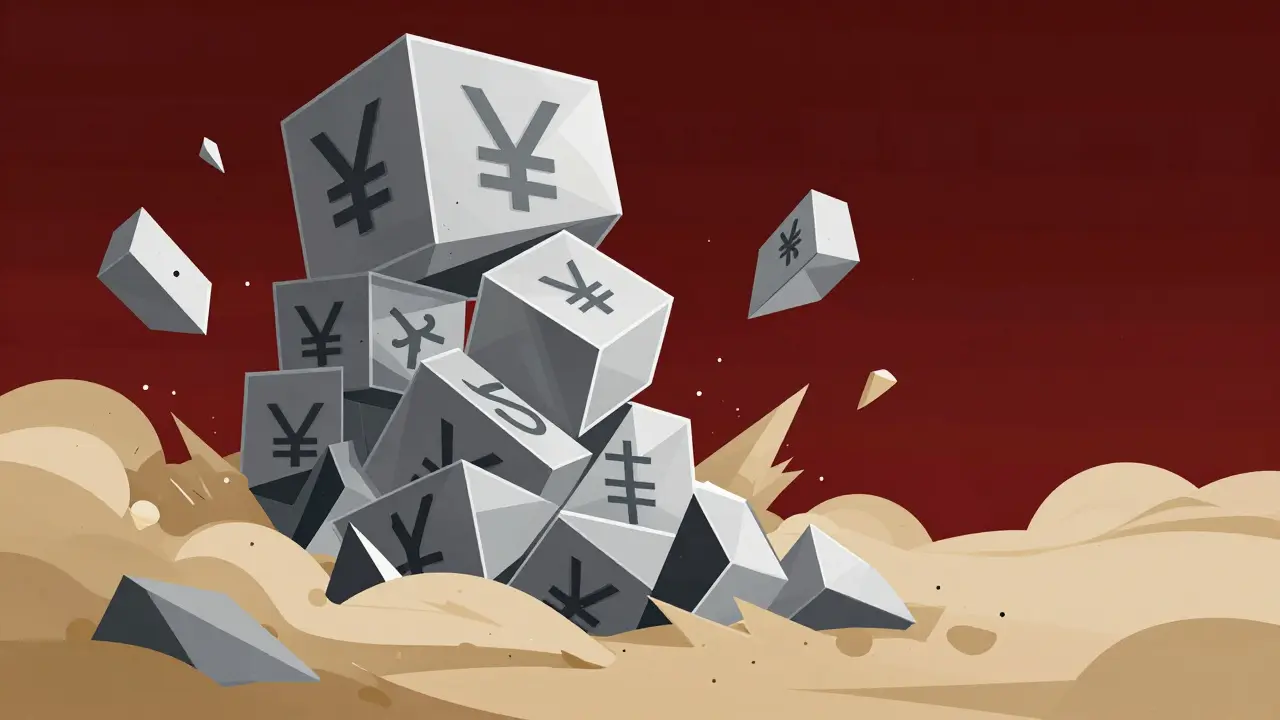
In May 2022, UST lost its peg to the US dollar. It wasn't a small dip; it was a death spiral. As UST plummeted, the collateral backing all the mAssets on Mirror Protocol evaporated. If your house is built on sand, and the tide comes in, the house falls. Mirror’s smart contracts were sound, but the asset they were holding (UST) became nearly worthless overnight.
The consequences were immediate:
- Liquidations: Massive amounts of mAssets were liquidated as collateral values dropped below thresholds.
- Loss of Confidence: Users fled the ecosystem. Liquidity dried up.
- Price Crash: MIR, which had traded for over $50 at its peak in 2021, crashed along with LUNA and UST. By September 2022, it was down to $0.25. Today, it trades around $0.0051.
This event highlighted a major risk in DeFi: interconnectedness. Even if one protocol (Mirror) is well-designed, it can fail if the underlying infrastructure (Terra) fails. This is known as systemic risk.
Mirror vs. Other Synthetic Asset Protocols
Mirror wasn't the only player in the synthetic asset space. Projects like Synthetix and UMA offered similar services but with different architectures. Understanding the differences helps explain why Mirror failed while others survived.
| Feature | Mirror Protocol (Legacy) | Synthetix | UMA (Optimistic Oracle) |
|---|---|---|---|
| Base Blockchain | Terra (now Terra Classic) | Ethereum / Optimism | Ethereum |
| Primary Collateral | UST (Algorithmic Stablecoin) | SNX (Native Token) + ETH | ETH / USDC |
| Risk Profile | High (Dependent on UST stability) | Medium (Dependent on SNX price) | Low (Overcollateralized) |
| Current Status | Dormant / Legacy | Active | Active |
Synthetix, for example, uses its own token (SNX) and Ethereum as collateral. When SNX drops, there is pressure, but Ethereum remains stable. Mirror relied on UST, which had no intrinsic value other than the confidence in the algorithm. When that confidence broke, there was nothing left to hold onto.
Is MIR Still Worth Buying in 2026?
Let’s be direct: MIR is a high-risk, speculative asset with little fundamental utility remaining. As of May 2026, the token trades at approximately $0.0051 with a market cap ranking near #2366. The 24-hour trading volume is often under $2,000, indicating extremely low liquidity.
Why do people still trade it?
- Speculation on Revival: Some investors hope for a miraculous restructuring or migration of the protocol to a new chain, though there is no concrete evidence of this happening.
- Arbitrage: Traders look for tiny price discrepancies between exchanges like Kraken and smaller DEXs.
- Nostalgia / Bag Holding: Many original holders are waiting for a bounce, despite the lack of catalysts.
From a practical standpoint, the original value proposition-accessing U.S. stocks via DeFi-is now handled by regulated entities or more robust DeFi platforms that don't rely on fragile algorithmic stablecoins. Regulatory scrutiny has also increased significantly since 2022. Offering unregistered securities (even synthetic ones) is a legal minefield, and Mirror’s original model faced heavy headwinds from regulators like the SEC.
If you are looking to invest in synthetic assets today, you are better served by established protocols on Ethereum or Layer 2 networks that use overcollateralized models (backed by ETH or USDC) rather than algorithmic bets. MIR serves more as a cautionary tale than a viable investment vehicle.
Common Confusion: The Other "Mirror Protocol"
Before you dive deeper, make sure you aren't confusing two different projects. There is another entity called "The Mirror Protocol" that focuses on peer-based staking and diversification rewards. It has an 11% transaction fee structure and operates completely independently of Terraform Labs.
Do not mix them up. The MIR token discussed here belongs to the Terraform Labs synthetic asset project. The other project has different mechanics, different risks, and a different tokenomics structure. Always check the contract address and the associated blockchain before interacting with any token.
Key Takeaways for DeFi Investors
The story of Mirror Protocol offers valuable lessons for anyone participating in decentralized finance:
- Check the Collateral: Never assume a synthetic asset is safe just because it tracks a real-world price. Look at what backs it. Algorithmic stablecoins are inherently risky.
- Understand Systemic Risk: A protocol can be great, but if it lives on a failing blockchain, it will die too. Diversify your exposure across different chains.
- Regulatory Reality: Synthetic stocks exist in a gray area. Regulations change, and platforms that ignore compliance face existential threats.
- Liquidity Matters: Low volume means you might not be able to sell when you need to. Always check trading depth before entering a position.
Mirror Protocol showed us what was possible: seamless, borderless access to global markets. It also showed us the fragility of building complex financial systems on unstable foundations. While MIR may remain tradable on exchanges like Kraken, its days as a leading DeFi innovator are long past.
What happened to Mirror Protocol after Terra collapsed?
After the Terra ecosystem collapsed in May 2022, Mirror Protocol effectively ceased normal operations. Since its primary collateral was UST, which became worthless, the smart contracts could no longer function reliably. The MIR token lost over 99% of its value, and user activity dropped to near zero. The protocol is now considered dormant.
Can I still buy synthetic stocks on Mirror Protocol?
No, you should not attempt to use Mirror Protocol for trading synthetic stocks. The liquidity is gone, and the underlying collateral mechanisms are broken. Using the platform now carries extreme risk of total loss. For synthetic assets, consider active alternatives like Synthetix or dYdX.
Is the MIR token a security?
This is a complex legal question. Because Mirror Protocol allowed users to gain exposure to U.S. equities, regulators like the SEC have scrutinized such platforms. While MIR itself is a governance token, the broader context of offering unregistered securities makes it a high-risk asset from a regulatory perspective. Consult a legal expert for specific advice.
Where can I buy or sell MIR tokens?
MIR is still listed on some centralized exchanges like Kraken, where you can set up recurring buys or stop-loss orders. However, due to low liquidity, slippage can be high. It may also be found on decentralized exchanges on Ethereum or Terra Classic, but verify the contract addresses carefully to avoid scams.
What is the difference between MIR and mAssets?
MIR is the governance token used to vote on protocol changes and stake for rewards. mAssets (like mAAPL) are synthetic tokens that track the price of real-world assets. You held MIR to influence the network; you held mAssets to speculate on stock prices.