Meme Coin Health Score Calculator
Is Your Meme Coin Still Alive?
Enter basic token metrics to calculate its health score based on industry standards. This tool is designed to identify dead tokens like MINU 2.0.
MINU 2.0 (MINU) isn’t a cryptocurrency you should be buying. It’s not a hidden gem. It’s not even a risky bet worth considering. It’s a dead token with zero trading volume, 163 holders, and a market cap of just $2,780 - less than the cost of a decent laptop charger. If you’re wondering what MINU 2.0 is, here’s the blunt truth: it’s a meme coin that failed before it even got started.
What MINU 2.0 actually is
MINU 2.0 is a token built on the BNB Smart Chain (BEP20), launched in 2024 as a "rebranded" version of an earlier, much larger Minu token. The original had over 3.7 trillion tokens in circulation. MINU 2.0 burned almost all of them down to just under 1 million tokens. That sounds impressive - like a clean slate. But in crypto, when a project suddenly shrinks its supply by 99.99%, it’s rarely about efficiency. It’s usually about resetting the price to make early buyers look like geniuses - while everyone else gets stuck with a worthless asset.
The token’s contract address is 0xb626...088989. You can look it up on BscScan. But don’t bother checking for updates. There are none. No GitHub commits. No official website. No Twitter growth. Just a static CoinMarketCap page with a 96% price drop from its all-time high of $0.06996 to $0.002366 as of December 2025.
How MINU 2.0 claims to work
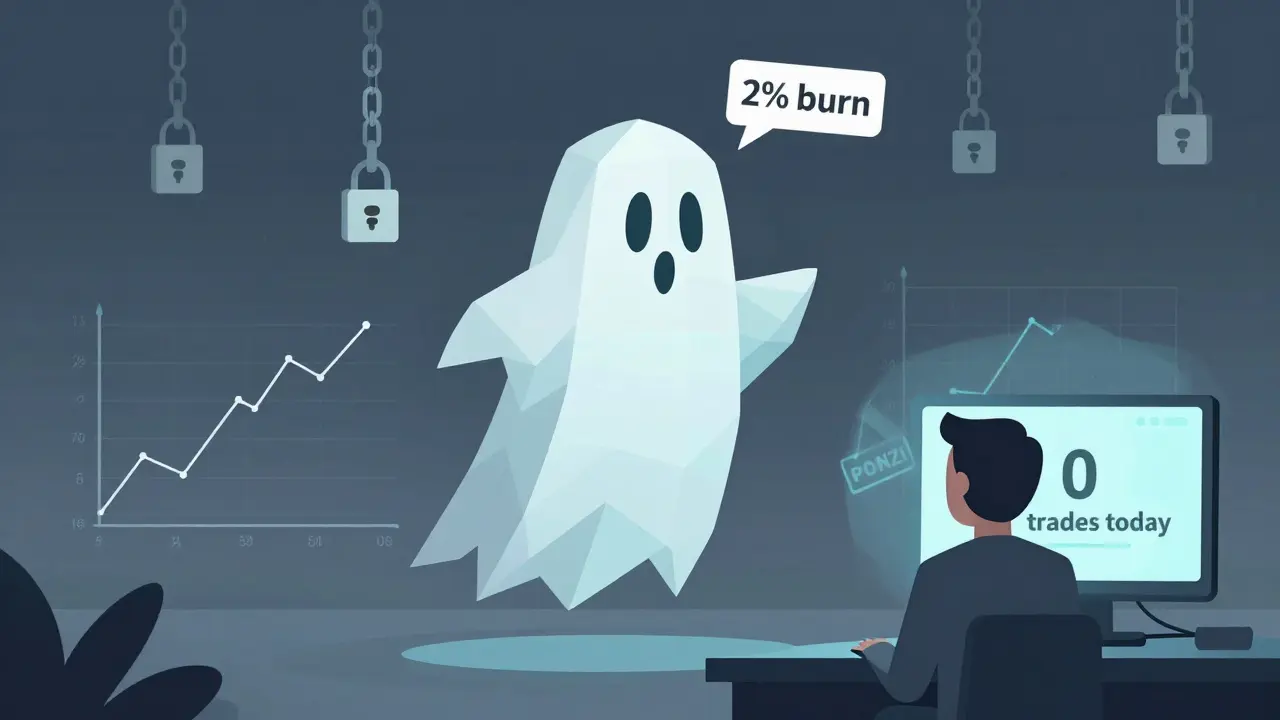
The project says it has a 2% automatic burn on every transaction. That means every time someone buys or sells MINU, 2% of the tokens involved get destroyed. Sounds good, right? Deflationary tokens are trendy. But here’s the catch: no one is trading it. With zero 24-hour volume across Binance, Bitget, and CoinMarketCap, that burn mechanism is a ghost. It doesn’t exist in practice. You can’t burn what isn’t moving.
It also claims to have a permanently locked liquidity pool. That’s supposed to mean the devs can’t rug pull. But if there’s no liquidity, how can you even buy the token? There are no active trading pairs. No DEX listings with real depth. Just a hollow promise on a page nobody reads.
Some sources - including CoinGecko - mention an "8% daily return" feature. That’s not a feature. That’s a red flag screaming PONZI. No legitimate token can sustain 8% daily returns. That’s 3,000% annualized. Even the most aggressive DeFi yield farms collapse under that weight. Dr. David Gerard, who’s studied over 50 crypto scams, calls this pattern "classic pump-and-dump theater." MINU 2.0 fits it perfectly.
Why no one is using MINU 2.0
There are only 163 wallets holding MINU 2.0. That’s fewer people than live in a small English village. Compare that to Dogecoin, which has over 2.5 million unique addresses. Or even Shiba Inu, with more than 1.2 million. MINU 2.0 doesn’t have a community. It doesn’t have memes. It doesn’t have influencers. It doesn’t even have a subreddit.
Search Twitter for #MINU2_0. You’ll find 12 tweets in the last 30 days. One is a bot. Another is someone asking if it’s a scam. The rest are spam links. No one’s excited. No one’s sharing. No one’s holding. It’s a ghost town.
There are zero reviews on Trustpilot, G2, or Capterra. No YouTube tutorials. No Reddit threads. No Medium articles. Not even a Discord server with more than 50 people. Meme coins live and die by their communities. MINU 2.0 never had one.
It’s not on any major exchange
MINU 2.0 isn’t on Binance. Not on Coinbase. Not on Kraken. Not on KuCoin. It’s only listed on a few obscure decentralized exchanges - and even there, you won’t find any trades. The token’s market cap is $2,780. That’s less than the price of a single Binance Coin at current rates. It’s ranked #7,706 out of over 25,000 cryptocurrencies. You’d have better luck finding a real investment in your local coffee shop than in MINU 2.0.
For a token to survive, it needs liquidity. Liquidity means people can buy and sell without crashing the price. MINU 2.0 has none. That means if you somehow bought it, you couldn’t sell it. Not without finding someone willing to pay you. And even then, you’d be risking a scam - because without trading volume, there’s no way to verify the contract is safe.
Experts ignore it. The data says it’s dead.
Delphi Digital’s 2024 report on micro-cap tokens found that 99.7% of tokens with market caps under $10,000 and zero trading volume fail within 12 months. MINU 2.0 is not just under $10,000 - it’s under $3,000. And it’s been flatlining for months.
Chainalysis flagged it as having traits of a "honeypot" - a scam where the smart contract locks your funds so you can’t sell. The signs? Zero volume despite claiming liquidity lock. Tiny holder count. Unrealistic promises. No team info. No roadmap. No updates. All of them.
Even the "technical analysis" on CoinCodex predicting a price jump to $0.0047 by May 2025 is meaningless. That’s a 231% increase - from a base of $0.00143. But if no one is trading, no one is moving the price. That prediction is just a number on a page. It’s not a forecast. It’s fiction.
Should you buy MINU 2.0?
No.
Not because it’s risky. Not because it might crash. But because it’s already dead. You can’t invest in something that has no buyers, no sellers, and no future. The 2% burn doesn’t matter if no one’s transacting. The locked liquidity doesn’t matter if you can’t access it. The meme branding doesn’t matter if no one cares.
If you’re looking for meme coins, go for ones with real volume - Dogecoin, Shiba Inu, or even newer ones like Pepe or Bonk. They have communities. They have exchanges. They have price action. MINU 2.0 has a contract address and a CoinMarketCap page. That’s it.
Buying MINU 2.0 isn’t speculation. It’s throwing money into a black hole. And the worst part? You won’t even know it’s gone until you check your wallet and realize you can’t sell it.
What MINU 2.0 teaches us
This isn’t just about one failed token. It’s a lesson in how crypto scams hide in plain sight. They use buzzwords like "automatic burn," "locked liquidity," and "meme utility" to sound legit. But real projects don’t need to hide behind jargon. They show their code. They update their roadmap. They talk to their users.
MINU 2.0 does none of that. It’s a shell. A ghost. A digital ghost town.
If you’re new to crypto, don’t chase the next big meme coin. Look for volume. Look for activity. Look for people talking about it - not just on CoinMarketCap, but on Reddit, Twitter, and Discord. If it’s quiet, it’s dead. And MINU 2.0? It’s the quietest of them all.
Bhoomika Agarwal
December 3, 2025 AT 09:05MINU 2.0? More like MINU 2.0-ruin-your-wallet. In India we have a word for this - *jugaad* gone wrong. They burn supply? Cool. Now burn my trust too while you’re at it. 163 holders? That’s less than my aunt’s WhatsApp group. And you’re telling me this isn’t a scam? Bro, even my chaiwala has more liquidity than this token.
Katherine Alva
December 4, 2025 AT 21:01It’s wild how we still fall for the same script 🥲. Burn mechanism? Locked liquidity? Sounds like a fairy tale written by someone who never read a whitepaper. Real innovation doesn’t need hype. It just… exists. And moves. This? This is digital ghostwriting.
Nelia Mcquiston
December 6, 2025 AT 18:33The more I read about projects like this, the more I realize crypto’s biggest risk isn’t volatility - it’s the human need to believe in something that doesn’t exist. We don’t invest in tokens. We invest in stories. And MINU 2.0? It’s a story with no ending, no characters, and no audience.
Mark Stoehr
December 7, 2025 AT 20:14Shari Heglin
December 9, 2025 AT 02:25The analysis presented here is methodologically sound and aligns with empirical data on micro-cap token failure rates. The absence of trading volume, coupled with a non-transparent development team and a non-functional liquidity pool, constitutes a textbook case of a non-viable asset. One might reasonably conclude that MINU 2.0 exhibits all the hallmarks of a failed speculative instrument.
Murray Dejarnette
December 10, 2025 AT 13:15Bro I just bought 50k MINU because the guy on TikTok said it’s gonna moon to $0.10. You’re telling me it’s dead? Nah man, you’re just salty because you didn’t get in early. I’m holding till I get my Lambo. 8% daily? That’s just compound interest, baby.
Maggie Harrison
December 12, 2025 AT 09:58You know what’s sadder than a dead token? The fact that people still believe in them 😔. But hey - if you wanna throw money into a void, at least do it with a smile. Life’s too short to be scared of memes. Just don’t cry when your wallet’s empty. You’ve been warned 💪✨
alex bolduin
December 14, 2025 AT 05:50Marsha Enright
December 14, 2025 AT 08:56Thank you for this. Seriously. I’ve seen so many newbies chasing these ghost tokens. If you’re just starting out, remember: if it’s not on CoinGecko with real volume, it’s not a crypto asset - it’s a digital collectible with no value. Keep learning. Stay safe. You’ve got this 💙
Andrew Brady
December 15, 2025 AT 14:54Who owns the BSC chain? Who controls the validators? Who’s really behind this? I’ve seen this pattern before - centralized control masked as decentralization. MINU 2.0 isn’t dead. It’s being quietly harvested. The 163 holders? They’re all bots. The ‘burn’? It’s just moving tokens between wallets. This is a surveillance tool disguised as a meme coin.
Sharmishtha Sohoni
December 17, 2025 AT 06:05Durgesh Mehta
December 17, 2025 AT 14:55Nora Colombie
December 19, 2025 AT 03:14Let me guess - you’re one of those ‘crypto purists’ who thinks real value only exists in institutions. Newsflash: the whole system is rigged. MINU 2.0 is the only real thing left. The banks are printing money, the Fed is printing lies, and you’re mad because a token with no volume didn’t make you rich? Wake up. The game is rigged. MINU 2.0 is the rebellion.
Greer Dauphin
December 20, 2025 AT 12:17Man I laughed so hard when I saw the 8% daily return claim. Like… you know what’s more unrealistic than that? Me believing a guy named ‘CryptoKing99’ on Telegram who sent me a screenshot of his ‘$500k profit’. But hey - at least MINU 2.0 has a better story than most. 😅
Mohamed Haybe
December 21, 2025 AT 03:06MINU 2.0? More like MINU 2.0-ruin-your-reputation. In India we call this ‘chalta hai’ culture - ‘it’ll work somehow’. Nah. It won’t. You don’t build value by burning supply. You build it by building trust. And this? This is a trust vacuum with a smart contract.
Althea Gwen
December 22, 2025 AT 16:24So… it’s dead? Cool. Can I get a meme about it? I need content for my Twitter. Also can someone explain why this is even on CoinMarketCap? Like… who approved this? Was there a meeting? Did someone say ‘yep, this looks legit’? 😅
Sarah Roberge
December 23, 2025 AT 20:17They’re not just scamming investors - they’re scamming the entire concept of decentralized finance. This isn’t about money. It’s about control. They created a token so useless, so hollow, that people are forced to question whether crypto itself is real. And that… that’s the real horror.
Steve Savage
December 25, 2025 AT 01:51Just sat here reading this and thought - wow. This is what happens when you treat crypto like a lottery ticket and not a technology. MINU 2.0 isn’t a failure. It’s a mirror. And it’s showing us how easy it is to fool ourselves.
Layla Hu
December 25, 2025 AT 11:54Thanks for laying this out clearly. I’ve been seeing people link this token on Twitter like it’s the next big thing. It’s heartbreaking. People need more education, not more hype.
Philip Mirchin
December 26, 2025 AT 14:36As someone who’s lived in three countries and traded in five different crypto ecosystems, I’ve seen this movie before. The script changes, the names change, but the ending? Always the same. MINU 2.0 isn’t special. It’s just another footnote in the long, messy history of crypto’s wild west. Stay grounded. Stay skeptical. And always check the volume.