
Imagine trying to trade a digital trading card on Ethereum, only to pay $50 in gas fees for a transaction worth $10. It’s a frustrating reality that has kept millions of casual gamers away from blockchain technology. That is exactly the problem Immutable X was built to solve. Launched by the Australian company Immutable in November 2021, this platform acts as a high-speed highway for non-fungible tokens (NFTs) and blockchain games, sitting on top of the slower, more expensive Ethereum mainnet.
If you are wondering what the IMX token actually does, or whether it is just another speculative asset, you are not alone. The crypto space is flooded with acronyms, but Immutable X has carved out a specific niche: infrastructure for gaming. This guide breaks down how the network works, why the IMX coin matters, and what risks you should watch out for before diving in.
How Immutable X Actually Works
To understand IMX, you first need to understand the bottleneck it fixes. Ethereum is secure, but it is slow and costly when the network gets busy. Immutable X solves this using a technology called zk-rollups. Think of a zk-rollup like a batch processor at a grocery store. Instead of processing every single item (transaction) individually on the main conveyor belt (Ethereum), Immutable X groups thousands of transactions together off-chain. It then creates a cryptographic proof-a "zero-knowledge proof"-that proves all those transactions were valid, and sends just that one small proof back to Ethereum for settlement.
This approach allows Immutable X to process up to 9,000 transactions per second (TPS). For comparison, Ethereum itself handles about 15-30 TPS during normal times. The result for you, the user, is instant confirmations and zero gas fees for minting or trading NFTs. You still need ETH to interact with the base layer eventually, but for most gaming actions, the cost is effectively zero.
- Speed: Near-instant transaction finality compared to Ethereum’s block times.
- Cost: No gas fees for end-users during trades or mints.
- Security: Inherits the security of Ethereum because proofs settle on the mainnet.
- Eco-Friendly: The network is carbon-neutral, verified by Climate Check in July 2025.
The Role of the IMX Token
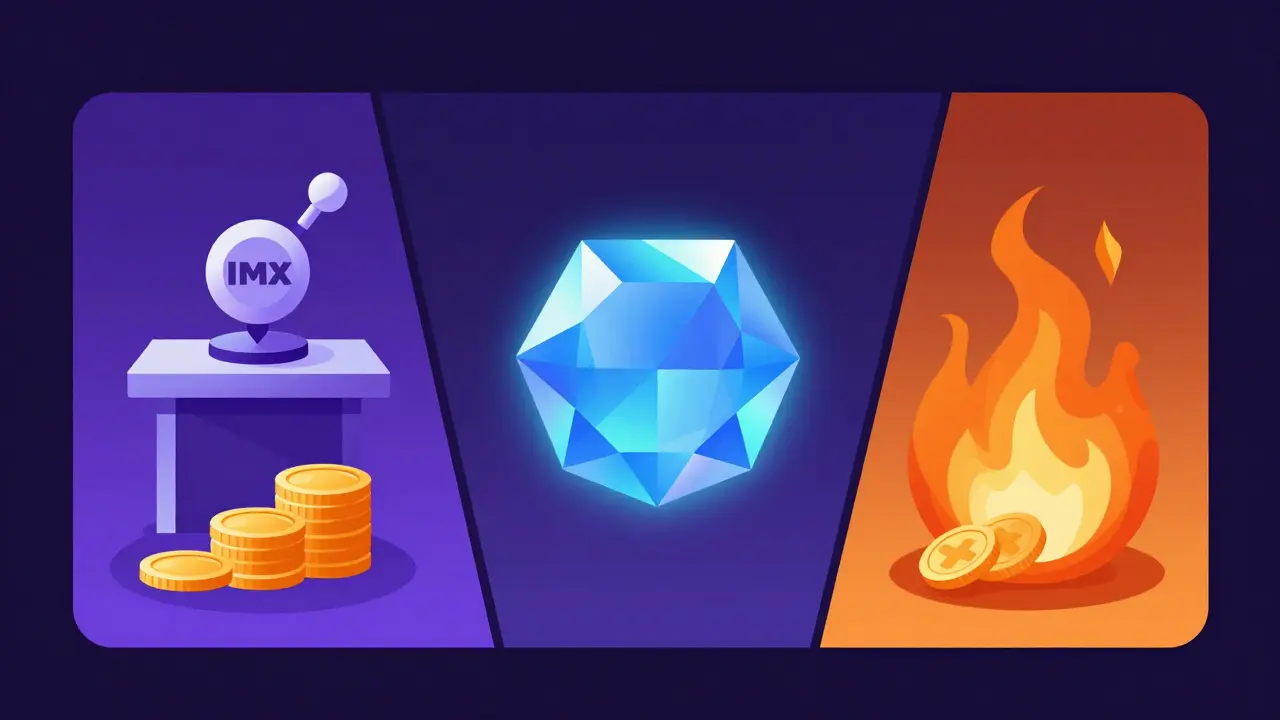
The IMX cryptocurrency is the fuel that keeps this engine running. It is an ERC-20 utility and governance token. If you hold IMX, you aren’t just holding a speculative asset; you are participating in the ecosystem’s economy. Here is how the token functions in practice:
- Governance: Holders can vote on proposals that shape the future of the protocol. For example, changes to fee structures or new feature rollouts require community approval.
Staking: You can stake your IMX tokens to help secure the network. In return, you earn rewards. As of late 2025, liquidity mining programs have made staking more attractive, with a recent adjustment redirecting 15% of development funds toward these incentives. - Deflationary Pressure: This is a key feature. The protocol burns 20% of the fees generated within the ecosystem. Burning means destroying those tokens permanently. With a fixed maximum supply of 2 billion IMX, this burn mechanism reduces circulating supply over time, which can theoretically support price appreciation if usage grows.
Charles Edwards of Capriole Investments noted in May 2025 that this deflationary model creates a unique dynamic where increased game activity directly benefits token holders through reduced supply.
Why Gamers and Developers Choose Immutable X
Not all blockchain platforms are created equal. While general-purpose Layer 2 solutions like Arbitrum or Optimism are great for DeFi applications, they weren’t built specifically for the unique needs of gaming. Games require frequent microtransactions, low latency, and seamless user experiences. Immutable X provides specialized tools for this:
| Feature | Immutable X | Polygon (Sidechain) | Arbitrum (Layer 2) |
|---|---|---|---|
| Primary Focus | NFTs & Gaming | General Purpose / NFTs | DeFi / General Scaling |
| Throughput (TPS) | Up to 9,000 | ~7,000 | 40,000+ (but higher latency) |
| User Gas Fees | Zero | Low (still exists) | Low (still exists) |
| Security Model | Zk-Rollup (Ethereum-level) | Sidechain (Centralized sequencer risk) | Optimistic Rollup |
| Key Advantage | Instant NFT trades, no gas | Large existing ecosystem | High compatibility with Ethereum apps |
For developers, Immutable X offers an SDK (Software Development Kit) that makes it easier to build games without needing deep expertise in zero-knowledge cryptography. However, the learning curve is still moderate. According to a Q3 2025 developer survey, it takes about 40-60 hours to complete the official certification program. Experienced Solidity developers typically need 2-3 weeks to become proficient.
Market Position and Real-World Adoption
As of October 2025, Immutable X holds a significant spot in the market. It controls approximately 28.7% of the Ethereum-based gaming NFT market share, trailing only Polygon (34.2%) but leading competitors like Enjin (12.1%). The network serves around 1.2 million monthly active users.
The ecosystem isn't just theoretical. Major titles like Gods Unchained, Guild of Guardians, and Habbo X drive the majority of activity. Enterprise adoption is also growing, with partnerships announced by Ubisoft (via Ubisoft Quartz) and GameStop integrating Immutable X solutions in 2025. Recently, a strategic partnership with Amazon Web Services (AWS) in September 2025 provided dedicated infrastructure support, signaling strong institutional confidence.
Risks and Challenges You Should Know
No investment or technology is without risk. When evaluating Immutable X, you need to look past the hype and consider the structural vulnerabilities.
Ecosystem Concentration Risk: This is the biggest red flag. Approximately 73% of IMX's trading volume is tied to just three major games. If Gods Unchained loses popularity, the entire network feels the pain. We saw this in Q1 2024 when Gods Unchained saw a 60% drop in active users, causing IMX's price to decline by 35%. Messari analyst Ryan Watkins warned in July 2025 that this concentration makes the token vulnerable to shifts in gaming trends.
Developer Complexity: While the SDK helps, building on zk-rollups is harder than building on standard Ethereum. Octobot Cloud’s technical assessment in June 2025 criticized the "steep learning curve for developers unfamiliar with zero-knowledge proof concepts." Common issues include zk-proof generation latency during peak loads, reported by 23% of surveyed developers.
Competition from Ethereum Upgrades: Ethereum itself is getting faster and cheaper. The upcoming Proto-Danksharding implementation expected in late 2026 could reduce costs on the mainnet significantly. Bernstein analysts warn that if Ethereum becomes cheap enough, the value proposition of specialized Layer 2s might diminish unless they offer distinct advantages beyond just cost.
Who Is Immutable X For?
You should consider paying attention to Immutable X if:
- You are a gamer: You want to own in-game assets without worrying about gas fees eating into your earnings.
- You are a developer: You are building an NFT-heavy application or game and need high throughput with Ethereum-level security.
- You are an investor: You believe in the long-term growth of blockchain gaming and want exposure to infrastructure rather than individual game tokens.
You might want to look elsewhere if:
- You prefer DeFi: If you are mostly swapping tokens or providing liquidity, general-purpose Layer 2s like Arbitrum or Base might be more suitable.
- You want simplicity: If you are uncomfortable with the concept of staking, governance voting, or managing digital wallets, the complexity might outweigh the benefits.
Getting Started with IMX
If you decide to engage with the ecosystem, here is the practical path forward:
- Get a Wallet: Use Immutable Passport, the platform’s non-custodial wallet solution. It simplifies login by allowing social sign-ups while keeping you in control of your keys.
- Acquire IMX: You can buy IMX on major exchanges like Kraken, Coinbase, or Binance. Keep in mind that prices fluctuate based on market sentiment and ecosystem news.
- Explore Games: Start with established titles like Gods Unchained to understand how IMX mechanics work in practice. Many games offer tutorials that walk you through minting and trading your first NFT.
- Consider Staking: If you plan to hold long-term, look into staking opportunities to earn passive rewards. Just be aware of lock-up periods and slashing conditions.
The landscape of blockchain gaming is evolving rapidly. Immutable X has positioned itself as a critical piece of infrastructure, bridging the gap between traditional gaming experiences and the ownership models of Web3. Whether it succeeds in becoming the default layer for global gaming depends on its ability to diversify beyond its current top three games and maintain its technological edge against both competitors and Ethereum’s native upgrades.
Is IMX a good investment in 2026?
Whether IMX is a good investment depends on your belief in the growth of blockchain gaming. The token has strong fundamentals, including a deflationary burn mechanism and major enterprise partnerships. However, it carries significant concentration risk, as most volume comes from just three games. Always do your own research and never invest more than you can afford to lose.
What is the difference between Immutable X and Ethereum?
Ethereum is the main blockchain (Layer 1) known for security but slower speeds and higher fees. Immutable X is a Layer 2 scaling solution built on top of Ethereum. It processes transactions off-chain and settles them on Ethereum, offering much faster speeds (up to 9,000 TPS) and zero gas fees for users, specifically optimized for NFTs and gaming.
How does the IMX token burn mechanism work?
The protocol automatically burns 20% of the fees generated within the Immutable X ecosystem. Burning means these tokens are sent to a dead address and removed from circulation permanently. Since the total supply is capped at 2 billion, this reduction in supply can create upward pressure on the price if demand remains constant or increases.
Kenneth Riley
June 24, 2026 AT 11:29you people are literally sleeping on the concentration risk here. it is insane how everyone ignores that 73% of volume comes from three games. if gods unchained dies the whole network collapses. i have seen this movie before with enjin and it ended badly. stop acting like zk-rollups fix bad tokenomics. they dont. you are just moving the bottleneck to a different place. wake up sheeple.
ravi mahla
June 26, 2026 AT 01:06hey guys! why so serious? immutable x is actually pretty cool for gamers who hate gas fees. i tried minting an nft recently and it was instant. no waiting around for ethereum to catch its breath. plus the carbon neutral thing is nice for the planet too right? lets keep it positive!
Mark Brunschwiler
June 27, 2026 AT 02:46i feel like we are missing the point entirely. what does ownership mean in a digital void? when you stake your imx tokens are you really securing the network or just feeding the beast? the burn mechanism feels like a psychological trick to keep us engaged. it is all about control. the deeper you go the more questions arise. why do we need another layer? is ethereum broken or are we just addicted to speed?
Terry Hyland
June 28, 2026 AT 07:02trust me bro but aws partnership is just a front. big tech wants to monitor every transaction you make. they say its for infrastructure support but its really for data harvesting. immutable passport social login is a trap. they want your identity linked to your wallet. stay off these platforms if you value privacy. the government will seize your assets eventually.
Tim Lefebvre
June 28, 2026 AT 21:11helo there. i think the sdk is great for devs but yeah learning curve is steep. took me like 3 weeks to get comfortable with zksnark proofs. not easy stuff. but once u get it the dev experience is smooth. zero gas fees for users is huge for adoption. hope more studios build on it soon. typos aside i love this tech.
Monica Pathammavong
June 29, 2026 AT 00:44obviously the table comparing polygon and arbitrum is flawed. polygon sidechain is centralized garbage compared to zk rollups. anyone claiming otherwise is either paid by polygon or just ignorant. immutable x has better security model because it posts proofs to eth mainnet. polygon relies on a sequencer that could censor transactions. do ur research before commenting.
JEVON HALL
June 29, 2026 AT 18:17lol imagine paying $50 gas fee for a $10 item 😂 that is wild. immutable x solves that perfectly. i staked my imx last month and the rewards are decent. plus the deflationary burn is real. supply goes down price should go up if demand stays same. simple math 📈🔥
aaliyah zahid
July 1, 2026 AT 09:35i see both sides here. some people worry about centralization while others love the ease of use. maybe the answer is diversification? dont put all eggs in one basket. try out guild of guardians and habbo x to see different experiences. community feedback helps improve the platform. lets discuss constructively please.
Karthikeyan S
July 2, 2026 AT 09:57the toxicity in this thread is unreal. people screaming about risks while ignoring the innovation. yes there is concentration risk but thats true for any early stage ecosystem. look at how many users monthly active. 1.2 million is not small number. growth is happening. stop being negative and start participating. join the discord play the games.
Dinesh Pattigilli
July 2, 2026 AT 16:06only amateurs talk about gas fees as primary concern. real developers care about throughput and finality time. immutable x offers 9000 tps which is impressive. however the developer survey showing 40-60 hours certification is concerning. if barrier to entry is too high adoption will stall. need simpler tools for junior devs. currently only experts can build efficiently.
Madhu Menon
July 4, 2026 AT 13:11in the grand scheme of things blockchain gaming is just another form of human interaction mediated by code. immutable x provides the stage but the actors are us. the question is whether we find meaning in owning digital cards or if it is just vanity. perhaps the value lies in the community formed around shared interests rather than the tokens themselves.
Filbert Reeves
July 5, 2026 AT 19:55everyone says zk rollups are secure but what happens when quantum computing arrives? current cryptography will be obsolete overnight. immutable x relies on zero knowledge proofs which might hold up longer but still vulnerable. also the claim of carbon neutrality is greenwashing. data centers consume massive energy regardless of offsets. dont believe the marketing hype.
Amit Thakur
July 6, 2026 AT 11:13listen up team. the key metric here is tvl and daily active users. immutable x is growing steadily. the partnership with ubisoft and gamestop validates the technology. institutional money is flowing in. retail investors are late to party but still entering. focus on fundamentals not noise. execute your strategy and hodl.
Eric Scheinberg
July 7, 2026 AT 03:19it is important to consider the regulatory landscape. securities laws vary by jurisdiction. holding imx tokens may constitute investment contract depending on interpretation. consult legal counsel before significant allocation. the technical merits are clear but legal risks remain ambiguous. prudent investors mitigate exposure accordingly.
pankaj chawla
July 8, 2026 AT 16:38i agree with the analysis on developer complexity. however the sdk improvements over last year have been significant. tutorials are better now. community support is helpful. if you want to build scalable dapps immutable x is solid choice. just need patience during learning phase. worth the effort for long term gains.
Jessica Lane
July 9, 2026 AT 04:48i appreciate the detailed breakdown of how zk rollups work. the grocery store analogy makes it easier to understand for non-technical users. it is fascinating how batching transactions reduces load on mainnet. curious if other l2s will adopt similar models. seems like efficient solution for scalability issues.
Charles Pawlikowski
July 9, 2026 AT 18:30made in australia eh? good for them. american companies usually dominate crypto space. but whatever works works. if it saves gas fees i am interested. just dont expect me to trust foreign entities with my money blindly. keep it local when possible. support domestic innovation first always.
Andrea Burd
July 11, 2026 AT 09:24boring article. nothing new here. everyone knows immutable x exists. why write another guide? copy paste content from website basically. lazy journalism. next time provide original insights instead of regurgitating press releases. waste of my time reading this fluff.
Akeem Whittaker
July 12, 2026 AT 12:40for those asking where to start just download immutable passport. it simplifies wallet creation significantly. no need to manage seed phrases manually initially. then buy imx on binance or coinbase. stake it for yield. play gods unchained to learn mechanics. step by step approach works best. dont rush into complex strategies immediately.