
When you hear that Bitcoin jumped 15% in a single day, then dropped 12% the next, you’re seeing cryptocurrency volatility in action. It’s not just noise - it’s the defining feature of digital assets. Unlike stocks or gold, crypto prices don’t slowly creep up or down. They lurch, spike, crash, and recover - often within hours. If you’re wondering why this happens, or whether it’s a deal-breaker for investing, you’re not alone. This isn’t about hype. It’s about understanding the real mechanics behind why your crypto portfolio feels like a rollercoaster.
What Exactly Is Cryptocurrency Volatility?
Cryptocurrency volatility is how much and how quickly prices change over time. A highly volatile asset swings wildly - think of it like a rubber band stretched too far. One minute, Ethereum is at $3,200. The next, it’s at $2,800. Then, in a few days, it’s back at $3,500. These moves aren’t random glitches. They’re driven by real forces: supply, demand, news, and human emotion.
Compare that to something like Apple stock. Over a year, Apple might move 20% up or down. Bitcoin? In 2021, it went from $30,000 to $69,000 and back to $40,000 - all within nine months. That’s not normal. That’s crypto.
Why Is Crypto So Much More Volatile Than Stocks?
There are three big reasons crypto swings harder than traditional markets.
- Small market size - Even though the whole crypto market hit $2.3 trillion in 2021, it’s still tiny next to global stocks, which are worth over $100 trillion. That means a few big buyers or sellers can move prices fast. If a single wallet holding 50,000 Bitcoin decides to sell, it can crash the price overnight.
- Limited liquidity - Liquidity means how easily you can buy or sell without changing the price. On big exchanges like Coinbase or Binance, trading volume looks high. But most of it comes from short-term traders. When panic hits, there aren’t enough buyers to soak up large sell orders. That’s when prices dive.
- Regulation is unclear - Governments still don’t agree on how to treat crypto. One day, the U.S. says Bitcoin is legal. The next, China bans mining. These policy shifts send shockwaves through markets. No other asset class reacts this fast to headlines.
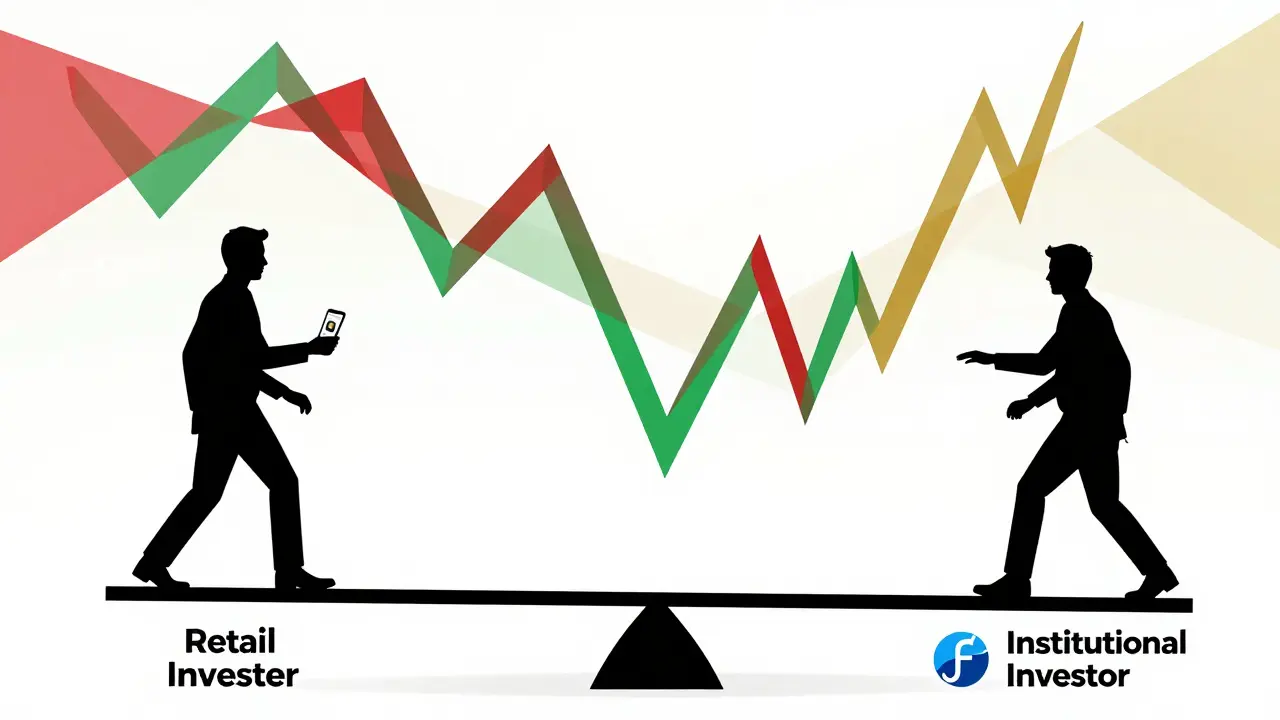
And then there’s the human factor. Most crypto buyers are retail investors - everyday people, not hedge funds. They see a tweet from Elon Musk, jump in, then panic-sell when the price dips. This emotional trading cycle amplifies every swing.
How Do We Measure It?
You can’t just say “crypto is volatile.” You need numbers. Experts use something called realized volatility - a statistical measure that tracks price changes over time. For example:
- Between 2020 and 2024, Bitcoin’s average daily volatility was 4-6%. That’s 3 to 4 times higher than the S&P 500.
- Gold (GVX index) had an average volatility of 1.5% over the same period.
- Even during the craziest days of 2021, Apple stock rarely moved more than 5% in a single day. Bitcoin? It did that twice a week.
There’s also something called CVX - the Cryptocurrency Volatility Index. It’s like the VIX (the “fear index” for stocks), but built for crypto. It doesn’t just look at past prices. It predicts future swings based on options trading. In 2023, CVX showed that volatility was dropping as institutional money flowed in. But it’s still far above traditional markets.
History Shows the Wild Ride
Look at the last 15 years, and you’ll see the same pattern repeat:
- 2017 - Bitcoin went from $1,000 to $20,000 in under a year. Then it crashed 80% by early 2018. FOMO drove the rise. Panic drove the fall.
- March 2020 - When the pandemic hit, Bitcoin fell 50% in one day. It wasn’t just crypto - global markets collapsed. But Bitcoin bounced back in weeks. Why? Because people started seeing it as a hedge against money printing.
- 2021 - Tesla bought $1.5 billion in Bitcoin. MicroStrategy loaded up. Bitcoin hit $69,000. Then came regulatory crackdowns, rising interest rates, and the Terra/Luna collapse. By late 2022, Bitcoin was back at $16,000.
Each cycle teaches the same lesson: extreme gains attract new money. That money fuels more buying. Then, when confidence cracks, everyone rushes to exit at once. That’s volatility.
Is It All Risk? Or Is There Opportunity?
Some people say crypto volatility makes it too dangerous. Others say it’s the only way to get 10x returns in a few months.
The truth? It’s both. High volatility means you can lose big - fast. But it also means you can make big gains - fast. The difference? Preparation.
Here’s what works for experienced investors:
- Dollar-cost averaging - Buy $100 of Bitcoin every week, no matter the price. You buy more when it’s cheap, less when it’s expensive. This smooths out the swings.
- Limit exposure - Most financial advisors recommend putting no more than 1-5% of your total portfolio into crypto. That way, even if it crashes 80%, you won’t be ruined.
- Use stop-losses - Set an automatic sell order if the price drops 20%. It won’t save you from every crash, but it stops emotional panic selling.
- Don’t chase trends - If you’re buying because everyone’s talking about a new altcoin, you’re already late. The biggest moves happen before the hype peaks.
Volatility isn’t something to fear - it’s something to work with. You can’t control it. But you can plan for it.
What’s Changing? Institutional Money Is Quietly Taming the Storm
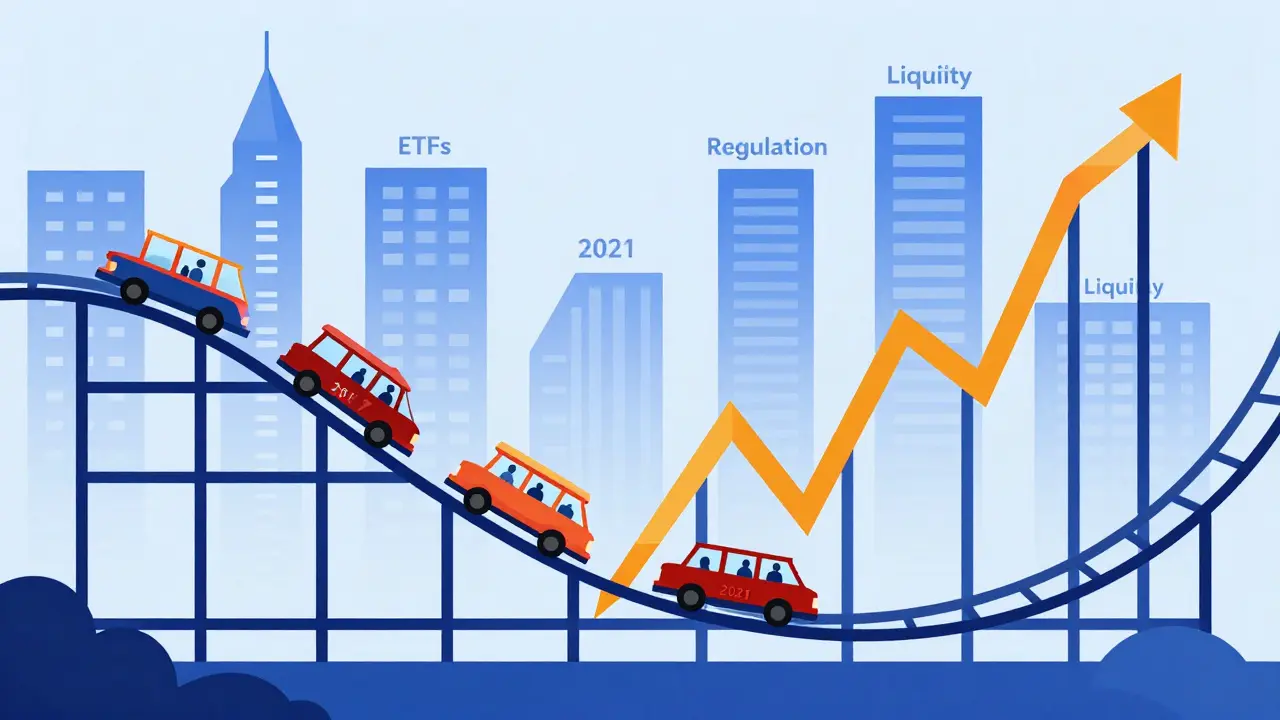
Here’s the surprising twist: crypto volatility is starting to drop - slowly.
In 2023 and 2024, Bitcoin and Ethereum spot ETFs started trading in the U.S. These aren’t just new products. They’re game-changers. Why? Because they let pension funds, universities, and large institutions invest in crypto without holding the actual coins. That means:
- More stable, long-term money is entering the market.
- Whales (big holders) are less likely to dump suddenly - they’re now part of regulated, institutional portfolios.
- 6% of all Bitcoin is now held by companies and ETFs - not individual traders.
This isn’t making crypto as stable as the S&P 500. But it’s making the swings smaller. The average daily volatility of Bitcoin dropped from 5.8% in 2021 to 3.1% in early 2025. That’s still high - but it’s moving in the right direction.
What’s Next? Volatility Won’t Disappear - But It Will Evolve
Expect crypto volatility to keep dropping over the next 5-10 years. Why?
- More regulation means less uncertainty.
- More institutional adoption means less emotional trading.
- More liquidity means big trades don’t crash the market.
But here’s the key: crypto will always be more volatile than stocks. That’s built into its DNA. It’s decentralized, global, unregulated in many places, and driven by tech innovation - not earnings reports.
So if you’re looking for steady, predictable returns? Crypto isn’t it. But if you understand the swings, plan for them, and keep your risk in check? It can still be one of the most rewarding asset classes out there.
Is cryptocurrency volatility higher than stock market volatility?
Yes, consistently. Between 2020 and 2024, Bitcoin’s average daily volatility was 3 to 4 times higher than the S&P 500. Even during calm periods, crypto moves more than most individual stocks. Gold and bonds are far more stable. The reason? Smaller market size, less liquidity, and retail-driven trading.
Can cryptocurrency volatility be predicted?
Not precisely, but it can be measured and anticipated. Tools like the Cryptocurrency Volatility Index (CVX) use options trading data to estimate future price swings. These are similar to the VIX for stocks. While they can’t tell you the exact price tomorrow, they show whether the market expects big moves ahead - helping investors prepare.
Why does Bitcoin volatility decrease over time?
As more institutional money enters - through ETFs, corporate treasuries, and regulated platforms - trading becomes less emotional and more strategic. Large investors don’t buy and sell based on tweets. They hold for years. This reduces the frequency of extreme swings. Bitcoin’s volatility has dropped from 5.8% daily in 2021 to 3.1% in early 2025 - a sign of maturing markets.
Should I avoid crypto because of its volatility?
Not if you understand it. Volatility isn’t a reason to avoid crypto - it’s a reason to approach it wisely. Limit your exposure (1-5% of your portfolio), use dollar-cost averaging, and never invest money you can’t afford to lose. Many people have made life-changing gains by staying calm through the swings.
What’s the safest way to invest in crypto with high volatility?
The safest approach is to use dollar-cost averaging (DCA). Buy a fixed amount - say $50 - every week, no matter the price. This automatically buys more when prices are low and less when they’re high. Combine that with a strict rule: never put more than 5% of your total savings into crypto. Add stop-loss orders if you’re trading actively. Diversify across Bitcoin and Ethereum - not dozens of obscure altcoins.
Ace Crystal
February 14, 2026 AT 08:46Stop treating it like a stock. It’s digital gold with a side of internet chaos. Embrace the volatility. It’s your edge.
Ekaterina Sergeevna
February 15, 2026 AT 20:33Real institutional money doesn’t care about ‘dollar-cost averaging’ - they care about liquidity pools, derivatives exposure, and regulatory arbitrage. You think a $50 weekly Bitcoin buy is ‘strategic’? Honey, that’s a hobby. The real game is in the dark pools where $500M trades happen before breakfast. Your ‘plan’ is cute. But it’s not market-moving. It’s Instagram finance.
Brittany Meadows
February 17, 2026 AT 14:28Every time Bitcoin drops? That’s when they’re accumulating. Every time Elon tweets? That’s a signal. The ‘retail traders’? They’re bots. Or paid shills. Or both.
They want you scared. They want you selling. So they can buy at 10% of peak. And you? You’re just the meat in the sandwich. 🤡💸
SAKTHIVEL A
February 18, 2026 AT 13:49Furthermore, the absence of centralized clearinghouses and the presence of heterogeneous participant behavior - particularly the disproportionate influence of emotionally driven retail actors - engender systemic fragility. One must therefore conclude that the current volatility is not a bug, but a feature of decentralized consensus mechanisms operating under conditions of asymmetric information.
It is, in fact, a testament to the purity of the blockchain paradigm - unfiltered, unregulated, and utterly unapologetic.
Sanchita Nahar
February 20, 2026 AT 10:54Kaz Selbie
February 20, 2026 AT 15:50‘Stability’? That’s just a pause between explosions. The real players aren’t buying ETFs - they’re shorting them. And you? You’re the one holding the bag when the next ‘regulatory clarity’ tweet drops. This isn’t maturation. It’s a slow-motion trap.
krista muzer
February 21, 2026 AT 10:11i didn’t get rich. but i didn’t lose anything either. and now? i just forget about it. i check it once a month. it’s like a weird little plant i water every so often. sometimes it blooms. sometimes it looks dead. but it’s still there.
maybe that’s the real lesson? not strategy. just… patience. and not checking your portfolio every 30 minutes. 🌱
Andrea Atzori
February 22, 2026 AT 22:17Consider this: Bitcoin’s daily volatility has declined by nearly 50% since 2021, even as market cap has doubled. That’s not noise. That’s structural maturation. The entry of regulated ETFs, corporate balance sheet allocations, and cross-border custody solutions has fundamentally altered the market’s DNA.
Volatility isn’t disappearing - it’s being refined. Like a rough diamond being cut. The brilliance remains - but the fractures are being smoothed. This is not the end of crypto. It’s the beginning of its adulthood.
blake blackner
February 23, 2026 AT 18:44now i’m broke. but i’m not mad.
it’s not about winning. it’s about the story.
imagine telling your grandkids: ‘i lost everything… but i was there when bitcoin was still $20k’
that’s the real crypto dream. 💯
Grace Mugambi
February 25, 2026 AT 02:36Some people see volatility as a threat. Others see it as a mirror.
The real question isn’t whether crypto is too volatile - it’s whether *you* are too attached. To outcomes. To validation. To the idea that you need to ‘win’ at this.
Maybe the lesson isn’t in the price chart. Maybe it’s in the breath you take when it drops 15%… and you don’t sell.
Will Lum
February 25, 2026 AT 19:52if it goes to zero? i lost a few bucks.
if it goes to 100k? i get a new car.
life’s too short to stress over numbers on a screen.
bitcoin’s not an investment. it’s a vibe.
Robbi Hess
February 27, 2026 AT 16:49What appears as ‘stabilization’ is merely the quiet accumulation of positions by entities with far deeper pockets and superior risk modeling. When the next macro shock hits - interest rate spike, geopolitical crisis, or regulatory crackdown - the liquidity vacuum will be catastrophic.
The market is not taming volatility. It is merely hiding it beneath layers of derivatives and regulatory smoke screens.
Keturah Hudson
February 28, 2026 AT 19:25My cousin bought $200 of Solana last year. Sold it for $2000. Bought a motorcycle. Then bought another $200. Now he’s waiting.
Volatility isn’t a flaw. It’s the rhythm. And in places where banks don’t work? Crypto isn’t a gamble. It’s the only game in town.
Desiree Foo
March 2, 2026 AT 19:16And not even smart gambling. You’re the kind of person who buys lottery tickets because your coworker won.
Volatility isn’t the problem. Ignorance is.
Read the whitepapers. Learn how blockchain consensus works. Understand what ‘decentralization’ actually means.
Otherwise, you’re not part of the future. You’re just noise.