Imagine a world where Bitcoin does more than just sit in a wallet as digital gold. What if it could handle complex smart contracts and tokens without needing a middleman to keep track of who owns what? That's exactly where Cat Protocol is heading. By leveraging a specific piece of Bitcoin's own code, it's attempting to bring a level of decentralization to Bitcoin tokens that we've never seen before.
For a long time, Bitcoin tokens relied on "indexers"-basically third-party databases that keep a list of tokens. If the indexer goes down or lies, your tokens effectively vanish. Cat Protocol changes the game by moving the rules directly onto the blockchain. This means the Bitcoin miners themselves validate the tokens, making the system as secure as Bitcoin itself.
Quick Summary: The Essentials of OPCAT
- What it is: The first CAT20 token deployed on Fractal Bitcoin.
- The Secret Sauce: Uses the
OP_CATopcode to enable smart contracts on Bitcoin. - Key Difference: No indexers required; everything is validated at Layer 1 by miners.
- Supply: A hard cap of 21 million tokens.
- Utility: Supports both fungible (CAT20) and non-fungible (CAT721) tokens.
Breaking Down the Tech: What is OP_CAT?
To understand
OPCAT, you first have to understand the
OP_CAT opcode. In simple terms, an opcode is a command the Bitcoin network understands. OP_CAT specifically allows the network to take two pieces of data and smash them together into one larger piece.
This sounds basic, but it's a powerhouse for developers. Back in 2010, this feature was disabled because it could potentially cause security issues. However, the community has brought it back into the conversation because it allows for "recursive covenants." Basically, it lets developers create complex rules for how tokens are minted and moved without needing a separate side-chain or a centralized server to track the state of the token.
Because
OPCAT is the first token to use the
CAT Protocol (Covenant Attested Token), it serves as a proof-of-concept for what's possible. It's currently living on
Fractal Bitcoin, a scaling solution that is compatible with Bitcoin and has OP_CAT enabled.

CAT20 vs. BRC-20: Why it Actually Matters
If you've followed the Bitcoin ecosystem, you've probably heard of BRC-20 tokens. While BRC-20 tokens were a breakthrough, they have a major flaw: they rely on indexers. If you want to know how many BRC-20 tokens you have, you're essentially asking a third-party website to check its database for you. If that database crashes, you're in the dark.
The CAT20 standard, used by OPCAT, removes that risk. Since the logic is embedded in the Bitcoin script, the network itself knows exactly how many tokens exist and who owns them. If someone tries to mint more tokens than the limit, the Bitcoin network just rejects the transaction. It doesn't wait for an indexer to flag it; the code simply won't let it happen.
| Feature | CAT20 (OPCAT) | BRC-20 |
|---|---|---|
| Validation | Miner-validated (Layer 1) | Indexer-based (Off-chain) |
| Security | Bitcoin Proof of Work | Dependent on Indexer reliability |
| Smart Contracts | Native via OP_CAT | Very limited / None |
| Failure Point | Network consensus | Centralized indexers |
The Utility: Beyond Just a Memecoin
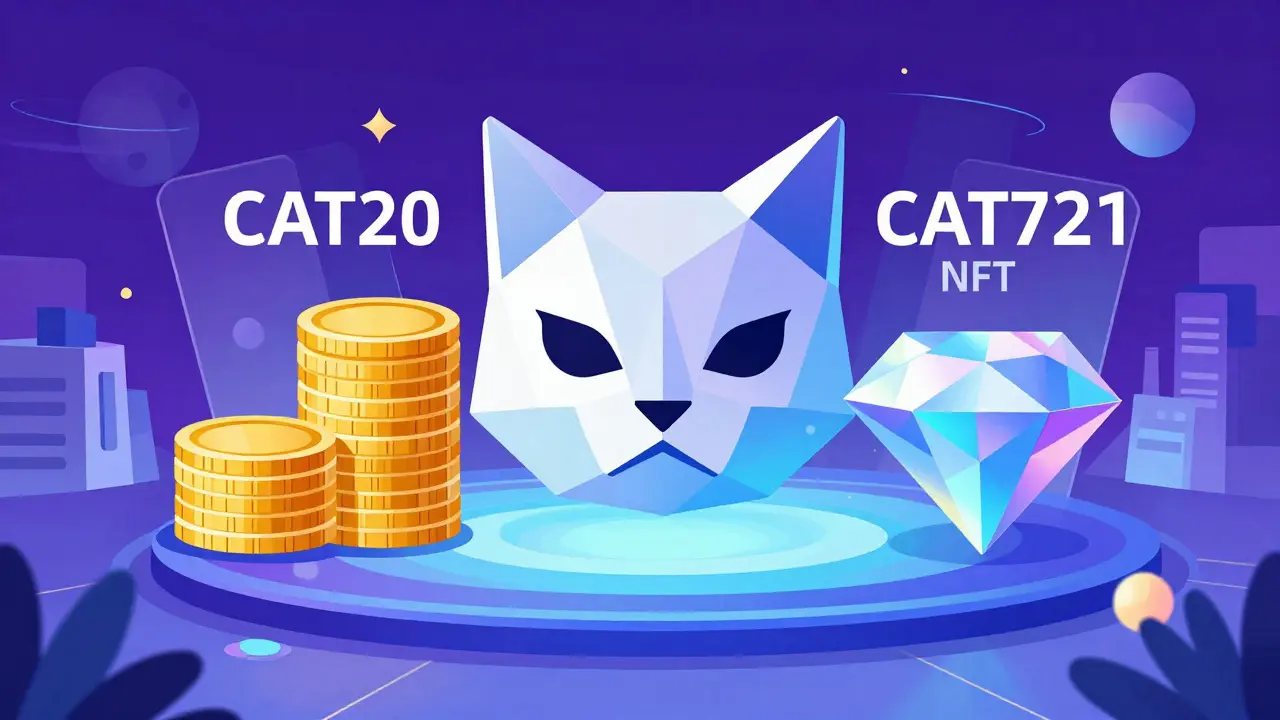
While OPCAT might look like just another token in the sea of crypto, the underlying protocol is designed for serious work. The CAT Protocol isn't just about one coin; it's a framework for two different types of assets:
- CAT20: These are fungible tokens. Think of them like dollars or other cryptocurrencies. They are perfect for payments, staking, and providing liquidity in decentralized exchanges.
- CAT721: These are non-fungible tokens (NFTs). These are used for unique items like digital art or gaming assets, but with the added security of being validated by Bitcoin miners.
Because these tokens are programmable, they can be plugged into more advanced tools. We're talking about Automated Market Makers (AMMs), lending protocols, and trustless bridges that let you move assets between different blockchains without needing a company to vouch for the transfer. This turns Bitcoin into a platform for DeFi (Decentralized Finance) rather than just a store of value.
Market Reality: Price and Volatility
If you're looking at the charts for OPCAT, you'll notice something strange: the price varies wildly depending on where you look. In April 2026, you might see $0.20 on one platform and $0.01 on another. This happens because the token is still in its early adoption phase, and liquidity is spread across different exchanges like Binance, Crypto.com, and Gate.com.
With a maximum supply of 21 million tokens, OPCAT mirrors the scarcity of Bitcoin itself. However, its market cap is still relatively small compared to the giants of the industry. For a regular investor, this means high volatility. It's a high-risk, high-reward scenario where the value depends more on the adoption of the OP_CAT opcode than on the token's individual utility.
Getting Started and Potential Pitfalls
If you're a developer, the Cat Protocol is pretty accessible. There's an open-source CLI tool available that helps with deploying and minting tokens. You can set your own rules for how tokens are created, and the network will enforce those rules automatically.
For the average user, the biggest hurdle is the environment. Since this isn't "Standard Bitcoin" (which doesn't have OP_CAT fully active on the mainnet for everyone), you'll be interacting with
Fractal Bitcoin. You'll need a wallet that supports these specific standards to manage your tokens safely.
One common mistake is confusing "Layer 2" with "Layer 1 validation." Many people think all Bitcoin tokens are Layer 2. OPCAT is different because it strives for Layer 1 security. If a project tells you they have a "Bitcoin token" but requires you to trust a specific website to see your balance, they aren't using a protocol like CAT.
Is OPCAT a safe investment?
Like all low-cap cryptocurrencies and memecoin implementations, OPCAT is highly volatile. While the technology behind the CAT Protocol is robust and targets real problems like indexer centralization, the market price is driven by speculation. Only invest what you can afford to lose.
What happens if the OP_CAT opcode isn't adopted on the main Bitcoin network?
If the main Bitcoin network never activates OP_CAT, the protocol will continue to live and grow on compatible side-chains and scaling solutions like Fractal Bitcoin. However, the "ultimate dream" of native Layer 1 validation on the main chain would remain unfulfilled.
How is CAT20 different from ERC-20?
ERC-20 tokens live on Ethereum, which is a smart-contract-native blockchain. CAT20 tokens bring similar functionality (fungibility) to Bitcoin. The main difference is the underlying architecture: CAT20 uses UTXO-based covenants and the OP_CAT opcode to achieve smart contract logic on a network that wasn't originally designed for it.
Do I need a special wallet for OPCAT?
Yes. Because OPCAT operates on Fractal Bitcoin and uses the CAT20 standard, you need a wallet that supports the Fractal network and is capable of reading the specific script logic used by the CAT Protocol. A standard Bitcoin Legacy wallet won't work.
What is the total supply of OPCAT?
The maximum supply of OPCAT is fixed at 21 million tokens, intentionally mirroring the total supply of Bitcoin to emphasize scarcity.