Imagine uploading a file to the cloud and paying for it once, forever. No monthly subscriptions, no service provider holding your data hostage, and encryption so strong that even future quantum computers couldn't crack it. That is the promise of Autonomi, a decentralized network designed to replace traditional cloud storage with a peer-to-peer system that prioritizes absolute user sovereignty. If you have stumbled upon the ticker symbol ANT on a chart or heard whispers about "post-quantum" tech in crypto circles, you might be wondering what exactly this project does. Unlike Bitcoin, which is primarily a store of value, or Ethereum, which is a platform for smart contracts, Autonomi solves a different problem: how do we store data permanently without relying on Amazon AWS, Google Cloud, or Microsoft Azure? This guide breaks down how the Autonomi network works, why its security model matters in 2026, and how the ANT token fits into this ecosystem. We will look at the technology, the economics, and whether this is just another buzzword or a genuine shift in digital infrastructure.
How Autonomi Works: The Basics
To understand Autonomi, you first need to unlearn how the current internet works. Today, when you save a photo to iCloud or a document to Dropbox, that data sits on a server owned by a company. They can see it, they can delete it, and they can shut it down if you stop paying. This is centralized storage. Autonomi flips this model. It is a distributed hash table (DHT) network. Think of it as a massive, global puzzle where every piece of data you upload is chopped into tiny chunks, encrypted, and scattered across thousands of everyday devices. These devices aren't just big data centers; they are home PCs, Raspberry Pis, and spare capacity in various servers around the world. When you want to retrieve your data, the network reassembles these chunks from multiple sources. Because the data is encrypted before it ever leaves your device, the network itself never sees your actual files. This is called zero-knowledge architecture. In simple terms, the network knows you stored something, but it has zero idea what that something is. The key difference here is permanence. Traditional cloud services require recurring payments. Autonomi operates on a one-time payment model. You pay to upload, and the data stays accessible as long as the network exists. There are no subscriptions, no accounts to manage, and no intermediaries between you and your data.
The Post-Quantum Security Edge
The biggest selling point of Autonomi isn't just decentralization; it's longevity. We are entering an era where quantum computing poses a real threat to current encryption standards. Algorithms like RSA and ECC, which protect most of today's online transactions and data, could theoretically be broken by powerful enough quantum machines. Autonomi was built from the ground up to be post-quantum secure. This means it uses cryptographic standards that are resistant to attacks from both classical and quantum computers. Specifically, the network implements:
- ML-DSA-65 Signatures: Based on FIPS 204 standards, this secures identity and node authentication.
- ML-KEM-768 Key Exchange: Based on FIPS 203 standards, this handles the secure exchange of keys over the QUIC transport protocol.
- ChaCha20-Poly1305 Encryption: Used for self-encryption of data chunks, combined with BLAKE3 hashing.
The Role of the ANT Token
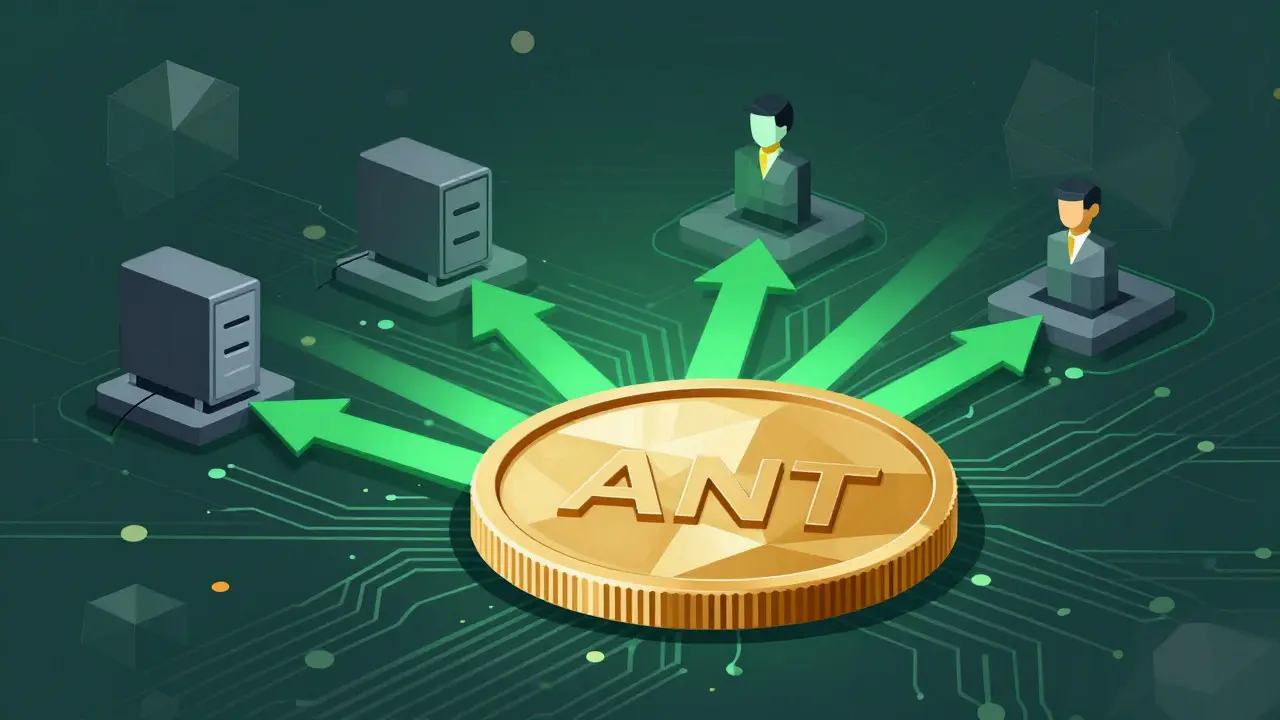
In any decentralized network, someone has to provide the resources-in this case, storage space and bandwidth-and someone has to pay for them. That is where the ANT token comes in. It is the utility token that powers the entire ecosystem. You can think of ANT as the "oil" that keeps the machine running. Here is how ANT flows through the system:
- Users Pay in ANT: When you upload data, you pay a fee in ANT tokens. This fee covers the cost of storing your data chunks across the network.
- Node Operators Earn ANT: Individuals who run nodes on the network contribute their hard drive space and internet bandwidth. In return, the network rewards them with ANT tokens.
- Service Payments: Developers building applications on top of Autonomi-such as messaging apps, AI skill sets, or live coordination tools-can use ANT for microtransactions and agent-to-agent payments.

Tokenomics and Supply Details
Understanding the supply dynamics of ANT helps set realistic expectations for its value. Here are the key metrics as of mid-2026:
| Metric | Value |
|---|---|
| Total Supply (Max Dilution) | 1.2 Billion ANT |
| Circulating Supply | 460 Million ANT |
| Blockchain Network | Arbitrum One (Ethereum L2) |
| Primary Use Case | Data storage fees, node rewards |
How to Get and Trade ANT
If you want to participate in the Autonomi ecosystem, you have two main paths: earning or buying. Earning via Nodes: You can run a node on your own computer or server. By contributing storage and bandwidth, you earn ANT tokens directly into your Ethereum-compatible wallet. This requires technical setup but offers a way to earn passive income while supporting the network's decentralization. Buying on Exchanges: For those who prefer to buy, ANT is available on several platforms. Since it lives on Arbitrum, you need a wallet that supports ERC-20 tokens on the Arbitrum network (like MetaMask or Trust Wallet). You can acquire ANT through:
- Decentralized Exchanges (DEXs): Uniswap V3 on Arbitrum One allows you to swap ETH or USDC for ANT directly.
- Centralized Exchanges (CEXs): Platforms like BitMart and Ourbit list ANT for trading. Note that availability can change, so always check current listings. For instance, while some major platforms like Crypto.com may not yet support ANT directly, other exchanges fill this gap.
Why This Matters Now
We are seeing a surge in AI-driven applications and autonomous agents. These systems generate and consume massive amounts of data. Centralized clouds are becoming bottlenecks-expensive, slow, and vulnerable to censorship or outages. Autonomi positions itself as the infrastructure layer for this next wave. By offering a trusted data layer that is immutable and private, it enables developers to build applications that don't rely on Big Tech. Whether it's storing training data for AI models securely or enabling peer-to-peer communication without a central server, the use cases are expanding. Moreover, the push for data sovereignty is growing. Users are increasingly wary of how their data is used by corporations. A network where you own your data, control your keys, and pay only for what you use aligns with the core ethos of the original internet: open, free, and uncensorable.
Risks and Considerations
No technology is perfect, and Autonomi is no exception. Here are some things to keep in mind:
- Volatility: Like most crypto assets, ANT's price can swing wildly. Recent data shows significant variance, with prices fluctuating based on broader market trends and specific network developments.
- Technical Complexity: Running a node or interacting with DEXs requires a certain level of technical know-how. It is not as plug-and-play as signing up for Google Drive.
- Network Maturity: While the technology is robust, the network is still growing. The reliability of data retrieval depends on the number of active nodes. A larger network means better redundancy and faster speeds.
Is Autonomi safe from quantum computers?
Yes, Autonomi is designed to be post-quantum secure. It uses advanced cryptographic standards like ML-DSA-65 and ML-KEM-768, which are specifically chosen to resist attacks from quantum computing capabilities, ensuring long-term data integrity.
Do I have to pay monthly fees to store data on Autonomi?
No. Autonomi operates on a one-time payment model. You pay a fee in ANT tokens when you upload your data, and it remains stored permanently on the network without any recurring subscription costs.
Which blockchain does the ANT token operate on?
The ANT token operates on the Arbitrum One network, which is a Layer 2 scaling solution for Ethereum. This allows for faster transactions and lower fees compared to the main Ethereum chain.
Can I mine ANT tokens?
Not in the traditional sense like Bitcoin mining. Instead, you earn ANT by running a node on the Autonomi network. By providing storage space and bandwidth, you are rewarded with tokens for contributing to the network's infrastructure.
Where can I buy ANT tokens?
You can buy ANT on decentralized exchanges like Uniswap V3 on Arbitrum, or on centralized exchanges such as BitMart and Ourbit. Always ensure you are using a wallet that supports the Arbitrum network.
Joshua Alcover
May 25, 2026 AT 10:07One must critically examine the epistemological foundations of this so-called "sovereignty" before accepting such a technocratic panacea. The notion that a distributed hash table can supplant the hegemonic infrastructure of AWS is not merely optimistic; it is a dangerous delusion that ignores the complex geopolitical realities of data governance. We are witnessing a pseudo-philosophical retreat into digital libertarianism, where individuals believe they can escape the panopticon by encrypting their trivialities on a network of Raspberry Pis. This is not freedom; it is a fragmentation of the collective digital commons into isolated, unregulated silos. Furthermore, the reliance on post-quantum cryptography, while technically impressive, serves as a smokescreen for the underlying economic instability of the ANT token. The jargon-heavy discourse surrounding ML-DSA-65 signatures obscures the fact that we are building a castle on sand. If the network fails to achieve critical mass, the "permanence" promised is nothing more than a temporary illusion. We must ask ourselves: who truly controls the narrative when the code is law and the law is written by anonymous developers? This aggressive push towards decentralization without centralized accountability is a recipe for chaos, not liberation. It is an intrusive boundary crossing into domains that require rigorous oversight, not wild-west experimentation.
Diana Morris
May 27, 2026 AT 03:19stop overthinking it guys just get in now its gonna moon
why do people always complicate simple tech
buy ant run node profit
Dianne Wright
May 28, 2026 AT 04:34i honestly think you are all missing the point here because you are too busy looking at charts instead of the actual technology which is genuinely revolutionary but also incredibly flawed if you actually read the whitepaper carefully which nobody does because they are too lazy
the part about quantum resistance is fine but the economics are completely broken because if everyone runs a node who pays the bills
also i feel like the author is trying too hard to sound smart with all these big words but really its just basic cloud storage wrapped in crypto buzzwords
it makes me so angry when people pretend this is new innovation when it is just IPFS with better marketing
and don't get me started on the tokenomics because that is just a ponzi scheme waiting to happen
i have been in this space since 2013 and i have seen it all and this is just another cycle of hype and disappointment
you need to wake up and smell the coffee before you lose your savings
Christina Pearce
May 29, 2026 AT 03:18This is such a fascinating breakdown! I’ve been following the rise of decentralized storage for a while, and Autonomi’s approach to post-quantum security really stands out. It’s reassuring to see a project that prioritizes long-term data integrity rather than just short-term gains.
I’m curious about how easy it would be for someone with limited technical skills to set up a node. The idea of earning passive income by contributing spare bandwidth sounds great, but I worry about the complexity involved. Has anyone here had success running nodes on older hardware? I’d love to hear some real-world experiences!
Barclay Chantel
May 30, 2026 AT 09:36Ah, the eternal promise of the peer-to-peer utopia. How quaint. One reads this guide and is struck by the sheer naivety required to believe that a network of random home PCs can offer reliability comparable to enterprise-grade data centers. The pretension of claiming "absolute user sovereignty" is laughable when one considers the physical vulnerabilities of such a distributed system. Who maintains the hardware? Who ensures the bandwidth? The moral high ground of "privacy" crumbles under the weight of practical inefficiency. It is a self-righteous fantasy for those who enjoy tinkering with code but lack the discipline to understand true infrastructure. The British public deserves better than this digital charade.
lorna erni
June 1, 2026 AT 07:41I am totally here for the privacy aspect! It feels amazing to know that no big corporation is peeking at my files. I love how inclusive this community is becoming. Let's all come together and support each other in building this new internet! I am super excited to start running a node and helping others do the same. We can make a difference together! 🌟
stalin brian
June 2, 2026 AT 13:44hey guys i was wondering if anyone has tried running a node on a raspberry pi yet? i got mine last week and im tryna figure out the setup process. its kinda confusing but i want to help the network grow. also does anyone know if there are any good tutorials for beginners? i am from the us but i think this tech is global so lets share knowledge!
kamal ifrani
June 4, 2026 AT 06:14oh look another person who doesnt know what they are talking about
running a node on a raspberry pi is a joke unless you have unlimited bandwidth and electricity
you are basically donating money to the network owners
but sure keep dreaming
the whole thing is a disaster waiting to happen and i will be the first to point it out when it crashes
typical american ignorance
saradee dee
June 4, 2026 AT 16:36Oh my goodness, please don't be so mean! 😢
Everyone starts somewhere and it is wonderful that stalin brian is trying to learn.
The community should be supportive, not toxic.
I hope he finds the help he needs because enthusiasm is important!
We all need to work together to make this technology accessible to everyone, not just the experts.
Please be kind to each other! ❤️
Craig Swanson
June 5, 2026 AT 07:12You need to step back and realize that attacking a beginner is counterproductive to the entire mission of decentralization. If we want a robust network, we need diverse participants, including those learning on lower-end hardware. Your negativity is draining the energy from this conversation. Instead of tearing down, why not offer constructive advice or simply move along? We are here to build, not to bully. Show some empathy and respect for those who are eager to contribute, even if their setup isn't perfect. That is how we grow a strong community.
Bill Gunn
June 6, 2026 AT 11:17Great discussion everyone! 👋 Just wanted to add that the Arbitrum integration is a game-changer for transaction speeds. I've been testing the DEX swaps and they are lightning fast compared to mainnet ETH. 🚀 Also, the zero-knowledge architecture is something we shouldn't take lightly-it’s huge for privacy advocates. Keep asking questions and supporting each other! 💪🔐
Dana Rapoport
June 6, 2026 AT 17:38The philosophical implications of post-quantum security are profound. We are essentially creating a time capsule for our digital identities. It forces us to consider what information is worth preserving forever in a universe where encryption standards evolve. While the technical details are dense, the core idea of enduring privacy resonates deeply. It is a quiet revolution in how we perceive ownership and memory in the digital age.
Hadleigh Edwards
June 7, 2026 AT 02:21I have to say that reading through all the different perspectives here has been quite illuminating for me personally as I have been hesitant to jump into the world of decentralized storage due to the perceived complexity and potential risks involved but seeing how passionate people are about the technology and the community support available makes me feel much more confident about exploring this further especially with the one-time payment model which aligns perfectly with my financial philosophy of avoiding recurring subscriptions whenever possible and the post-quantum security aspect gives me peace of mind knowing that my data will be safe for decades to come regardless of technological advancements which is exactly what I have been looking for in a storage solution that respects my privacy and autonomy while still being accessible and reliable enough for everyday use cases like backing up important documents and photos that I want to preserve for future generations.
mark valmart
June 8, 2026 AT 14:38looks pretty solid tbh. i been using ipfs for a bit but this seems easier to manage. gonna try buying some ant on uniswap later today. nice writeup.