
Have you ever tried to use a decentralized app on Ethereum only to get hit with a $50 gas fee for a simple swap? It’s frustrating, right? That’s exactly the problem Arbitrum was built to solve. It’s not just another coin; it’s a high-speed highway built on top of the congested Ethereum main road. By moving transactions off-chain and then posting them back to Ethereum in batches, Arbitrum makes crypto usage cheaper and faster while keeping your assets secure.
But if you’ve been looking at charts recently, you might be confused by the price of the ARB token. Why does it trade for pennies when the network handles billions in value? The answer lies in understanding that ARB isn’t used to pay for gas-it’s a governance key. This guide breaks down what Arbitrum actually is, how its technology works, why the ARB token exists, and what the current market reality looks like as we move through 2026.
How Arbitrum Works: The Optimistic Rollup Model
To understand Arbitrum, you need to know what an Optimistic Rollup is. Think of it like this: instead of every single transaction being verified individually by every computer on the Ethereum network (which is slow and expensive), Arbitrum groups thousands of transactions together into one big bundle.
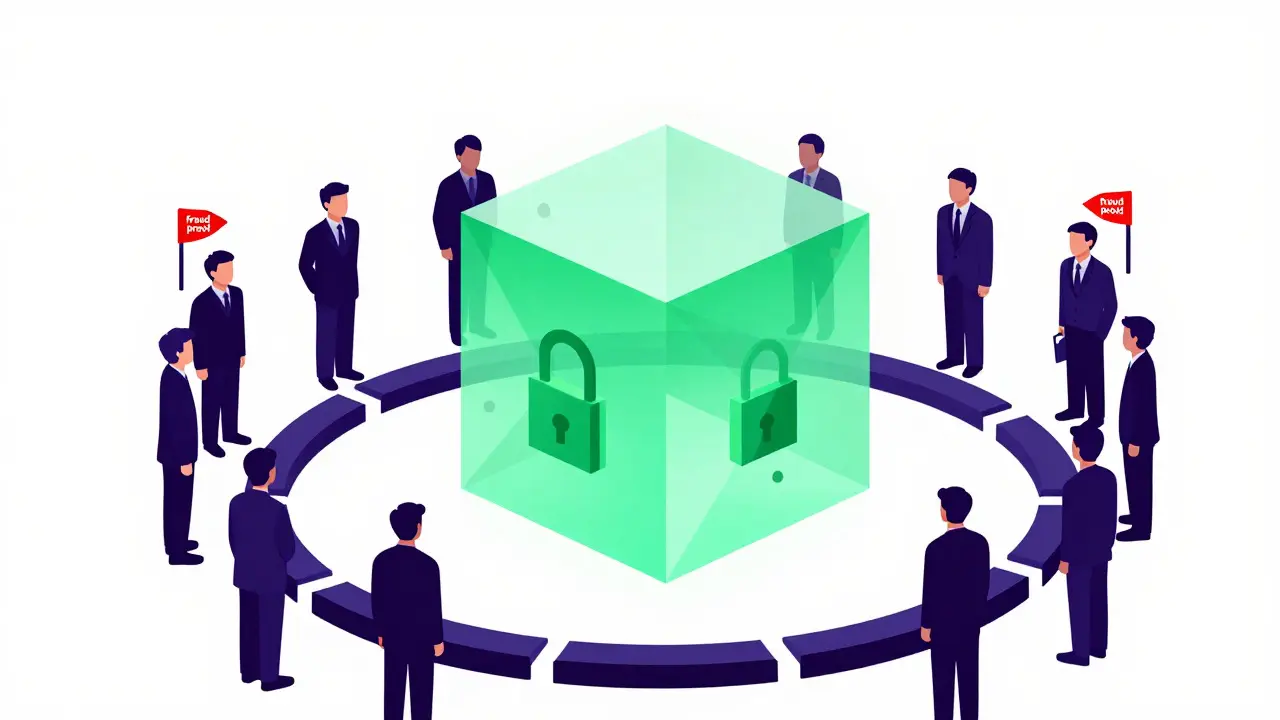
This bundle is posted to Ethereum, but here’s the clever part: the system assumes these transactions are valid "optimistically." It doesn’t check them immediately. Instead, it gives validators about seven days to step up and say, "Wait, something is wrong here!" If no one challenges the batch within that week, it becomes final. This method drastically cuts costs because Ethereum only has to process one complex proof instead of thousands of individual ones.
The engine behind this is called Arbitrum Nitro, which launched as a major upgrade to make the network even more efficient. Nitro uses a modified version of Geth (the standard Ethereum client) and WebAssembly (WASM) to ensure that smart contracts run exactly as they would on Ethereum, but much faster. This means developers don’t have to rewrite their code-they can deploy Solidity contracts directly onto Arbitrum with minimal changes.
- Batching: Hundreds of transactions are compressed into a single data block.
- Fraud Proofs: A one-week challenge period allows anyone to dispute invalid transactions.
- EVM Equivalence: Full compatibility with Ethereum Virtual Machine ensures easy migration for apps.
What Is the ARB Token Used For?
This is where most new users get tripped up. You might expect ARB to be used to pay for transaction fees on the network. But that’s not the case. On Arbitrum, you still pay gas fees using Ethereum (ETH).
So, what do you hold ARB for? Governance. The ARB token is the voice of the Arbitrum DAO. Holding ARB gives you the right to vote on proposals that shape the future of the network. These votes decide things like how the treasury funds are spent, which projects get grants, and whether protocol upgrades should be implemented.
When ARB launched in March 2023 via a massive airdrop, it marked the transition of control from the founding team to the community. While this sounds idealistic, the reality is nuanced. The token distribution heavily favored the DAO treasury and early investors, which means the power dynamics are still evolving. As of mid-2026, holding ARB is less about utility and more about betting on the long-term success and decentralization of the Arbitrum ecosystem.
Tokenomics and Supply Dynamics in 2026
If you’re analyzing ARB as an investment, you need to look closely at the supply schedule. The total supply of ARB is fixed at 10 billion tokens. There is no inflationary minting happening after the initial allocation. However, "circulating supply" tells a different story than "total supply."
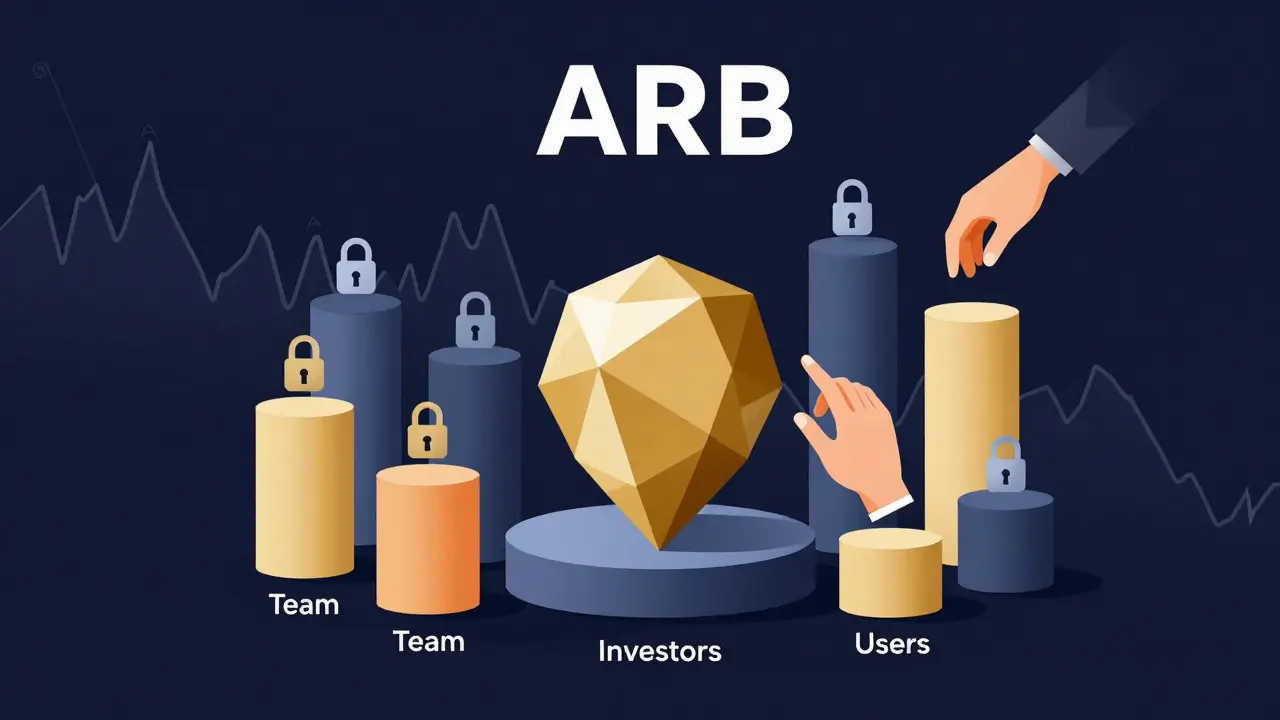
At launch, only about 12.75% of the tokens were freely tradable. The rest were locked up in a four-year vesting schedule for the team, advisors, investors, and the DAO treasury. As we move through 2026, these locks are gradually unlocking. For example, significant monthly unlocks continue to add sell pressure to the market. By early 2026, over half of the total supply had entered circulation, meaning the initial scarcity premium has largely disappeared.
| Recipient | Allocation Percentage | Purpose |
|---|---|---|
| Arbitrum DAO Treasury | 43% | Ecosystem funding, grants, and long-term development |
| Team & Advisors | 26% | Core development staff and strategic guidance |
| Investors | 18% | Venture capital backers who funded early stages |
| Network Users | 12% | Airdropped to early adopters and active wallets |
| Ecosystem DAOs | 1% | Sub-governance bodies within the ecosystem |
This structure means that while the community has a voice, the majority of voting power remains concentrated in the hands of the treasury managers and early stakeholders. This is a critical factor to consider when evaluating the true decentralization of the network.
Market Performance and Price Context
Let’s talk numbers, because the chart can be confusing. In late 2024, ARB traded near $1.00. By late 2025, it had dropped significantly, hovering around $0.24-$0.30. As of August 2026, the price sits firmly in the sub-$0.10 range, typically trading between $0.078 and $0.086.
Why such a drop? Several factors are at play:
- Dilution: As more tokens unlock from vesting schedules, the circulating supply increases, diluting the value per token if demand stays flat.
- Broader Market Conditions: Crypto markets are cyclical. After the hype cycle of 2021-2023, many Layer 2 tokens faced a correction phase.
- Governance vs. Utility: Because ARB isn’t burned or used for fees, there’s less inherent buy-pressure mechanism compared to models where tokens are consumed for usage.
Despite the lower price, liquidity remains strong. Daily trading volumes often exceed $30-50 million across major exchanges like Coinbase, Kraken, and Binance. This means you can enter or exit positions easily, but it also reflects a mature, albeit bearish, market sentiment toward governance tokens specifically.
Arbitrum vs. Other Layer 2 Solutions
You aren’t forced to use Arbitrum. The Ethereum scaling landscape is crowded. How does it stack up against competitors like Optimism or Base?
Arbitrum’s biggest advantage is its head start and developer adoption. Being one of the first successful Optimistic Rollups, it attracted a massive amount of Total Value Locked (TVL) in DeFi protocols. Many popular apps launched on Arbitrum first, creating a network effect. If you want to trade on a specific DEX or borrow from a lending platform, Arbitrum likely has the deepest liquidity.
However, it faces stiff competition. Optimism shares a similar tech stack but focuses heavily on a shared sequencer model for interoperability. Base, backed by Coinbase, benefits from massive retail onboarding due to its integration with a familiar exchange. Meanwhile, Zero-Knowledge (ZK) rollups offer faster finality without the one-week withdrawal wait time, though they are currently more expensive to build and maintain.
For users, the choice often comes down to where the apps you use are deployed. Arbitrum remains the heavyweight champion in terms of raw TVL and activity volume, making it the default choice for many serious DeFi participants.
Security and Risks to Consider
No crypto project is risk-free. With Arbitrum, the primary security model relies on Ethereum. Since all data is posted to Layer 1, it’s nearly impossible for the Arbitrum chain to disappear or lose funds unless Ethereum itself fails. This is a huge plus.
But there are nuances. The "optimistic" nature means there is a theoretical window for fraud during that seven-day challenge period. While extremely unlikely given the financial penalties for malicious actors, it introduces a latency issue. If you want to withdraw money from Arbitrum back to Ethereum mainnet, you have to wait. This isn’t instant. For day traders who need speed, this delay can be a dealbreaker.
Additionally, smart contract risks remain. Just because the layer is secure doesn’t mean the apps built on it are. Rug pulls and exploits happen on Arbitrum just as they do anywhere else. Always verify the contracts you interact with, regardless of the underlying infrastructure.
Who Should Care About Arbitrum?
If you are a casual investor who just wants to buy Bitcoin or Ethereum, Arbitrum might not be your immediate focus. But if you actively use DeFi, NFTs, or gaming apps on Ethereum, Arbitrum is essential knowledge.
It offers a practical solution to the high-cost barrier of entry. By switching your wallet network to Arbitrum One, you can perform swaps, staking, and transfers for fractions of a cent. For developers, it provides a robust, EVM-equivalent environment to build scalable applications without reinventing the wheel. And for governance enthusiasts, ARB offers a seat at the table of one of the most influential decentralized organizations in crypto.
Is ARB token inflationary?
No, the total supply of ARB is capped at 10 billion tokens. However, the circulating supply increases over time as vested tokens from the team, investors, and treasury are unlocked according to a set schedule. This creates sell pressure but not inflationary minting.
Do I need ARB to use the Arbitrum network?
No. You do not need to hold ARB to transact on Arbitrum. Gas fees on the Arbitrum network are paid in ETH (Ethereum). ARB is strictly a governance token used for voting within the Arbitrum DAO.
How long does it take to withdraw from Arbitrum to Ethereum?
Withdrawals typically take about seven days. This is due to the optimistic fraud-proof mechanism, which requires a challenge period to ensure the validity of transactions before finalizing them on the Ethereum mainnet.
Is Arbitrum safer than Ethereum mainnet?
Arbitrum inherits Ethereum’s security for data availability and consensus, making it highly secure. However, it introduces additional complexity with its bridge contracts and sequencers. While theoretically very safe, it has slightly more attack vectors than the base Ethereum layer.
What is the difference between Arbitrum One and Arbitrum Nova?
Arbitrum One is the main general-purpose L2 chain focused on high-value DeFi and security. Arbitrum Nova is a secondary chain designed for high-throughput, low-cost applications like gaming and social media, using Data Availability Committees (Data Availability Committees) instead of posting all data to Ethereum L1 to reduce costs further.
Namrata Mapgaonkar
August 4, 2026 AT 07:38hmm interesting read but i still think the 7 day wait is a dealbreaker for me :/
Phil Babb
August 6, 2026 AT 06:28You are absolutely missing the forest for the trees here!!! The seven-day window is a security feature, not a bug!! If you want instant withdrawals, go use Solana and pray your bridge doesn't get drained by hackers who don't even exist yet!!! Arbitrum gives you Ethereum-level security which is what matters in this bear market!! Stop complaining about latency when you're saving 99% on gas fees!! It's a trade-off people!! Deal with it!!!
Namrata Mapgaonkar
August 8, 2026 AT 03:39ok ok chill dude :) just saying it feels slow compared to other chains
Dominic Greco
August 9, 2026 AT 08:35The DAO is just a front for the VC firms to slowly dump their bags on retail 📉🤡 They control 43% of the supply through the treasury which means they decide everything while we hold the bag. The 'governance' aspect is a lie designed to keep us engaged while they exit liquidity. Wake up sheeple! The tokenomics are rigged from day one.
Ken G
August 10, 2026 AT 02:36its all controlled by the elites anyway so why bother voting if you dont own millions of tokens
Dominic Greco
August 10, 2026 AT 04:40Exactly!! And they know it!! That's why they pump the narrative about 'decentralization' while quietly moving funds to offshore accounts 😂🚫 You think your vote counts? Please. The insiders have already coded their exit strategy into the smart contracts. We are just liquidity providers for their yacht parties.
Eden Tadesse
August 11, 2026 AT 05:30I really liked how you explained the Nitro upgrade part because it was super clear and easy to understand for someone like me who isnt a dev but i did notice a few typo's in the middle section where you talked about the vesting schedule and maybe you could fix those next time? Just a small suggestion from a reader who appreciates the effort put into breaking down complex tech stuff!
Don Fizy
August 11, 2026 AT 10:07Glad you found the Nitro explanation helpful! It's a game changer for devs because they can just copy-paste Solidity code without rewriting everything in Rust or Go. Keep learning, the space is wild but rewarding! 👍
Emma Smith
August 12, 2026 AT 08:57the concept of optimistic rollups is fundamentally flawed because it relies on trust in validators which contradicts the very essence of decentralization we claim to strive for isn't it essentially a centralized sequencer pretending to be distributed while hoarding data availability costs on the mainnet creating a parasitic relationship between layer two and layer one that ultimately drains value from the base protocol
Michael Mostyn
August 13, 2026 AT 01:20One must consider the philosophical implications of 'optimism' as a cryptographic primitive. Is it not merely a suspension of disbelief enforced by economic incentives rather than mathematical certainty? The seven-day challenge period serves as a temporal buffer against entropy, allowing human agency to intervene in algorithmic determinism. Yet, does this reliance on fallible observers not introduce a new vector for systemic risk?
Emma Smith
August 14, 2026 AT 11:47precisely my point the human element is the weakest link and also the most expensive one when you factor in the opportunity cost of capital locked up during that week
Eric Zehr
August 15, 2026 AT 06:19This is a fantastic breakdown of the current state of Arbitrum. It’s great to see the distinction made between gas utility and governance power, as that confuses so many newcomers. The comparison with Base and Optimism adds valuable context for anyone deciding where to deploy their capital or build their next dApp. Keep up the excellent work!
Ed Mitchell
August 16, 2026 AT 10:55A mediocre summary of an overhyped project. The price action speaks for itself. Why would anyone invest in a token with no burn mechanism and massive unlocks looming? It is a classic case of vaporware masquerading as infrastructure. The author fails to mention the centralization risks of the sequencer which is a glaring omission.