
ANALOS (LOS) isn’t just another crypto coin. It’s a full blockchain built from scratch by copying Solana’s code-and then trying to rebuild everything around it. If you’ve ever wondered why someone would fork a blockchain like Solana instead of just using it, ANALOS is the answer. But here’s the real question: is it a smart move, or just a risky experiment with little chance of survival?
What Exactly Is ANALOS?
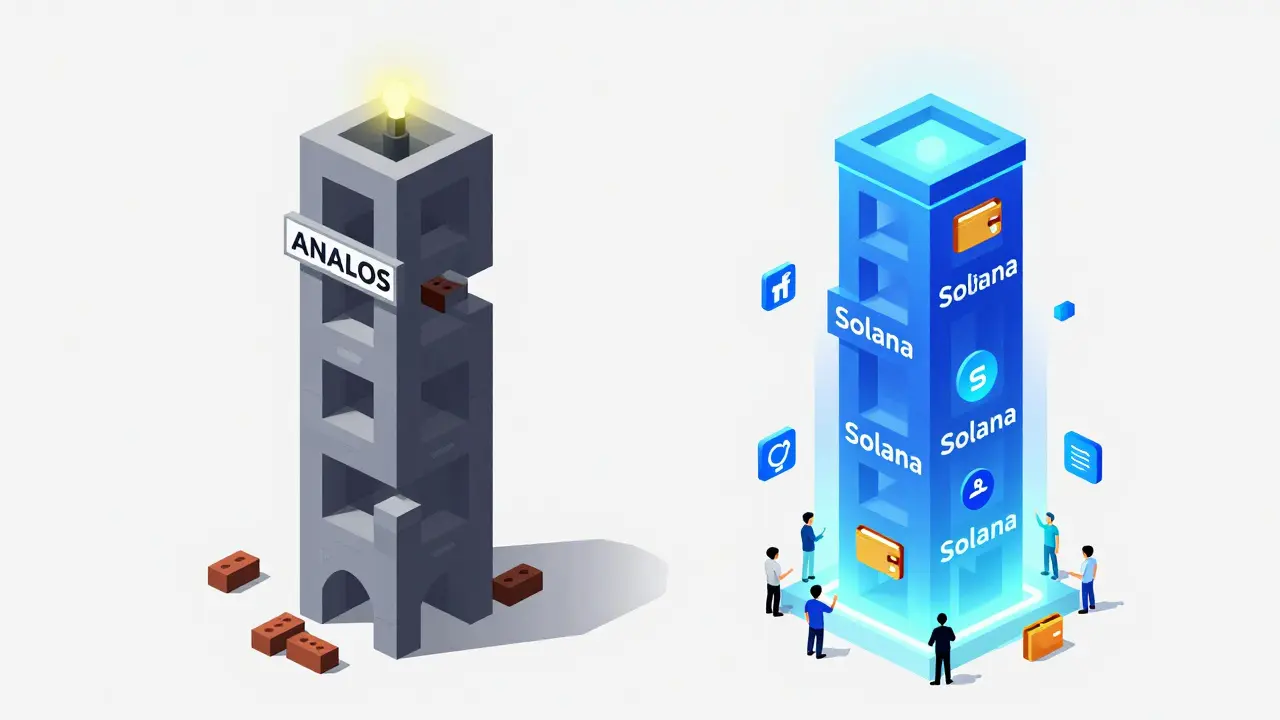
ANALOS is a Layer 1 blockchain that started as a direct copy of Solana’s codebase. But unlike most forks that just tweak a few things and call it a day, ANALOS claims to have rebuilt the entire ecosystem from the ground up. That means it didn’t just copy the consensus mechanism or block times-it built its own RPC server, its own wallet, its own blockchain explorer, its own decentralized exchange (DEX), and even its own launchpad for new tokens. All of it runs on the same token: LOS.
This isn’t like adding a DeFi app to Solana. This is like taking a car engine, rebuilding every part, and then designing your own gas stations, repair shops, and navigation system around it. The goal? To create a self-contained blockchain that doesn’t need to rely on Solana’s infrastructure. That’s ambitious. But ambition doesn’t always mean success.
The LOS Token: What Is It Used For?
LOS is the native token of the ANALOS blockchain. It’s used to pay for transactions, stake to help secure the network, and interact with the built-in DEX and launchpad. On paper, it’s supposed to be the lifeblood of the whole system. But in practice, there’s almost no demand for it outside of trading.
Unlike Ethereum’s ETH or Solana’s SOL, which are used by millions of users daily for DeFi, NFTs, and apps, LOS doesn’t power anything meaningful yet. There are no popular dApps built on ANALOS. No big names are using it. No wallets outside of the official one support it. And there’s no clear reason for someone to hold LOS beyond hoping the price goes up.
Bitrue’s analysis points out the core issue: ‘Will the LOS token gain strong utility beyond transactions?’ So far, the answer is no. It’s a token with no real job to do.
How Does ANALOS Compare to Solana?
Solana isn’t just a blockchain-it’s a thriving ecosystem with over 8 billion in DeFi total value locked (TVL) as of late 2025. Thousands of developers build on it. Millions of users trade on it. It has wallets like Phantom and Backpack, DEXs like Raydium and Orca, and bridges to other chains.
ANALOS tries to copy all of that. But it’s doing it alone. And it’s failing to attract even a fraction of the users. As of October 2025, ANALOS had a market cap of just $1.61 million. Solana’s was over $56 billion. That’s a 3,500x difference.
Even the trading volume tells the story. On Bybit, ANALOS’s 24-hour volume was listed as ‘$--’-meaning it was too low to register. On Crypto.com, it was $5,894. Compare that to Solana’s daily volume, which regularly exceeds $2 billion. ANALOS isn’t just small-it’s barely alive.

Why Does ANALOS Exist?
There’s no official team behind ANALOS. No website with a team page. No GitHub repo with code commits. No Twitter account with regular updates. The project was launched anonymously, which raises red flags in a space where transparency matters.
So why build it? The most likely reason is speculation. A group of developers forked Solana, added a few tools, and created a token. Then they listed it on a few exchanges and waited for people to buy in. There’s no evidence they’re trying to solve a real problem. Solana already works. It’s fast. It’s cheap. It’s used by real projects.
ANALOS doesn’t offer anything Solana doesn’t already have-except more fragmentation. If you want speed and low fees, you can get them on Solana. If you want a full-stack ecosystem, Solana already has one, built by thousands of contributors. ANALOS is trying to do the same thing with zero community, zero developers, and zero traction.
Can You Buy ANALOS (LOS)?
Yes, you can buy LOS on a few exchanges like Bybit and Crypto.com. The process is simple: sign up, verify your identity, deposit funds, and search for ‘LOS’ or ‘ANALOS’.
But here’s the catch: you won’t be able to use it for anything meaningful. You can’t stake it meaningfully because there’s no real staking reward system. You can’t send it to any DeFi protocol because none exist. You can’t even use the official wallet for much beyond holding the token.
The price is wildly volatile. On October 29, 2025, it traded between $0.00034 and $0.0033 in a single day. That’s over a 900% swing. One day it’s up, the next it’s down 42%. That’s not a sign of a healthy market-it’s a sign of low liquidity and high manipulation risk.
Is ANALOS a Good Investment?
Some websites claim LOS could hit $0.0147 by 2032. That sounds great-until you realize that’s a 10x increase from its price in late 2025. But those predictions come from sites with no track record, no methodology, and no transparency.
Real investment decisions are based on utility, adoption, and team credibility. ANALOS has none of those. There’s no developer activity. No partnerships. No institutional interest. No audits. No whitepaper with technical depth.
If you’re looking for a speculative gamble with high risk and zero upside potential, ANALOS might fit. But if you’re looking for a project with long-term value, it’s not even on the radar.
What’s Missing from ANALOS?
For a project that claims to be ‘designed for builders,’ there’s a shocking lack of resources. No SDKs. No API documentation. No testnet. No tutorials. No GitHub commits. No community forums. No Reddit threads. No Discord server with more than a handful of members.
Compare that to Solana, which has over 1,000 open-source projects on GitHub, 50+ developer grants programs, and weekly hackathons. ANALOS doesn’t even have a basic developer guide.
And without developers, there are no apps. Without apps, there’s no users. Without users, there’s no value. It’s a classic chicken-and-egg problem-and ANALOS hasn’t even started to solve it.
The Bottom Line
ANALOS (LOS) is a Solana fork with a full-stack vision-but no users, no developers, and no future. It’s not a revolution. It’s not even a real alternative. It’s a speculative token built on borrowed technology, with no reason to exist beyond short-term trading.
If you’re curious, you can buy a few LOS tokens for under a dollar. But don’t expect to use them. Don’t expect them to grow. And don’t expect anyone to care about them in six months.
The real winners in crypto aren’t the ones who copy. They’re the ones who build something new. ANALOS didn’t build anything new. It just took Solana’s code, slapped on a few tools, and called it a project.
There’s a reason no one’s talking about it. And that’s the most telling sign of all.
Deepu Verma
January 26, 2026 AT 04:55Look, I get why people are skeptical, but every big thing started small. Maybe ANALOS is just in the quiet phase. Solana didn’t explode overnight either. If you believe in the tech, give it time. Not everything needs a Twitter account to be real.
Mathew Finch
January 26, 2026 AT 09:36Calling this a ‘fork’ is generous. It’s a dumpster fire with a whitepaper. Solana’s ecosystem took years, billions in capital, and actual developers. This is some guy in a basement copying GitHub repos and hoping for a rug pull. Don’t confuse ambition with competence.
MICHELLE REICHARD
January 27, 2026 AT 02:42Wow. Just wow. You’re acting like crypto is a meritocracy. The truth? Most projects are just marketing with code. ANALOS might be trash, but so is 90% of what’s on the chain. At least this one has the guts to try something. Most just copy DeFi apps and call it innovation.
MOHAN KUMAR
January 27, 2026 AT 22:51LOS token has no use. No dApps. No devs. No community. Just price swings. This is pump and dump 101. Don’t waste your time. Stick to Solana or Ethereum. They work.
Abdulahi Oluwasegun Fagbayi
January 29, 2026 AT 10:33People forget that blockchains are not just code. They’re communities. ANALOS has the code but no heartbeat. Solana thrives because people believe in it. This? It’s a ghost town with a token.
Andy Marsland
January 30, 2026 AT 19:17Let’s be clear here. The entire crypto space is built on speculation, but ANALOS takes it to a new level of absurdity. There’s no team, no roadmap, no audits, no developer grants, no documentation - not even a basic GitHub commit history. You can’t build a decentralized ecosystem on anonymity and hope. That’s not innovation, that’s negligence wrapped in a whitepaper. And don’t even get me started on the ‘$0.0033 to $0.00034’ price swings - that’s not volatility, that’s market manipulation by bots with zero liquidity. This isn’t a blockchain; it’s a casino with a blockchain-shaped logo.
Anna Topping
February 1, 2026 AT 14:09I don’t know why I’m even reading this. But I’m weirdly fascinated. It’s like watching a car crash in slow motion. You know it’s gonna end badly, but you can’t look away. Maybe that’s the point. Maybe ANALOS isn’t meant to be useful - maybe it’s just art. Sad, desperate, chaotic art.
Jeffrey Dufoe
February 2, 2026 AT 11:53Yeah, I bought a few LOS tokens just to see what it was like. Didn’t do anything with them. Just sat there. Kinda like holding a key to a door that doesn’t exist. But hey, it was cheap. Worth the curiosity.
katie gibson
February 2, 2026 AT 21:28ANALOS is the crypto version of that one high school kid who wore the same hoodie every day and claimed he invented the internet. Everyone laughed. Then he sold NFTs of his hoodie for $50k. Who’s the fool now? 🤔
Ashok Sharma
February 4, 2026 AT 14:38It is important to understand that technology alone cannot create value. Community, trust, and utility are the real foundations. ANALOS lacks all three. Investors should focus on projects with transparency and long-term vision.
Margaret Roberts
February 5, 2026 AT 15:37Notice how no one knows who made this? That’s not ‘anonymous’ - that’s a scam waiting to happen. They’re using Solana’s code because they know people trust it. Then they create a fake ecosystem to lure in the gullible. This isn’t crypto. This is digital Ponzi.
Tselane Sebatane
February 6, 2026 AT 10:03Let me tell you something - the real tragedy isn’t that ANALOS exists. The real tragedy is that people still believe in this stuff. We’ve seen this movie before. The same script. The same actors. The same ending. And yet, here we are, watching it again like it’s the first time. The blockchain isn’t magic. It’s not a lottery ticket. It’s a tool. And this? This is a broken tool with a shiny paint job. You don’t need to be a genius to see it. You just need to stop hoping.
tim ang
February 7, 2026 AT 05:38Wait wait wait - I just checked the wallet. The official one? It doesn’t even support sending to external addresses? That’s not a blockchain, that’s a digital notebook. LOL. Someone please tell me this is satire.