
China banned all major crypto exchanges years ago - and it’s still enforcing the ban hard in 2026
If you’re in China and you try to sign up for Binance, Coinbase, or Kraken today, you won’t get past the first page. The website will either freeze, show an error, or redirect you to a blank screen. That’s not a glitch. It’s by design. Since 2017, China has been systematically shutting down every centralized cryptocurrency exchange that tries to serve its 1.4 billion people. By 2021, the ban became total. No exceptions. No loopholes. And in 2026, the rules haven’t changed - they’ve just gotten tighter.
It’s not just about blocking websites. The Chinese government uses its Great Firewall to cut off access to over 200 foreign crypto platforms. Internet providers are ordered to block VPNs that people use to bypass these restrictions. Banks are forbidden from processing payments to any crypto-related business. Even using your Chinese ID to register on a foreign exchange can trigger account freezes, fines, or worse - criminal charges under laws against illegal fundraising or capital flight.
Here are the crypto exchanges officially banned in China
China doesn’t publish an official list, but enforcement records and platform outages make it clear which ones are targeted. Any exchange that offered services to Chinese users - even indirectly - got blocked. These are the major ones:
- Binance - The world’s largest exchange was forced to shut down its China operations in 2017. By 2021, even its international site was blocked in China. Users who tried to log in with Chinese phone numbers or IDs had accounts frozen.
- Coinbase - Never officially launched in China, but its global platform was blocked as part of the 2021 crackdown. Chinese users reporting access issues saw error codes tied to government IP filtering.
- Kraken - Blocked since 2021. Kraken’s support team confirmed they no longer accept Chinese users due to regulatory pressure.
- Huobi - Originally founded in China, Huobi moved its headquarters to Malta in 2018 to avoid the crackdown. Even then, its platform was blocked within China by 2021.
- OKX - Formerly OKEx, this exchange relocated its base from China to the Seychelles. It’s now blocked in China like the others.
- Bitfinex, Poloniex, Gate.io, Bybit, KuCoin - All are inaccessible from mainland China. Even platforms that claim to be "global" and don’t target Chinese users still get caught in the net because of IP detection and KYC matching.
There’s no gray area. If it’s a centralized exchange - meaning you deposit funds, trade on their platform, and they hold your keys - it’s banned. Period.
What about holding crypto? Is it illegal to own Bitcoin in China?
This is where people get confused. A lot of social media posts in 2025 claimed China made it illegal to even own Bitcoin or Ethereum. That’s false.
Chinese authorities have never passed a law saying "you can’t hold crypto." What they banned is trading on exchanges, mining, and facilitating transactions through financial institutions. If you bought Bitcoin before 2021 and kept it in a private wallet - no exchange, no bank link - you’re not breaking the law by holding it.
But here’s the catch: if you try to sell it, send it to a Chinese exchange, or convert it to yuan through a P2P platform that’s monitored by banks, you’re at risk. Authorities track wallet addresses linked to Chinese IDs. If you move large amounts of crypto to a foreign wallet and then cash out via an OTC dealer, you could be investigated for capital flight.
There’s a difference between possession and activity. Owning crypto? Not illegal. Using a Chinese bank to trade it? That’s where the penalties start.

How do people still trade crypto in China?
Despite the ban, crypto hasn’t disappeared from China. It just went underground.
Many users now rely on decentralized exchanges (DEXs) like Uniswap or PancakeSwap. These platforms don’t require sign-ups, don’t collect KYC data, and run on public blockchains. You can trade directly from your wallet - if you can access them.
But even DEXs aren’t foolproof. To use them, you need to connect a wallet like MetaMask, and if your wallet was ever linked to a banned exchange or Chinese ID, it could be flagged. Plus, you still need to buy Ethereum or BNB to pay for gas fees - and getting those into China usually means using peer-to-peer (P2P) trading.
P2P platforms like LocalBitcoins or Paxful are popular, but they’re risky. Sellers demand cash deposits, WeChat transfers, or bank payments - all of which leave a trail. Chinese police have cracked down on P2P traders, arresting dozens in 2024 for operating unlicensed money services.
Some wealthy individuals use offshore companies or foreign bank accounts to move crypto. Others hire intermediaries in Hong Kong or Macau to handle trades. But these methods are expensive, slow, and legally shaky. One Reddit user from Shanghai reported paying 15% extra in fees just to convert BTC to cash through a middleman.
China’s answer: the digital yuan (e-CNY)
While banning crypto, China didn’t give up on digital money. Instead, it built its own.
The e-CNY, or digital yuan, is a central bank digital currency (CBDC) controlled entirely by the People’s Bank of China. Unlike Bitcoin or Ethereum, it’s not decentralized. Every transaction is tracked. Every user is verified. Every dollar is monitored.
Since 2020, the government has rolled out the e-CNY in over 200 cities. Millions of people use it for public transit, groceries, and even paying taxes. By 2025, over 300 million digital yuan wallets had been created. The goal? Replace cash, control capital flow, and eliminate the need for private cryptocurrencies.
There are rumors China is planning a yuan-backed stablecoin - a digital token pegged to the yuan - that could be traded on a government-controlled platform. This would let people "invest" in digital assets… but only if the state approves it.
In short: China doesn’t want you to own crypto. It wants you to use its own version.
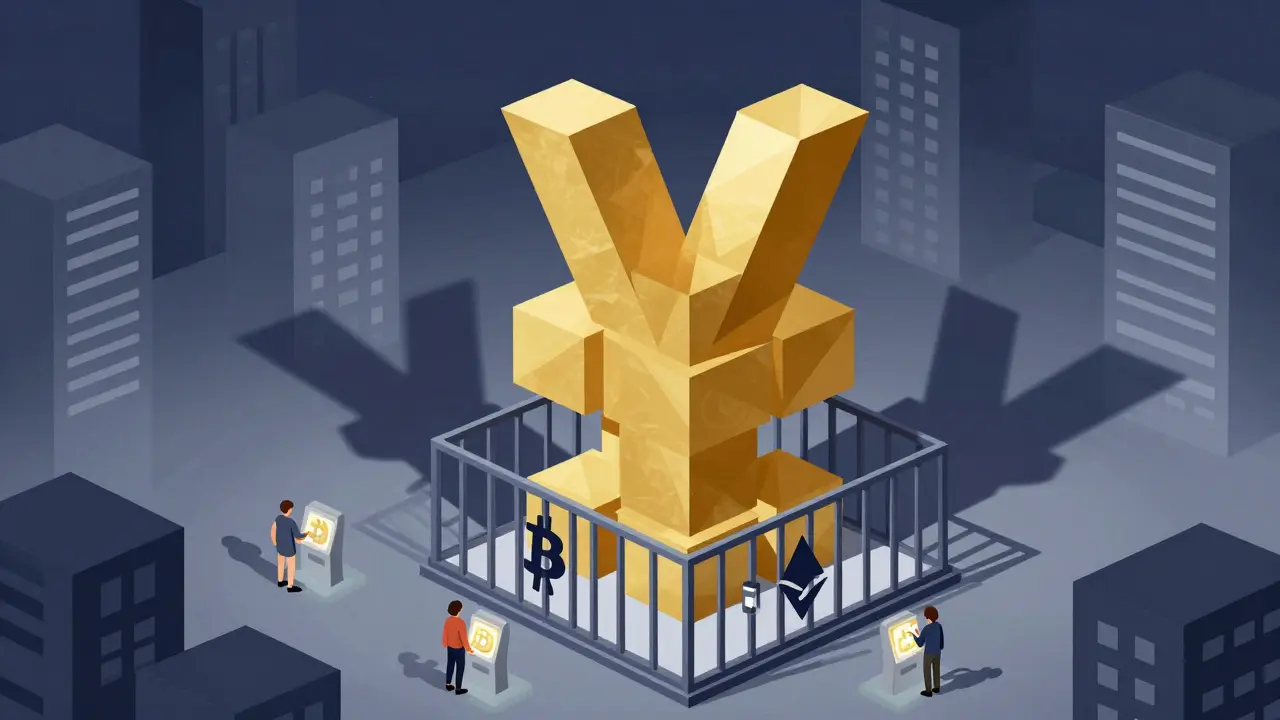
The real impact: market chaos and lost opportunities
China’s ban didn’t just affect Chinese users - it shook the global crypto market.
In May 2025, false rumors spread that China was banning crypto ownership. Bitcoin dropped from $111,000 to under $104,000 in under four hours. Ethereum fell 7%. Stablecoins like USDT surged as people rushed to move out of volatile assets.
But the bigger story is liquidity. China once accounted for nearly 40% of global Bitcoin trading volume. Now, it’s zero. That means fewer buyers, less price discovery, and more volatility worldwide.
Some traders see this as an opportunity. When fear hits hard, smart money buys. But for millions of Chinese citizens? They’re locked out. No matter how much they want to participate, they can’t legally buy, sell, or trade crypto through normal channels.
Will China ever lift the ban?
Unlikely - at least not in the way most people hope.
There’s no sign the government is planning to reverse course. In July 2025, the Shanghai State-Owned Assets Supervision and Administration Commission hinted that digital assets might lead to "softening" of policy. But no law changed. No exchange was unblocked.
Experts think China’s next move will be to expand the e-CNY, not relax crypto rules. Maybe they’ll allow licensed trading of tokenized assets - like stocks or bonds - on a government platform. But Bitcoin? Ethereum? Those are seen as threats to financial control.
Enforcement is getting smarter. AI now scans wallet addresses linked to Chinese phone numbers. Banks flag transfers to crypto-related domains. Even using a Chinese passport to sign up for a foreign exchange can trigger a warning.
As of 2026, China remains the largest market in the world that has completely shut out decentralized crypto. And they’re not showing signs of opening the door again.
What happens if you get caught trading crypto in China?
It depends. For most people, it’s not jail - it’s fines and account freezes.
If you’re a regular user who bought $5,000 worth of Bitcoin and held it, you’ll probably get a warning from your bank. Your account might be frozen for a few weeks while they check your transactions. You might have to explain where the money came from.
But if you’re running a P2P trading operation, acting as an intermediary, or moving large sums out of China - you could face criminal charges. In 2024, Chinese courts processed over 800 crypto-related cases. Many resulted in prison sentences of 1 to 5 years for "illegal business operations" or "illegal fundraising."
The message is clear: small-time holders might get a slap on the wrist. Big-time traders? They’re targets.
Gavin Francis
January 30, 2026 AT 21:12Gary Gately
January 31, 2026 AT 10:11Gareth Fitzjohn
February 1, 2026 AT 01:05Katie Teresi
February 2, 2026 AT 19:49Moray Wallace
February 3, 2026 AT 12:32William Hanson
February 3, 2026 AT 15:28Lori Quarles
February 4, 2026 AT 12:11Steven Dilla
February 6, 2026 AT 02:45Ramona Langthaler
February 6, 2026 AT 06:00Sunil Srivastva
February 7, 2026 AT 06:12Devyn Ranere-Carleton
February 8, 2026 AT 00:26Kevin Thomas
February 8, 2026 AT 12:08Robert Mills
February 10, 2026 AT 04:27Jerry Ogah
February 11, 2026 AT 18:58Andrea Demontis
February 11, 2026 AT 20:43Joseph Pietrasik
February 11, 2026 AT 21:43Raju Bhagat
February 12, 2026 AT 17:39laurence watson
February 14, 2026 AT 09:50