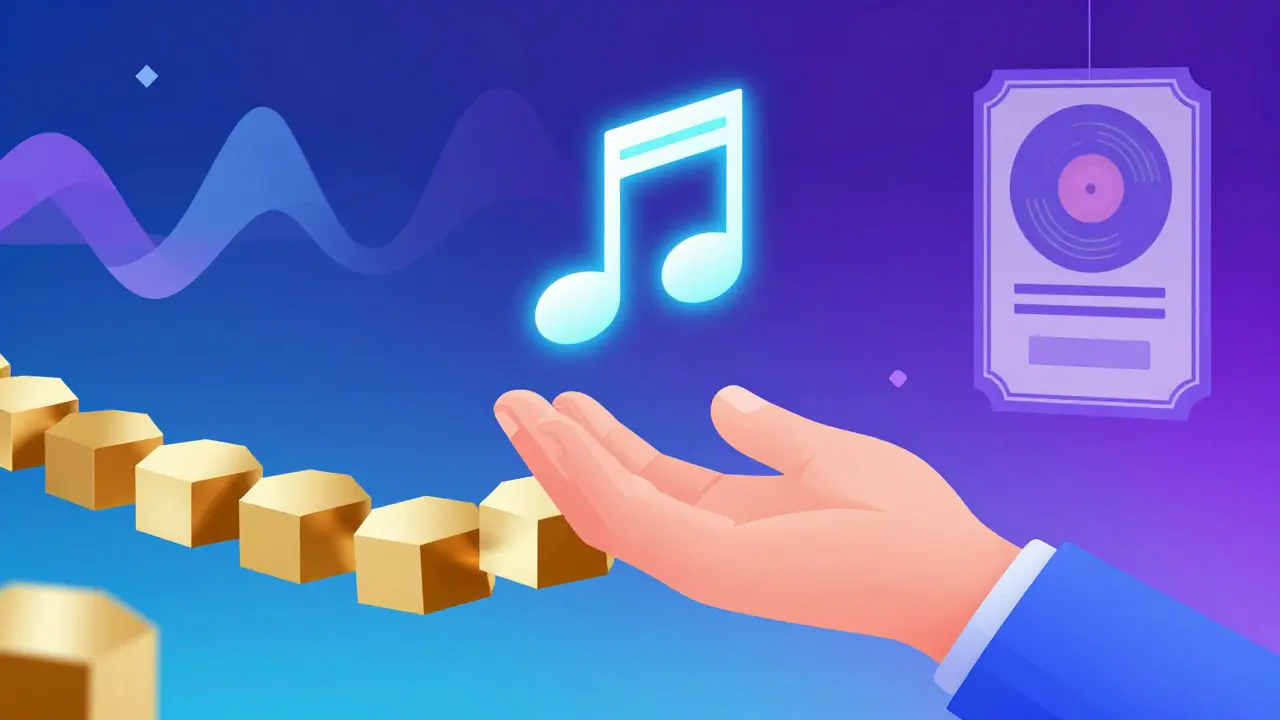
Imagine owning a song the same way you own a rare vinyl record - not just the right to play it, but actual proof that you hold something unique, verified, and unchangeable. That’s what music NFTs are: blockchain-based digital certificates of ownership for music. Unlike streaming, where you pay for access, music NFTs let you own a piece of the music itself - and sometimes even a share of its future earnings.
What Exactly Is a Music NFT?
A music NFT (non-fungible token) is a one-of-a-kind digital asset stored on a blockchain, linked directly to a song, album, or even a live performance. It’s not the file itself you’re buying - it’s the verified proof that you own that specific version. Think of it like owning the original painting of a famous artwork while everyone else can still see a print. The music can be streamed freely, but only one person holds the official, blockchain-verified ownership.
Each music NFT has a unique ID and contract address that can’t be copied or erased. This data lives on public ledgers like Ethereum or Solana, making ownership transparent and permanent. Some NFTs even contain the audio file inside the token’s metadata. Others point to storage locations like IPFS (InterPlanetary File System), which keeps the music accessible even if the artist’s website goes down.
How Is This Different From Streaming?
On Spotify or Apple Music, you’re renting access. For every stream, artists might earn less than a penny. Even if a song hits a billion plays, the artist might still struggle to pay rent. Music NFTs flip that model. When you buy a music NFT, you’re not paying for a stream - you’re buying a collectible, a membership, or even a share of future royalties.
Platforms like Opulous let fans buy NFTs that entitle them to a percentage of future streaming revenue. So if the song you helped fund becomes a hit, you get paid. No middleman. No label taking 70%. This changes everything for independent artists who’ve spent years trying to make a living without corporate backing.
What Can You Actually Own With a Music NFT?
It’s not just songs. Music NFTs can bundle:
- A single track with exclusive artwork
- An entire album with behind-the-scenes footage
- Virtual concert tickets tied to the NFT
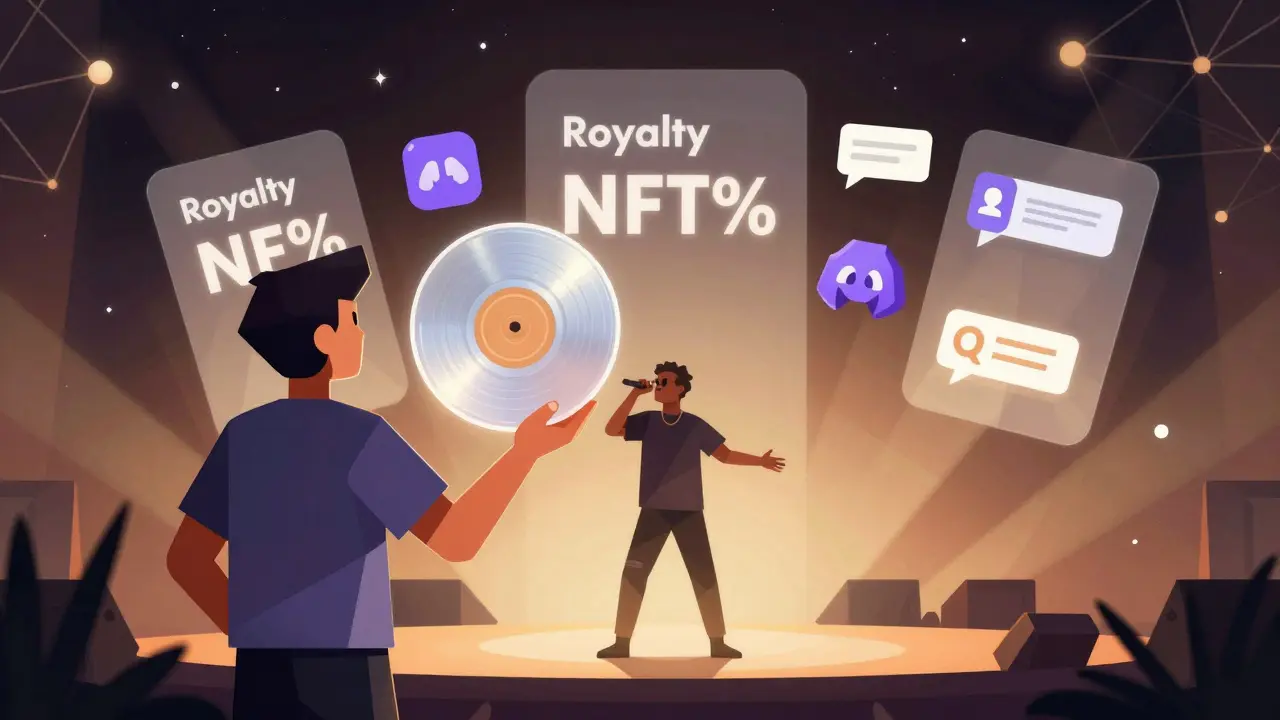
- Access to private Discord channels or live Q&As
- Algorithmically generated music - where each listen creates a slightly different version
- Future royalty rights or voting power in artist decisions
Some artists release limited editions - say, 100 NFTs for a new single. Each one is numbered, and only the first 10 owners get a live performance invite. Others release generative music NFTs, where the song evolves based on who owns it. Imagine a track that changes its beat every time a new collector joins - it’s art that grows with its community.
Why Do People Pay for Music NFTs?
It’s not just about money. People buy music NFTs because they want to feel connected. Owning an NFT from your favorite artist isn’t like buying a playlist - it’s like becoming a patron. You’re not just a listener. You’re part of something bigger.
Early supporters of artists like 3LAU, Grimes, and Snoop Dogg have seen their NFTs increase in value as those artists gained more attention. Some NFTs sold for $100 and now trade for over $10,000. That’s speculation, sure - but it’s also proof that fans are willing to invest in creators they believe in.
For collectors, it’s about rarity. There’s only one NFT with the original demo of a song. Only one with handwritten lyrics. Only one that includes a voice note from the artist. These aren’t just files - they’re pieces of history.
How Do You Buy a Music NFT?
It’s not as simple as clicking ‘Buy Now’ on Amazon. You need:
- A crypto wallet (like MetaMask or Phantom)
- Some cryptocurrency (usually ETH or SOL)
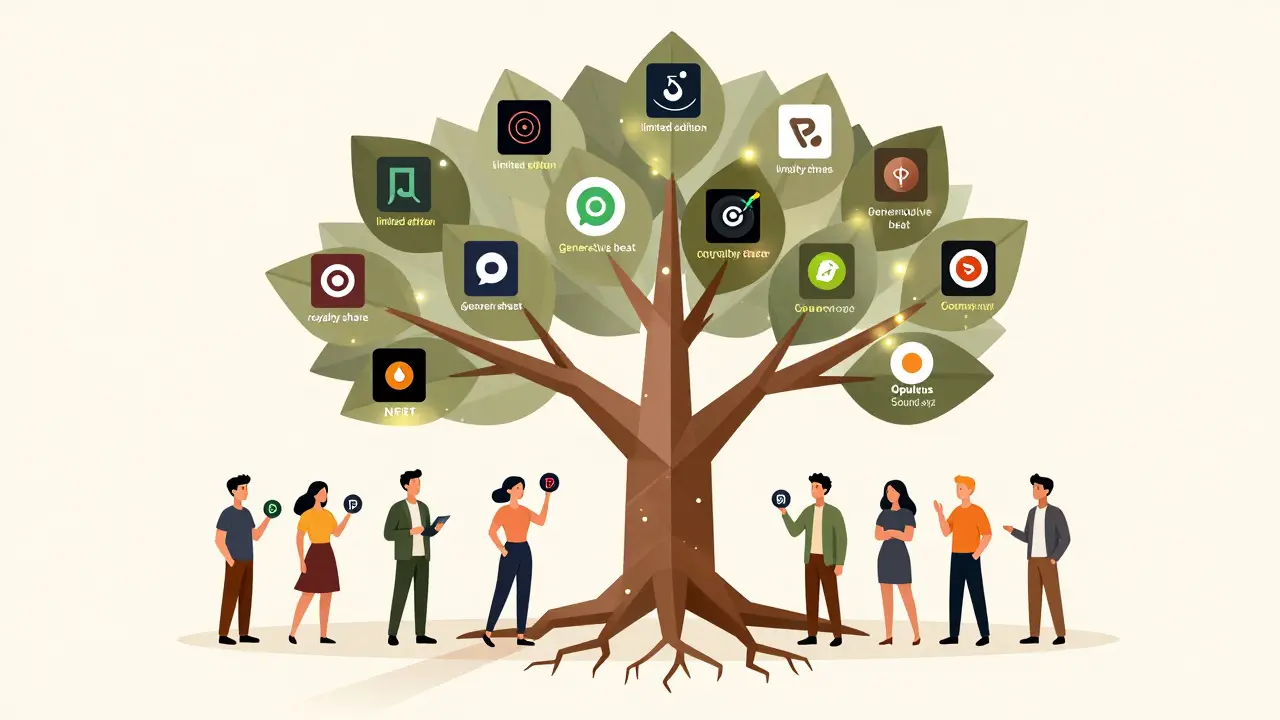
- An account on a music NFT platform (like Royal, Opulous, or Sound.xyz)
Once you’ve set that up, you can browse available NFTs, place bids, or buy outright. Transactions are recorded on the blockchain, so you’ll get a permanent receipt. But here’s the catch: if you don’t know how wallets or gas fees work, you can lose money. Many people buy NFTs and forget to store their private keys - and then lose everything.
That’s why adoption is still limited. Most music fans aren’t ready for crypto. But platforms are trying to fix that. Some now let you buy with a credit card. Others let you earn NFTs by listening to music or sharing playlists. The goal? Make Web3 feel as easy as Spotify.
Is This Just a Speculative Bubble?
Some say yes. The NFT market crashed hard in 2022. Many music NFTs lost 90% of their value. But that’s not the whole story. The ones that survived? The ones tied to real art, real community, and real revenue sharing - those are still growing.
The problem isn’t the technology. It’s the hype. When people treat music NFTs like lottery tickets, they miss the real potential: giving artists control over their work and fans a real stake in their success.
Compare it to the early days of YouTube. No one thought musicians could make money from free videos. But those who built communities did. Music NFTs are at that same inflection point. The tools are still rough, but the shift is real.
What’s Next for Music NFTs?
Artists are testing new models:
- DAOs (decentralized autonomous organizations) where fans vote on album releases
- Smart contracts that automatically split royalties among collaborators
- Integration with streaming services so NFT owners get bonus streams
- Live concerts where your NFT unlocks backstage access or a personalized song
Major labels are watching. Some are quietly buying up NFT platforms. Others are signing artists to hybrid deals - part traditional contract, part blockchain partnership.
The future isn’t about replacing Spotify. It’s about giving artists a new way to survive outside the old system. For independent musicians, that’s not just a novelty - it’s survival.
Final Thoughts
Music NFTs aren’t magic. They won’t fix every problem in the music industry. But they do offer something rare: a path for artists to own their work again - and for fans to truly support them, not just stream them.
If you’re an artist, it’s a chance to cut out the middlemen. If you’re a fan, it’s a chance to be more than a listener. And if you’re just curious? Try buying one small NFT. Not to flip it. But to feel what it’s like to be part of something that’s changing how music is made - and who gets paid.
Ann Liu
March 20, 2026 AT 00:35Music NFTs are fundamentally about reasserting creator sovereignty. The blockchain doesn't just verify ownership-it enforces it. No more opaque royalty splits, no more label middlemen siphoning 80% of revenue. When an artist mints an NFT with smart-contract-embedded royalties, every stream, every resale, every sync license triggers an automatic payout. This isn't speculation-it's accounting reform for the digital age.
And yes, the infrastructure is still clunky. Wallets, gas fees, onboarding friction-but that's like saying the internet was useless in 1995 because you needed to type commands in DOS. The underlying protocol is sound. Adoption follows utility, not convenience.
The real innovation? Permissionless collaboration. A producer in Lagos, a vocalist in Manila, and a mixer in Berlin can co-own a track with transparent, immutable shares. No lawyers. No escrow. Just code. That’s the future. Not hype. Not collectibles. Infrastructure.
Dionne van Diepenbeek
March 20, 2026 AT 12:52Graham Smith
March 21, 2026 AT 01:37The ontological shift here is non-trivial. We're witnessing the commodification of cultural capital through verifiable scarcity protocols on a trustless distributed ledger. The traditional music industry operated on a rent-seeking model predicated on gatekeeping-physical distribution, radio airplay, label A&R. NFTs dissolve those chokepoints by enabling direct peer-to-peer value transfer via cryptographic provenance. The liquidity premium is non-linear: a 1/1 tokenized demo of an unreleased track doesn't merely represent audio-it represents historical artifact status, algorithmically reinforced by community consensus via secondary market activity.
Moreover, the compositional mutability enabled by generative smart contracts introduces a new aesthetic paradigm: music as emergent, evolving, participatory architecture rather than static artifact. This is postmodern sonic ontology in action.
Jerry Panson
March 22, 2026 AT 09:53While the concept of decentralized ownership is theoretically compelling, the practical implementation remains fraught with systemic vulnerabilities. The reliance on volatile cryptocurrency ecosystems introduces financial instability for both creators and collectors. Furthermore, the environmental cost of proof-of-work blockchains, though mitigated by newer consensus mechanisms, still presents an ethical quandary for conscientious participants.
It is also worth noting that the legal status of NFT-based royalties remains ambiguous across jurisdictions. Without standardized regulatory frameworks, enforceability of smart contract terms is uncertain. This is not a rejection of innovation, but a call for responsible, well-structured evolution.
Katrina Smith
March 22, 2026 AT 14:58Anastasia Danavath
March 23, 2026 AT 06:14anshika garg
March 23, 2026 AT 15:52There is something sacred about owning a piece of music that was once only heard in silence-your headphones, your room, your heart. NFTs don’t just change ownership; they change intimacy. When an artist gives you a token, they’re not selling a file. They’re offering a thread in their soul’s tapestry. You become a keeper of memory. A witness to the moment before the world heard it.
Some call it speculation. I call it spiritual commerce. In a world where everything is mass-produced and algorithmically fed, this is a return to the ritual of art. Not as product. As promise. As prayer.
Let the market crash. Let the hype fade. The ones who truly understand-those who listen with their soul, not their spreadsheet-they’ll still be holding the keys. And the music will still be alive.
Bruce Doucette
March 24, 2026 AT 20:42Marie Vernon
March 24, 2026 AT 22:17It’s beautiful how this is creating new kinds of connection. I’ve seen fans from Nigeria, Poland, and Chile forming communities around NFTs from indie artists they’ve never met in person. It’s not about the money. It’s about being part of a story that’s still being written.
I remember when I bought my first NFT-a 1/1 version of a song with handwritten lyrics from a tiny artist in Oregon. I didn’t flip it. I just listened to it every morning while making tea. Now I get updates when new versions drop. It feels like friendship.
We don’t need to force everyone into crypto. We just need to make space for those who want to show up differently. And that’s already happening.
Ross McLeod
March 25, 2026 AT 11:50One must consider the structural implications of this paradigm shift. The traditional music industry’s revenue model was predicated on centralized control of distribution channels, which in turn allowed for economies of scale in marketing, promotion, and physical logistics. The emergence of blockchain-based ownership disrupts this by decentralizing access to both production and monetization, thereby collapsing the vertical integration model that has dominated since the 1950s.
However, this does not eliminate power asymmetries-it merely relocates them. The most successful NFT projects are still those backed by influencers, established artists with existing fanbases, or venture capital-backed platforms. The so-called democratization of music ownership is, in practice, a reconfiguration of privilege rather than its abolition.
Moreover, the technical literacy required to participate meaningfully creates a new form of exclusion. Those without access to digital infrastructure, or those who lack the cognitive bandwidth to navigate wallets, private keys, and gas fees, are effectively disenfranchised. This is not innovation-it is digital redlining.
rajan gupta
March 26, 2026 AT 14:35Billy Karna
March 27, 2026 AT 11:27Let’s get real about what’s actually happening. Music NFTs aren’t replacing streaming-they’re augmenting it. The real value isn’t in owning a token; it’s in the ecosystem that token unlocks. Access to private listening parties. Early drops. Voting on album art. Exclusive studio sessions. These aren’t gimmicks-they’re community-building tools that streaming platforms can’t replicate.
And yes, some NFTs are overpriced junk. But so were cassette tapes in the '80s. So were CDs in the '90s. The market corrects itself. What matters is the long-term shift: artists are regaining agency. Fans are becoming stakeholders. And the value isn’t just monetary-it’s relational.
The next decade won’t be about who has the most streams. It’ll be about who has the most loyal, engaged, empowered listeners. That’s the revolution.
Cheri Farnsworth
March 28, 2026 AT 18:49