
Using a VPN to access cryptocurrency exchanges in China isn’t just a technical workaround-it’s a legal gamble with real consequences. By 2025, China had shut down nearly every avenue for private cryptocurrency activity. Trading, mining, even holding Bitcoin or Ethereum became illegal under a sweeping crackdown led by the People’s Bank of China and other financial regulators. But people still try. They use VPNs to bypass the Great Firewall, log into Binance or Kraken, and trade crypto like nothing changed. What they don’t realize is that they’re stacking two violations on top of each other: breaking financial rules and breaking internet rules.
What’s Actually Illegal in China Right Now?
It’s not just exchanges that are blocked. In 2025, China made it clear: no one-citizen or foreigner-is allowed to trade, mine, or hold cryptocurrencies as financial assets. The rules cover everything: buying Bitcoin with a bank transfer, selling Ethereum for cash, even receiving crypto as payment. The government doesn’t recognize it as money. It doesn’t recognize it as property. And it doesn’t care if you bought it overseas. If you’re in China and you touch crypto, you’re breaking the law.
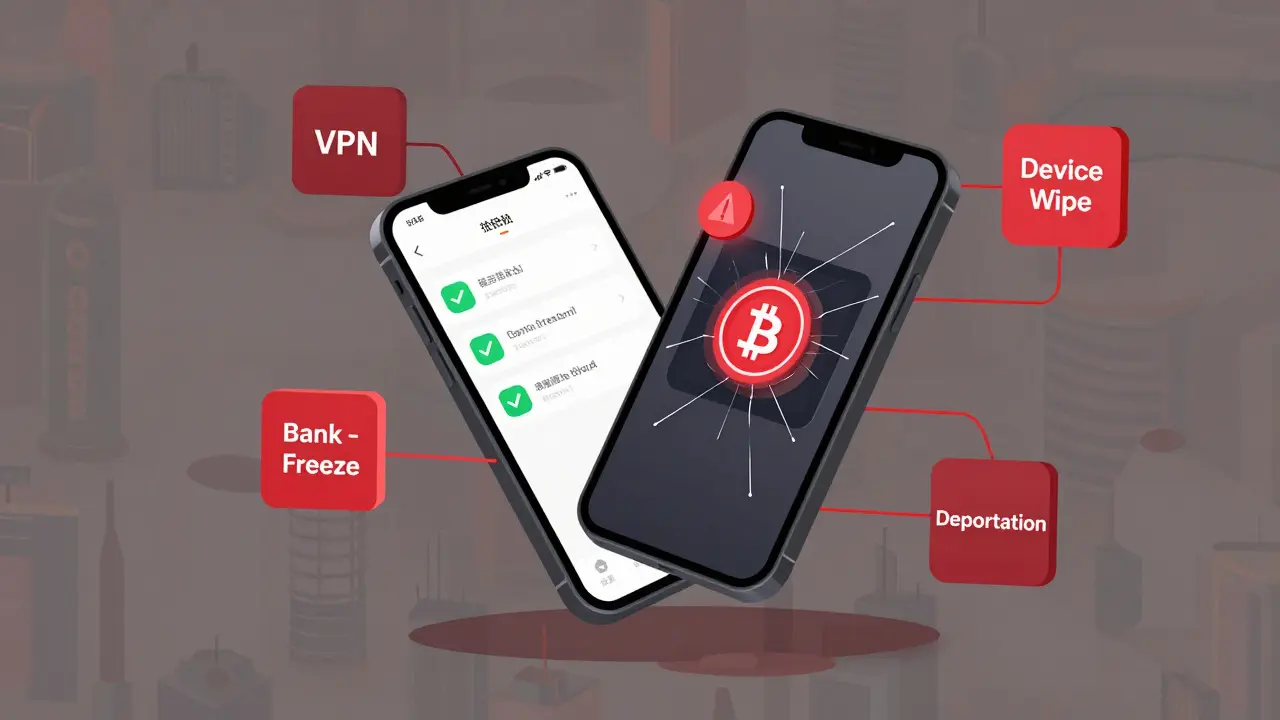
Even worse, banks and payment apps like WeChat Pay and Alipay are required to flag any transaction linked to crypto. If your account sends money to a foreign exchange or receives funds from one, it triggers an automatic alert. The People’s Bank of China, the Ministry of Public Security, and the Cyberspace Administration all get notified. Your account could be frozen. Your phone could be confiscated. You might be called in for a "chat" at the local police station.
VPNs Are Not a Safe Workaround
Most people think using a VPN is harmless-it’s just a tool to browse privately. But in China, that’s not true. The government doesn’t ban all VPNs. It bans unapproved ones. Only state-sanctioned providers are legal, and they don’t let you access foreign websites like Binance. So users turn to third-party apps: ExpressVPN, NordVPN, Astrill. These work… sometimes. But the Great Firewall is always watching. It detects patterns. It blocks IP ranges. It shuts down servers overnight.
There’s no guarantee your VPN will work tomorrow. One day you’re trading Bitcoin. The next, your connection drops. Your app disappears from your phone. Your mobile carrier sends a message: "Your service has been suspended due to unauthorized network access." You have to go to a local office, prove you’re not a criminal, and beg for your service back. Some users report having their phones wiped clean-VPNs, crypto wallets, even browser history deleted-before being allowed to use their device again.
The Real Danger: Overlapping Crimes
The biggest risk isn’t just using a VPN. It’s using a VPN for crypto. That combination turns a gray-area tech issue into a serious legal threat. You’re not just bypassing internet controls-you’re enabling financial activity that’s been outlawed. Authorities treat this as a dual violation: circumventing state censorship + engaging in illegal financial transactions.
There are no public records of people being jailed just for using a VPN. But there are cases of people being fined, having assets seized, or even charged with "illegal fundraising" or "money laundering" when their crypto trades reached certain volumes. In one 2024 case in Guangdong, a man transferred $200,000 worth of Ethereum through a VPN-connected wallet. He wasn’t trading-it was a personal transfer. But because he used an unapproved VPN and the funds moved through a foreign exchange, prosecutors treated it as an illegal cross-border capital flow. His assets were frozen. He paid a fine of 300,000 RMB ($41,000) and lost the crypto.
Foreigners aren’t safe either. Tourists, expats, business travelers-they’re subject to the same rules. If you’re caught trading crypto on your phone while staying in Shanghai, you can be deported. Your visa revoked. Your bank account in China closed. No warning. No second chance.
Why the Digital Yuan Isn’t the Answer
China isn’t trying to ban crypto because it hates technology. It’s trying to control money. That’s why the government is pushing the digital yuan (e-CNY) so hard. Unlike Bitcoin or Ethereum, the digital yuan is fully traceable. Every transaction is logged by the central bank. There’s no anonymity. No decentralization. No risk of capital flight.
The digital yuan works through state-approved apps. You can use it to pay for groceries, bus rides, even rent. But you can’t send it overseas without approval. You can’t trade it on open markets. You can’t use it to buy crypto. It’s designed to replace cash, not compete with Bitcoin. And it’s growing fast-over 500 million users by late 2025, with pilot programs in 26 provinces.
Trying to use crypto alongside the digital yuan is like trying to drive a Tesla in a city that only allows bicycles. The system doesn’t support it. The infrastructure doesn’t allow it. And the authorities won’t tolerate it.
What Happens If You Get Caught?
There’s no single punishment. It depends on how much you traded, how often, whether you promoted it to others, and whether you used a local or foreign VPN provider. Most first-time offenders face administrative penalties: fines, account freezes, mandatory counseling at a local police station. Repeat offenders or those moving large sums risk criminal charges.
Common outcomes include:
- Bank account frozen for 3-12 months
- Confiscation of crypto holdings (no compensation)
- Deletion of apps and data from personal devices
- Loss of mobile service until you sign a statement agreeing not to use VPNs
- Criminal investigation for "illegal business operations" if you helped others access crypto
There’s no appeal process. Once your assets are seized, they’re gone. No court, no lawyer, no refund. The government doesn’t have to prove you knew the law. If you used a VPN to access crypto, you’re assumed to have known the risk.

Who’s Really at Risk?
It’s not just traders. It’s anyone who touches crypto in China:
- Students receiving crypto as payment for freelance work
- Investors holding crypto from before the 2025 ban
- Developers building blockchain tools-even if they’re not trading
- People who accepted crypto as a gift
Even owning crypto in a wallet you never used can be flagged if your IP address connects to a known exchange through a blocked VPN. The system doesn’t care if you meant no harm. It only cares if you broke the rules.
There’s No Safe Way to Do This
Some people say, "I just use it for research," or "I only access it from my laptop when I travel." But the system doesn’t distinguish. Once your device connects to a crypto exchange through an unapproved VPN, you’re in the system. Your digital footprint is recorded. Your behavior is analyzed. Your risk score goes up.
There are no "safe" VPNs in China for crypto. Even the most reliable ones get blocked without warning. Even the most cautious users get caught. The government doesn’t need to catch everyone. It just needs to catch enough to scare the rest.
What Should You Do Instead?
If you’re in China and you want to use digital assets, your only legal option is the digital yuan. It’s not perfect. It’s not decentralized. But it’s the only one the government won’t shut down. Use it for payments. Use it for savings. Don’t try to turn it into Bitcoin.
If you’re outside China and you’re considering sending crypto to someone inside, don’t. You’re not helping them. You’re putting them at risk. Their bank account, their phone, their freedom-everything could be on the line.
There’s no workaround that’s safe. No trick that works long-term. No loophole that won’t get closed tomorrow. The rules aren’t going to change. The digital yuan is the future-and private crypto has no place in it.
Is it illegal to own cryptocurrency in China?
Yes. As of June 2025, China’s regulations explicitly prohibit private cryptocurrency ownership, trading, and mining. While courts have occasionally recognized crypto as property in civil cases like divorce or fraud, this doesn’t make it legal to hold or transfer. Any crypto you own is considered an illegal asset and can be seized without compensation.
Can I use a VPN to access Binance from China?
Technically, some people still do-but it’s risky. Binance has been blocked since 2017, and the Great Firewall actively blocks known VPN servers. Even if you get connected, your traffic can be logged, your device flagged, or your internet service suspended. Using a VPN for crypto access combines two violations: circumventing censorship and engaging in illegal financial activity.
What happens if I’m caught trading crypto with a VPN?
You could face fines, asset seizure, account freezes, or even criminal charges if your transactions are large or involve others. Your phone might be confiscated and wiped. Your bank account could be locked. Foreigners risk deportation. There’s no formal appeal process-authorities act quickly and without warning.
Is the digital yuan the same as Bitcoin?
No. The digital yuan (e-CNY) is a state-controlled digital currency issued by China’s central bank. It’s not decentralized, not anonymous, and not traded on open markets. It’s designed to replace cash, not compete with crypto. Unlike Bitcoin, every transaction is tracked by the government, and there’s no way to use it to access foreign exchanges.
Are tourists safe using crypto in China?
No. Tourists are subject to the same laws as Chinese citizens. If you use a VPN to trade crypto while visiting China, you can be fined, have your devices seized, or be deported. Authorities don’t make exceptions based on nationality. Your passport doesn’t protect you from financial regulations.
Can I use crypto for remittances from China?
No. Sending crypto out of China is treated as an illegal cross-border capital transfer. The State Administration of Foreign Exchange (SAFE) monitors all international financial flows. Even small transfers via crypto can trigger investigations. The only legal way to send money abroad is through approved channels like bank wire transfers with proper documentation.
Will China ever legalize Bitcoin again?
Almost certainly not. China’s goal is total control over its financial system. The digital yuan is its tool for that. Bitcoin and other decentralized cryptocurrencies represent a threat to that control. All signs point to stricter enforcement, not loosening. The government is investing billions into blockchain tech-but only for state-approved uses like supply chain tracking, not open crypto markets.
CHISOM UCHE
January 16, 2026 AT 07:47China’s crypto crackdown isn’t about control-it’s about erasing financial autonomy. The digital yuan is a surveillance tool dressed as innovation. Every transaction tracked, every byte logged. This isn’t progress-it’s financial authoritarianism wrapped in code.
Shaun Beckford
January 17, 2026 AT 00:15Let’s be real-anyone using a VPN for crypto in China is either delusional or suicidal. The Great Firewall doesn’t just block sites, it hunts users. I’ve seen reports of people getting fined for holding ETH in a wallet they never touched. The system doesn’t care about intent. It cares about existence.
Bryan Muñoz
January 18, 2026 AT 20:07THEY KNOW YOU’RE DOING IT. THEY’RE WAITING. THEY’RE NOT JUST BLOCKING VPNs-they’re building AI that flags your typing rhythm, your app usage patterns, your battery drain when you open a crypto wallet. This isn’t a ban. It’s a digital trap. And you’re already in it. 🤖💥
Pat G
January 20, 2026 AT 07:50China’s doing what every sovereign state should do-protect its monetary sovereignty. Crypto is a Western scam built on speculation and anonymity. The digital yuan is the future. Anyone fighting it is just clinging to a dying ideology. Stop romanticizing lawbreaking as rebellion.
Lauren Bontje
January 21, 2026 AT 13:42Oh please. The ‘digital yuan is surveillance’ narrative is just crypto bros crying because they lost their tax-free casino. China’s not evil-it’s smart. Letting unregulated digital assets flow freely would collapse their economy. Your ‘freedom’ is their systemic risk.
Kelly Post
January 22, 2026 AT 13:43I’ve spoken with Chinese developers who quietly run nodes in their homes. They don’t trade. They don’t speculate. They just believe in the tech. But even that’s becoming dangerous. The line between ‘research’ and ‘illegal activity’ is being erased. We’re watching a society dismantle digital rights under the guise of stability.
Deb Svanefelt
January 24, 2026 AT 03:34There’s a chilling philosophical irony here: China is constructing the most centralized digital monetary system in human history, all while claiming to advance technological sovereignty. But in doing so, it extinguishes the very principle that made crypto revolutionary-decentralized trust. The digital yuan isn’t money-it’s a ledger of compliance. And compliance, when enforced by surveillance, is the opposite of freedom.
Dustin Secrest
January 24, 2026 AT 09:45It’s funny how people act like China invented digital control. The Fed tracks every dollar. The EU monitors every transaction. The difference? China doesn’t pretend it’s not watching. At least they’re honest about the trade-off: convenience for control. You want privacy? Then don’t live in a country that demands obedience.
Pramod Sharma
January 25, 2026 AT 10:51Stop fighting the system. Adapt. Use e-CNY. It’s faster, cheaper, and legal. Crypto is dead in China. The war is over. The government won. Move on.
Bharat Kunduri
January 27, 2026 AT 00:27lol i used binance last week on my phone in shanghai. vpn worked. nothin happened. maybe they just dont care about small fries? 🤷♂️
Bill Sloan
January 28, 2026 AT 18:10Guys. This isn’t just about crypto. It’s about the future of the internet. If China can erase private finance and censor access globally, what’s next? Private messaging? End-to-end encryption? This is the template. They’re not just banning Bitcoin-they’re building the blueprint for a digital police state. Wake up.
Rod Petrik
January 30, 2026 AT 01:58they planted spyware in popular vpn apps years ago. you think you're safe but your wallet seed is being sent to the cia or whoever runs the firewall. your phone is already compromised. dont use any vpn. dont touch crypto. dont even look at the word 'bitcoin' on your screen. they're watching. always watching. 😈
Stephanie BASILIEN
January 31, 2026 AT 15:20One must consider the epistemological framework under which state-sanctioned digital currencies operate: they are not merely instruments of monetary policy, but ontological assertions of state supremacy over individual economic agency. The digital yuan, therefore, represents not an evolution of currency, but a metaphysical reconfiguration of the relationship between citizen and sovereign. One cannot ‘opt out’ of this paradigm without surrendering one’s status as a participant in the national economic body.
Chris Evans
February 2, 2026 AT 15:14Let’s not pretend this is about money. It’s about control. China’s building a society where dissent isn’t punished-it’s rendered irrelevant. If you can’t trade crypto, you can’t organize. If you can’t move value privately, you can’t resist. The digital yuan isn’t a currency. It’s a cage with a QR code. And the people who think they’re just ‘using a VPN’? They’re already inside.