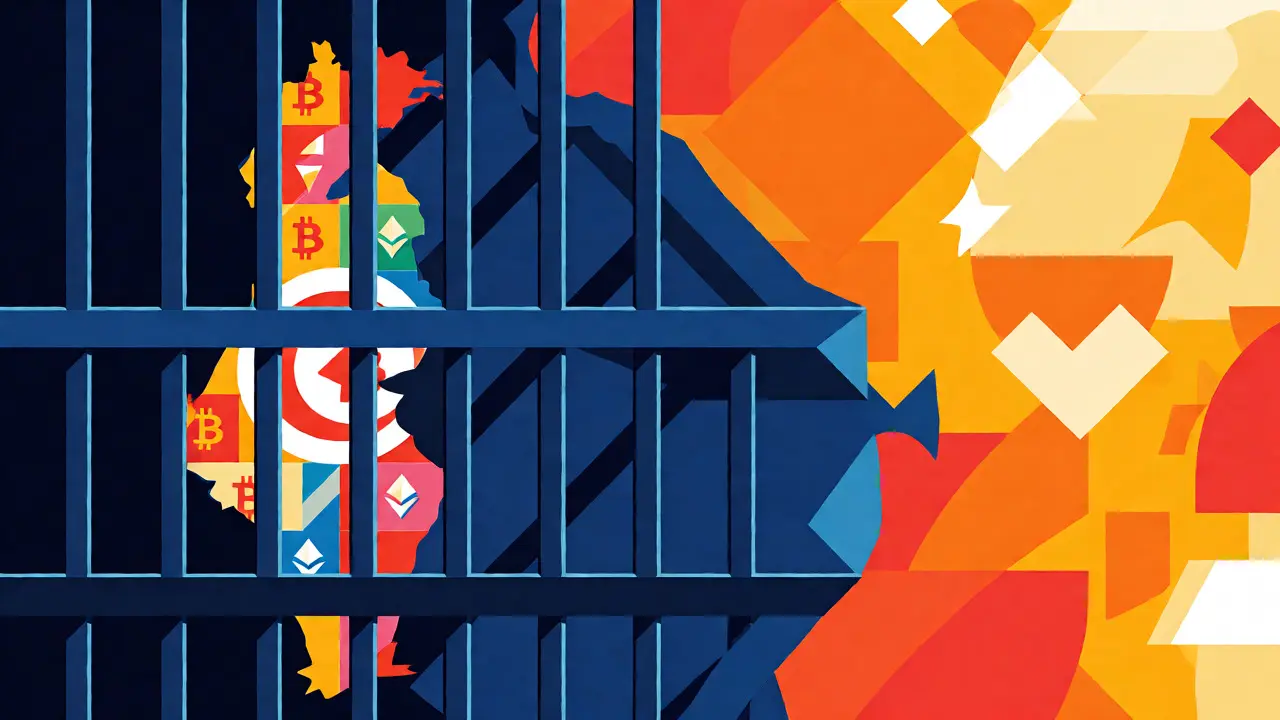
Imagine buying a coffee in Tunis with Bitcoin. In most of the world, this is becoming routine. In Tunisia, it could land you in prison. This isn't an exaggeration or a minor regulatory hiccup; it is the reality of one of the strictest crypto bans on the planet. While neighbors like Morocco are debating their stance and global giants like El Salvador have made Bitcoin legal tender, Tunisia has kept its doors firmly shut since 2018.
If you're an expat, a digital nomad, or just curious about how different regions handle digital money, understanding Tunisia's position is crucial. It’s not just about banning coins; it’s about protecting a fragile economy from capital flight. But as technology evolves and younger generations push for change, cracks are starting to show in this rigid framework. Here is exactly what the law says, why it exists, and where it might be heading next.
The Core of the Prohibition
At the heart of the issue is a directive issued by the Central Bank of Tunisia (BCT) in May 2018. Before this date, things were murky. From 2013 to 2017, people traded Bitcoin largely through peer-to-peer chat rooms, operating in a gray area. The 2018 directive cleared that up with a sledgehammer. It declared that any transaction involving virtual currencies without explicit state authorization is illegal.
This wasn't a partial restriction. It was a blanket ban. The BCT stated clearly that cryptocurrencies do not have legal tender status in Tunisia. Consequently, they cannot be used for payments, trading, or investment within the country. The logic was straightforward from the regulator's perspective: if the state doesn't control the currency, it can't manage the economy effectively. For a country already struggling with balance of payments issues, the idea of money flowing out via untraceable digital assets was a nightmare scenario.
What Activities Are Actually Illegal?
You might think, "Okay, I'll just keep my Bitcoin in a hardware wallet at home." Think again. The scope of the ban is incredibly broad. It covers:
- Public Trading: Operating an exchange or facilitating trades between users is prohibited.
- Merchant Payments: Shops and service providers cannot accept crypto for goods or services.
- Mining Operations: Importing mining rigs, such as ASICs, often leads to seizure by customs authorities. Converting mined coins into Tunisian dinars is also a violation.
- Holding Assets: While holding isn't always actively prosecuted for small amounts, the legal framework technically classifies unauthorized possession and exchange as violations of currency control regulations.
Banks play a critical enforcement role here. Since 2018, Tunisian banks have been instructed to block card purchases on foreign exchanges. If you try to buy crypto using a local debit card on a platform like Binance or Coinbase, the transaction will likely fail or be flagged. This creates a significant barrier for anyone trying to enter the market legitimately.
Penalties: More Than Just Fines
The consequences of ignoring these rules can be severe. Under Tunisia's currency-control regulations, violating the crypto ban can result in fines and imprisonment. The maximum penalty cited in various legal interpretations is up to five years in jail. This isn't just a slap on the wrist.
A notable incident in 2021 brought this harsh reality into the spotlight. A teenager was jailed for exchanging a relatively small amount of cryptocurrency. This case sparked widespread public debate and even reached cabinet-level discussions. Critics argued that criminalizing basic financial literacy or small-scale experimentation was disproportionate. Yet, the government held firm, signaling that they were willing to use heavy-handed tactics to maintain monetary sovereignty.
Why Did Tunisia Choose Total Ban Over Regulation?
It’s easy to look at Tunisia’s approach and call it backward-looking, especially when compared to countries like Germany or Singapore, which have built robust regulatory frameworks. However, the decision stems from specific economic anxieties rather than pure technophobia. The primary drivers were:
- Capital Flight: Tunisia faces pressure on its foreign exchange reserves. If citizens move wealth into Bitcoin, those dollars leave the local banking system, weakening the dinar.
- Money Laundering: The anonymity of crypto poses risks for anti-money laundering (AML) compliance. Without strict KYC (Know Your Customer) protocols integrated into the national banking system, regulators fear illicit flows.
- Monetary Policy Control: Central banks rely on controlling the money supply to manage inflation and interest rates. Cryptocurrencies operate outside this sphere, making them difficult to influence or tax effectively.
Tunisia isn't alone in this thinking. It joins a small club of nations with total bans, including Algeria, Morocco, Egypt, Nepal, Bangladesh, Qatar, and China. Most other countries opted for regulation instead of prohibition, but Tunisia prioritized stability over innovation.
The Underground Market and Real-World Usage
Despite the ban, cryptocurrency hasn't vanished from Tunisia. An underground ecosystem persists. Enforcement varies, and while large commercial operations are shut down, small-scale peer-to-peer (P2P) trading continues. People meet online, agree on prices, and transfer funds via bank transfers or cash handovers, keeping the crypto transactions off the books.
However, this comes with high risk. There are no consumer protections. If you send your Bitcoin and the counterparty disappears, you have little recourse because the transaction itself was technically illegal. Mainstream adoption remains negligible. You won't find a cafe accepting Dogecoin in Sousse. The legal uncertainty scares off both merchants and average consumers who don't want to deal with potential police scrutiny.

Blockchain vs. Cryptocurrency: The Nuanced Exception
Here is where it gets interesting. While Tunisia bans cryptocurrencies, it hasn't banned blockchain technology. In fact, the government sees value in the underlying tech. The BCT launched a regulatory sandbox in 2020, allowing select fintech companies to test blockchain applications under tight supervision.
Startups like VFunder (for crowdfunding), Hydro E-Blocks (carbon tracking), and No Phobos (AI-generated NFTs) have participated in these programs. These projects typically focus on permissioned ledgers-private blockchains where access is controlled-rather than public cryptocurrencies like Bitcoin or Ethereum. The goal is to improve transparency in areas like land registry digitization and subsidy distribution. So, while you can't pay for bread with Bitcoin, the state might use blockchain to track who received agricultural subsidies.
| Country | Status | Key Characteristics |
|---|---|---|
| Tunisia | Total Ban | Prohibits trading, mining, and payments. Severe penalties. Focus on capital control. |
| Algeria | Total Ban | Similar strict prohibition on purchase, sale, and use. No legal recognition. |
| Morocco | Restrictive/Ban | Officially banned by central bank, but enforcement varies. Debates ongoing about legalization. |
| Egypt | Religious/Legal Ban | Islamic scholars deemed it haram; central bank prohibits dealing. Strong cultural resistance. |
Is Change Coming? The Path Forward
The landscape is shifting slowly. As of 2025, parliamentary committees have been considering a draft bill to decriminalize cryptocurrency possession and create a licensing regime. This represents the most significant potential shift since 2018. The argument is simple: absolute prohibition may be unsustainable in a digital age.
The Digital Tunisia 2025 project highlights blockchain for supply chain transparency, indicating institutional acceptance of the tech. Policymakers are balancing innovation against the need for currency stability. If the new bill passes, we might see a regulated environment where licensed exchanges can operate, subject to strict AML checks and reporting requirements similar to traditional finance.
For now, though, caution is key. If you plan to visit or live in Tunisia, treat your crypto holdings with care. Don't advertise your holdings, avoid large local transactions, and remember that the law favors the state's control over individual financial freedom.
Is it illegal to own Bitcoin in Tunisia?
Technically, yes. The Central Bank of Tunisia's 2018 directive prohibits all transactions involving virtual currencies without state authorization. While mere possession in a private wallet is hard to enforce, exchanging or using it violates currency control laws, potentially leading to fines or imprisonment.
Can tourists use crypto in Tunisia?
No. Merchants are strictly prohibited from accepting digital assets as payment for goods or services. All crypto payments within the state are classified as illegal. Tourists should stick to Tunisian Dinars or major fiat currencies like USD or EUR.
Are there any exceptions to the crypto ban?
Yes, limited exceptions exist for blockchain technology, not cryptocurrencies themselves. The BCT regulatory sandbox allows selected fintech startups to test blockchain applications like supply chain tracking and digital identity on permissioned ledgers. These projects must operate under strict supervision and volume limits.
What happens if I import a mining rig to Tunisia?
Customs authorities are authorized to seize ASIC mining rigs upon import. Additionally, converting mined coins into Tunisian dinars constitutes a violation of the 2018 directive, exposing the miner to legal penalties including fines and potential jail time.
Will Tunisia lift the crypto ban soon?
There are signs of change. As of 2025, parliamentary committees are discussing a draft bill to decriminalize possession and introduce licensing. However, the timeline is uncertain. Policymakers remain cautious due to concerns about capital flight and currency stability, so any changes will likely be gradual and highly regulated.