
Remember the days when getting your music heard meant begging radio stations for airtime or paying thousands for ads? The landscape has shifted. Now, blockchain technology is rewriting the rules of how artists connect with fans and how fans get rewarded for their support. At the center of this shift is The HUSL, a blockchain-based platform designed to reshape the music industry by connecting artists and fans through decentralized finance and non-fungible tokens. If you’ve been hearing buzz about the latest HUSL airdrop, you’re not alone. But before you jump in, you need to know exactly how it works, what’s at stake, and whether this project has legs beyond the hype.
This isn’t just another token giveaway. It’s part of a broader ecosystem that aims to solve real problems in the music business-like unfair royalty splits and lack of artist control. In this guide, we’ll break down the current MEXC Exchange campaign, explain the tech behind the scenes, and help you decide if participating makes sense for your portfolio.
What Is The HUSL?
Let’s start with the basics. The HUSL is more than just a place to buy digital art. It’s a DeFi Art ecosystem specifically built for music. Founded by CEO Varun Bajaj, the platform launched on September 12, 2021, on the Ethereum network. The goal was simple but ambitious: create a peer-to-peer system where artists can monetize their work directly, and fans can own a piece of that success.
Unlike general marketplaces like OpenSea, which host everything from profile pictures to virtual land, The HUSL focuses exclusively on audio and music-related assets. This specialization allows for features that generic platforms can’t offer, such as stem pack distribution. When you buy an NFT on The HUSL, you might receive not just the final track, but the individual stems (vocals, drums, bass) used to create it, along with full commercial rights. Imagine buying a beat that producers usually charge $10,000 to $50,000 for, and owning the rights to use it in your own projects. That’s the value proposition here.
| Feature | The HUSL | OpenSea / Generic Platforms |
|---|---|---|
| Primary Focus | Music & Audio NFTs | All types of digital assets |
| Upload Fees | Free for artists | Often requires gas fees or listing costs |
| Commercial Rights | Often included with purchase | Rarely included; mostly collectibles |
| Artist Compensation | Direct, no intermediaries | Variable, often platform-dependent |
The platform raised 65,000 BUSD during its initial fundraising round, selling HUSL tokens at $0.2 each. As of October 2025, the token holds a CoinMarketCap ranking of #3445, with a market cap hovering around $10,574 USD. While these numbers might look small compared to giants like Bitcoin or Ethereum, they reflect a niche player surviving in a volatile market. The low market cap also means high volatility, so caution is always advised.
How the MEXC Kickstarter Airdrop Works
The most significant opportunity right now is the collaboration between The HUSL and MEXC Exchange. This isn’t a random tweet giveaway; it’s structured as a Kickstarter campaign. Here’s what you need to know to participate effectively.
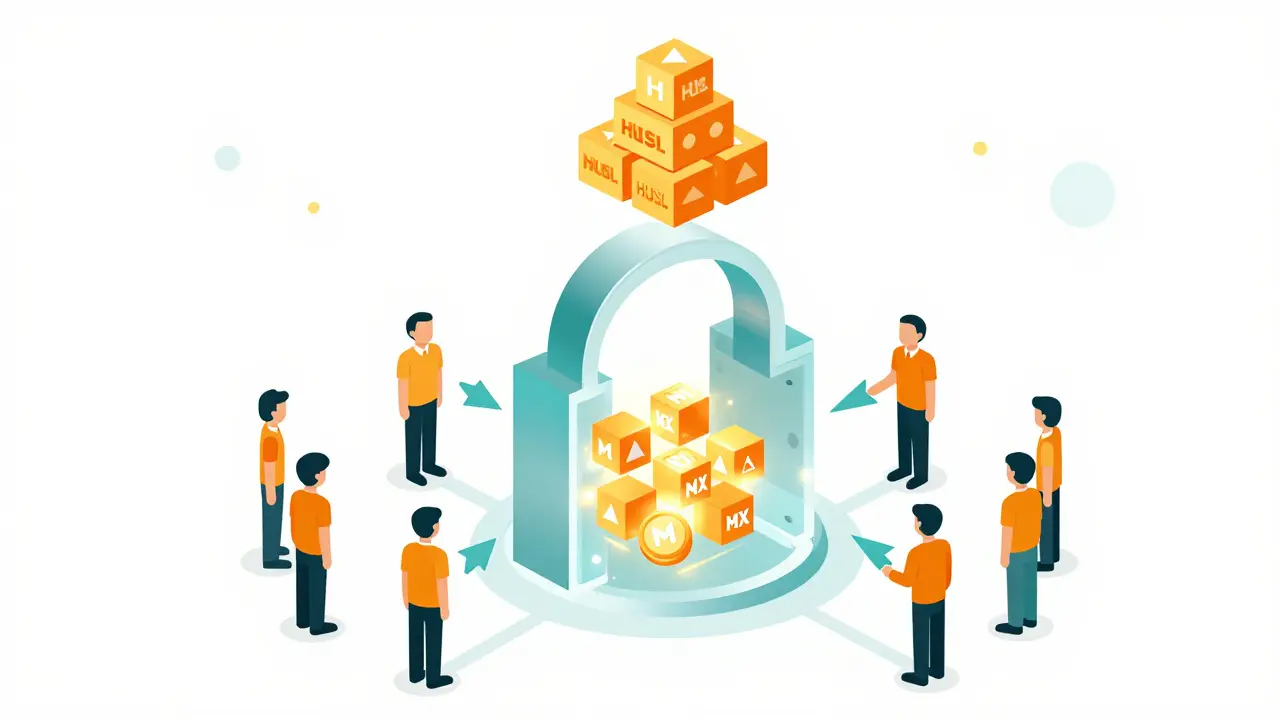
The reward pool sits at 50,000 HUSL tokens. With a reference price of $1.00 per token, the total value of this airdrop is $50,000. Sounds good, right? But there’s a catch-you have to put skin in the game. To vote in this campaign, you need to use MX tokens, the native token of MEXC Exchange.
Here are the specific rules:
- Minimum Votes: You must cast at least 10 votes to qualify.
- Voting Cap: You can lock up to 500,000 MX tokens.
- Token Locking: Your MX tokens are temporarily locked during the event. They unlock within one hour after the campaign ends.
- Distribution: Rewards are distributed proportionally based on your total votes relative to all participants.
There’s also a bonus layer. Out of all participants, 500 users who hold total assets exceeding 1,000 MX tokens will be randomly selected to receive a 10 USDT Futures Bonus. These bonuses are distributed within seven working days after the event concludes. This adds a lottery-style element to the campaign, encouraging higher engagement from serious traders.
Why does MEXC do this? It’s about liquidity and visibility. By locking MX tokens, you’re demonstrating commitment to the exchange, and in return, you get exposure to new projects like The HUSL. For The HUSL, it’s a way to distribute tokens widely and build a community of early adopters without spending massive marketing budgets.
The Tech Behind the Trust: Chainlink VRF
If you’ve been burned by rigged giveaways or opaque algorithms in the past, you’ll appreciate the technical backbone of The HUSL. The platform integrates Chainlink VRF (Verifiable Random Function), a service that provides cryptographically secure random numbers for smart contracts.
Why does this matter? In many blockchain games or NFT drops, the "random" selection of winners or rare items is generated off-chain by a central server. Users have to trust that the company isn’t rigging the odds. With Chainlink VRF, the randomness is proven on-chain. Anyone can audit the process to ensure it was fair. This transparency addresses a major pain point in the crypto space: trust.
CEO Varun Bajaj highlighted this feature during his appearance on Chainlink’s NFTs & Gaming YouTube series. He emphasized that The HUSL isn’t just using blockchain as a buzzword; it’s leveraging it to build a verifiable, fair system for distributing rewards. This is crucial for a platform that promises experiential rewards, like exclusive beats or fan experiences, where fairness directly impacts user satisfaction.
Who Are the Artists on The HUSL?
A platform is only as good as its content. The HUSL has made moves to attract credible talent, moving beyond anonymous indie producers. One notable partnership involves members of 808 Mafia, including Pvlace and Gunboi. These producers have contributed to dozens of Billboard number-one hits in recent years. Their involvement signals that The HUSL is aiming for professional-grade quality.
Additionally, rapper Styles P recorded proof-of-concept material on the platform, demonstrating the quality of beats available. This isn’t just about slapping a logo on a JPEG; it’s about integrating with established industry players who understand the value of intellectual property. When a producer known for charging $50,000 per beat joins your platform, it validates the model.
For emerging artists, the barrier to entry is lower. The HUSL offers completely free music uploads. This creates an equal playing field, allowing unknown bands to showcase their work alongside bigger names. However, discovery remains a challenge. Without organic traffic, even great music can get lost. This is where the tokenomics come into play-the HUSL token incentivizes users to listen, engage, and promote artists, creating a "compete-for-attention" economy.
Is the HUSL Token Worth It?
Let’s talk numbers. As mentioned, the market cap is relatively low ($10,574 USD as of late 2025). This indicates limited mainstream adoption. While this can mean high growth potential if the platform takes off, it also carries significant risk. Many NFT projects launched in 2021 failed to survive the bear market. The HUSL has survived, which is a positive sign, but survival isn’t the same as thriving.
The token’s utility is tied to the platform’s activity. If more artists upload music and more fans buy NFTs, demand for HUSL tokens could rise. Currently, the token is used for governance, staking, and accessing premium features. The MEXC airdrop is a short-term incentive, but long-term value depends on the platform’s ability to generate revenue. Can they scale partnerships with producers? Can they convince labels to join? These are the questions investors should ask.
Also, consider the competition. Spotify and Apple Music dominate streaming, but they don’t offer ownership. Other NFT platforms like Sound.xyz focus on music too. The HUSL’s differentiator is the combination of free uploads, commercial rights, and Chainlink-backed fairness. Whether this is enough to steal market share remains to be seen.
How to Participate Safely
If you decide to join the MEXC Kickstarter, follow these steps to protect yourself:
- Use a Secure Wallet: Ensure your MetaMask or hardware wallet is updated and protected with strong passwords and two-factor authentication.
- Verify Links: Only access the campaign through official MEXC channels. Phishing sites often mimic airdrop pages to steal credentials.
- Calculate Costs: Remember that locking MX tokens ties up capital. Make sure you’re comfortable with the opportunity cost of those funds being unavailable for other trades during the lock period.
- Check Tax Implications: In many jurisdictions, airdrops are considered taxable income. Keep records of the value received and consult a tax professional if needed.
Don’t invest more than you can afford to lose. The crypto market is unpredictable, and NFT valuations can swing wildly. Treat the airdrop as a speculative opportunity, not a guaranteed profit.
Future Outlook for The HUSL
The future of The HUSL hinges on execution. The team has the tech (Chainlink integration), the vision (artist empowerment), and some high-profile partners. What’s missing is mass adoption. To grow, they need to onboard more listeners and creators. The MEXC campaign is a step in that direction, bringing in crypto-native users who might become active participants.
Long-term viability also depends on regulatory clarity. As governments scrutinize NFTs and crypto assets, platforms that prioritize compliance and transparency (like using auditable randomness) will have an advantage. The HUSL’s focus on real-world utility-commercial rights, stem packs-positions it better than pure speculative NFT projects.
If you’re an artist, The HUSL offers a unique chance to retain control over your work. If you’re a fan, it offers a way to support artists while potentially earning rewards. But stay skeptical, do your research, and never let FOMO drive your decisions.
When did The HUSL launch?
The HUSL platform launched on September 12, 2021, on the Ethereum network following a successful fundraising round.
How much is the MEXC HUSL airdrop worth?
The total airdrop pool is 50,000 HUSL tokens, valued at approximately $50,000 based on a reference price of $1.00 per token.
Do I need to pay to enter the airdrop?
Yes, participation requires voting with MX tokens. You must lock a minimum of 10 votes, with a maximum cap of 500,000 MX tokens. These tokens are unlocked one hour after the campaign ends.
What is Chainlink VRF and why does The HUSL use it?
Chainlink VRF provides cryptographically secure random numbers. The HUSL uses it to ensure fair and auditable distribution of NFTs and rewards, preventing manipulation by central servers.
Can artists upload music for free on The HUSL?
Yes, The HUSL offers completely free music uploads for all artists, removing traditional barriers to entry and providing an equal playing field for emerging and established talent.
What is the current market cap of HUSL token?
As of October 2025, The HUSL token has a market capitalization of approximately $10,574 USD, ranking #3445 on CoinMarketCap.
Who are some notable artists on The HUSL?
Notable collaborators include members of 808 Mafia (Pvlace and Gunboi) and rapper Styles P, who have created content and demonstrated the platform's capabilities.
Do buyers get commercial rights to NFTs on The HUSL?
In many cases, yes. Buyers often receive complete production elements (stems) along with full commercial rights, allowing them to use the beats in their own commercial projects.