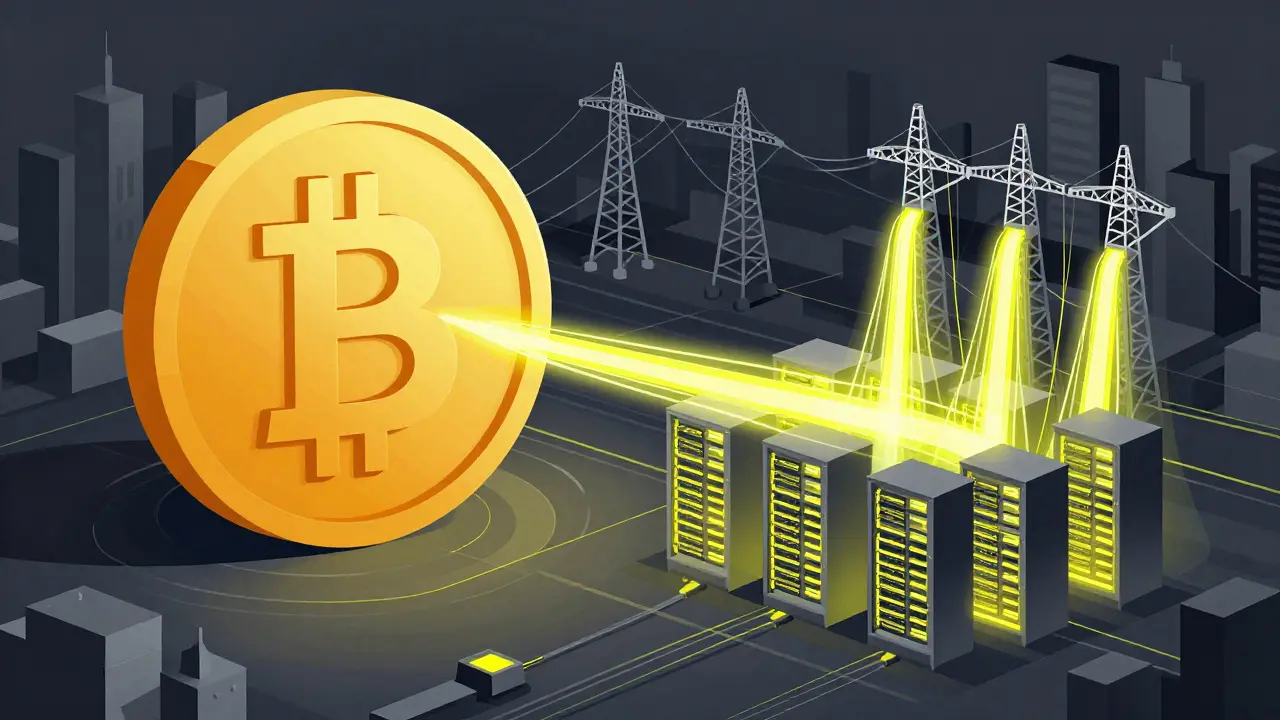
Mining digital gold sounds exciting until you realize it takes as much power as a medium-sized country. For years, the conversation around Proof of Work is a consensus mechanism that requires miners to solve complex mathematical puzzles to validate transactions and secure a blockchain network. Commonly associated with PoW, this system is the bedrock of the original cryptocurrency revolution, but it comes with a heavy price tag for the planet.
The core problem isn't just that these computers use electricity; it's the scale and the nature of that demand. To keep a network like Bitcoin secure, thousands of high-powered machines must run 24/7. This creates a permanent, massive drain on power grids that doesn't go away when the sun sets or the wind stops blowing. If you've ever wondered why some people are pushing so hard for a shift in how blockchains work, the answer lies in the staggering amount of carbon emitted and the sheer volume of energy wasted on calculations that serve no purpose other than to prove a miner spent money on electricity.
The Massive Energy Appetite of PoW
To understand the scale, we have to look at the numbers. Bitcoin is the most prominent example of a PoW network. According to data analyzed by Bitwave, Bitcoin alone consumes about 112.06 TWh of electricity annually. To put that in perspective, that's roughly 0.5% of the entire world's electricity consumption. We aren't just talking about a few server farms; we're talking about an energy footprint comparable to the entire nation of Argentina or the Netherlands.
The inefficiency is baked into the design. In a PoW system, miners compete. The more computing power you have, the better your odds of winning the block reward. This leads to an "arms race" where miners buy more powerful hardware, which in turn increases the overall energy requirement of the network. The Cambridge Centre for Alternative Finance (CCAF) monitors this closely, and their data shows that the energy demand remains consistently high, regardless of how many people are actually using the network to send payments.
The individual cost of a transaction is where it gets really shocking. While a traditional digital payment takes negligible energy, a single Bitcoin transaction can require around 707 kWh. For context, that's eleven times more energy than what was required for Ethereum transactions before it changed its system. When you multiply that by millions of transactions, the environmental toll becomes an undeniable global concern.
Carbon Footprints and Climate Consequences
Energy consumption is one thing, but where that energy comes from is what determines the actual damage to the atmosphere. Many PoW mining operations set up shop in regions where electricity is cheap, which often means it's coming from coal-fired power plants. This is why Bitcoin is estimated to produce approximately 62 metric tons of carbon dioxide emissions every year.
Some argue that miners are simply using "stranded" energy-power that would otherwise go to waste-or that they are investing in renewables. While some companies do build their own solar or wind farms, there's a catch called the opportunity cost. If a massive wind farm is dedicated entirely to mining Bitcoin, that green energy isn't being used to power homes, hospitals, or schools. Furthermore, because mining needs to run 24/7 to maintain security, intermittent sources like wind and solar can't handle the load alone without massive battery storage or backup from fossil fuel grids.
This isn't just a theoretical problem for climate scientists. Research published in PubMed has highlighted the direct links between the industrial-scale energy needs of cryptocurrency mining and broader environmental health impacts, including local air pollution from the fossil fuel plants that power these rigs.
The Great Shift: Proof of Work vs. Proof of Stake
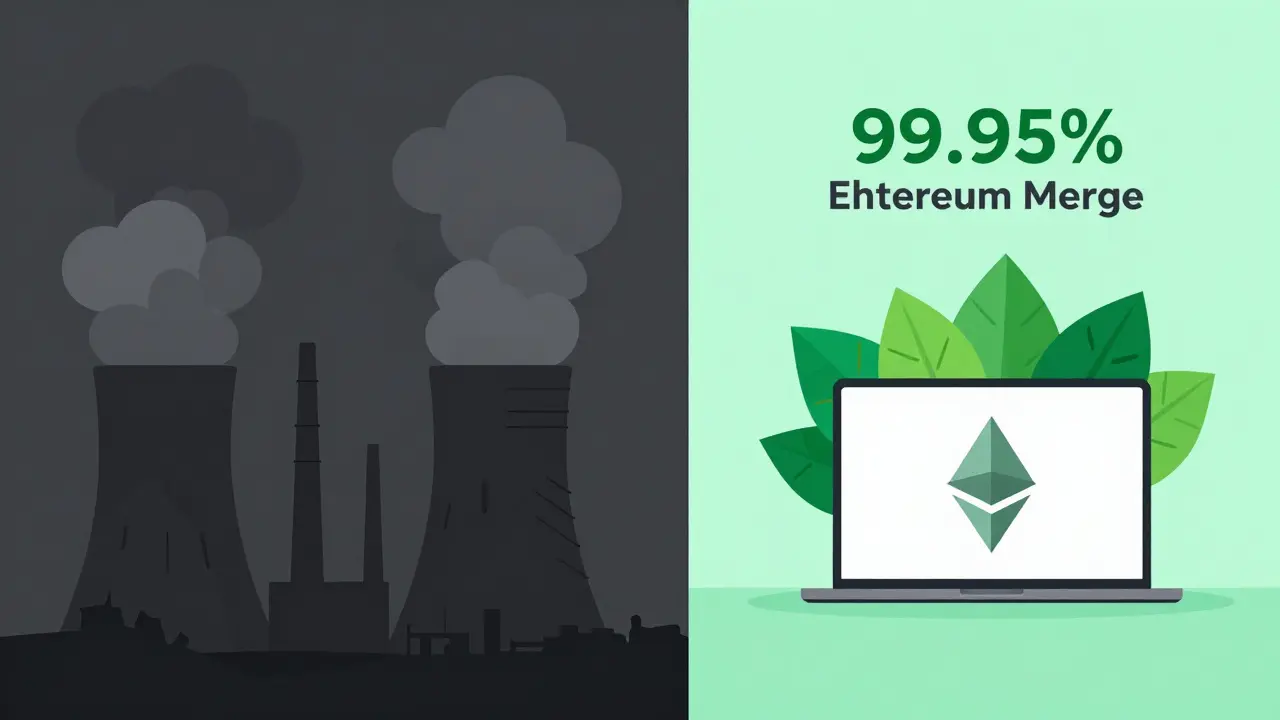
The good news is that we don't have to use PoW to have a secure blockchain. The industry's biggest case study in sustainability is the "Merge" of Ethereum. In September 2022, Ethereum transitioned from PoW to a mechanism where validators are chosen based on the number of coins they hold and are willing to "stake" as collateral Proof of Stake (PoS).
The result was an immediate and dramatic drop in energy use. The Ethereum Foundation and Amnesty International noted that the network's energy consumption plummeted by about 99.95%. It went from using 8.5GW of power to less than 85MW. Essentially, the need for massive warehouses full of humming computers vanished overnight, replaced by a system that can be run on a standard laptop.
| Metric | Proof of Work (Bitcoin) | Proof of Stake (Ethereum Post-Merge) |
|---|---|---|
| Electricity Consumption | ~112.06 TWh | ~0.01 TWh |
| Carbon Emissions | ~62.51 Mt CO2 | ~0.01 Mt CO2 |
| Energy Use Relative to Bitcoin | 100% | < 0.001% |
This comparison proves that blockchain technology isn't inherently "dirty"; rather, the Proof of Work mechanism is the specific cause of the environmental strain. PoS networks provide similar security and decentralization without requiring the planet to burn through terawatt-hours of power.
Corporate and Regulatory Pushback
The world is starting to react to these numbers. For a long time, crypto was a niche interest, but as it hit the mainstream, big companies had to consider their Environmental, Social, and Governance (ESG) goals. A pivotal moment happened in 2021 when Tesla decided to stop accepting Bitcoin payments. Elon Musk cited the high fossil fuel use required to produce Bitcoin as the primary reason. This sent a signal to the rest of the corporate world: PoW is a liability for any company claiming to be "green."
Governments are also stepping in. The OECD has pushed for more scrutiny of digital assets, recommending mandatory environmental impact assessments. In some parts of the world, we've seen outright bans on PoW mining, especially in regions where the electricity grid is already struggling or where there are strict national carbon targets. The US has explored legislation to specifically target the emissions produced by mining hubs.
For the average user, this is changing how they invest. Younger generations, who prioritize sustainability, are increasingly avoiding PoW coins in favor of "green" alternatives. This shift in sentiment is creating a market where sustainable blockchains have a competitive advantage in attracting both retail and institutional capital.

Can PoW Ever Be Truly Green?
There are attempts to mitigate the damage. Some initiatives, like TGB Green by The Giving Block, use carbon offset programs to neutralize the impact of crypto donations. Exchanges like Gemini have also implemented offsets for their transactions. Then there's the trend of "geographic arbitrage," where miners move to places like Iceland or Norway to use geothermal or hydroelectric power.
While these moves are better than mining with coal, they don't solve the fundamental problem. Offset programs are often criticized as "greenwashing" because they don't reduce the actual energy demand-they just pay to plant trees elsewhere. Moving to a hydroelectric dam helps, but as mentioned before, it still consumes massive amounts of energy that could be used more productively in other sectors of the economy.
The reality is that as long as the network rewards the person with the most computing power, the incentive will always be to consume more energy. The only true "fix" for the environmental impact is a fundamental change in the protocol itself, moving away from computational competition entirely.
Why does Proof of Work use so much energy?
PoW requires miners to compete in solving a complex mathematical puzzle. The only way to solve it is through trial and error, which requires billions of guesses per second. This process requires massive amounts of computational power, which translates directly into high electricity consumption across thousands of machines running 24/7.
Is Bitcoin the only blockchain with a high environmental impact?
Bitcoin is the most significant because it is the largest and most famous PoW network. Other smaller PoW coins also contribute, but Bitcoin's scale makes its impact comparable to entire countries. Most newer blockchains use Proof of Stake or other efficient mechanisms to avoid this problem.
Does using renewable energy make PoW sustainable?
It reduces the carbon footprint, but it doesn't make the system sustainable. The sheer volume of energy required is so high that it creates an "opportunity cost," meaning that green energy used for mining is energy taken away from other essential societal needs.
What happened during the Ethereum Merge?
Ethereum switched its consensus mechanism from Proof of Work to Proof of Stake. This removed the need for energy-hungry mining hardware, reducing the network's overall energy consumption by approximately 99.95% almost instantly.
Are there alternatives to Proof of Stake?
Yes, there are several other low-energy alternatives including Proof of Authority (PoA), Proof of History (PoH), and various hybrid models. These focus on identity, time-stamping, or reputation rather than raw computational power to secure the network.
Next Steps for the Eco-Conscious User
If you want to participate in the blockchain space without destroying the planet, you have a few options. First, look for networks that use PoS or other energy-efficient consensus models. If you are investing, check the energy metrics of the project before buying in.
For those already holding PoW assets, consider using platforms that offer verified carbon offsets for your transactions. Lastly, support developers and projects working on "Layer 2" solutions-these are protocols built on top of existing blockchains to make transactions faster and more efficient, reducing the need for heavy lifting on the main energy-intensive chain.
Felix Eduardo Velasquez
May 1, 2026 AT 09:12The fundamental flaw in the PoW argument is the narrow focus on energy consumption without considering the security trade-offs. While PoS is efficient, it introduces a different set of risks, specifically the potential for wealth concentration to translate into governance control. In a PoW system, the cost of attacking the network is tied to external physical resources, whereas PoS ties it to the internal token economy. We must ask whether the reduction in carbon is worth the potential increase in centralization over a long enough time horizon. Many forget that the 'waste' in PoW is actually the cost of trustless security. If you remove the energy barrier, you change the nature of the security guarantee. The industry is trading an environmental cost for a systemic risk cost. It is a classic engineering trade-off. We should be looking at hybrid models that leverage the stability of PoW with the efficiency of PoS. Only then can we achieve a truly sustainable and secure global financial layer. The current obsession with the 'Merge' ignores the philosophical shift from physical work to capital ownership. Most users don't care about the mechanism as long as the app works, but those of us studying the architecture know that the energy is the feature, not the bug. Without the energy, the network is just a database managed by the rich. We need to stop pretending there is a free lunch in distributed systems. The energy footprint is the only thing that makes the system immutable in a way that resists state-level coercion. Until we find a way to decouple security from cost, we are just picking our poison.
Andrew Todd
May 2, 2026 AT 06:34USA makes the best tech anyway and if we want to mine we mine. The rest of the world just hates we are winning.
Emily A
May 3, 2026 AT 21:16The comparison between Bitcoin and Ethereum's post-merge status is mathematically sound, yet the presentation fails to account for the inherent volatility of the energy markets themselves. It is simply disappointing that some still cling to PoW under the guise of 'security' when the data clearly indicates a superior alternative exists.
Ryan Nakielny
May 4, 2026 AT 01:30Oh wow, a chart! I'm sure that'll totally convince the guys running coal plants to just stop.
Arti Jain
May 5, 2026 AT 10:36India is leading in green energy. Bitcoin is a waste.
Ralph Espinosa
May 5, 2026 AT 19:53I totally agree with the point about Layer 2 solutions!!! They really are the key to scalability without the carbon footprint!!! Everyone should look into Lightning Network or Polygon!!!
Rain Richardsson
May 6, 2026 AT 23:00Makes sense. PoS seems better.
VIVEK SINGH
May 6, 2026 AT 23:48Imagine thinking that planting a few trees solves a systemic failure of logic. It's almost cute how we pretend offsets aren't just paying for a piece of paper that says the planet is fine while the servers keep humming. Truly a masterpiece of modern delusion.
Veronica Bago
May 8, 2026 AT 14:49It's honestly just cool to see how much the tech has changed since the early days!
its me
May 9, 2026 AT 05:41We all just want to feel better about our wallets while the world burns. It's a spiritual void we fill with tokens.
Harvey Alford
May 10, 2026 AT 01:33My ex used to mine and it ruined us. Just drained everything.
Lloyd I
May 11, 2026 AT 21:38Let's keep pushing for these green alternatives! We can actually make a difference if we move our capital to the right projects!
Gabby Puche
May 12, 2026 AT 09:51So proud of the progress we're making! 🌿✨ Keep it up everyone! 🚀
Lynne Teperman
May 13, 2026 AT 04:42such a wild ride watching this tech evolve into a neon nightmare of energy
Rushell Perry
May 13, 2026 AT 15:09if you are new to this just try looking at the whitepapers for new chains they are way easier on the earth
Carli Bates
May 14, 2026 AT 22:08sure because the corporate world is just so famous for its honest environmental goals lol
Kathleen Warren
May 16, 2026 AT 16:04I can see why people are worried about the planet. It's a lot to take in but the change to PoS is a good start for everyone.
Barbara Jones
May 17, 2026 AT 07:42I think its great that we have options now. Just gotta be carefull where you invest your money lol
Ipsita Seal
May 19, 2026 AT 06:59too long didn't read but it sounds bad.