
Imagine you park your money in a savings account expecting it to stay exactly where you left it. Now imagine waking up one morning to find that $100 has turned into $95 without any warning. For years, this was just a nightmare scenario for stablecoins, digital tokens designed to hold a steady value against fiat currencies like the US dollar. But in the volatile world of cryptocurrency, that nightmare became reality more than once.
We are now well past the era where we treated stablecoins as risk-free havens. The history of stablecoin depegging is written in billions of dollars of lost value and shattered trust. Whether you are using these tokens for daily transactions, trading pairs, or yield farming, understanding why they break their peg is no longer optional-it’s essential survival knowledge.
The Anatomy of a Depeg
To understand the risk, you first have to understand the mechanism. A Stablecoin is a type of cryptocurrency that aims to maintain a fixed exchange rate with another asset, usually the US dollar. When a stablecoin trades significantly below its intended value-say, $0.98 instead of $1.00-we call this a Depeg.
A temporary dip might be caused by a glitch in an automated market maker (AMM) or a momentary liquidity crunch on an exchange. However, a sustained depeg indicates a deeper failure. It means the market no longer believes the issuer can redeem the token at face value. This loss of confidence triggers a feedback loop: traders sell to avoid losses, pushing the price down further, which causes more people to panic-sell.
There are three main types of stablecoins, each with different vulnerability profiles:
- Fiat-Collateralized: Backed by real-world cash and equivalents held in reserve banks. Examples include USDT and USDC. These rely heavily on the solvency and transparency of the issuing company.
- Crypto-Collateralized: Backed by other cryptocurrencies, often overcollateralized to absorb volatility. DAI is the prime example here.
- Algorithmic: Not backed by direct reserves but by code and arbitrage incentives. These were the darlings of innovation until they proved to be the most fragile.
Historical Flashpoints: When Stability Failed
The history of stablecoin depegging is short but violent. While minor fluctuations happen regularly during extreme market stress, two events stand out as defining moments for the industry.
In 2021, Tether (USDT) faced intense scrutiny. As the largest stablecoin by market cap, its dominance gave it systemic importance. Regulators fined Tether for misleading statements about its reserves, claiming it was fully backed by US dollars when it held a mix of commercial paper and other assets. Although USDT did not permanently depeg, the incident exposed the opacity risk inherent in centralized issuers. Users realized they were trusting a private company’s word rather than audited proof.
Then came May 2022. This is the case study every crypto investor needs to memorize. TerraUSD (UST) was an algorithmic stablecoin paired with Luna. Its design relied on a complex economic game: if UST dropped below $1, users could burn Luna to mint new UST, theoretically driving UST back up. If UST rose above $1, they could burn UST to mint Luna. It worked beautifully in bull markets.
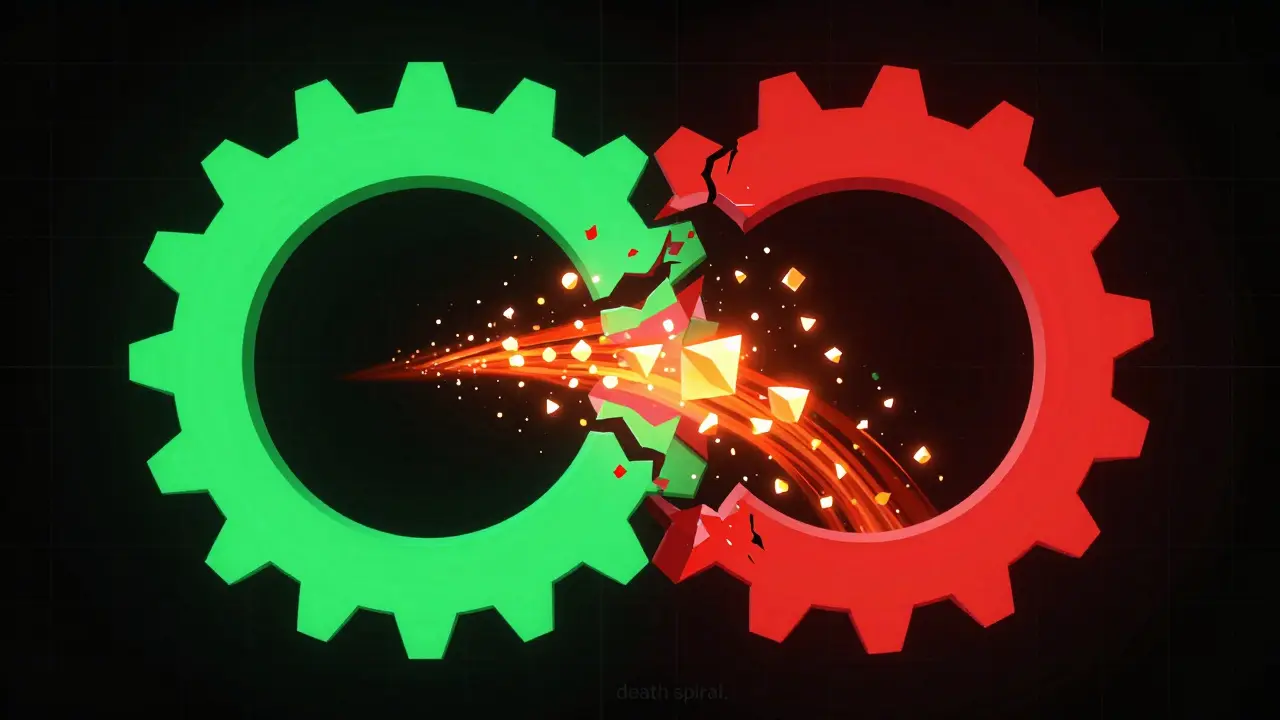
But when selling pressure overwhelmed the system, the mechanism broke. To defend the peg, the protocol printed trillions of Luna tokens, hyperinflating them to near-zero value. Within days, UST collapsed from $1.00 to pennies. Billions of dollars evaporated. This wasn't just a depeg; it was a total systemic failure that demonstrated how algorithmic models can create death spirals under stress.
| Type | Backing Mechanism | Primary Risk | Example |
|---|---|---|---|
| Fiat-Backed | Cash & Equivalents | Counterparty/Issuer Solvency | USDT, USDC |
| Crypto-Backed | Overcollateralized Crypto | Collateral Volatility/Liquidation | DAI |
| Algorithmic | Code & Arbitrage Incentives | Death Spiral/Mechanism Failure | UST (Defunct) |
Why Do Stablecoins Depeg? The Core Drivers
Depegging rarely happens because of a single factor. It is usually a perfect storm of technical, psychological, and financial pressures. Here are the primary drivers identified by analysts and regulators.
Liquidity Crises: Even a perfectly backed stablecoin can depeg if there is no one willing to buy it. During flash crashes, order books dry up. If you try to sell $1 million worth of a stablecoin and the deepest bid is only $10,000, the price slippage will cause a massive drop. This creates a self-fulfilling prophecy where low liquidity leads to lower prices, which scares off buyers further.
Loss of Confidence: Trust is the currency of stablecoins. Rumors about frozen reserves, regulatory bans, or hacked wallets can trigger a bank run. Unlike traditional banks, many stablecoin issuers do not have deposit insurance. If investors fear the issuer cannot honor redemptions, they rush for the exit simultaneously. Since stablecoins are often backed by illiquid assets like corporate bonds, the issuer may be forced to sell those assets at a discount to meet demands, actually causing the very losses they feared.
Regulatory Shocks: Legal actions can instantly freeze assets. In 2023, when Circle (issuer of USDC) had assets frozen by US authorities related to the FTX collapse, USDC briefly traded at $0.87. It recovered quickly, but the event showed that legal entanglements can disrupt redemption mechanisms overnight.
Technical Vulnerabilities: Smart contract bugs or exploits can drain reserves. If a hacker drains the collateral backing a decentralized stablecoin, the peg becomes mathematically impossible to maintain. Network congestion can also delay transactions, causing arbitrageurs-who normally keep the peg tight-to step away due to high gas fees or execution risks.
The Systemic Danger: Contagion Effects
You might think, "If my specific stablecoin depegs, I’ll just move to another." But the danger lies in contagion. The crypto ecosystem is deeply interconnected. Lending protocols, decentralized exchanges (DEXs), and yield farms use stablecoins as base pairs and collateral.
When a major stablecoin wobbles, lending platforms often pause withdrawals to prevent insolvency. This freezes user funds across multiple projects. We saw this during the Terra collapse: liquidity drained from Uniswap, Curve, and other major protocols as users fled to Bitcoin or Ethereum, crashing prices across the board. Traditional finance is also watching closely. With billions in institutional exposure to stablecoins, a large-scale depeg could trigger margin calls in hedge funds and disrupt payment rails used by merchants.

How to Assess Stability in 2026
As we navigate the current landscape, distinguishing between robust and fragile stablecoins requires looking beyond marketing claims. Here is a practical checklist for evaluating stability:
- Reserve Transparency: Does the issuer publish monthly attestation reports from reputable accounting firms? Look for details on asset composition. High-quality liquid assets (HQLA) like Treasury bills are safer than commercial paper or private credit.
- Decentralization Level: Is the governance controlled by a single CEO or a distributed community? Decentralized stablecoins like DAI offer censorship resistance but come with smart contract risk. Centralized ones offer ease of use but carry counterparty risk.
- Diversification of Issuers: Never hold all your stablecoins in one token. Spread exposure across USDC, USDT, and perhaps a smaller portion in DAI or FDUSD. This mitigates the risk of a single point of failure.
- Market Depth: Check the trading volume and liquidity pools on major DEXs. A stablecoin with thin liquidity is dangerous during volatility.
Regulatory frameworks are tightening globally. The EU’s MiCA regulation and various US legislative proposals aim to enforce stricter reserve requirements and regular audits. While this increases compliance costs for issuers, it should theoretically reduce the likelihood of catastrophic depegs in the long term.
Mitigating Personal Risk
If you are active in crypto, you cannot eliminate stablecoin risk entirely, but you can manage it. Avoid holding large amounts of algorithmic stablecoins unless you fully understand the underlying mechanics and accept the possibility of total loss. For everyday holdings, stick to overcollateralized or fiat-backed options with transparent audit trails.
Monitor news feeds for regulatory developments. A lawsuit filed against an issuer today can impact the peg tomorrow. Use multi-signature wallets and hardware security modules to protect against theft, ensuring that even if a platform fails, your keys remain safe. Finally, remember that 'stable' is a relative term. In a crisis, correlation goes to one-all risky assets tend to fall together. Have an exit strategy that doesn't rely solely on converting to a potentially compromised stablecoin.
What causes a stablecoin to depeg?
A stablecoin depegs when market forces push its trading price significantly away from its target value (usually $1.00). Common causes include liquidity crises, loss of confidence in the issuer's reserves, regulatory actions freezing assets, technical failures in smart contracts, or fundamental flaws in algorithmic stabilization mechanisms.
Is USDT (Tether) safe from depegging?
While USDT has maintained its peg through numerous crises, it carries counterparty risk. It is centralized, meaning its stability depends on Tether Ltd.'s ability to manage reserves and comply with regulations. Past fines and opaque reporting have raised concerns, so while it is currently stable, it is not risk-free.
Can algorithmic stablecoins ever be trusted again?
After the collapse of TerraUSD (UST), trust in pure algorithmic stablecoins is extremely low. Many developers have moved toward hybrid models that combine some collateral backing with algorithmic adjustments. However, pure algorithmic designs remain highly speculative and prone to death spirals during market downturns.
What happened to TerraUSD (UST)?
In May 2022, UST lost its peg due to a flaw in its algorithmic design. As selling pressure mounted, the protocol burned Luna tokens to mint UST, causing hyperinflation of Luna. This led to a death spiral where both UST and Luna crashed to near-zero value, wiping out billions in market capitalization.
How can I protect myself from stablecoin depegging?
Diversify your stablecoin holdings across different issuers and types (e.g., fiat-backed and crypto-backed). Choose tokens with transparent, regularly audited reserves. Avoid keeping large sums in algorithmic stablecoins. Monitor regulatory news and be prepared to convert to non-crypto assets or hard assets like Bitcoin if systemic instability arises.