Imagine logging into your favorite crypto exchange only to find a warning from the government telling you that platform isn’t licensed. For millions of Filipinos, this wasn’t just a hypothetical scenario-it became reality starting in mid-2025. The Securities and Exchange Commission (SEC) of the Philippines has shifted from watching the crypto market to actively policing it. With new rules taking effect in July 2025, the regulator is cracking down on unregistered platforms with fines, blocks, and forced exits.
If you trade crypto in the Philippines or run a business there, you need to know what changed, who is being targeted, and how these enforcement actions affect your wallet. This isn’t about banning Bitcoin; it’s about forcing exchanges to play by strict local rules. Here is exactly what the SEC is doing and why it matters for your digital assets.
The New Rules: Why the SEC Is Cracking Down
To understand the enforcement actions, you first have to look at the rules they are enforcing. In May 2025, the SEC issued two major documents: SEC Memorandum Circular No. 4 (the Rules on Crypto-Asset Service Providers) and SEC Memorandum Circular No. 5 (Guidelines on Operations). These took effect on July 5, 2025.
These rules created a new category called Crypto Asset Service Provider (CASP). Basically, if you help Filipinos buy, sell, or store crypto, you must register as a CASP. But registration isn’t easy. The SEC wants proof that you can protect investors from scams and collapses like the one seen with FTX in 2022.
- Minimum Capital: You need at least 100 million Philippine pesos (around $1.8 million USD) in paid-up capital.
- Local Presence: You must incorporate as a domestic corporation in the Philippines and have a physical office.
- Fund Segregation: Customer money must be kept separate from company funds to prevent misuse.
- Security Standards: Platforms need ISO 27001 certification, multi-factor authentication, and cold storage for 95% of assets.
The goal is clear: stop fraud and money laundering. The SEC argues that without these safeguards, ordinary investors are vulnerable. As Commissioner Kelvin Lee stated, these rules do not prohibit trading-they just require safety nets.
Who Is Being Targeted? The List of Non-Compliant Exchanges
The SEC didn’t wait years to enforce these rules. By August 2025, they had already identified major players operating without proper authorization. On August 1, 2025, the SEC released a public advisory naming ten specific global exchanges facing enforcement action.
| Exchange Name | Status | Primary Risk Cited |
|---|---|---|
| OKX | Non-Compliant | Lack of local incorporation |
| Bybit | Non-Compliant | Inadequate fund segregation |
| KuCoin | Non-Compliant | No physical office in PH |
| Kraken | Non-Compliant | Missing AML protocols |
| LBank | Non-Compliant | Low capitalization |
| CoinW | Non-Compliant | Unverified security audits |
These platforms were chosen because they serve large numbers of Filipino users but failed to meet the CASP requirements. The SEC views them as risks to investor protection. If you use any of these apps, expect disruptions soon.
The Binance Precedent: How It Happened Before
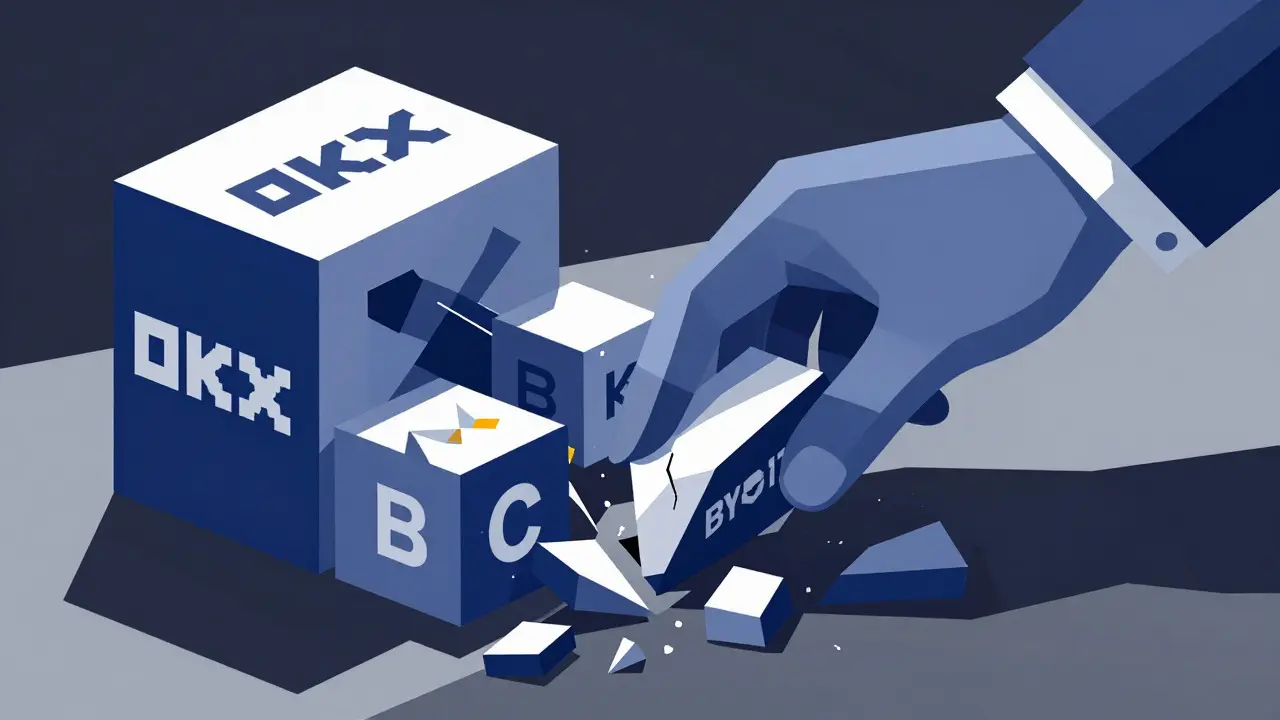
You might wonder if this is just talk. Look at what happened to Binance in 2024. The SEC successfully forced Binance out of the Philippine market through a coordinated blockade. They worked with internet service providers (ISPs) to restrict access and requested app stores to remove the app.
Binance was given a 90-day exit period for users to withdraw their funds. According to the SEC’s November 2024 report, 78% of affected users managed to withdraw within that window. However, 12% faced difficulties with verification processes. This case set a dangerous precedent for other global exchanges: comply locally or leave entirely.
The result was significant. The Philippine National Police reported a 67% decrease in crypto-related fraud cases after Binance’s removal. This data gives the SEC confidence that stricter enforcement reduces crime, even if it limits choice.
Penalties and Consequences for Non-Compliance
If an exchange ignores the SEC, the costs add up quickly. The penalties under the Securities Regulation Code are severe and designed to hurt financially.
- Initial Fines: Ranging from 50,000 PHP to 10 million PHP ($900 to $180,000 USD) per violation.
- Daily Penalties: An additional 10,000 PHP ($180 USD) for every day the violation continues.
- Criminal Liability: Executives can face up to 5 years in prison and fines up to 2 million PHP ($36,000 USD).
Atty. Paolo Ong, Assistant Director of the SEC’s Enforcement Department, said these rules give the team "more teeth" to go after unregistered platforms. The threat isn’t just financial; it’s existential for businesses targeting Filipinos.
What This Means for Retail Investors
For the average Filipino trader, these changes bring both safety and frustration. On one hand, fewer scams mean less risk of losing life savings. On the other hand, options are shrinking. Chainalysis data shows that 85% of current Philippine crypto users (about 12.75 million people) rely on unlicensed international platforms.
Social media reactions reflect this tension. On Reddit’s r/PhilippinesCrypto, many users supported the crackdown. One user noted, "I lost 150,000 PHP on Celsius in 2022-these rules might be strict but they’ll save others." However, critics worry that blocking popular apps will drive activity to darker, harder-to-regulate channels like peer-to-peer (P2P) markets or virtual private networks (VPNs).
The SEC acknowledges this risk. Their Cybersecurity Bureau estimates that 15-20% of crypto activity could migrate to less regulated spaces. To counter this, they are focusing on educating users about the dangers of unlicensed platforms.
How to Stay Compliant and Safe
If you are a trader, check if your exchange is registered as a CASP. The SEC maintains a list of compliant entities on its website. If your platform isn’t on that list, consider moving your assets to a licensed provider before September 1, 2025, when website blocking is expected to begin.
For businesses, the path forward involves rigorous preparation. You need to gather documentation including business plans, risk matrices, and proof of cybersecurity measures. The SEC’s PhiliFintech Innovation Office processes applications within 30 business days, but early adopters report average processing times of 45 days due to high demand.
Remember, the SEC is also planning a Crypto-Asset Investor Compensation Fund by Q1 2026. This fund, financed by registration fees, aims to provide a safety net for future losses. While it doesn’t replace good security habits, it adds another layer of protection for users of compliant platforms.
Is cryptocurrency banned in the Philippines?
No, cryptocurrency itself is not banned. The SEC clarified that the CASP rules regulate service providers, not the assets. You can still own and trade Bitcoin, Ethereum, and other tokens, but you should use platforms that are registered with the SEC to ensure legal protection.
Which exchanges are currently blocked or targeted?
As of August 2025, the SEC has named OKX, Bybit, KuCoin, Kraken, LBank, and CoinW among others for enforcement action. Binance was previously removed from the market in 2024. Website blocking for these non-compliant platforms is expected to start around September 1, 2025.
What happens if I use an unregistered exchange?
Using an unregistered exchange does not carry criminal penalties for individual users, but it means you lack regulatory protection. If the platform collapses or engages in fraud, recovering your funds may be difficult. Additionally, access to these platforms may be restricted by ISPs and app stores.
How much does it cost to register as a CASP?
Registration requires a minimum paid-up capital of 100 million Philippine pesos. There are also ongoing compliance costs for audits, reporting, and a registration fee set at 0.05% of gross revenue, which funds the future Investor Compensation Fund.
Will DeFi protocols be regulated next?
Currently, decentralized finance (DeFi) protocols are excluded from CASP registration requirements. However, SEC Commissioner Maria Lourdes Limgenco indicated that the next phase of regulation, potentially starting in 2027, will address smart contract risks and liquidity pool vulnerabilities associated with DeFi.