
Piexgo Crypto Exchange: A Dead Platform with Important Lessons
If you're looking to trade crypto on Piexgo, you're out of luck - it shut down in April 2021 and hasn't come back. No official announcement. No warning. Just gone. That’s not just inconvenient; it’s a red flag for anyone considering lesser-known exchanges. Piexgo wasn’t a giant like Binance or Coinbase, but it had enough users to make its collapse worth studying. Why did it fail? And what can you learn from it before you put your money on another platform?
What Piexgo Actually Offered (When It Was Alive)
Piexgo launched in early 2019 out of Singapore and claimed to support over 40 trading pairs across 27 cryptocurrencies. It focused on spot trading and had an OTC desk for larger trades - useful if you wanted to move big amounts without crashing the market price. It also planned to add futures trading, though that never happened.
One real advantage was its mobile app. Users on Steemit confirmed both Android and iOS apps worked well, making it easy to trade on the go. For traders already holding crypto, that was a plus. But here’s the catch: Piexgo didn’t accept fiat currency. No USD, EUR, GBP - nothing. You had to buy crypto elsewhere first, then send it over. That made it useless for beginners. If you didn’t already have crypto, you couldn’t start here.
Fees Were Low, But That Wasn’t Enough
Piexgo’s fee structure looked attractive on paper: 0.05% for makers, 0.15% for takers. Back in 2019, that was below average. Most exchanges charged around 0.25% or more. On paper, this made Piexgo look cost-effective.
But fees don’t matter if you can’t trade. By March 2020, CoinGecko and CoinMarketCap stopped tracking Piexgo’s trading volume. That’s a huge deal. Volume tells you how liquid a market is - how easily you can buy or sell without moving the price. If no one’s trading, your orders sit there. Or worse, you can’t withdraw your funds when you need to.
And here’s the scary part: no one could find out what Piexgo charged for withdrawals. Not a single source listed withdrawal fees. That’s not transparency - that’s a risk. What if they hit you with a 5% fee out of nowhere? You’d have no warning. No recourse.
Security Claims Without Proof
Piexgo’s website talked about "advanced security," "monthly audits," and an "international asset management team." Sounds impressive, right? But there were no details. No reports. No third-party verification. No public proof that any of it was real.
Compare that to Binance, which publishes its Secure Asset Fund for Users (SAFU) balances quarterly. Or Coinbase, which discloses its cold storage percentages and insurance coverage. Piexgo gave you buzzwords, not facts. In crypto, where hacks and exit scams are common, that’s a dealbreaker.
Even worse, KYC was optional. That might sound great for privacy, but it also meant the exchange wasn’t following basic compliance rules. In Singapore, where it was based, regulators were tightening crypto rules. Operating without KYC made Piexgo vulnerable to legal action - or worse, a sudden shutdown by authorities.

The Final Warning Signs
By late 2019, Piexgo’s 24-hour trading volume hovered around $3.4 million. That’s not terrible for a small exchange, but it was far behind leaders like Binance, which was doing billions daily. Then, in early 2020, volume data vanished. CoinMarketCap labeled Piexgo as an "Untracked Listing" - meaning they couldn’t verify any activity. That’s the crypto equivalent of a store closing its doors but leaving the lights on.
Cryptowisser, a trusted exchange review site, warned users in March 2020: "Anyone interested in opening an account with Piexgo should be aware of the trading volume." That was six months before the platform disappeared. If you read that warning and still signed up, you were gambling.
There was one funding event: a $2.5 million investment from Viking Capital in May 2019. That should’ve helped Piexgo scale. But it didn’t. No new features. No marketing push. No liquidity boost. Just silence.
Why Piexgo Died - And What It Teaches You
Piexgo didn’t die because of a hack. It died because it failed at the basics:
- No fiat on-ramps = limited user growth
- Unverified volume = no trust from traders
- No withdrawal fee transparency = hidden risks
- Vague security claims = no accountability
- Optional KYC = regulatory red flag
It was trying to compete with giants without having the infrastructure, transparency, or liquidity to back it up. And when the market cooled in 2020, it had no buffer. No safety net. Just an app that stopped working.
The lesson? Don’t be fooled by low fees or a slick mobile app. Look at volume. Look at transparency. Look at whether the exchange has a track record of keeping users’ money safe - not just promising it.
What Happened to Users’ Money?
No one knows. When Piexgo shut down on April 1, 2021, there was no email. No notice. No migration plan. Users were left in the dark. Some may have been able to withdraw before the final shutdown. Others? Their funds vanished with the platform.
That’s the biggest risk with unregulated, opaque exchanges. You’re not just trusting them with your trades - you’re trusting them with your entire balance. And if they vanish, you have no legal recourse.
Is There Any Way to Recover Funds From Piexgo?
No. Piexgo is officially dead. Its website is offline. Its social media accounts are inactive. No team members have come forward. No lawyers have filed class-action suits. There’s no path to recovery.
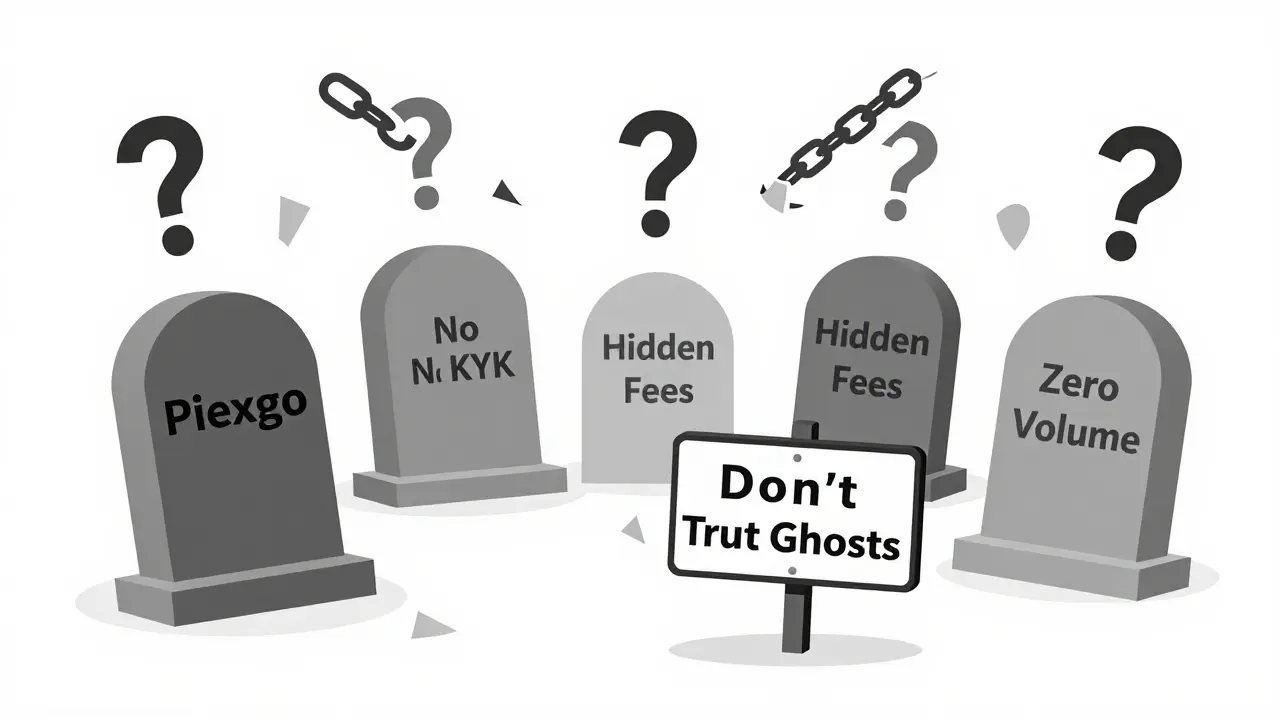
It’s now listed in Cryptowisser’s "Exchange Graveyard," a category for exchanges that shut down without warning. Piexgo is a textbook example of what happens when a platform prioritizes marketing over substance.
What Should You Use Instead?
If you’re looking for a reliable exchange today, stick with platforms that:
- Offer fiat on-ramps (credit card, bank transfer)
- Display real-time, verified trading volume
- Have clear, public withdrawal fee schedules
- Require KYC for compliance and protection
- Regularly publish security reports or proof of reserves
Examples: Coinbase, Kraken, Binance (where available), and Bitstamp. These aren’t perfect, but they’ve proven they can survive market cycles - and protect user funds when things go wrong.
Final Thought: Don’t Chase Low Fees - Chase Trust
Piexgo offered cheap trading. But cheap doesn’t mean safe. In crypto, the cheapest exchange is often the most dangerous one.
Before you deposit any money, ask: Can I withdraw it anytime? Can I verify its activity? Is there a team behind it - or just a website? If you can’t answer those questions, walk away. There are plenty of exchanges that play fair. You don’t need to gamble on ghosts.
Is Piexgo still operating in 2026?
No, Piexgo shut down permanently on April 1, 2021. Its website is offline, and there has been no revival or official communication since then. It is listed as a defunct exchange in Cryptowisser’s Exchange Graveyard.
Can I still access my Piexgo account or withdraw my crypto?
No. Since the platform shut down without warning, all services have been terminated. There is no way to log in, contact support, or retrieve funds. If you held assets on Piexgo, they are likely lost.
Why did Piexgo shut down without warning?
The exact reason was never disclosed. However, experts point to low trading volume, lack of fiat on-ramps, and unverified security practices as key factors. Without enough users or liquidity, the business became unsustainable. The lack of an official announcement suggests poor management or possible insolvency.
Was Piexgo safe to use before it closed?
It had serious red flags. While it claimed to use security audits and penetration testing, it never published any proof. Withdrawal fees were undisclosed, KYC was optional, and trading volume disappeared months before shutdown. These are not signs of a trustworthy platform - they’re warning signs.
Did Piexgo have a mobile app?
Yes, Piexgo had Android and iOS apps that were functional before its shutdown. Users praised the mobile interface for its ease of use. However, the app’s existence doesn’t make the exchange safe - it just made it more accessible while hiding deeper problems.
Can I use Piexgo’s OTC service today?
No. All OTC services, trading pairs, and customer support have been discontinued since April 2021. The OTC desk was one of Piexgo’s few unique features, but it vanished along with the rest of the platform.
What are better alternatives to Piexgo?
Use exchanges with verified volume, fiat on-ramps, and public security reports. Coinbase, Kraken, and Binance (where available) are top choices. They offer transparent fee structures, regulatory compliance, and long-term stability - things Piexgo never delivered.
Did Piexgo support US users?
Piexgo didn’t explicitly block US users, but it didn’t comply with US regulations either. It had no KYC requirement and no fiat support, making it unsuitable for most American traders. Even if you could sign up, using it as a US resident carried legal and financial risks.
Gavin Francis
January 31, 2026 AT 09:51mary irons
February 2, 2026 AT 08:54Wayne mutunga
February 2, 2026 AT 12:05Joshua Clark
February 2, 2026 AT 23:47Katie Teresi
February 3, 2026 AT 04:52Dylan Morrison
February 4, 2026 AT 22:49William Hanson
February 6, 2026 AT 00:41Steven Dilla
February 7, 2026 AT 17:19Akhil Mathew
February 9, 2026 AT 14:40Ramona Langthaler
February 10, 2026 AT 13:08Devyn Ranere-Carleton
February 11, 2026 AT 00:24Robert Mills
February 11, 2026 AT 01:14Jerry Ogah
February 12, 2026 AT 17:24Andrea Demontis
February 14, 2026 AT 10:49Joseph Pietrasik
February 16, 2026 AT 10:26Moray Wallace
February 18, 2026 AT 08:08