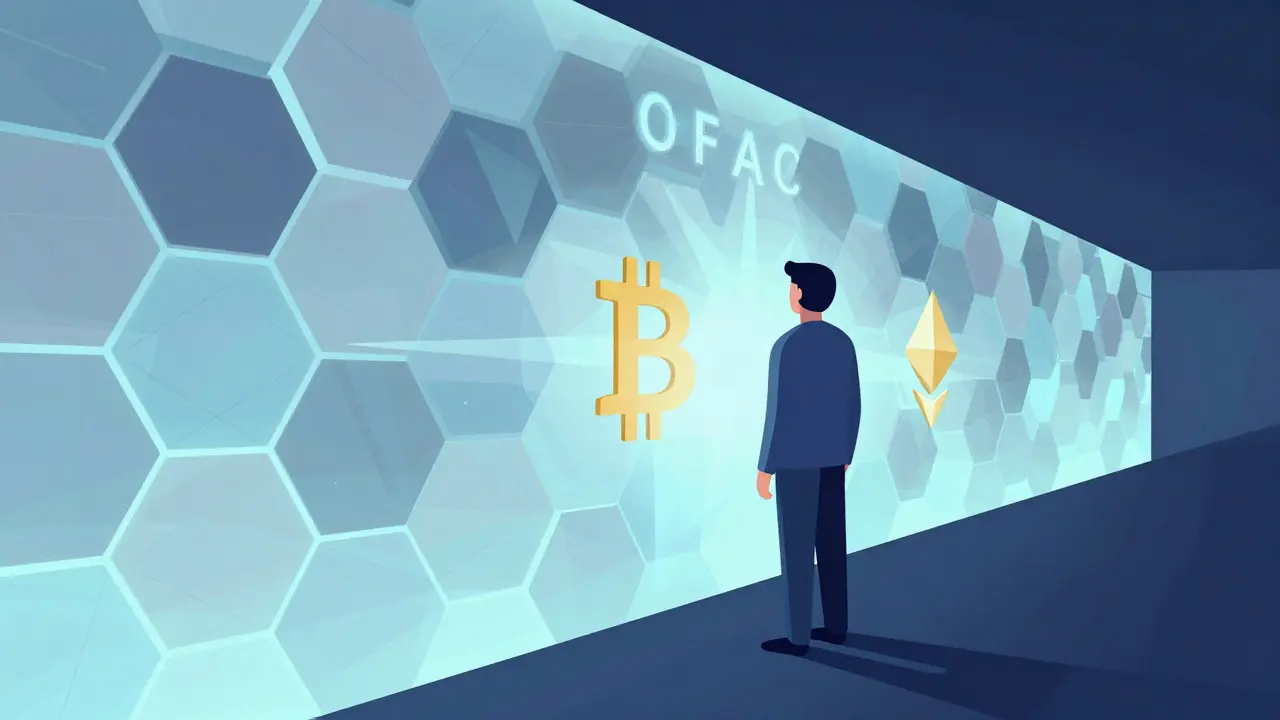
Imagine trying to send money across borders, only to find your digital wallet frozen because of a government list you never saw coming. For millions of Iranians, this isn’t a hypothetical scenario-it’s daily reality. The Office of Foreign Assets Control (OFAC) has turned the transparent nature of blockchain technology into a powerful enforcement tool, effectively cutting off mainstream cryptocurrency exchanges from serving users in Iran. But how does this work in practice? And what happens when sanctions push users toward darker corners of the web?
The landscape changed dramatically after April 1, 2015, when OFAC established its cyber-related sanctions program. Since then, the agency hasn't just targeted traditional banks; it has gone after individuals and entities facilitating malicious cyber-enabled activities using digital assets. If you are an Iranian user looking to trade Bitcoin or Ethereum on platforms like Binance or Coinbase, you will likely hit a wall. These major exchanges implement strict geo-blocking and enhanced due diligence measures. They don’t want to risk the multi-million dollar fines that come with violating U.S. sanctions.
How OFAC Tracks Digital Money
You might think that cryptocurrencies offer anonymity, but that’s a dangerous misconception. Most blockchains are public ledgers. Every transaction is visible. OFAC uses this transparency against sanctioned entities. A historic shift occurred on November 28, 2018, when the Treasury Department sanctioned two Iranian individuals for facilitating bitcoin ransom payments from the SamSam ransomware scheme. This was the first time OFAC published specific digital currency addresses linked to sanctioned individuals.
Why does this matter to you? Because once an address is listed on the Specially Designated Nationals (SDN) list, any compliant exchange must freeze those funds. The SamSam case involved actors who converted bitcoin ransoms into Iranian rial, depositing proceeds into local banks. By publishing the addresses, OFAC signaled that they could trace funds back to their source. However, experts note a limitation: individuals can use multiple addresses or migrate to privacy-focused coins like Monero or Verge, which obscure transaction details.
The Rise of Shadow Banking Networks
Sanctions haven’t stopped all illicit flows; they’ve just made them more complex. In September 2025, OFAC targeted a massive $600 million Iranian shadow banking network. This wasn’t just about moving cash; it was about laundering over $100 million in oil proceeds for Iran's military apparatus, specifically the Islamic Revolutionary Guard Corps-Qods Force (IRGC-QF) and the Ministry of Defense and Armed Forces Logistics (MODAFL).
This network spanned Hong Kong, the United Arab Emirates, and China. Companies like Shenzhen Jiasibo Technology Co. supplied dual-use military goods through mislabeled routes, while Alpha Trading Co. in Hong Kong acted as a financial hub. Blue Sky General Trading LLC in the UAE used Dubai’s commercial position to funnel money. Crucially, these entities utilized cryptocurrency infrastructure to move funds outside traditional banking systems. This demonstrates that while direct exchange access is blocked, sophisticated networks still find ways to bypass restrictions using front companies and mixed-asset strategies.
Specific Wallet Addresses as Enforcement Tools
Let’s look at a concrete example from September 2025. OFAC designated Arash Estaki Alivand and five specific cryptocurrency addresses associated with him. These included:
- Two Ethereum addresses:
0xe3d35f68383732649669aa990832e017340dbca5and0x532b77b33a040587e9fd1800088225f99b8b0e8a - Three Tron addresses:
TYDUutYN4YLKUPeT7TG27Yyqw6kNVLq9QZ,TRakpsE1mZjCUMNPyozR4BW2ZtJsF7ZWFN, andTQ5H49Wz3K57zNHmuXVp6uLzFwitxviABs
These designations covered Bitcoin, Ether, Tether, and Tron holdings. When an exchange sees a transaction involving these addresses, their automated screening tools flag it immediately. The result? Blocked transactions and potential account freezes for anyone interacting with these wallets. This diversified portfolio approach shows that Iranian facilitators aren’t sticking to one coin; they spread risk across multiple chains to avoid detection.
Exchange Compliance and High-Stakes Penalties
If you run a cryptocurrency exchange, ignoring OFAC rules is not an option. The financial risks are enormous. Take ShapeShift AG, for instance. Founded by crypto-pioneer Erik Vorhees, ShapeShift operated as a market maker for 79 different digital assets, handling about 20,000 daily transactions before shutting down in 2021. On September 20, 2025, they agreed to pay $750,000 to settle civil liability for sanctions violations spanning nearly two years.
During that period, ShapeShift allowed users from Cuba, Iran, Sudan, and Syria to exchange approximately $12.57 million in cryptocurrency. This settlement established a clear precedent: even if you didn’t intend to break the law, failing to implement adequate sanctions screening carries heavy penalties. It forces all platforms, including decentralized ones, to adopt risk-based compliance controls. You now see real-time screening of wallet addresses against the SDN list as a standard industry requirement.
The Cat-and-Mouse Game: Successor Exchanges
When one door closes, another opens-often illegally. The creation of successor exchanges to evade sanctions is a persistent challenge for OFAC. Consider the case of Garantex. On March 6, 2025, U.S. Secret Service-led actions shut down Garantex. Almost immediately, officers created Grinex, a new platform designed to continue serving sanctioned customers. Grinex explicitly stated in promotional materials that it was formed in response to sanctions affecting Garantex.
Grinex facilitated billions of dollars in transactions by transferring Garantex customer deposits to the new platform. They even introduced the A7A5 token, a ruble-backed digital asset issued by a Kyrgyzstani firm, to help customers regain account access. This illustrates the resilience of sanctions evasion networks. While major exchanges comply, niche platforms in jurisdictions with limited U.S. oversight continue to operate, often offering higher fees and lower liquidity in exchange for reduced scrutiny.
What This Means for Iranian Users
For the average Iranian citizen, access to global crypto markets has become significantly harder. Major international exchanges have implemented geo-blocking based on IP addresses and device fingerprints. Enhanced due diligence measures mean that even if you bypass IP blocks, you may need to provide identity verification that reveals your location.
As a result, many users have migrated to peer-to-peer (P2P) trading platforms or decentralized exchanges (DEXs). These options don’t require centralized identity checks. However, they come with trade-offs. P2P trades often involve higher costs due to intermediary fees. DEXs can suffer from low liquidity, meaning large trades impact prices significantly. Additionally, privacy-focused cryptocurrencies like Monero are becoming more popular among users seeking to avoid blockchain analysis, though these coins are increasingly being delisted from major fiat on-ramps.
| Platform Type | Access Difficulty | Risk Level | Liquidity |
|---|---|---|---|
| Mainstream CEX (e.g., Binance) | Very High (Blocked) | High (Account Freeze) | High |
| Niche/Unregulated Exchange | Medium | Medium (Scams/Fraud) | Low |
| Peer-to-Peer (P2P) | Low | Medium (Counterparty Risk) | Variable |
| Decentralized Exchange (DEX) | Low | Low (Smart Contract Risk) | Low |
Future Trends: AI and Blockchain Analytics
The battle between enforcers and evaders is escalating technologically. Industry observers predict continued growth in both enforcement sophistication and evasion complexity. Blockchain analytics firms are playing an increasingly central role. They use artificial intelligence and machine learning to analyze transaction patterns, identifying clusters of addresses linked to sanctioned entities.
This means that simply changing your wallet address isn’t enough anymore. Advanced algorithms can link multiple addresses to a single user based on timing, amount, and interaction patterns. As these tools improve, the window for anonymous transactions shrinks. Conversely, privacy protocols are also advancing, creating an ongoing arms race. For now, however, the balance tips heavily toward enforcement, making compliant access to major exchanges nearly impossible for Iranian users.
Can Iranian users legally use cryptocurrency exchanges in 2026?
No, mainstream cryptocurrency exchanges that comply with U.S. laws strictly prohibit users from Iran. OFAC sanctions make it illegal for U.S. persons and entities to transact with Iranian nationals. Exchanges implement geo-blocking and identity verification to enforce this. Violating these terms can result in frozen funds and legal consequences.
What happens if I accidentally send crypto to a sanctioned address?
If you send funds to an address listed on the OFAC SDN list, those funds are considered blocked property. Compliant exchanges will freeze the transaction and potentially your entire account. You should report the incident immediately to the relevant authorities and seek legal counsel, as retaining or attempting to recover these funds can lead to further violations.
How do exchanges detect Iranian users?
Exchanges use a combination of IP address tracking, GPS data from mobile apps, KYC (Know Your Customer) document verification, and behavioral analysis. Even if you use a VPN, inconsistencies in your profile or transaction patterns can trigger flags. Advanced blockchain analytics can also trace funds back to known Iranian-linked wallets.
Are decentralized exchanges (DEXs) safe from OFAC sanctions?
While DEXs don’t have a central authority to block users, the smart contracts governing them can be updated to blacklist specific addresses. Furthermore, the bridges and fiat on-ramps connecting DEXs to traditional money are often regulated. Using a DEX doesn’t guarantee immunity from sanctions enforcement, especially if you interact with sanctioned addresses.
Why did OFAC target the $600 million shadow banking network?
The network was identified as laundering over $100 million in oil proceeds for Iran's military apparatus, including the IRGC-QF. By targeting this complex web of front companies in Hong Kong, UAE, and China, OFAC aimed to disrupt the financial lifeline supporting military operations, demonstrating that cryptocurrency is used not just for retail transactions but for large-scale state-sponsored evasion.