NFT Marketplace Fee Calculator
Calculate Your NFT Fees
See how much you'll pay in total fees when selling your NFT across different platforms and blockchains.
Your Total Fees Breakdown
Total Platform Fees:
Gas Fees:
Net Proceeds:
Platform Comparison
Compare marketplace fees across popular platforms
| Platform | Transaction Fee | Listing Fee | Best For |
|---|---|---|---|
| OpenSea | 2.5% | $0 | Volume, liquidity |
| Rarible | 2.5% | $0 | Creator control |
| SuperRare | 3% | $10–$50 | High-end art |
| NFTrade | 0% | $0 | Low-cost trading |
| TofuNFT | 5% | $0 | Multi-chain creators |
| PlayDapp | 2.5% | $0 | Gaming NFTs |
*Gas fees vary based on network congestion
When you buy or sell an NFT, you see the price tag. But what you don’t see? The hidden fees eating into your profit. Whether you're an artist minting your first piece or a startup building a marketplace, understanding NFT marketplace fees and costs isn’t optional-it’s survival.
How Much Does It Cost to Build an NFT Marketplace?
Building an NFT marketplace isn’t like setting up a Shopify store. It’s a complex blockchain project with layers of code, security, and infrastructure. The cost varies wildly depending on what you need. A basic version with minimal features-like listing, bidding, and wallet connect-can start around $30,000. That’s the budget option from companies like Coinsclone. But if you want to compete with OpenSea or Rarible, you’re looking at $150,000 to $250,000. Why the gap? Here’s the breakdown from real developer reports:- Development Team: $10,000-$100,000 (depends on location and experience)
- Smart Contract Development: $5,000-$50,000 (critical for royalties and ownership)
- Decentralized Storage: $3,000-$30,000 (IPFS or Arweave for NFT metadata)
- Security Audits: $5,000-$50,000 (non-negotiable-32% of platforms have vulnerabilities)
- UI/UX Design: $3,000-$30,000 (users won’t stick around if it’s clunky)
- Maintenance: $4,000-$6,000 per month (updates, bug fixes, server costs)
What Fees Do Users Actually Pay?
If you’re a creator or collector, you care about what comes out of your wallet. These are the fees you’ll see at checkout:- Royalty Fees: 5%-10% of sale price. On a $1,000 NFT, that’s $50-$100 going to the original artist every time it resells. This is baked into smart contracts and enforced by platforms like SuperRare and OpenSea.
- Listing Fees: $1-$200 per NFT. Some platforms charge nothing. Others, especially curated ones, charge up to $200 just to put your NFT up for sale. That’s a huge barrier for new creators.
- Bidding Fees: 1%-3% of the auction amount. If you bid $5,000 on an NFT, you might pay $50-$150 just to enter the auction.
- Gas Fees: Not a marketplace fee, but a blockchain fee. On Ethereum, gas can spike to $500 during congestion. On Polygon, it’s often under $0.10.
How Do Major Platforms Compare?
Not all marketplaces are built the same. Here’s how the big players stack up in early 2025:| Platform | Transaction Fee | Listing Fee | Blockchain | Best For |
|---|---|---|---|---|
| OpenSea | 2.5% | $0 | Ethereum, Polygon | Volume, liquidity |
| Rarible | 2.5% | $0 | Ethereum, Polygon | Creator control |
| SuperRare | 3% | $10-$50 | Ethereum | High-end art |
| NFTrade | 0% | $0 | Polygon, BSC | Low-cost trading |
| TofuNFT | 5% | $0 | Multichain | Multi-chain creators |
| PlayDapp | 2.5% | $0 | Polygon | Gaming NFTs |
Why Do Some Marketplaces Fail?
Perimattic analyzed 87 failed NFT marketplaces. The #1 reason? Bad fee structure. Platforms that charged $150+ per listing saw 89% of creators quit within 90 days. Why? Because if you’re a small artist selling $20 NFTs, paying $150 to list is insane. You lose money before the first bid. Other failures came from:- Underestimating maintenance costs by 300-400%
- Not supporting multiple blockchains (alienating users)
- Ignoring gas fee spikes on Ethereum
- Skipping security audits (resulting in hacks)
What’s the Real Cost of Gas Fees?
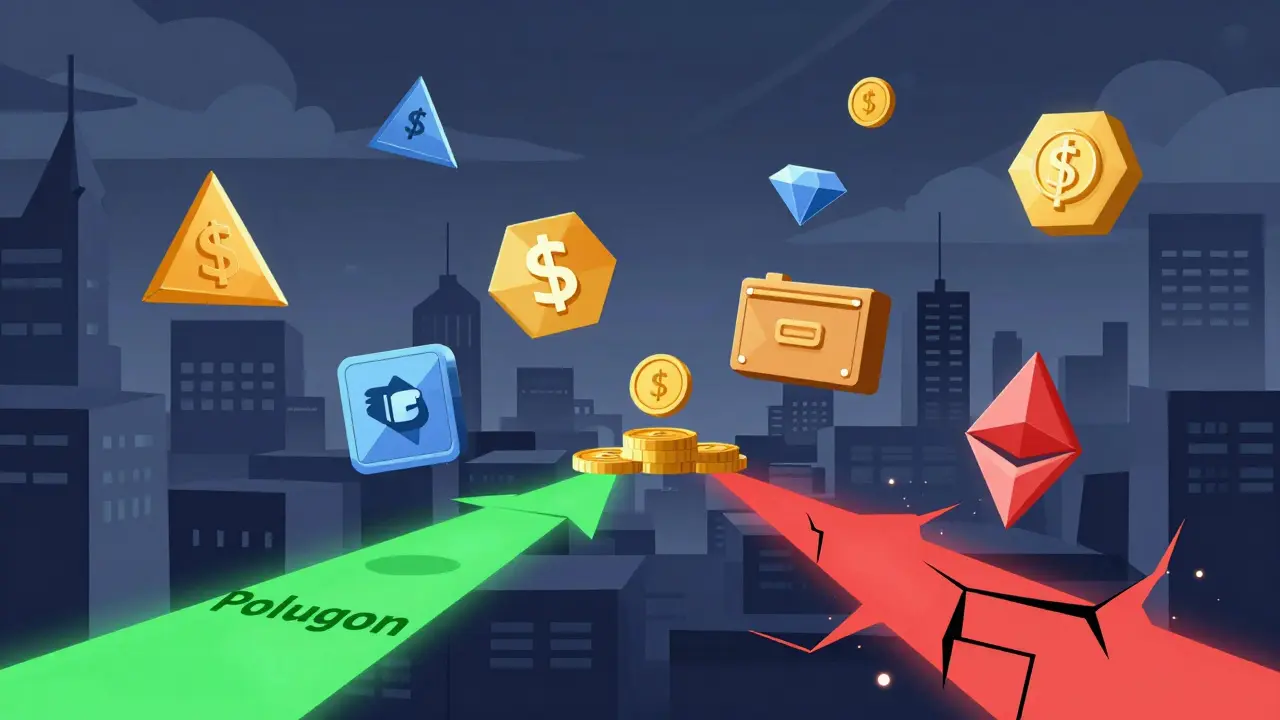
Gas fees aren’t charged by the marketplace-they’re paid to the blockchain network. But they’re the silent killer of NFT sales. On Ethereum, average gas used to be $50-$150 per transaction. In early 2025, during NFT drops or DeFi surges, it spiked to $500+. That’s more than the price of most NFTs. That’s why Polygon, BSC, and Solana-based marketplaces are growing at 67% annually. Polygon gas? Often under $0.10. Solana? Around $0.01. You can mint 100 NFTs for less than $1. Alchemy’s February 2025 report warns: Ethereum is dead for micro-transactions. If you’re selling NFTs under $100, you’re not on Ethereum unless you’re desperate.Who’s Winning in 2025?
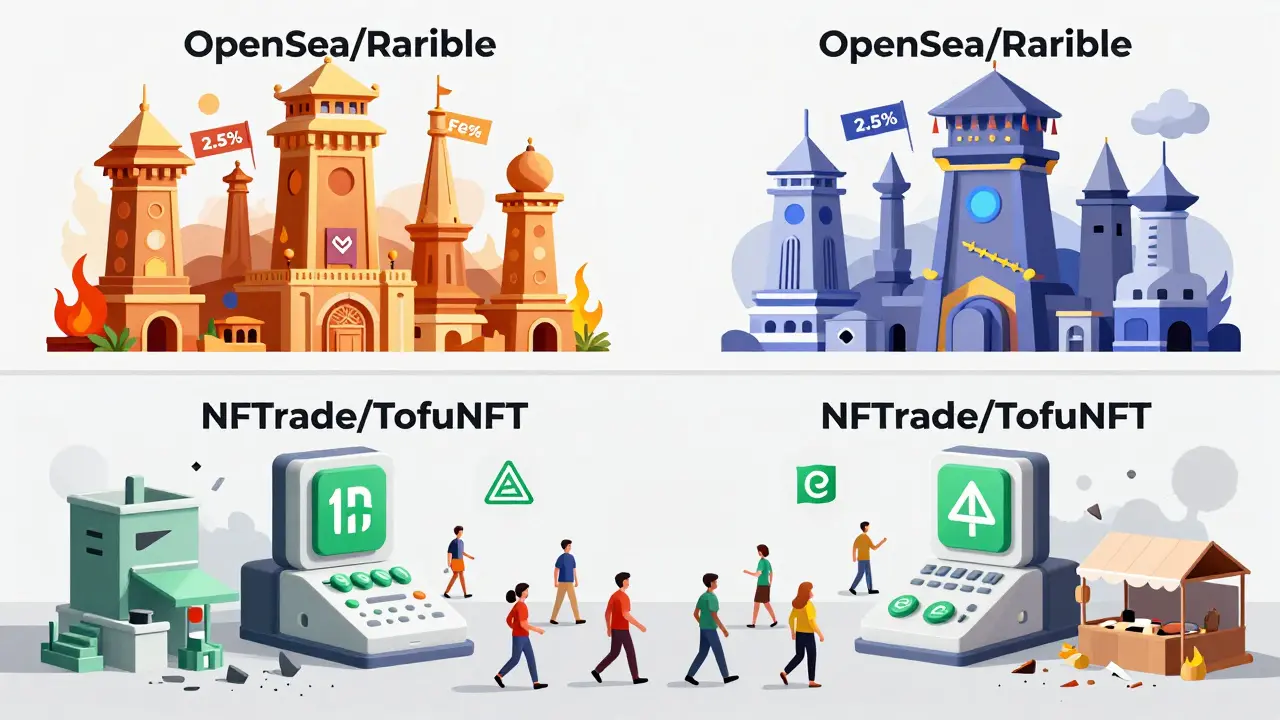
The market is splitting into two camps:- Volume Giants: OpenSea, Rarible. High liquidity, higher fees, Ethereum-heavy. Good for big collectors and established artists.
- Low-Cost Innovators: NFTrade, TofuNFT, PlayDapp. Polygon or BSC-based. Zero or near-zero fees. Winning with indie creators and gamers.
What Should You Do?
If you’re a creator:- Use Polygon-based marketplaces for low-cost minting and selling.
- Avoid platforms charging $100+ to list.
- Check the royalty rate-5% is standard, 10% is aggressive.
- Always factor in gas fees before listing.
- Start with Polygon, not Ethereum. Lower fees mean faster growth.
- Use tiered pricing: free for first 50-100 listings, then 1-2%.
- Invest in security audits. Don’t skip this.
- Build for cross-chain. Users hate being locked in.
- Set aside 4x your initial budget for maintenance.
What’s Next?
The future of NFT marketplaces isn’t about more features-it’s about smarter fees. Cubix is rolling out AI pricing assistants to help creators set optimal prices. Perimattic is adding regulatory compliance tools to handle SEC rules. Coinsclone is building a module to auto-switch blockchains based on gas prices. Gartner predicts 35% of small marketplaces will vanish by 2026. The survivors? Those that understand one truth: users don’t pay for technology. They pay for value. And if your fees eat that value, they’ll walk.Do NFT marketplaces charge fees to list items?
Yes, but not all. OpenSea and Rarible don’t charge listing fees on Polygon. SuperRare charges $10-$50 per listing. Some platforms like NFTrade charge $0. But others, especially curated or legacy platforms, charge up to $200. Always check before you mint.
What’s the average royalty fee on NFTs?
The standard royalty fee is 5% to 10% of the sale price. This is paid to the original creator every time the NFT is resold. Some platforms let creators set their own rate, while others cap it at 10%. Higher rates can discourage buyers, so 5-7% is often the sweet spot.
Why are Polygon-based NFT marketplaces cheaper?
Polygon uses a layer-2 solution that processes transactions off Ethereum’s main chain. This cuts gas fees from $50-$500 down to under $0.10. It’s faster, cheaper, and scales better. That’s why platforms like NFTrade and TofuNFT are growing fast-they’re built for creators, not speculators.
Can I avoid gas fees entirely when selling NFTs?
You can’t avoid blockchain fees completely, but you can avoid Ethereum’s high gas fees. Use marketplaces on Polygon, Solana, or BSC-all have gas fees under $0.50. Some even offer gas-free minting (where the buyer pays the fee). Always choose a platform that supports low-cost chains if you’re selling frequently.
How much does it cost to maintain an NFT marketplace monthly?
Monthly maintenance costs range from $4,000 to $6,000 for basic platforms, but can hit $10,000+ for high-traffic, multi-chain marketplaces. This includes server costs, smart contract updates, security patches, and customer support. Most new operators underestimate this by 300-400%, which is why so many fail after launch.
Are NFT marketplaces regulated in 2025?
Yes. The SEC now requires platforms to verify whether NFTs qualify as securities-especially those tied to investment promises or profit-sharing. About 18.3% of listed NFTs fall into this gray area. Marketplaces like OpenSea now include compliance checks. Ignoring this can lead to legal action.
Noriko Robinson
December 6, 2025 AT 05:16Just spent 3 hours trying to list a piece on OpenSea and got burned by gas fees I didn’t see coming. Polygon is the only way forward if you’re not a millionaire. Why are we still pretending Ethereum is viable for small creators?
Also, why do platforms charge listing fees at all? It’s like a bouncer charging you to walk into a club you’re already paying to perform in.
Yzak victor
December 6, 2025 AT 18:07Man, I built a small marketplace last year. Thought I could do it for $50k. Ended up spending $180k and still have bugs. Maintenance is a nightmare. Monthly server costs alone ate my lunch.
And don’t even get me started on security audits. One guy told me I was ‘lucky’ my platform didn’t get drained because I skipped it. Lucky? I lost $22k in fake bids. Don’t skip the audit.
Neal Schechter
December 7, 2025 AT 17:47Biggest myth: ‘NFTs are dead.’ Nah. They’re just evolving. The losers are the platforms stuck in 2021 thinking Ethereum is king.
Look at NFTrade - 0% fee, Polygon-native, and growing fast because they get it. Creators don’t want to pay to play. They want to create. The platforms that respect that win.
Also, royalty fees at 10%? That’s greed. 5% is fair. Anything higher and you’re just taxing passion.
Tisha Berg
December 8, 2025 AT 15:24As someone who teaches digital art to teens, I see this every day. Kids get excited, mint their first NFT, then get crushed by fees. One student paid $80 in gas to sell a $15 drawing. That’s not a marketplace. That’s a trap.
Always check the blockchain. Always. Polygon is your friend. Solana even better. Ethereum is for museums, not makers.
nicholas forbes
December 10, 2025 AT 03:45Anyone who says ‘gas fees are just a blockchain thing’ doesn’t understand economics. The marketplace sets the ecosystem. If they force you onto Ethereum, they’re complicit. They’re not neutral. They’re predators.
And yes, I’ve seen platforms charge $200 to list. That’s not a fee. That’s a robbery. No wonder 89% of creators quit. They’re not stupid. They’re just done.
Kenneth Ljungström
December 11, 2025 AT 08:34Just launched my own marketplace on Polygon last month. 0% fee for first 50 listings, then 1.5%. Got 2,100 creators signed up in 4 weeks.
Biggest surprise? People actually *stay*. They don’t ghost after one sale. Why? Because they don’t feel like they’re being bled dry.
Also, added a ‘gas estimator’ tool. Shows real-time fees before they mint. Small thing. Huge difference. People love feeling in control.
Cristal Consulting
December 12, 2025 AT 06:51Stop calling it ‘NFT marketplace fees.’ Call it ‘creator tax.’
If you’re charging more than 5% total (platform + gas), you’re not a platform. You’re a toll booth.
And if your users are leaving after 90 days? You’re not failing because of tech. You’re failing because you don’t care about them.
Sandra Lee Beagan
December 13, 2025 AT 04:50From a dev standpoint: the real hidden cost isn’t the audit or the server. It’s the customer support load. When gas spikes, people panic. They think the platform broke. You get 500 tickets an hour saying ‘my NFT vanished.’
Most teams aren’t built for that. They hire one support person. Then they burn out. Then the whole thing collapses.
Build for scale. Or don’t build at all.
Nina Meretoile
December 14, 2025 AT 15:49There’s a deeper truth here: NFTs aren’t about art or collectibles anymore. They’re about identity and belonging.
When a creator pays $150 to list a piece they made in their garage, they’re not paying for a transaction. They’re paying for validation. If the platform takes 90% of their hope? They’ll leave.
The winners aren’t the ones with the most features. They’re the ones who understand that value isn’t in code. It’s in trust.
Chloe Hayslett
December 15, 2025 AT 12:48Wow. So the solution to America’s economic collapse is… letting artists sell JPEGs on Polygon for $0.10? Brilliant. Truly. The future is here, and it’s a 12-year-old with a crypto wallet and a Photoshop file.
Meanwhile, real industries like manufacturing and healthcare are crumbling. But hey - at least your cat’s face on the blockchain is royalty-free.
Jerry Perisho
December 16, 2025 AT 19:58Gas fees on Ethereum are a scam. Polygon is the only sane option. Period.
Also, tiered listing fees work. Free first 50, then 1%. Simple. Effective. Creators don’t leave. Platforms grow. Everyone wins.
Stop overcomplicating it. Just fix the fee structure and stop pretending you’re a bank.
Vincent Cameron
December 17, 2025 AT 09:27What if the real cost isn’t the fee… but the attention economy? We’re not paying for blockchain. We’re paying to be seen.
Every fee is a filter. High fees mean exclusivity. Low fees mean noise.
Maybe the market isn’t broken. Maybe it’s just revealing who’s really invested - and who’s just chasing the next hype cycle.
Krista Hewes
December 18, 2025 AT 15:26Just listed my first NFT on NFTrade. Paid $0.03 in gas. Sold it for $12. Walked away with $11.97. First time I didn’t feel like I got robbed.
Thank you to whoever built this. You saved my sanity.