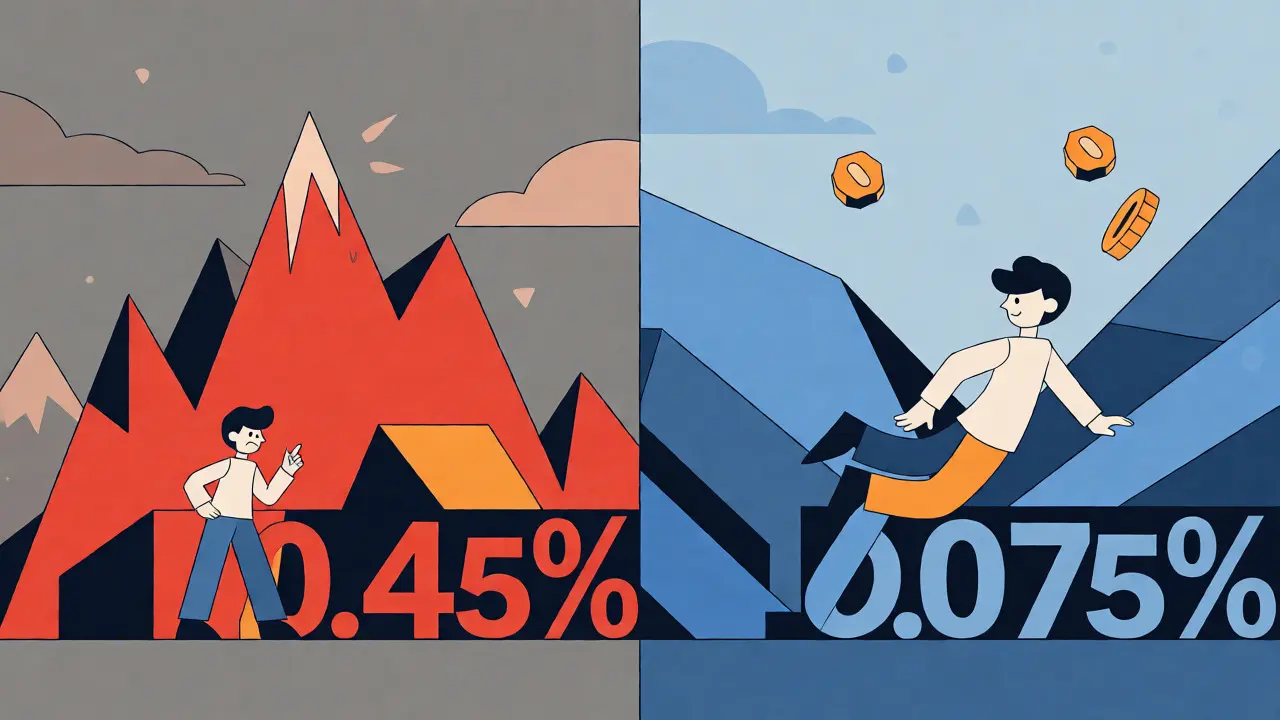
Imagine paying 0.4% in trading fees on Coinbase for a quick swap, only to realize you could have paid 0.075% elsewhere. That is the core promise of Mandala Exchange: a cryptocurrency trading platform built on Binance Cloud infrastructure that offers significantly lower fees and multi-chain support without mandatory KYC for basic crypto deposits. But is it worth the switch? If you are an intermediate trader already holding Bitcoin or Ethereum, Mandala might save you hundreds of dollars a year. If you are a beginner trying to buy your first crypto with a credit card, you might find yourself stuck before you even start.
This review cuts through the marketing noise. We looked at the actual fee structures, the confusing jurisdiction claims, and real user feedback from late 2023 and early 2026 contexts. Here is what you need to know about Mandala Exchange’s liquidity, security, and whether its "no-KYC" claim holds up under scrutiny.
What Is Mandala Exchange and How Does It Work?
Mandala Exchange is not a standalone blockchain monster like Binance or Coinbase. Instead, it operates as a white-label solution powered by Binance Cloud. Think of it as a specialized storefront that uses Binance’s massive engine room for matching orders and securing assets. Launched around 2020 by Mandala Acquisition LLC, the platform positions itself as the first privately owned exchange to leverage this specific infrastructure.
The operational model is straightforward. You create an account, deposit cryptocurrency, and trade against the deep liquidity pools provided by Binance. Because it rides on Binance’s rails, Mandala inherits some serious technical advantages. The order books are tight, meaning slippage (the difference between expected and executed price) is minimal even for larger trades. However, this also means you are trusting a third party-Mandala-to manage your interface and customer service while Binance handles the heavy lifting behind the scenes.
A critical detail often missed in quick summaries: Mandala is primarily a crypto-to-crypto exchange. While it integrates with Indacoin, a London-based service, to allow Visa and Mastercard purchases of its native token (MDX), it does not offer direct bank transfers for buying Bitcoin or Ethereum directly into your wallet. This distinction matters. If you want to sell your house and buy Bitcoin with a wire transfer, Mandala isn’t your best bet. If you already have USDT in your MetaMask and want to swap it for Solana cheaply, Mandala shines.
Fee Structure: The Main Selling Point
Let’s talk numbers, because this is where Mandala justifies its existence. Most major exchanges charge between 0.1% and 0.4% per trade. Mandala flips this script with aggressive pricing designed to attract high-volume traders.
| Exchange | Maker Fee | Taker Fee | Fiat On-Ramp |
|---|---|---|---|
| Mandala Exchange | 0.025% | 0.075% | Via Indacoin (Card only) |
| Coinbase | ~0.40% | ~0.60% | Bank Transfer, Card, PayPal |
| Binance | 0.10% | 0.10% | Extensive options |
| Kraken | 0.16% | 0.26% | Bank Transfer, Card |
As shown above, Mandala’s taker fee of 0.075% is less than half of Binance’s standard rate and a fraction of Coinbase’s. For a $10,000 trade, you pay $7.50 on Mandala versus $40 on Coinbase. Over ten such trades, that is $325 saved. If you use the native MDX Token, Mandala’s utility token used for fee discounts and rebates, these rates can drop further. Holding MDX allows you to pay fees in the token, which often comes with a discount tier system similar to BNB on Binance.
Security and Regulation: The Grey Area
Here is where things get complicated. Mandala Exchange claims to be regulated, but sources conflict on where exactly. Some reports list Seychelles, others Malta. What is clear is that it lacks the robust regulatory framework of US-regulated entities like Coinbase or Kraken. Wikibit.com’s analysis notes that Mandala is effectively unregulated in many major jurisdictions.
Does this mean it is unsafe? Not necessarily. Because it runs on Binance Cloud, users gain access to Binance’s Security Asset Fund for Users (SAFU). This is an emergency insurance fund that covers losses if the hot wallets are hacked. Additionally, the platform uses multi-signature cold storage for long-term asset holdings. Withdrawal whitelisting is available, adding a layer of protection against unauthorized withdrawals.
However, independent verification of these security measures is limited. Unlike public companies, Mandala does not publish regular proof-of-reserves audits in the same transparent manner as larger competitors. You are essentially trusting the partnership between Mandala Acquisition LLC and Binance. If Mandala fails operationally, your assets are still technically on Binance’s infrastructure, but accessing them requires navigating Mandala’s withdrawal process. This introduces counterparty risk that pure self-custody avoids.
User Experience and Interface Challenges
If you are expecting a sleek, Apple-like design, you might be disappointed. User reviews paint a mixed picture. Some praise the speed and efficiency, noting that order execution is rapid due to the underlying Binance tech. Others describe the interface as a "maze," particularly when navigating the multi-chain features.
The platform supports multiple networks including Binance Smart Chain (BSC), Polygon, Solana, Fantom, and Avalanche. This is a huge plus for DeFi users who want to avoid bridge fees. You can deposit ETH on one chain and withdraw on another without leaving the exchange, saving gas fees. But for beginners, selecting the wrong network during a deposit can lead to lost funds if not handled correctly. There is no comprehensive, step-by-step guide prominently displayed on the dashboard to warn new users about network mismatches.
Customer support is another pain point. While marketing materials claim 24/7 support, real-world reports suggest slower response times. One verified user noted that support was "slower than a snail," while Reddit threads mention withdrawal delays of up to 12 hours for certain assets. This contrasts sharply with the instant withdrawals promised by top-tier competitors.
Who Should Use Mandala Exchange?
Mandala Exchange is not for everyone. It occupies a specific niche in the crowded crypto market. Let’s break down who benefits and who should look elsewhere.
- Intermediate Traders: If you already hold crypto and trade frequently, the low fees and Binance-level liquidity make Mandala a strong contender. The ability to earn rebates via MDX tokens adds value for active users.
- Multi-Chain Users: If you interact with DeFi protocols across BSC, Polygon, and Solana, Mandala’s integrated cross-chain support saves you time and money compared to using separate bridges.
- Non-US Residents: Since Mandala does not serve the United States, it is ideal for users in Asia, Latin America, and parts of Europe who face restrictions on other platforms.
Conversely, avoid Mandala if:
- You are a US Resident: You cannot sign up. Period.
- You are a Complete Beginner: The lack of direct fiat on-ramps (like ACH or SEPA transfers) forces you to buy crypto elsewhere first. The learning curve for managing multi-chain deposits can be steep.
- You Need Instant Support: If you lose access to your account or have a pending withdrawal issue, the reported support delays could cause significant stress.

Pros and Cons Summary
To help you decide quickly, here is a distilled view of the platform’s strengths and weaknesses based on current data.
- Pro: Extremely low trading fees (0.025%/0.075%).
- Pro: Access to Binance Cloud liquidity and security infrastructure.
- Pro: No mandatory KYC for crypto deposits (up to 2 BTC daily withdrawal).
- Pro: Multi-chain support reduces bridging costs.
- Con: Unavailable in the United States.
- Con: Limited fiat on-ramp options (mostly card-based via Indacoin).
- Con: Inconsistent customer support experiences.
- Con: Regulatory uncertainty and conflicting jurisdiction claims.
Frequently Asked Questions
Is Mandala Exchange safe to use?
Mandala Exchange leverages Binance Cloud's security infrastructure, including multi-signature cold wallets and access to the SAFU insurance fund. While it lacks the extensive regulatory oversight of US-based exchanges, its technical foundation is robust. However, as a smaller player, it carries higher counterparty risk than industry giants like Coinbase.
Does Mandala Exchange require KYC verification?
No, Mandala does not require KYC for basic crypto deposits and withdrawals. Users can withdraw up to two Bitcoin per day without identity verification. However, using fiat on-ramps like Indacoin may trigger their own KYC requirements.
Can I buy Bitcoin with a credit card on Mandala?
You cannot buy Bitcoin directly with a credit card on the main exchange. Instead, you can purchase the native MDX token via Indacoin using Visa or Mastercard. You would then typically trade MDX for Bitcoin or other cryptocurrencies within the platform.
Why is Mandala Exchange not available in the USA?
Mandala Exchange has chosen not to operate in the United States, likely due to the complex and stringent regulatory environment enforced by the SEC and CFTC. This restricts its user base to international markets where regulations may be more flexible.
What are the withdrawal limits without KYC?
Without completing KYC verification, users are generally limited to withdrawing up to two Bitcoin worth of assets per day. Higher limits typically require submitting identification documents.