
When you send cryptocurrency, how long do you wait before you’re sure it’s really gone through? In most blockchains, you don’t know for sure until several blocks have been added on top. That’s called probabilistic finality - and it’s slow. Bitcoin asks you to wait about an hour. Ethereum’s old system? Same thing. But what if you could know, in less than a second, that your transaction is permanent? That’s instant finality.
What Instant Finality Actually Means
Instant finality means one thing: as soon as a transaction is confirmed, it’s done. Forever. No more waiting for six confirmations. No more second-guessing if a reorg will erase your trade. Once the network agrees, the transaction is written in stone - like signing a contract with permanent ink, not pencil.
This isn’t theoretical. It’s built into modern blockchains that use Byzantine Fault Tolerant (BFT) consensus. These systems require validators - nodes that stake real money - to agree on every transaction before it’s added. If two-thirds of the staked value agrees, the transaction is final. No exceptions. No delays. No ambiguity.
Compare that to Bitcoin. There, miners compete to add blocks. Each new block makes it harder to reverse a transaction, but it never hits zero risk. A 51% attack could still rewrite history. Instant finality removes that risk entirely by design.
How It Works: Validators, Staking, and Agreement
Instant finality doesn’t happen by accident. It needs three things:
- Small, trusted validator sets - usually hundreds, not tens of thousands.
- Economic staking - validators lock up real tokens. If they cheat, they lose it.
- Fast consensus - a protocol that lets them vote and lock in results in seconds.
Think of it like a jury. In Bitcoin’s system, anyone can join the courtroom. In instant finality, only qualified jurors with skin in the game are allowed. They vote. If the majority agrees, the verdict is immediate and binding. If someone tries to lie, they’re fined heavily. That’s the economic incentive.
Protocols like Tendermint (used by Cosmos), Avalanche’s Snowman, and Sei’s Twin-Turbo are built this way. They don’t rely on luck or time. They rely on math, economics, and coordinated agreement.
Speed Comparison: From Minutes to Milliseconds
Here’s how real blockchains stack up:
| Blockchain | Finality Time | Consensus Type |
|---|---|---|
| Sei Network | <400 milliseconds | Twin-Turbo |
| Avalanche | <1 second | Snowman |
| Near Protocol | ~2 seconds | Nightshade |
| Cosmos (Tendermint) | ~6 seconds | Tendermint BFT |
| Solana | 2-5 seconds | Proof of History + PoS |
| Ethereum (PoW) | ~60 minutes | Proof of Work |
| Bitcoin | ~60 minutes | Proof of Work |
Sei Network’s sub-400ms finality isn’t a marketing gimmick - it’s a technical breakthrough. It means you can build trading bots that execute orders faster than human reaction times. You can settle payments in real time without worrying about chargebacks or delays. That’s not just faster - it’s a new class of application.
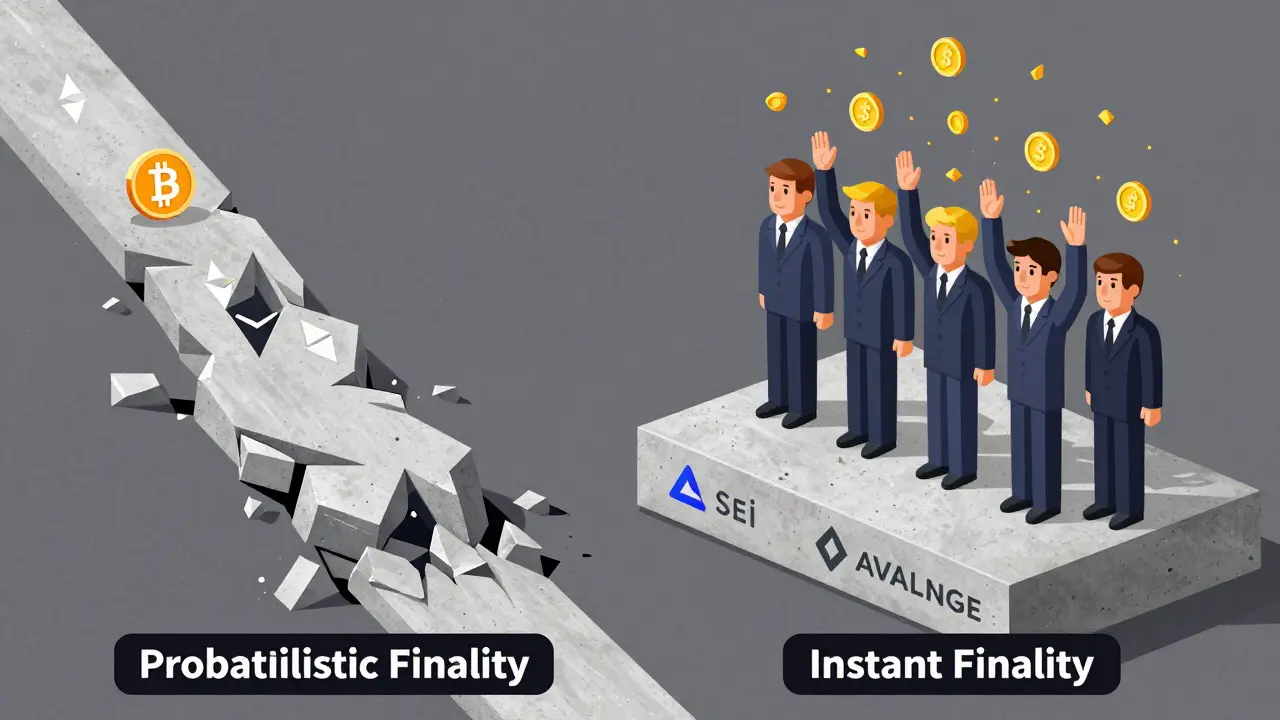
Instant Finality vs. Probabilistic Finality: The Trade-Offs
There’s no free lunch. Instant finality isn’t better in every way. It trades off something important: decentralization.
Bitcoin and Ethereum (pre-merge) had thousands of independent miners. Anyone with a GPU could join. That’s powerful. It’s resilient. But it’s slow.
Instant finality chains usually have 100-200 validators. That’s still decentralized compared to banks - but far less than Bitcoin. Some users worry: What if a few big players control the majority? What if they collude?
That’s why staking matters. Validators don’t just vote - they risk their own money. If they act dishonestly, they get slashed. Their stake disappears. This turns trust into economics. It’s not perfect, but it’s far more secure than relying on hash power alone.
Probabilistic finality is like a slowly drying cement. The longer you wait, the harder it is to change. Instant finality is like pouring concrete - it sets the moment it’s poured. One is safer over time. The other is certain right away.
Why It Matters for DeFi and Enterprise
Imagine you’re running a decentralized exchange. You offer a trade: 1 ETH for 500 USDC. But the system doesn’t finalize until 60 seconds later. What if the price moves 10% in that time? You just lost money.
With instant finality, the trade executes and locks in instantly. No slippage. No uncertainty. No middlemen.
Enterprise use cases need this too. Think supply chain tracking, insurance claims, or cross-border payments. Companies can’t wait minutes for settlement. They need real-time, auditable, irreversible records. Instant finality makes blockchain usable for business - not just speculation.
Atomic swaps between chains? Those only work if both sides finalize instantly. Otherwise, one side could walk away with your funds. Instant finality makes cross-chain bridges secure and trustless.
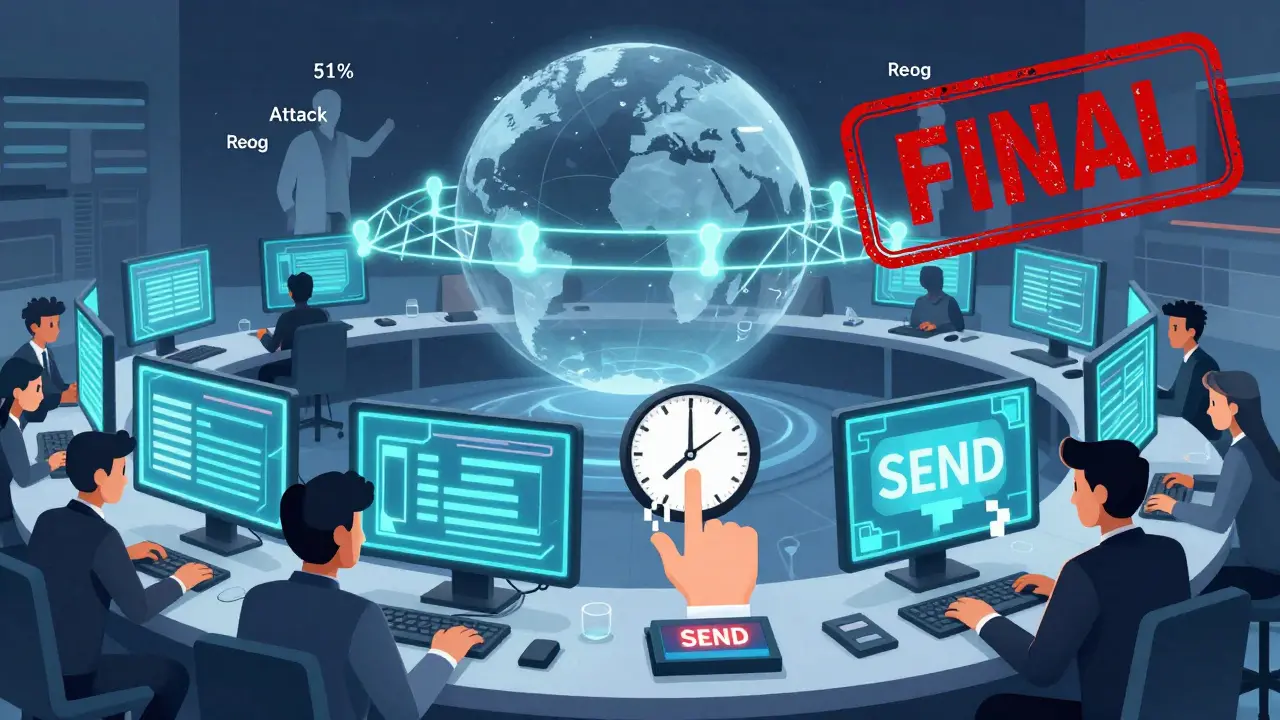
The Downside: Less Decentralization, More Complexity
It’s not all smooth sailing. Instant finality systems are more complex. They need:
- Highly synchronized validators
- Strict network timing rules
- Strong incentives to stay honest
- Careful handling of network partitions
If the network splits, some validators might think a transaction is final while others don’t. That’s a risk. Probabilistic systems handle this better - they just keep building blocks. Eventually, the longest chain wins.
Instant finality systems can stall if they can’t reach agreement. That’s called a liveness failure. It’s rare, but it’s possible. That’s why researchers are working on hybrid models - combining instant finality for critical transactions with probabilistic finality for others.
What’s Next? The Future Is Instant
Every new blockchain launched in 2025 and beyond is building for instant finality. Even Ethereum, after its merge, still has a probabilistic finality window - but layer-2 solutions like zk-rollups now offer near-instant settlement on top.
Experts agree: the future belongs to systems that give users confidence the moment they hit send. Whether it’s trading, paying, or transferring assets, people don’t want to wait. They want to know - right away - that it’s done.
Blockchains that stick with 60-minute finality will become relics. Not because they’re insecure - but because they’re too slow for the world we live in now.
Real-World Impact: What Users Experience
Traders on Sei or Avalanche report trading with zero anxiety. No more refreshing screens waiting for confirmations. No more missed opportunities because a transaction was "pending."
DeFi protocols like lending platforms and automated market makers now offer near-instant withdrawals. Users don’t need to wait hours to access their funds. That’s a massive UX win.
Enterprise pilots in logistics and banking are seeing 80% faster settlement cycles. That’s not just tech - that’s real money saved.
But some purists still prefer Bitcoin. They argue: "More decentralization means more security." And maybe they’re right. But for most people - traders, developers, businesses - speed and certainty matter more than theoretical decentralization.
Is instant finality safer than probabilistic finality?
Yes - but differently. Instant finality eliminates the risk of reorganizations and double-spends by design. Once confirmed, transactions are permanent. Probabilistic systems reduce risk over time but never eliminate it. Instant finality’s safety comes from economic penalties and validator coordination, not just computational work. For most users, this is a net gain.
Can instant finality be hacked?
It’s designed to survive up to one-third of validators acting maliciously. That’s called the Byzantine Fault Tolerance limit. If more than 33% of staked tokens collude, the network can be compromised. But that requires controlling a massive amount of capital - often hundreds of millions of dollars. It’s harder than a 51% attack on Bitcoin because you’d need to buy or borrow that much stake, and you’d lose it all if caught.
Why don’t all blockchains use instant finality?
Because it trades off decentralization. Bitcoin and Ethereum (initially) prioritized open participation over speed. Anyone could mine. That’s powerful. Instant finality requires a smaller, coordinated set of validators. That’s faster - but less permissionless. Some networks choose decentralization. Others choose speed. Both are valid trade-offs.
Does instant finality mean no more forks?
Yes - for transactions. Once a block is finalized, it can’t be undone. But protocol upgrades can still happen. Forks for software updates are different from transaction reversals. Instant finality doesn’t stop chain upgrades - it just makes confirmed transactions permanent.
Which blockchain has the fastest instant finality?
As of 2026, Sei Network holds the record at under 400 milliseconds. It uses a custom consensus called Twin-Turbo that parallelizes block validation. Avalanche is close behind with sub-second finality. Both are significantly faster than Solana or Near, which operate in the 2-5 second range.
If you’re using blockchain for anything beyond simple transfers - trading, lending, automation, payments - instant finality isn’t a luxury. It’s the baseline. The future of finance doesn’t wait. Neither should you.
Elijah Young
February 9, 2026 AT 19:36Finally someone explains this without the hype. Instant finality isn't magic-it's just better economics. No more guessing if your trade will stick. I've lost money waiting for Bitcoin confirmations. This changes everything for trading.
Christopher Wardle
February 11, 2026 AT 05:42It’s fascinating how we’ve traded openness for speed. Bitcoin’s slow finality was a feature, not a bug. It forced patience. Now we’re optimizing for milliseconds, but at what cost to resilience?
John Doyle
February 12, 2026 AT 01:34Bro this is why I switched from ETH to Sei. No more refreshing my wallet for 10 minutes. I made a trade, hit send, and boom-it was done. I literally high-fived my cat. 🤙
kelvin joseph-kanyin
February 12, 2026 AT 13:27400ms? That’s faster than my coffee cools down 😎 I just did a $5k swap and didn’t even blink. This isn’t the future-it’s already here. Who’s still waiting an hour? 🤡
Grace Mugambi
February 14, 2026 AT 06:37There’s something deeply human about waiting. Probabilistic finality gave us time to reflect-now we’re conditioned to expect instant results. Is that progress, or just convenience dressed up as innovation?
Crystal McCoun
February 15, 2026 AT 16:50Validators with skin in the game? Yes. But I worry about concentration risk. If five entities hold 70% of the stake, is this really decentralized-or just a different kind of bank? The staking incentives help, but governance still needs scrutiny.
Beth Trittschuh
February 16, 2026 AT 04:27I love how this removes anxiety. No more "is it confirmed?" panic before bed. I used to check my wallet like a nervous habit. Now? I send, walk away, and forget. Peace of mind? Priceless. 🌿
Benjamin Andrew
February 16, 2026 AT 22:06Let’s be brutally honest: this is centralized by design. You’re replacing miners with a cartel of wealthy validators. The "economic penalty" is just a fancy term for "if you cheat, you lose your millions." That’s not security-it’s oligarchy with a blockchain sticker.
Michelle Cochran
February 18, 2026 AT 00:51People don’t realize how dangerous this is. You’re giving up the one thing that made crypto special-permissionless participation. Now you need thousands of dollars to even be a validator. This isn’t finance revolution. It’s Wall Street 2.0 with crypto jargon.
monique mannino
February 19, 2026 AT 12:58As someone who’s used this for remittances to family overseas-this is life-changing. Used to take 3 days. Now? Instant. No fees, no middlemen. Just gone. Thank you for making this real. 🙏❤️
Peggi shabaaz
February 20, 2026 AT 20:53i just like that i dont have to stare at my screen waiting anymore. feels like the internet finally works like it should
Sakshi Arora
February 22, 2026 AT 03:56Desiree Foo
February 23, 2026 AT 13:09Stop pretending this is "decentralized." You’re trading one centralized system for another. The validators are all institutional players. This isn’t innovation-it’s a rebranding of banking. You’re fooling yourselves.
Robbi Hess
February 23, 2026 AT 17:20So we’re just replacing proof-of-work with proof-of-wealth? Brilliant. The rich get richer, and the rest of us get to watch as our "decentralized" network becomes a gated community. I miss when blockchain meant freedom, not finance for billionaires.