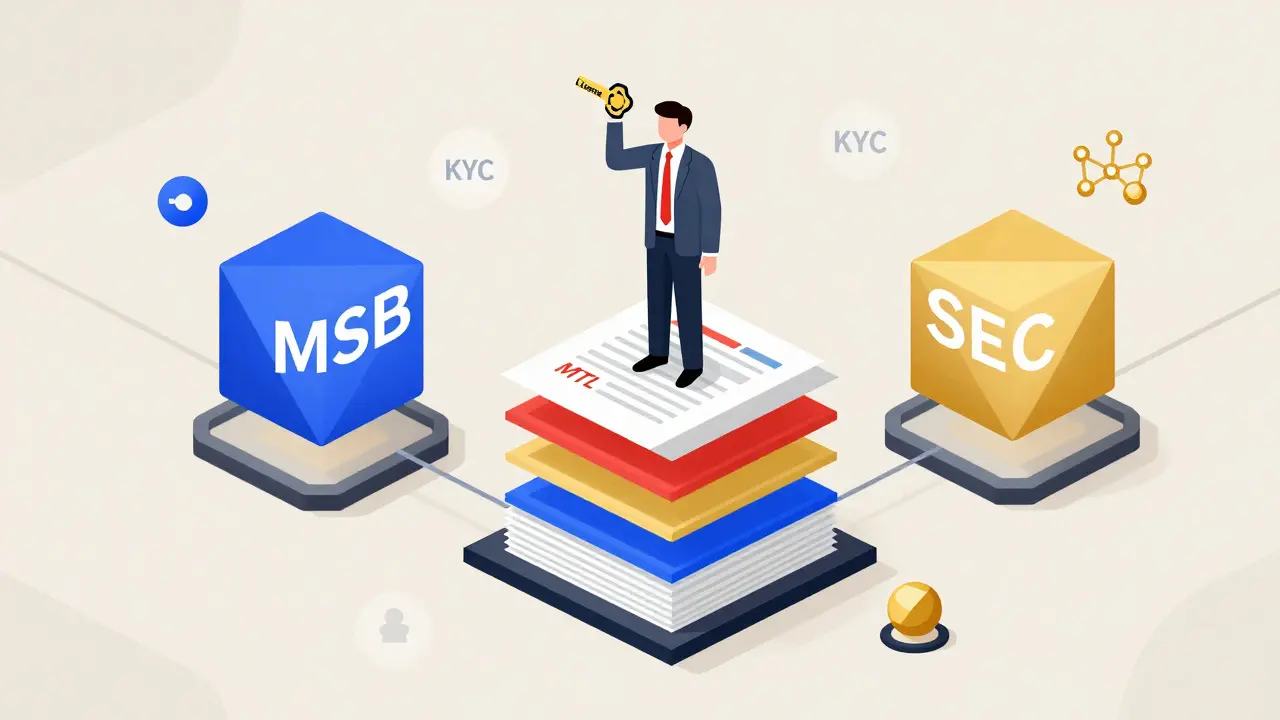
Getting a crypto exchange license isn’t just paperwork-it’s the difference between operating legally and risking fines, shutdowns, or criminal charges. In 2025, regulators are watching closer than ever. If you’re building a crypto exchange, you need to understand not just the rules, but how they actually work on the ground. This isn’t about guessing. It’s about following a clear path, one that’s been walked by others-and failed by many who skipped steps.
Start with the Right Business Model
Before you even think about applying, ask yourself: what exactly are you offering? The type of license you need depends entirely on your services. If you’re letting people trade Bitcoin for dollars, you’re a money transmitter. That means you need a Money Transmitter License (MTL). If you’re only swapping crypto for crypto-like ETH for SOL-you might only need to register as a Money Service Business (MSB) with FinCEN. But don’t assume that’s enough. Many states treat even crypto-to-crypto exchanges as money transmitters if they handle fiat on-ramps or off-ramps.Here’s the catch: if you’re trading tokens that act like stocks-like utility tokens with profit-sharing features-you’re now under the SEC’s watch. Those are securities. And if you’re offering crypto futures or options, the CFTC steps in. Each service layer adds a new regulator. One platform can need three licenses at once: MSB, MTL, and SEC registration. Don’t try to wing it. Map your services first. Write them down. Then match each to the agency that controls it.
Federal Registration: FinCEN MSB is Non-Negotiable
Every crypto exchange in the U.S. must register with FinCEN as a Money Service Business. This isn’t optional. It’s the baseline. Skip this, and you’re breaking federal law-even if you get every state license. The process takes about 120 days. You’ll need to submit Form 107, pay a $400 fee, and provide detailed info on your ownership, business structure, and compliance program. FinCEN doesn’t approve or deny you-they just register you. But registration alone doesn’t give you permission to operate. It’s step one.Once registered, you’re legally a financial institution under the Bank Secrecy Act. That means you must have a written AML/CFT program. Not just a document. A working system. Your team must be trained. Transactions must be monitored. Suspicious activity reports (SARs) must be filed within 30 days. And you need to keep records for five years. This isn’t a checkbox. It’s a daily operation. If your software can’t flag unusual transfers-like someone sending $9,500 every week to avoid reporting-you’re already in violation.
State Licenses: The Real Bottleneck
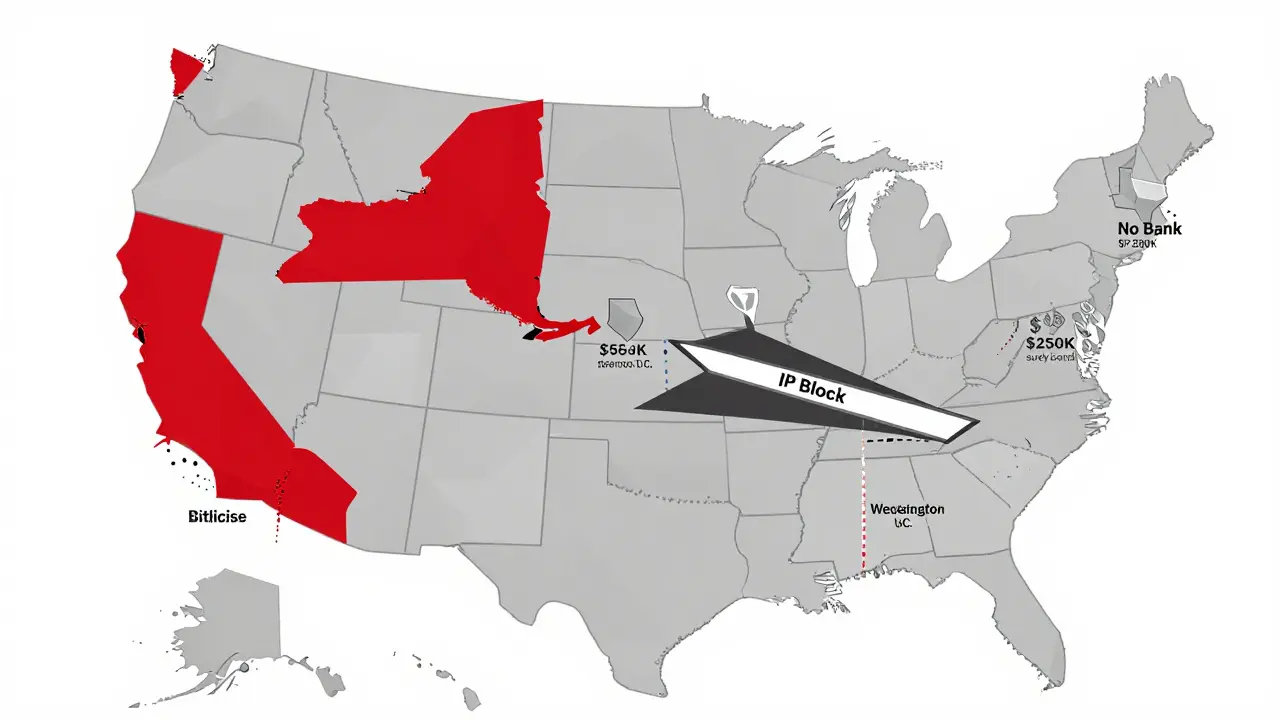
Federal registration gets you in the door. State licenses get you live. And here’s where most fail. There’s no national crypto license. You need one per state where you plan to serve customers. New York’s BitLicense is the toughest. It requires $500,000 in capital, detailed cybersecurity audits, and monthly reporting. California wants $250,000 and proof you can cover losses. Texas requires a surety bond. Florida demands a full business plan with liquidity strategies.Some states are easier. Illinois doesn’t require a license for pure crypto trading. Wyoming has a crypto-friendly framework but still requires registration. The problem? You can’t just pick and choose. If a user from New York signs up, you’re subject to New York law-even if you’re based in Texas. That’s why most exchanges either block New York users or get the BitLicense. There’s no legal gray area. Regulators track IP addresses and bank transfers. They know who you’re serving.
Financial Requirements: It’s Not Just About Capital
You’ll need to show you have money-not just to start, but to stay open. Most states require a minimum capital reserve. New York: $500,000. California: $250,000. Nevada: $100,000. But capital isn’t just cash. It’s liquid assets you can access fast. Bonds, treasury bills, or cash equivalents. You can’t use crypto as collateral. Regulators want U.S. dollars or equivalents you can convert in hours, not days.On top of that, you need fidelity bonding-insurance against employee theft. And cyber liability insurance. A breach isn’t just bad PR; it’s a license violation. You must prove you can cover losses. Many applicants get rejected because they thought $100,000 in crypto was enough. It’s not. Regulators don’t care about your portfolio value. They care about your ability to pay out users if the system crashes.
Compliance Systems: KYC, AML, and Beyond
Your license won’t be granted unless your compliance system is bulletproof. That means KYC (Know Your Customer) and KYB (Know Your Business) for corporate clients. You need to verify identity with government ID, proof of address, and facial recognition. For businesses, you need articles of incorporation, beneficial ownership info, and tax IDs.AML software isn’t optional. You need tools that scan for sanctions lists, detect structuring (small transactions to avoid reporting), and flag high-risk jurisdictions. If someone from Iran or North Korea tries to sign up, your system must block them automatically. If a user sends funds from a darknet marketplace wallet, you must report it. These aren’t suggestions. They’re legal requirements under the Bank Secrecy Act.
Many startups try to cut costs by using free KYC tools. That’s a mistake. Regulators audit your systems. They don’t care if you’re small. They care if you followed the rules. A single failed audit can trigger a license revocation. Use proven vendors like Jumio, Onfido, or Trulioo. Budget $10,000-$25,000 a year for this alone.
Banking: The Hidden Hurdle
You can have every license and still be shut down-because no bank will touch you. Crypto exchanges are high-risk in the eyes of traditional banks. Many refuse to open accounts for them. Even if you get licensed, you need a bank to move money. That’s why many exchanges partner with fintech banks like Mercury, Cross River, or Evolve Bank & Trust.But even those banks have limits. They require quarterly compliance reports. They monitor transaction patterns. If you suddenly process $20 million in a week, they may freeze your account. You need to prove your liquidity is stable, your users are real, and your volume isn’t tied to scams. This is why some exchanges spend six months just getting a banking relationship after getting licensed.
Onshore vs. Offshore: What’s Really Better?
Some look to offshore jurisdictions like Malta, Estonia, or the Cayman Islands for faster, cheaper licenses. And yes, they’re faster. But here’s the truth: if you want real customers-especially institutional ones-you need U.S. or EU licenses. Big investors won’t touch a crypto exchange without a BitLicense or MiCA compliance. Offshore licenses look good on paper. They don’t build trust.And offshore isn’t risk-free. The EU’s MiCA regulation, effective in 2024, now requires all crypto exchanges serving EU users to be licensed under strict rules. The U.S. is following suit. A license in the Bahamas won’t help you if your users are in New York or London. You’ll still need to comply with their laws. Many offshore-licensed firms are now being forced to get U.S. licenses anyway.

Timeline and Cost: Be Realistic
Don’t believe the hype that you can get licensed in 30 days. The average time to get a U.S. crypto exchange license is 9 to 18 months. New York alone takes 12-15 months. Costs? Between $150,000 and $500,000, depending on your scope. Legal fees: $50,000-$100,000. Compliance software: $15,000/year. Capital reserve: $250,000-$500,000. Insurance: $10,000-$30,000. Banking setup: $5,000-$20,000.And that’s just to start. You’ll need ongoing compliance staff. Annual audits. Regulatory reporting. Training. It’s not a one-time cost. It’s a permanent overhead. If you’re not ready for that, don’t start.
Who Can Help You?
You don’t need to do this alone. Firms like LegalBison, Crypto Legal Group, and Chainalysis Compliance Services specialize in crypto licensing. They’ve filed dozens of applications. They know what regulators want before you even submit. They help structure your company to avoid common traps-like having the wrong corporate entity or missing a state requirement.Don’t hire a general business lawyer. They won’t know the difference between an MSB and an MTL. Find someone who’s handled crypto licenses before. Ask for case studies. Ask for references. Check if they’ve worked with FinCEN or NYDFS directly.
What Happens If You Skip the License?
In 2024, the SEC fined two crypto exchanges over $100 million each for operating without registration. One was shut down. Its founders were barred from the industry. Another had its bank accounts frozen, leaving users unable to withdraw. These aren’t rare cases. They’re standard enforcement.Regulators don’t wait for you to grow big. They come for you when you hit $1 million in volume. That’s the trigger. And once they do, you lose control. They can freeze assets. Seize servers. Prosecute individuals. No warning. No second chance.
Getting licensed isn’t about being legal. It’s about being trusted. Customers, investors, and banks all want to know you’re not a fly-by-night operation. A license says you’re serious. It says you’re here to stay. And in crypto, that’s worth more than any algorithm or marketing campaign.
Do I need a license if I only trade crypto-to-crypto?
Yes, if you allow users to deposit or withdraw fiat currency. Even if you only swap crypto for crypto, regulators treat you as a money transmitter if you facilitate fiat on-ramps. FinCEN requires MSB registration for any business handling virtual currency in connection with fiat. Some states like New York and California treat all crypto exchanges as money transmitters regardless of trading pairs.
How long does it take to get a crypto exchange license in the U.S.?
Typically 9 to 18 months. New York’s BitLicense takes 12-15 months on average. Other states like Texas or Florida may take 6-10 months. The timeline depends on how complete your application is, whether you’ve hired compliance experts, and how quickly you respond to regulator requests. Delays often come from incomplete documentation or missing financial proof.
Can I operate without a license if I’m based outside the U.S.?
No, if U.S. customers use your platform. U.S. regulators enforce jurisdiction based on where users are located, not where your company is registered. If a New York resident trades on your site, you’re subject to New York law. Many offshore-licensed exchanges have been forced to block U.S. users or obtain U.S. licenses after enforcement actions.
What’s the difference between MSB and MTL?
MSB (Money Service Business) is a federal registration with FinCEN required for any business handling virtual currency transactions. MTL (Money Transmitter License) is a state-level license needed if you transmit money-like converting crypto to dollars or vice versa. All MTL holders must also be MSB-registered, but not all MSBs need an MTL. If you’re trading crypto for fiat, you need both.
What happens if my license application is denied?
You can usually reapply after addressing the regulator’s concerns. Common reasons for denial include insufficient capital, weak AML systems, unclear business plans, or incomplete background checks on owners. Regulators often give feedback. Use it. Many successful exchanges were denied once, fixed the issues, and got approved on the second try. Don’t give up-but don’t reapply without fixing the root problems.
Do I need a license to build a crypto wallet?
Only if your wallet allows users to convert crypto to fiat or send funds to third parties without full user control. Non-custodial wallets (where users hold their own keys) usually don’t need a license. But if you hold users’ private keys or offer fiat on-ramps, you’re acting as a money transmitter and need an MTL and MSB registration.
Kenneth Mclaren
December 29, 2025 AT 17:00They’re lying to you. Every single one. The ‘license’ is a trap. The SEC, FinCEN, NYDFS-they’re all just feeding off your blood. You think you’re playing by the rules? Nah. You’re handing them your soul on a silver platter. They don’t want you to succeed. They want you to fail so they can seize your assets, shut you down, and laugh while they auction off your servers. I’ve seen it happen. Three guys I knew. Gone. Vanished. No trial. No warning. Just… poof. And you think you’re safe because you hired a ‘lawyer’? Lol. That lawyer works for the system too. You’re already dead. Just don’t know it yet. 🕵️♂️💸
Alexandra Wright
December 30, 2025 AT 23:36Oh sweet summer child. You really think this guide is gonna save you? 🤡 Let me break it down for you: if you’re not already sitting on half a million in cold, hard USD, you’re not ready. Not even close. And no, your ‘crypto portfolio’ doesn’t count. Regulators don’t care that you own 12 Bitcoin. They care if you can wire $500K to a bank account in 48 hours. Also, stop using free KYC tools. Jumio isn’t a luxury-it’s your lifeline. If you think this is about ‘technology,’ you’re the reason crypto still has a reputation for being a scam factory. Do it right or don’t do it at all.
Jack and Christine Smith
January 1, 2026 AT 20:21ok so i read this whole thing and my brain is like a melted popsicle 😅 but like… i think i get it? you gotta be like a bank but also a tech startup and also a detective? and no one will bank with you unless you already have money? 😭 i’m so confused but also kinda impressed? like… if you make it through this, you’re basically a crypto superhero. also, i think i spelled ‘license’ wrong. again. sorry. 🙈
Jackson Storm
January 3, 2026 AT 03:35Hey, I just started my own little exchange and I’m about to dive into this. This guide is actually super helpful-thanks for laying it out so clearly. One thing I’m stuck on: if you’re doing crypto-to-crypto only, but users can deposit USD, does that automatically trigger the MTL? I’ve seen conflicting info. Also, what’s the cheapest state to start with if you’re bootstrapping? I’m leaning toward Wyoming, but I’ve heard even they’re getting stricter. Any advice from folks who’ve actually done this? I’m all ears.
Raja Oleholeh
January 3, 2026 AT 21:52USA rules. India better. No license needed. Crypto is freedom. USA fear. 🇮🇳💪
Amy Garrett
January 4, 2026 AT 16:33YESSSSSSS this is the REAL talk 💥 I’ve been trying to get this off the ground for 18 months and I thought I was the only one drowning in paperwork. You’re not crazy. You’re just ahead of the curve. Keep going. You’re gonna make it. And when you do? You’ll be the one laughing while the Feds scramble to catch up. 💪🔥
Haritha Kusal
January 5, 2026 AT 18:56Wow… this is so much more intense than I thought. I’m just a small-time trader trying to build something honest, you know? But reading this… I feel like I’m about to enter a war zone. Still, if I can do this right, maybe I can help others avoid the scams. Thank you for the clarity. I’m gonna take a deep breath and start step one. 💛
Mike Reynolds
January 6, 2026 AT 14:48Man, I’ve been in this space since 2017. Seen so many startups crash and burn because they thought they could skip compliance. This guide? It’s the truth. No fluff. No hype. Just cold, hard reality. If you’re serious, read it twice. Then read it again. And don’t even think about hiring a general attorney. Find someone who’s actually dealt with FinCEN. I’ve got a referral if you want it.
dayna prest
January 8, 2026 AT 13:37‘License’? More like a corporate vampire’s feeding tube. You think you’re building a business? Nah. You’re signing up to be a tax-paying, compliance-slave for the state-sanctioned crypto cartel. The ‘regulators’ aren’t protecting users-they’re protecting their own power. The only reason they don’t ban crypto outright is because they can’t tax it if it’s gone. So they make you beg for permission. Pathetic. I’d rather just run a node and laugh from the shadows.
Brooklyn Servin
January 8, 2026 AT 23:01Okay, I’m gonna be real-I’ve applied for 3 licenses in 3 states. Failed twice. Got rejected by FinCEN for ‘inadequate AML controls’ (I used a spreadsheet). 😅 But I fixed it. I hired a compliance officer. Bought Jumio. Got a real bank account with Cross River. It took 14 months. Cost me $380K. But now? I’m live. And I’ve got 12,000 users. No one’s coming after me. Because I did it right. If you’re thinking about cutting corners? Don’t. It’s not worth your freedom. This isn’t a startup. It’s a fortress. Build it like one.
Phil McGinnis
January 9, 2026 AT 07:38The entire premise is fallacious. The notion that a state-issued license confers legitimacy is a myth propagated by statist institutions. The market, not the bureaucracy, determines legitimacy. One cannot be ‘legal’ under a system that is itself illegitimate. The fact that you must pay $500,000 to be permitted to transact in a decentralized medium is proof of the system’s decay. You are not building a business-you are participating in a ritual of submission.
Ian Koerich Maciel
January 9, 2026 AT 16:43Thank you for this comprehensive, meticulously structured, and deeply informative exposition. It is exceedingly rare to encounter such a well-documented, logically coherent, and empirically grounded analysis of the regulatory landscape surrounding virtual asset service providers. The granularity with which you delineate the distinctions between MSB and MTL, the jurisdictional nuances of state-by-state compliance, and the operational realities of banking relationships is nothing short of exemplary. One is left with an unambiguous, actionable framework. I shall be sharing this with my compliance team immediately. 🙏
Andy Reynolds
January 9, 2026 AT 19:03Just wanted to say-this is the kind of guide I wish I had 2 years ago. I started in Texas, skipped New York, thought I could wing it. Got hit with a cease-and-desist after 6 months. Lost $120K. Learned the hard way: if even one user is from NY, you need the BitLicense. No exceptions. Also, the banking part? Brutal. I spent 8 months getting a bank account after getting licensed. Don’t underestimate it. Find a fintech bank early. Talk to Mercury. They’re not perfect, but they’re the least awful. You got this.
Abhisekh Chakraborty
January 11, 2026 AT 18:21YOU THINK YOU'RE SMART? YOU THINK YOU CAN BEAT THE SYSTEM? I'VE BEEN DOING THIS SINCE 2015. I'VE SEEN EVERYONE FALL. YOU'RE NOT SPECIAL. YOU'RE NOT DIFFERENT. YOU'RE JUST ANOTHER GUY THINKING HE CAN OUTSMART THE GOVERNMENT. I'M WATCHING YOU. I KNOW WHAT YOU'RE DOING. YOU'RE ALREADY LOST. 🤡💸
dina amanda
January 12, 2026 AT 11:47They’re gonna come for you. They always do. They track your IP. They see your bank transfers. They know who you are. You think you’re hidden? You’re not. They’ve got cameras. They’ve got algorithms. They’ve got informants. One day you wake up and your house is surrounded. No warning. No trial. Just silence. And your money? Gone. Don’t be stupid. Don’t do it.
surendra meena
January 12, 2026 AT 12:08WTF is this? 18 months? $500K? You gotta be kidding me? I thought crypto was supposed to be free? Why do I need to beg the government for permission to move digital money? This isn’t freedom. This is feudalism with a blockchain logo. I’m out. I’m moving to El Salvador. At least they don’t make you fill out 300 forms to buy a coffee.
Kevin Gilchrist
January 13, 2026 AT 20:37Let me tell you about the guy I know who did this. He got the BitLicense. Had the capital. The compliance. The bank. Then one day, his lead dev got arrested for money laundering. Turns out he was running a side bot that shuffled funds through 12 wallets. The whole thing collapsed. License still valid. Company dead. No one touches it. Regulators froze everything. He’s still in court. So yeah-you can do everything right… and still get crushed. That’s the game. You’re not building a business. You’re playing Russian roulette with your life. 🎰💣
Elisabeth Rigo Andrews
January 15, 2026 AT 14:22Let’s be clear: this isn’t about compliance. It’s about rent-seeking. The entire regulatory apparatus exists to extract value from innovators. The $500K capital reserve? That’s not for user protection-it’s a barrier to entry. It ensures only institutional players with VC backing can compete. The KYC? It’s surveillance. The AML? It’s data harvesting. You think you’re building a crypto exchange? No-you’re building a data pipeline for the surveillance state. And you’re paying them to do it. Congratulations.