Smart contracts on Ethereum aren’t magic. They’re not mysterious AI agents. They’re just code-simple, predictable, and unchangeable once deployed. And that’s exactly what makes them powerful.
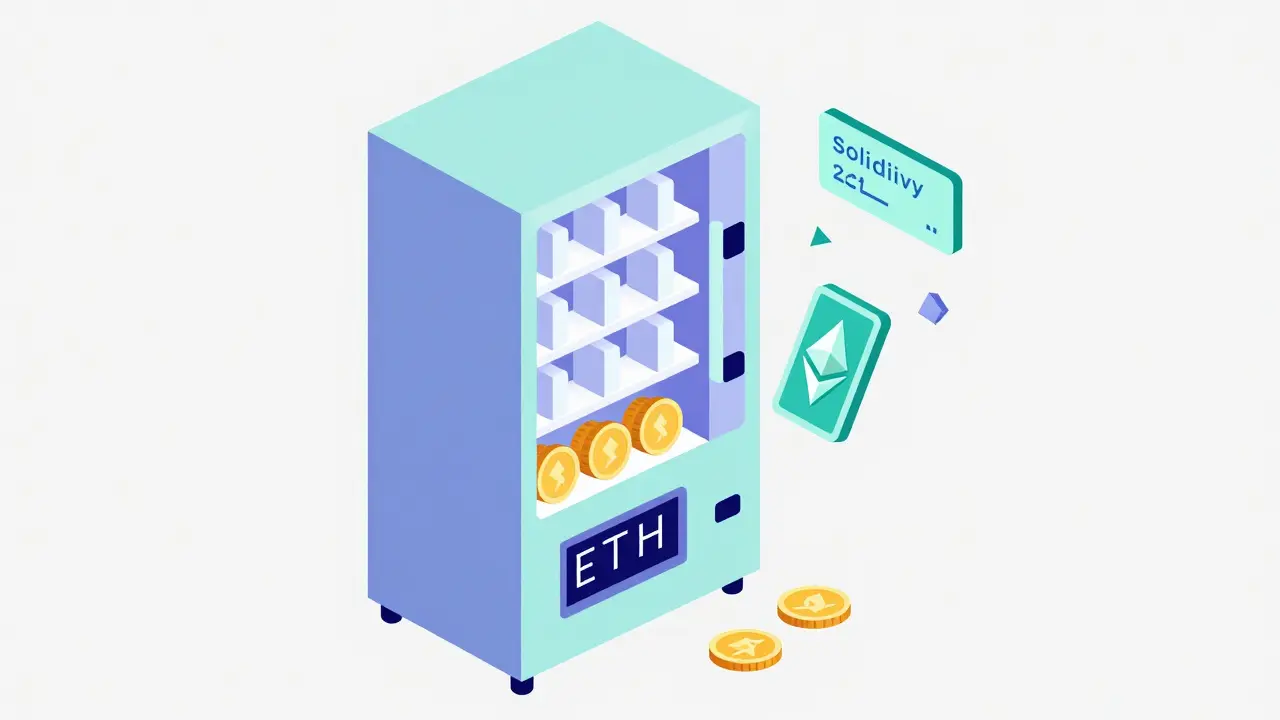
Imagine a vending machine. You put in money, select a snack, and out comes your treat. No clerk. No negotiation. No delays. That’s what a smart contract does-but for anything digital: money, property, certificates, even votes. On Ethereum, these contracts run automatically when conditions are met. No middleman. No paperwork. Just code.
What Exactly Is a Smart Contract?
A smart contract is a program stored directly on the Ethereum blockchain. It’s not a document you sign. It’s not an email agreement. It’s code-written in Solidity or Vyper-that lives at a unique address on the blockchain, like a digital locker with rules built in.
When you send a transaction to that address, the contract checks if the conditions are right. If yes, it runs. If not, it stops. For example: “If Alice sends 1 ETH to this address by Friday, then send her the NFT.” That’s it. No one has to approve it. No bank needs to clear it. The blockchain does it for you.
These contracts are made up of two things: state (data stored on the chain, like balances or ownership records) and functions (rules that change that data). Once deployed, they can’t be edited. That’s intentional. It means everyone can trust that the rules won’t change after the fact.
How Do They Run? The Ethereum Virtual Machine (EVM)
Smart contracts don’t run on your phone or laptop. They run on the Ethereum Virtual Machine-a global, decentralized computer made up of thousands of machines around the world. Every node on the Ethereum network runs the same code, and they all agree on the outcome.
This is why smart contracts are so secure. If one computer says the contract should pay out, but another says no, the network checks the code and the data. Only if every node agrees does the transaction go through. That’s consensus. And it’s what stops fraud.
The EVM understands low-level instructions called opcodes. But you don’t write in opcodes. You write in Solidity-a language made for smart contracts. Think of it like writing a recipe in English, and the EVM translates it into machine steps. The compiler turns your Solidity code into bytecode the EVM can run.
Key Building Blocks: Functions, Variables, and Triggers
Every smart contract has structure. Here’s what’s inside:
- State variables: Data stored permanently on the blockchain. Example:
uint256 public balance;tracks how much ETH is held. - Functions: Actions the contract can perform. Some are public (anyone can call them), others are private (only the contract itself can use them).
- Modifiers: Like safety checks. The
require()function stops execution if something’s wrong. Example:require(msg.sender == owner, "Only owner can withdraw");-this ensures only the contract creator can take money out. - Events: Logs that say “something happened.” Useful for apps to react without constantly checking the chain.
Special variables give contracts access to blockchain info:
msg.sender- Who called this function?msg.value- How much ETH was sent with the transaction?block.timestamp- Current time on the blockchain.tx.gasprice- How much the user paid per unit of gas.
These let contracts make decisions based on real-time blockchain data. For example, a contract could say: “If the current time is past June 1, 2025, release the funds.”
How Are Smart Contracts Deployed?
You can’t just upload a contract like a file. You have to pay to deploy it. That cost is called gas-paid in ETH. Deploying a contract costs more than sending ETH because the network has to store the entire code permanently.
Here’s how it works:
- You write the contract in Solidity (using tools like Remix IDE, Hardhat, or Foundry).
- You compile it into bytecode the EVM can understand.
- You connect your wallet (like MetaMask) to a testnet like Sepolia to test first.
- You send a transaction to deploy it. The network mines it, and your contract gets a permanent address.
- Now anyone can interact with it-by sending transactions to that address.
Once deployed, the contract is public. Its code is visible to everyone. That’s transparency. But it also means bugs can be exploited. That’s why testing on testnets is non-negotiable.
Composability: The Secret Superpower
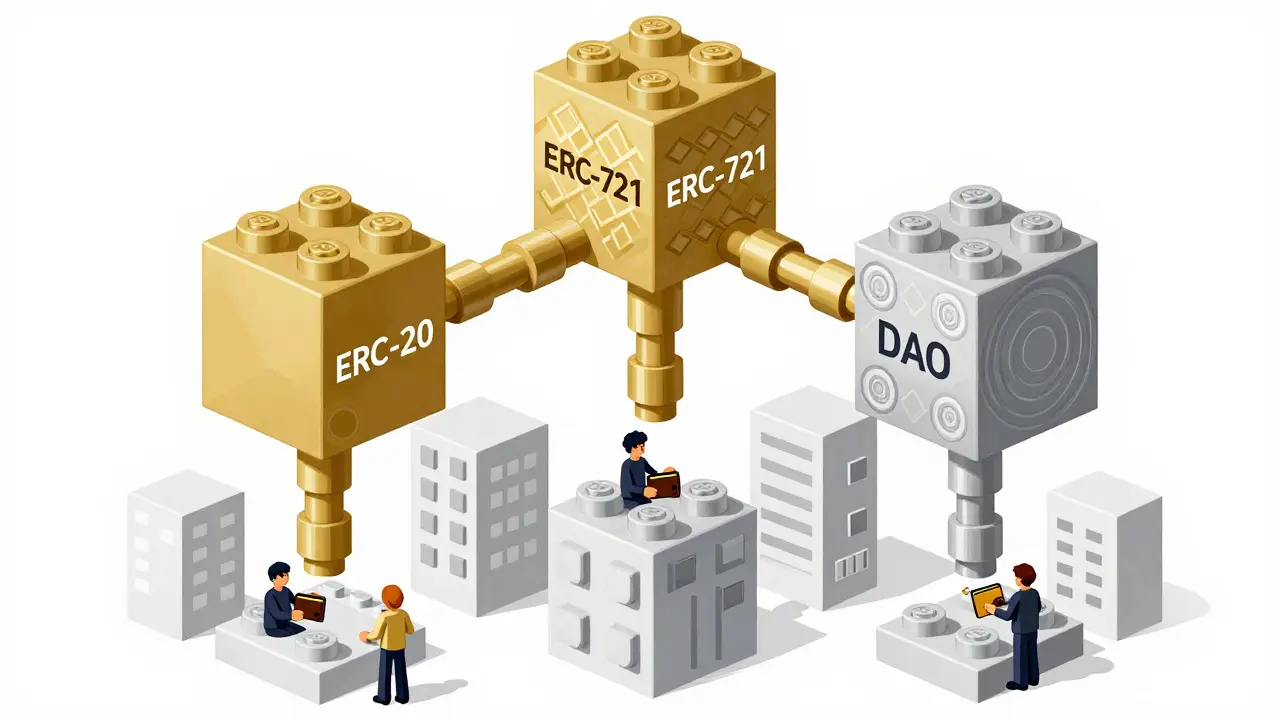
Smart contracts can talk to each other. That’s called composability. One contract can call another contract’s functions. That’s how DeFi apps like Uniswap or Aave work.
Imagine this:
- Contract A holds your ETH.
- Contract B lets you borrow against it.
- Contract C lets you earn interest on your borrowed ETH.
You can use all three without logging into different apps. They just work together. That’s why Ethereum is called a “programmable blockchain.” It’s not just money-it’s Lego blocks for finance.
Contracts can even create new contracts. A DAO (Decentralized Autonomous Organization) might deploy a new voting contract every time a proposal is made. All of it happens automatically, without human oversight.
Limitations: What Smart Contracts Can’t Do
Smart contracts are powerful-but they’re not perfect.
They can’t access the real world on their own. Need to know the price of Bitcoin? The weather in London? A flight departure time? The blockchain doesn’t have access to that data. That’s where oracles come in. Oracles are third-party services that feed real-world data into contracts. Chainlink is the most popular one.
There’s a size limit. Ethereum restricts contracts to 24KB of code. If you go over, deployment fails. That’s why big apps use patterns like the Diamond Pattern-splitting logic across multiple contracts.
They’re immutable. If there’s a bug, you can’t patch it. You have to deploy a new contract and migrate users. That’s risky. That’s why audits are critical. Many big projects hire firms like CertiK or OpenZeppelin to review code before launch.
Token Standards: The Most Common Use Cases
Most smart contracts you interact with are actually token contracts. Two standards dominate:
- ERC-20: For fungible tokens-like USDC, DAI, or LINK. Each token is identical and interchangeable. These are used for payments, staking, and DeFi.
- ERC-721: For NFTs-unique digital items like CryptoPunks or Bored Apes. Each token has a unique ID and metadata. Used for art, collectibles, and game items.
These aren’t just random codes. They’re rules. If a wallet or marketplace supports ERC-20, it can read and display any ERC-20 token-no extra work needed. That’s interoperability. And it’s why Ethereum’s ecosystem exploded.
Why This Matters Beyond Crypto
Smart contracts aren’t just for traders. They’re changing how institutions work.
Imagine a supply chain where a shipment triggers payment automatically when GPS hits a checkpoint. Or a royalty system where musicians get paid every time their song is streamed-no record label needed. Or insurance that pays out if a flight is delayed, verified by a flight data oracle.
These aren’t sci-fi. They’re already happening. Companies like Siemens and Maersk are testing blockchain contracts for logistics. Governments are exploring them for land registries and voting.
The core idea is simple: automate trust. Remove the need to rely on people, banks, or lawyers to enforce agreements. Let code do it-fairly, transparently, and permanently.
What’s Next?
Ethereum is evolving. With upgrades like Dencun and layer-2 solutions like Arbitrum and Optimism, gas fees are dropping. Smart contracts are getting faster and cheaper to run.
Future updates may even let contracts access more data directly, or reduce size limits. But the foundation won’t change: code is law. And that law is written in plain sight, on a public ledger, enforced by thousands of computers.
Smart contracts don’t need you to believe in them. They just need you to understand them. Once you do, you’ll see why they’re not just a crypto trend-they’re the next layer of the internet’s infrastructure.
Can smart contracts be hacked?
Yes, if they have bugs. Smart contracts are code, and code can have flaws. Famous hacks like The DAO attack in 2016 and the Parity wallet freeze in 2017 happened because of logic errors, not because the blockchain was broken. That’s why audits, testing on testnets, and using battle-tested libraries (like OpenZeppelin’s) are essential. Once deployed, you can’t fix them-so get it right before launch.
Do I need to know how to code to use smart contracts?
No. You can interact with smart contracts through wallets like MetaMask, apps like Uniswap, or NFT marketplaces like OpenSea. You don’t need to write code to send ETH, buy an NFT, or stake tokens. But if you want to create your own contract, yes-you’ll need to learn Solidity or use a no-code platform like Mintbase or Zerion.
How much does it cost to deploy a smart contract?
It varies. On Ethereum mainnet, deploying a simple contract can cost between $50 and $300 in gas fees, depending on network congestion. On testnets like Sepolia, it’s free. Complex contracts with lots of code or storage can cost over $1,000. Layer-2 networks like Arbitrum or Polygon reduce this to under $5.
Can smart contracts be deleted or canceled?
No. Once deployed, a smart contract is permanent. You can’t delete it. But you can design it to be upgradeable using proxy patterns or stop certain functions using access controls. However, the original code and all past transactions remain on the blockchain forever.
What’s the difference between a smart contract and a regular app?
A regular app runs on a company’s server. If the company shuts down, the app disappears. A smart contract runs on the Ethereum blockchain. No single person controls it. Even if the original developer vanishes, the contract keeps working. It’s trustless, decentralized, and always on.
Prateek Chitransh
January 1, 2026 AT 17:30So you're telling me this vending machine doesn't take my $20 bill and give me back $18 in change? Cool. I'll believe it when I see it. Also, why does every crypto post sound like a TED Talk written by a 14-year-old who just read the Ethereum whitepaper?
But hey, at least it's not another 'Web3 will save the world' post. Progress.
christopher charles
January 2, 2026 AT 21:14OMG YES!! This is exactly how I explain it to my grandma!! She thought smart contracts were like... robots that yelled at you if you didn't pay rent?? 😅
But seriously-this breakdown is gold. The vending machine analogy? Perfect. I’ve been trying to explain this to my buddy for months, and now I can just send him this. THANK YOU!! 🙌
Amy Garrett
January 4, 2026 AT 14:09ok so like… i just used uniswap yesterday and i thought i was being so cool but now i realize i was just… poking a vending machine?? 🤯
also why does everything on ethereum feel like lego? like i just built a house out of tiny blocks and now i’m scared to touch it bc one wrong move and the whole thing falls apart?? 😭
Antonio Snoddy
January 6, 2026 AT 11:12Ah, the illusion of autonomy. The god complex of code. We build these deterministic prisons of logic, these frozen sermons in Solidity, and call them 'trustless'-as if removing human fallibility somehow makes us more ethical.
But tell me, when the oracle lies, when the gas price spikes, when the immutable contract locks your life savings in a 24KB tomb-whose fault is it? The code? Or the hubris of those who thought they could outsource morality to a machine?
Perhaps the real smart contract is the one that binds us to our own arrogance. And that one? It’s already running.
🫡
Rajappa Manohar
January 7, 2026 AT 19:31deploy cost too high. testnet free. just use that.
prashant choudhari
January 8, 2026 AT 14:49Composability is the real innovation here. Not the contract itself but how it integrates with others. That’s where the network effect kicks in. ERC-20 and ERC-721 aren’t just standards-they’re protocols for collaboration.
Most people miss this. They focus on the code. But the power is in the ecosystem.
Willis Shane
January 8, 2026 AT 15:43While I appreciate the technical clarity presented herein, I must express my profound concern regarding the unchecked proliferation of un-audited smart contracts on mainnet.
As a fiduciary professional with over two decades in financial compliance, I have observed the systemic risk inherent in deploying immutable logic without regulatory oversight. This is not innovation-it is financial anarchy dressed in blockchain aesthetics.
And yet-I remain open to dialogue.
surendra meena
January 9, 2026 AT 00:01YOU THINK THIS IS BAD?? WAIT TILL YOU SEE WHAT HAPPENED WHEN SOMEONE DEPLOYED A CONTRACT WITHOUT A PAUSE FUNCTION AND NOW 300 MILLION DOLLARS ARE STUCK FOREVER??
AND THE DEV JUST VANISHED?? LIKE A WIZARD WHO CAST A SPELL AND THEN FELL INTO A HOLE??
THIS ISN'T TECHNOLOGY-IT'S A HORROR MOVIE WITH MORE GAS FEES
Khaitlynn Ashworth
January 9, 2026 AT 20:57Oh wow. A 10-page essay on how a vending machine works. How original. Did you also write a 5000-word treatise on how a toaster doesn’t need a chef?
Also, you mentioned oracles. Did you forget to mention that 90% of them are run by one company? And that ‘decentralized’ oracles are just centralized ones with a fancy name?
Thanks for the lecture. I’ll go back to my DeFi portfolio now. 😘
NIKHIL CHHOKAR
January 9, 2026 AT 22:26Smart contracts are great until someone realizes they’re just glorified if-statements with a blockchain sticker on them.
And yes, I know you’re gonna say ‘but the immutability!’-but guess what? The devs who wrote them had a backdoor. Always do.
It’s not trustless. It’s just trust transferred to the people who wrote the code. And we all know how that ends.
Mike Pontillo
January 10, 2026 AT 17:55Code is law? Nah. Code is just code. People are law. If the code breaks, you fix it. If the people behind it are shady, you move on.
Stop pretending this is some holy text. It’s software. Bad software gets hacked. Good software gets updated.
Stop worshipping your toaster.
Mandy McDonald Hodge
January 11, 2026 AT 14:55i just wanted to say thank you for writing this. i’m a total newbie and i was so overwhelmed by all the jargon, but this felt like someone finally sat down with me over coffee and explained it like i was 10. 🥹
also the lego analogy? yes. that’s exactly how i feel. like i’m building something beautiful but terrified i’ll knock it over.
you’re amazing. 💖
Bruce Morrison
January 12, 2026 AT 07:16Composability is the real story here. It’s not just about one contract doing one thing. It’s about dozens working together like a symphony.
That’s why Ethereum isn’t just a platform. It’s an operating system for finance.
Simple. Clear. Accurate.
Andrew Prince
January 12, 2026 AT 09:23While your exposition is technically adequate, it lacks the necessary philosophical depth to address the ontological implications of deterministic autonomy in distributed systems. You speak of ‘code as law,’ yet fail to interrogate the epistemological foundation of consensus as a proxy for truth.
Furthermore, your dismissal of oracles as mere ‘data feeders’ ignores the fundamental tension between on-chain immutability and off-chain volatility-a tension that renders the entire paradigm unstable under real-world conditions.
And you call this a ‘clear breakdown’? It’s a children’s primer with a blockchain logo.
Jordan Fowles
January 14, 2026 AT 02:24It’s funny. People treat smart contracts like they’re some kind of divine revelation. But really, they’re just a tool. Like a hammer. Can build a house. Can smash a thumb.
The real question isn’t how they work.
It’s why we keep building them.
And who’s really holding the hammer.