
Imagine you borrow money to buy Bitcoin. You feel confident because the price is rising. Then, in a matter of minutes, the market crashes. Your collateral value drops below what you owe. Suddenly, your position vanishes. You didn't click "sell." No human trader made the decision. An automated system did. This is the liquidation engine in action.
In the world of cryptocurrency and decentralized finance (DeFi), these engines are the unsung heroes-and sometimes villains-of leveraged trading. They protect lenders from losing their capital when borrowers default. But for traders, they represent the moment everything goes wrong. Understanding how these systems work isn't just academic; it’s the difference between surviving a volatile market and getting wiped out.
The Core Purpose: Why Liquidation Engines Exist
At its simplest, a liquidation engine is an automated system that forcefully closes under-collateralized positions or leveraged trades when specific risk thresholds are breached. Without this mechanism, lending platforms would be exposed to unlimited counterparty risk. If a borrower defaults, who pays back the lender? In traditional banking, there are legal processes and insurance funds. In crypto, especially DeFi, code is law. The engine acts as the enforcer.
The primary goal is solvency. When you open a leveraged position, you put up collateral. If the value of that collateral falls too low relative to your debt, the protocol must act immediately. Otherwise, the protocol itself becomes insolvent, threatening all users. The engine monitors health factors continuously. Once a position crosses a predefined line-the maintenance margin requirement-it triggers a closure sequence.
This process protects the ecosystem. It ensures that losses are contained to the individual trader rather than spreading across the entire platform. However, the execution method varies wildly depending on whether you are on a centralized exchange or a decentralized protocol.
Centralized vs. Decentralized: Two Different Worlds
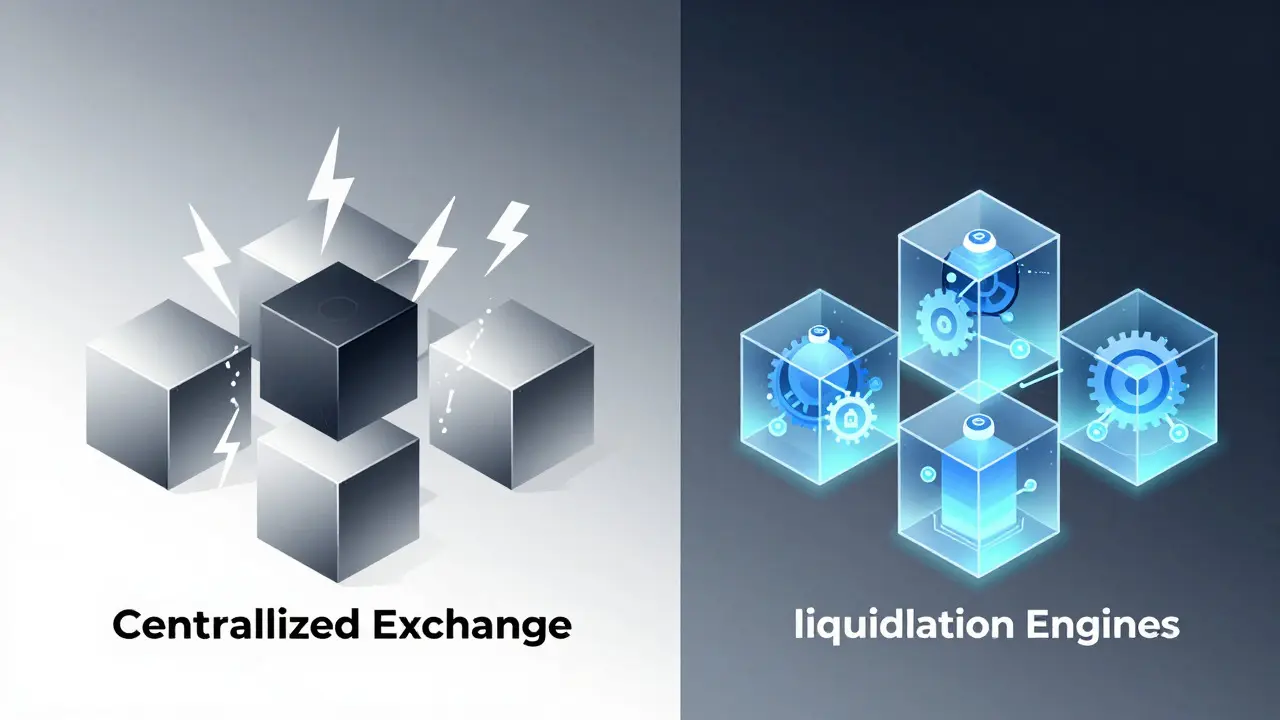
Not all liquidation engines are built the same. The architecture depends heavily on the underlying infrastructure. Centralized exchanges (CEXs) like BitMEX prioritize speed and efficiency. They operate off-chain databases that can update prices and execute orders in milliseconds. On the other hand, DeFi protocols like Fathom or Dolomite rely on smart contracts deployed on blockchains like Ethereum or Cosmos. These are transparent but bound by network constraints.
| Feature | Centralized Exchanges (e.g., BitMEX) | DeFi Protocols (e.g., Fathom, Dolomite) |
|---|---|---|
| Execution Speed | Milliseconds (off-chain) | Block time dependent (seconds to minutes) |
| Transparency | Low (black box execution) | High (on-chain, verifiable code) |
| Price Source | Internal order book or oracle | Decentralized Oracles (e.g., Chainlink) |
| Fallback Mechanism | Auto-Deleveraging (ADL) | External Liquidators / Virtual Liquidity |
| User Control | None during liquidation | None, but parameters are public |
On a CEX, the engine might use a market-price execution model. It tries to close your position at the prevailing market rate. If liquidity is thin, slippage can be severe. In DeFi, the process often requires an external actor-a "liquidator"-to broadcast a transaction to initiate the closure. This creates a dependency on incentives. If the reward for liquidating isn't high enough, no one might bother, leaving the system vulnerable until prices stabilize.
Anatomy of a DeFi Liquidation Engine
Let's look under the hood of a sophisticated DeFi implementation, such as the Fathom Protocol's comprehensive DeFi liquidation infrastructure. A robust engine isn't a single script; it's a collection of interacting components designed to handle edge cases and maintain integrity.
- LiquidationEngine Contract: This is the central controller. It manages the overall process, validating requests and coordinating with other modules.
- PriceOracle: The eyes of the system. It provides real-time asset pricing. If the oracle fails or is manipulated, the engine makes bad decisions. Most modern protocols use decentralized oracle networks to prevent single points of failure.
- BookKeeper: This module tracks user positions. It calculates the current health factor based on collateral value and debt size.
- CollateralPoolConfig: Here, the rules are defined. Parameters like liquidation ratios (the threshold at which liquidation starts) and close factors (how much of the debt can be repaid in one transaction) are stored here.
- FixedSpreadLiquidationStrategy: This determines how the collateral is sold. Does it get swapped instantly? Is there a spread applied to incentivize liquidators?
- SystemDebtEngine: Manages the accounting side, ensuring that when collateral is seized, the corresponding debt is accurately reduced.
These components work together to ensure that when a position becomes unhealthy, the system reacts predictably. For example, if your collateral ratio drops below 105%, the BookKeeper flags it. The LiquidationEngine checks the PriceOracle to confirm the value. Then, it opens the position for external liquidators to claim a bonus for closing it out.
When Standard Liquidation Fails: Auto-Deleveraging and Beyond
What happens if the market crashes so hard that no one wants to buy your collateral? Or if the liquidity pool is empty? Standard liquidation relies on selling assets into the market. If there are no buyers, the price spirals further down, worsening the situation. This is where fallback mechanisms come in.
BitMEX pioneered the concept of Auto-Deleveraging (ADL), a system that reduces exposure by gradually closing profitable positions of other traders to absorb the losses of a defaulted account. Instead of dumping all the collateral onto the market at once, the ADL queue matches the insolvent trader's loss against the gains of other traders. The most profitable traders have their positions closed first to cover the deficit. This prevents massive slippage and keeps the market stable, though it can be controversial since it affects traders who were otherwise winning.
In DeFi, approaches vary. Demex uses an on-chain mechanism where any account holder can run a liquidator service executable to broadcast MsgInitiateLiquidation messages. This democratizes the process but relies on active participation. Dolomite takes a different route with its virtual liquidity model. By allowing assets to serve multiple roles simultaneously, it reduces slippage and maintains market function even during crisis periods. This systemic stability is crucial for preventing cascading failures.
Risk Thresholds and Triggers: The Math Behind the Wipeout
To avoid unpleasant surprises, you need to understand the math. Liquidation doesn't happen when you break even. It happens when your equity drops below a certain percentage of your total position value. This is known as the maintenance margin.
Consider a trader using 10x leverage. They put up $1,000 to control $10,000 worth of Bitcoin. If the price of Bitcoin drops by 10%, their $1,000 collateral is now worth only $900. However, they still owe the $9,000 borrowed plus interest. Their equity is effectively zero or negative. At this point, the liquidation engine triggers.
Platforms set specific thresholds. Bibox, for instance, implements a tiered approach. Users with the lowest risk limits face immediate position takeover at bankruptcy price. Those with higher risk limits receive graduated interventions, such as order cancellations or Fill-Or-Kill orders, before full liquidation occurs. This gives experienced traders a bit more breathing room but requires them to manage their risk actively.
The formula for liquidation price generally looks like this:
Liquidation Price = Entry Price * (1 - Leverage Factor + Maintenance Margin Ratio)
While simple in theory, real-world calculations include funding rates, interest accrual, and gas fees (in DeFi). These hidden costs can push your liquidation price closer to your entry point than you expect.

User Experience and Common Pitfalls
Traders often report frustration with "unfair" liquidations. Why does this happen? Usually, it's due to three factors: slippage, oracle lag, and insufficient margin buffers.
During high volatility, the price you see on your screen might not be the price the engine sees. If the oracle updates every 10 seconds, and the market dumps 5% in 5 seconds, your position could be liquidated at a worse price than expected. On centralized exchanges, lack of transparency in the ADL queue means you might not know why your winning trade was suddenly closed.
In DeFi, network congestion can delay liquidation transactions. If gas fees spike, liquidators might wait for cheaper times, leaving your position in limbo. Or, conversely, if they rush in, you might face higher fees deducted from your remaining collateral.
Experienced traders mitigate these risks by maintaining margin buffers well above the minimum requirements. They also monitor their health factors closely, using tools provided by the platform. For DeFi users, understanding the smart contract interactions and gas fee dynamics is essential. Documentation quality varies; established protocols like Fathom provide detailed technical specifications, while newer platforms may offer limited guidance, increasing the learning curve.
The Future of Liquidation Infrastructure
As the global cryptocurrency derivatives market exceeds $3 trillion in daily volume, the sophistication of liquidation engines continues to evolve. We are seeing a shift toward hybrid systems. Layer-2 solutions aim to combine the speed of centralized execution with the transparency of blockchain verification. This allows for rapid liquidation execution while maintaining immutable records.
Regulatory scrutiny is also increasing. Jurisdictions are examining whether current mechanisms adequately protect retail traders from excessive losses. This pressure drives innovation in fairness and transparency. Protocols are implementing more nuanced risk management approaches, such as improved ADL algorithms that better distribute risk among profitable positions.
Looking ahead, the most successful platforms will be those that balance efficiency, transparency, and user protection. Whether through advanced virtual liquidity models or smarter oracle systems, the goal remains the same: to keep the market solvent without punishing traders unfairly. For anyone engaging in leveraged trading, understanding these mechanics is not optional-it's survival.
What exactly triggers a liquidation in crypto?
A liquidation is triggered when the value of your collateral falls below the maintenance margin requirement set by the exchange or protocol. This usually happens when the market moves against your leveraged position by a certain percentage, determined by your leverage level and the platform's risk parameters.
How do DeFi liquidations differ from centralized exchange liquidations?
DeFi liquidations are executed via smart contracts on the blockchain, offering full transparency but relying on external liquidators and subject to network latency. Centralized exchange liquidations are processed off-chain by internal systems, offering faster execution but less transparency into the exact mechanics and priority queues.
What is Auto-Deleveraging (ADL)?
Auto-Deleveraging is a fallback mechanism used when standard liquidation fails due to lack of liquidity. It absorbs the losses of a defaulted trader by gradually closing the profitable positions of other traders in the same market, starting with the most profitable ones.
Can I avoid being liquidated?
You can reduce the risk by using lower leverage, setting stop-loss orders, and maintaining a healthy margin buffer above the minimum requirement. Monitoring your position's health factor and understanding the specific liquidation mechanics of your chosen platform are also crucial.
Why do liquidations sometimes happen at unexpected prices?
Unexpected liquidations can occur due to slippage in illiquid markets, delays in oracle price updates, or sudden spikes in volatility that breach thresholds faster than you can react. In DeFi, gas fees and network congestion can also impact the final execution price.