
You’ve probably seen it happen. You’re watching a chart, the market is swinging wildly, and suddenly your USDC or USDT dips to $0.98 or spikes to $1.02. It’s a tiny movement, sure, but in the world of digital assets, that fraction of a cent matters. Why? Because these tokens promise stability. They promise that one token equals one dollar. But how do they actually keep that promise when the market goes crazy?
The answer isn’t magic, and it isn’t just code. It’s a mix of boring banking, strict rules, and human behavior. Let’s break down exactly how fiat-backed stablecoins hold their ground.
The Core Mechanism: One Token, One Dollar
At its heart, a fiat-backed stablecoin is a digital IOU. When you buy one Tether (USDT), you aren’t just buying a random number on a blockchain. You are effectively putting a dollar into a bank account, and the issuer gives you a digital receipt for it. That receipt is the stablecoin.
The issuer, like Circle for USDC or Tether for USDT, holds the actual cash (or cash equivalents) in reserve. This is the foundation of the peg. If there are 1 billion USDC in circulation, Circle needs to have roughly 1 billion dollars sitting in secure accounts. These accounts aren’t just checking accounts at your local branch; they are typically held with major regulated financial institutions. The goal is simple: ensure that every single token out there can be redeemed for real money.
This model relies heavily on trust. Unlike Bitcoin, which doesn’t need anyone to trust a company, fiat-backed stablecoins require you to trust that the issuer is honest, solvent, and keeping accurate records. If the issuer says they have $50 billion in reserves, you have to believe them-or see proof.
Arbitrage: The Market’s Self-Correcting Engine
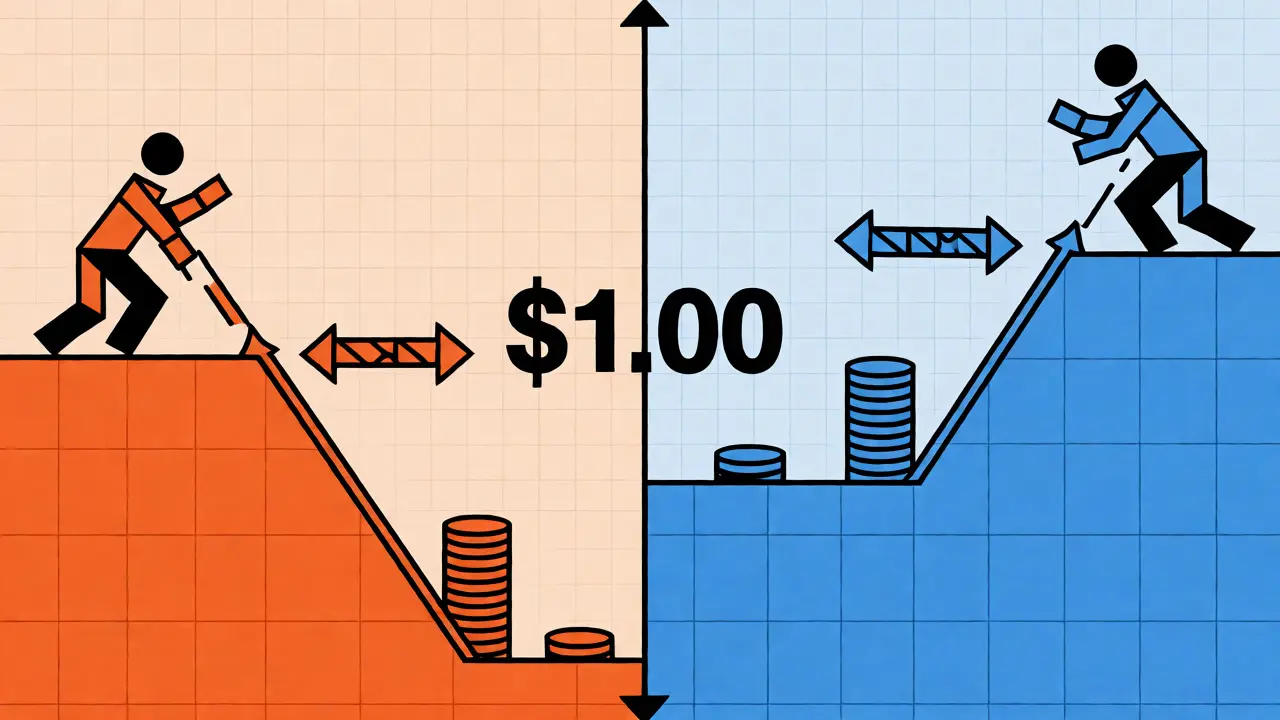
So, what happens if the price drifts? Say USDC drops to $0.98. Is the system broken? Not necessarily. This is where arbitrage kicks in, acting as the invisible hand that pushes the price back to $1.00.
Imagine you are a trader. You see USDC trading at $0.98 on an exchange. You know you can redeem that USDC directly from Circle for $1.00. So, you buy 1,000 USDC for $980. You send those tokens to Circle, burn them (delete them from existence), and receive $1,000 back. You just made $20 profit with almost no risk.
But here’s the key: by buying up USDC, you reduce the supply available on the open market. Less supply, with steady demand, pushes the price up. Eventually, the price climbs back toward $1.00, making the arbitrage opportunity disappear.
The reverse works too. If USDC trades at $1.02, traders will mint new USDC (deposit $1.00 with Circle, get a token) and sell it immediately for $1.02. This floods the market with new tokens, increasing supply and pushing the price back down. This constant tug-of-war keeps the peg tight, provided people can easily move between the stablecoin and the actual dollar.
Reserves: More Than Just Cash Under the Mattress
It’s not always literal cash in a vault. Holding billions in physical bills is inefficient and risky. Instead, issuers use "cash equivalents." These are highly liquid, low-risk assets that can be turned into cash quickly. Common examples include:
- Treasury Bills: Short-term debt issued by the government. Very safe, very liquid.
- Commercial Paper: Short-term unsecured debt issued by corporations.
- Money Market Funds: Pooled funds that invest in short-term debt instruments.
The composition of these reserves matters. In 2023, when Silicon Valley Bank collapsed, USDC briefly lost its peg because some of its reserves were exposed to banks that failed. It recovered quickly, but it was a wake-up call. It showed that even "stable" assets carry counterparty risk-the risk that the bank holding the money might fail.
To combat this, top issuers now diversify their holdings. They don’t put all their eggs in one basket. They spread reserves across multiple global custodians and asset types to minimize the impact of any single failure.
Audits and Transparency: Building Trust
Trust is hard to earn and easy to lose. How do you know the issuer isn’t lying about their reserves? Enter third-party audits.
Major stablecoins undergo regular attestations by accounting firms. These aren’t full-blown forensic audits every time, but they verify that the assets listed match what’s on the balance sheet. For example, Circle publishes monthly reports showing exactly what backs each USDC. Tether has historically faced criticism for opacity, but they have increased transparency in recent years, providing more frequent updates on their reserve breakdown.
Without these checks, the entire model collapses. If users suspect the reserves are missing, they rush to redeem their tokens. If everyone tries to withdraw at once, and the issuer can’t convert their Treasury bills to cash instantly, you get a run on the bank. This is why transparent, real-time data feeds are becoming standard. Users want to see the health of the reserves without waiting for a quarterly report.
Fiat-Backed vs. Other Stablecoins
Not all stablecoins work this way. Understanding the differences helps clarify why fiat-backed models dominate the market despite their centralization.
| Feature | Fiat-Backed (e.g., USDC, USDT) | Crypto-Backed (e.g., DAI) | Algorithmic (e.g., UST - Defunct) |
|---|---|---|---|
| Collateral | Fiat currency & equivalents | Cryptocurrency (ETH, BTC) | None (or mixed mechanisms) |
| Decentralization | Low (Centralized issuer) | Medium (Smart contract governance) | High (Code-only) |
| Risk Profile | Counterparty/Bank risk | Volatility/Collateral risk | Death spiral risk |
| Peg Stability | Very High | High (if over-collateralized) | Low/Unpredictable |
| Redemption | Direct to fiat via issuer | Burn collateral for stablecoin | Mint/Burn sibling token |
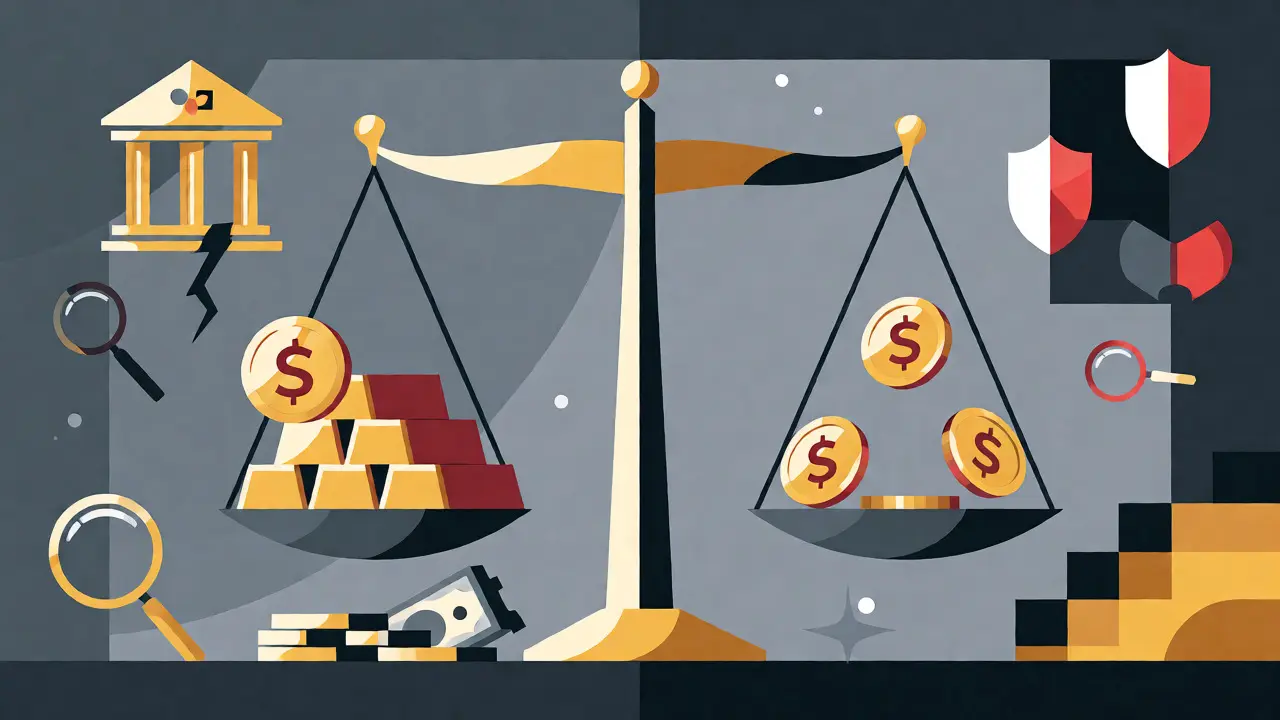
Fiat-backed coins win on stability because they mirror the traditional financial system. Crypto-backed coins like DAI are cool because they are decentralized, but they require over-collateralization. To issue $1 of DAI, you might need to lock up $1.50 worth of Ethereum. If Ethereum crashes, the collateral value drops, potentially triggering liquidations. Algorithmic coins, like Terra’s UST, tried to solve this with pure math and incentives. As we saw in 2022, when confidence broke, the algorithm couldn’t save it, leading to a catastrophic collapse.
The Role of Regulation and Compliance
Regulation is the double-edged sword of fiat-backed stablecoins. On one hand, it provides legitimacy. Banks and institutional investors prefer compliant tokens like USDC because they fit within existing legal frameworks. On the other hand, regulation introduces friction. Issuers must follow Know Your Customer (KYC) and Anti-Money Laundering (AML) laws. This means they can freeze addresses or block transactions if required by law.
In the EU, the Markets in Crypto-Assets (MiCA) regulation sets strict standards for stablecoin issuers. They must maintain specific capital buffers and provide clear redemption terms. In the US, legislation is still evolving, but the trend is toward treating stablecoins similarly to money market funds. This regulatory clarity favors large, well-capitalized issuers who can afford compliance costs, potentially squeezing out smaller competitors.
What Can Go Wrong?
Despite their stability, fiat-backed stablecoins aren’t invincible. Here are the main threats:
- Bank Runs: If the public loses faith in the issuer’s solvency, mass redemptions can strain liquidity.
- Regulatory Freezes: Governments can order issuers to freeze assets linked to sanctioned entities.
- Reserve Mismanagement: Investing in risky assets to chase yield can lead to losses if markets turn.
- Technical Failures: While rare, smart contract bugs or blockchain congestion can hinder redemptions temporarily.
The Silicon Valley Bank incident proved that even diversified reserves face systemic risks. However, the quick recovery showed that strong relationships with regulators and transparent communication can mitigate panic.
Key Takeaways
- Backing is Key: Fiat-backed stablecoins derive value from actual reserves held in regulated accounts.
- Arbitrage Maintains Price: Traders buy low and sell high against the issuer, naturally correcting price deviations.
- Transparency Builds Trust: Regular audits and clear reserve disclosures are essential for user confidence.
- Centralization is the Trade-off: You gain stability and ease of use but sacrifice decentralization and censorship resistance.
- Regulation Shapes the Future: Compliance requirements are raising barriers to entry, favoring established players like USDC and USDT.
Are fiat-backed stablecoins really backed 1:1?
Yes, reputable issuers like Circle and Tether claim to maintain a 1:1 ratio. However, "backed" often includes cash equivalents like Treasury bills, not just physical cash. The critical factor is whether these assets can be converted to cash quickly during a redemption event. Independent attestations help verify this claim.
What happens if a stablecoin issuer goes bankrupt?
If an issuer goes bankrupt, holders become creditors. Depending on the legal structure, they may recover their funds from the segregated reserve accounts, which are often protected from the issuer’s general liabilities. However, delays and legal complexities can occur. This is why choosing issuers with strong legal protections and transparent reserve segregation is vital.
Why did USDC depeg during the Silicon Valley Bank crisis?
Circle had approximately $3.3 billion of its reserves deposited at Silicon Valley Bank. When SVB failed, concerns arose that this portion of the reserves might be inaccessible. This fear caused traders to sell USDC, dropping its price below $1. The peg was restored after Circle announced alternative banking arrangements and regulators confirmed the safety of the remaining reserves.
Can I redeem stablecoins for actual dollars?
Yes, but usually only through authorized participants or direct accounts with the issuer. Most retail users trade stablecoins on exchanges rather than redeeming directly. Direct redemption often requires KYC verification and may involve fees or minimum amounts. Exchanges facilitate most conversions for everyday users.
Is USDT safer than USDC?
Both are widely used, but USDC is generally perceived as having higher regulatory compliance and transparency standards, particularly in the US. USDT has faced historical scrutiny regarding its reserve composition and audit history. However, USDT has significantly improved its transparency and maintains the largest market share. Safety depends on your risk tolerance and jurisdiction.