
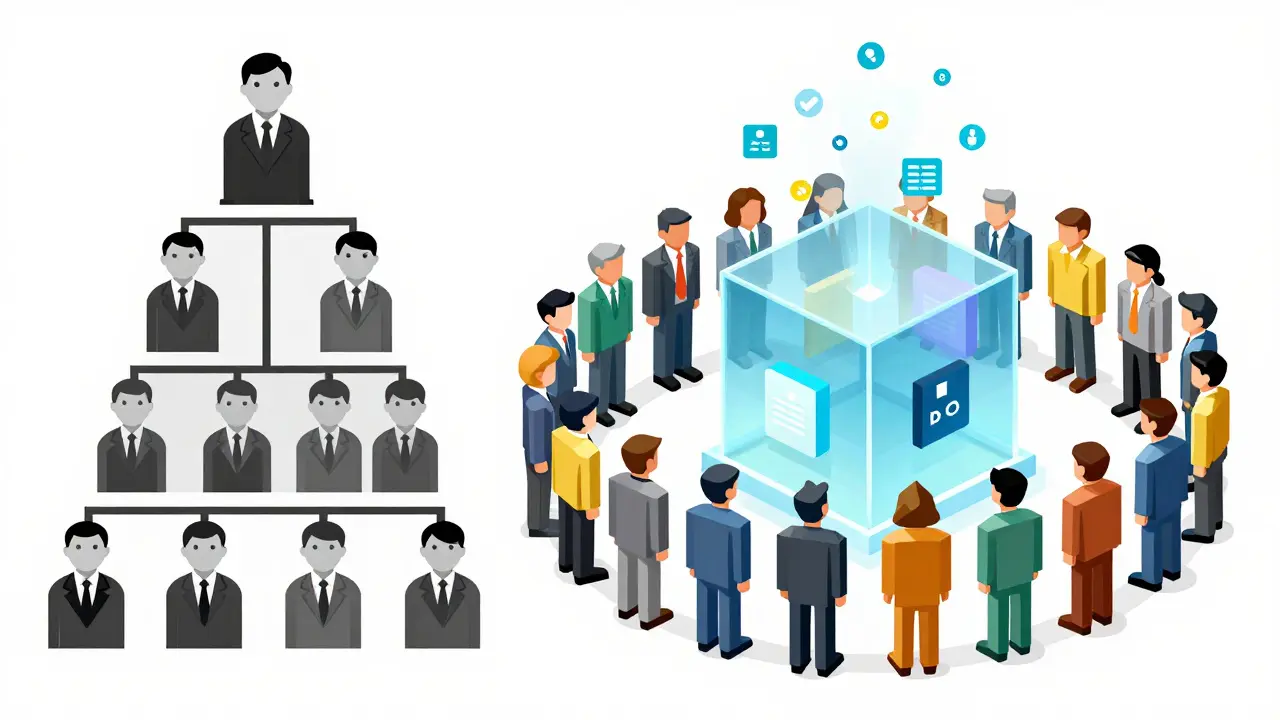
When you hear about a company making big decisions-like spending millions, hiring teams, or changing its rules-you usually think of a CEO, a board, or a corporate hierarchy. But what if no single person had that power? What if every decision was made by a group of strangers around the world, all voting using code? That’s how DAOs work.
DAO stands for Decentralized Autonomous Organization. It’s not a company in the traditional sense. There’s no office, no HR department, and no boss. Instead, it’s a set of rules written as smart contracts on a blockchain. These rules control everything: who can vote, how votes are counted, and what happens when a proposal passes. The magic isn’t in the technology alone-it’s in how it flips power from a few leaders to thousands of members.
How Proposals Start
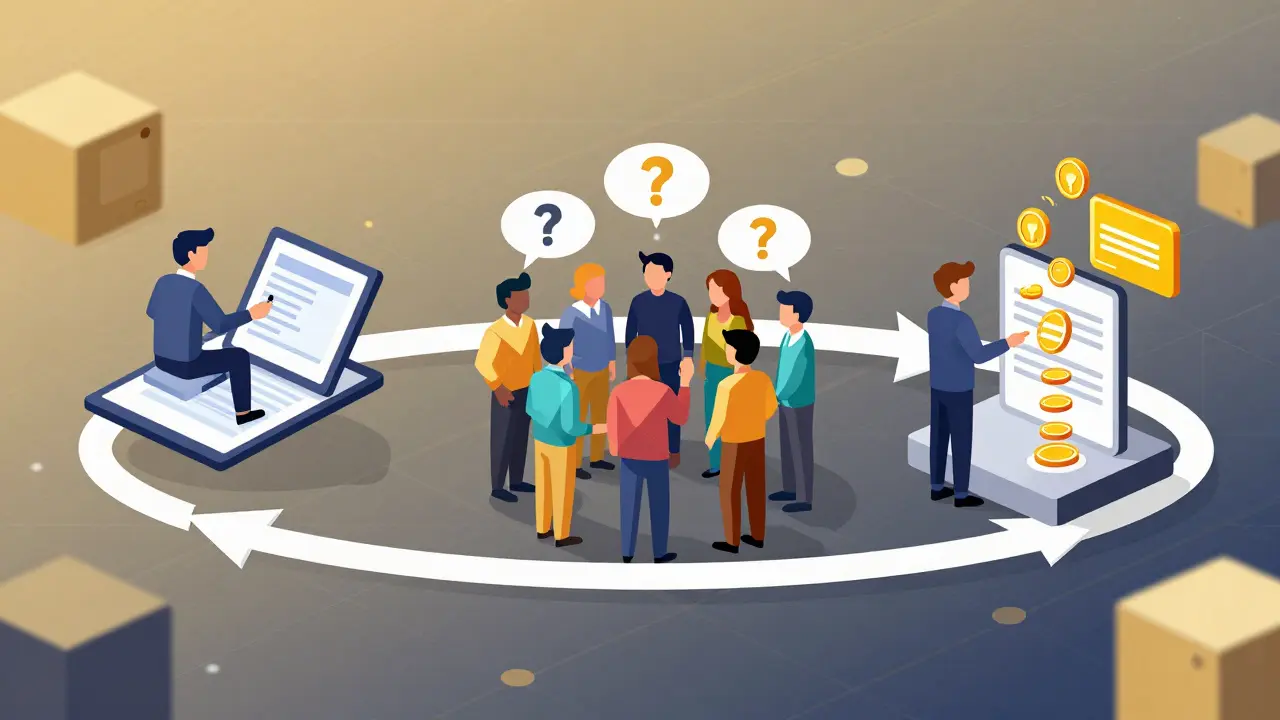
Every decision in a DAO begins with a proposal. It could be something simple, like "Pay $50,000 to hire a new developer," or something huge, like "Change the way our tokens are distributed." Anyone who holds the DAO’s native token can submit a proposal. No permission needed. No manager to approve it first. Just open the governance platform, type it out, and hit submit.
Once submitted, the proposal goes live. Members read it. They debate it. In many DAOs, discussions happen on Discord, Telegram, or specialized forums like Snapshot. People ask questions: "What’s the risk?", "Who benefits?", "What if it fails?" This isn’t just formality-it’s where real governance happens. A proposal that sounds good on paper might fall apart under scrutiny.
Voting Power: Tokens Are Votes
Not everyone gets the same vote. In most DAOs, your voting power is tied to how many tokens you hold. If you own 1% of the total supply, you get 1% of the votes. This is called token-weighted voting. It sounds fair on the surface-you’re rewarded for investing early. But it also means a few big holders can swing decisions.
Take Lido DAO. To pass a proposal, at least 5% of all tokens must vote "yes," and more than half of those votes must be in favor. That’s a high bar. It stops small, noisy groups from pushing through risky ideas. But it also means if a single wallet owns 30% of the tokens, they can block anything they don’t like-even if 90% of the community supports it.
Some DAOs try to fix this. Aragon-based DAOs let members set a "quorum"-the minimum number of votes needed for a vote to count. If only 10% of token holders vote, the proposal fails, even if 95% of those votes are "yes." This forces engagement. It says: "Don’t just vote if you care. Show up if you want change."
The Voting Process: When, How, and How Long
Voting doesn’t happen instantly. It’s timed. Most DAOs give members 3 to 7 days to vote. Some, like Lido, split voting into two phases. The first 48 hours let people vote "for" or "against." Then, the last 24 hours become an "objection phase"-where you can change your mind. If you voted "yes" but then heard new concerns, you can switch to "no." This reduces rushed decisions.
Why not vote all at once? Because blockchain transactions cost money. If 10,000 people voted on-chain every hour, gas fees would explode. So most DAOs use off-chain voting tools like Snapshot. You sign a message with your wallet, and it’s counted without spending crypto. Then, once a proposal passes, the smart contract executes the action on-chain. That’s the final step.
Smart Contracts: The Automatic Enforcers
This is where DAOs get their name: "Autonomous." Once a vote passes, a smart contract kicks in. No human touches it. No manager approves the payment. No lawyer signs the contract. The code just runs.
For example, if a proposal passes to fund a marketing campaign, the smart contract automatically sends the funds from the DAO’s treasury to the contractor’s wallet. The entire process is public. Anyone can check the blockchain and see: who voted, how much they voted with, when they voted, and when the money moved.
This removes corruption. It removes delays. It removes guesswork. But it also removes mercy. If a proposal passes and the code has a bug? Too bad. The money’s gone. That’s why testing and debate matter more than ever.
Alternative Voting Systems
Token-weighted voting isn’t the only way. Some DAOs use other methods to balance power.
Permissioned voting gives decision-making to a small group of experts-say, 10 people with proven track records. They vote on behalf of everyone else. It’s faster. But it’s also less democratic. You’re trading decentralization for efficiency.
Holographic consensus is wilder. Members don’t vote on proposals directly. Instead, they predict whether a proposal will pass. If they guess right, they earn tokens. If they guess wrong, they lose tokens. It turns governance into a betting game. The theory? People who really understand the project will risk their own money to back good ideas. It’s not widely used yet, but it’s being tested in serious DAOs.
Multisig voting sits in the middle. A small group of trusted members (say, 3 out of 5) can execute urgent decisions. But only if the community approves the action first. It’s like having an emergency override-but only if the community says it’s okay. This helps in crises, like a hack or a bug. But if the multisig team acts without community input? That’s centralization creeping back in.
Real-World Problems
DAOs sound perfect on paper. But they’re messy in practice.
Low turnout is the biggest issue. Most DAOs have tens of thousands of token holders. But only a few hundred vote. Why? Because voting takes time. People forget. They don’t understand the proposal. Or they think their vote won’t matter. DAOs fight this by bundling proposals. Instead of 10 separate votes, they combine them into one. Less effort. More participation.
Security risks are real. In 2016, The DAO-a pioneering DAO-lost $60 million because of a coding flaw. Hackers exploited a loophole in the smart contract. Since then, every DAO spends months auditing their code before launch. Still, mistakes happen. One wrong line of code can let someone drain the treasury.
Centralization risks are sneaky. A DAO might say it’s decentralized, but if the founding team controls 40% of the tokens, or if they can change the voting rules at will, then it’s not really decentralized. Some DAOs set proposal thresholds so high that only the founders can get things done. That’s not democracy. That’s a facade.
What Makes a DAO Work?
Good DAO governance isn’t about the tech. It’s about the people.
The best DAOs don’t just write smart contracts-they build culture. They reward participation. They explain proposals clearly. They hold regular town halls. They listen. They adapt.
Take MakerDAO. It’s one of the oldest and most successful DAOs. It doesn’t just vote on code. It has working groups-finance, legal, outreach-that do the groundwork. They draft proposals, test them, and bring them to the community. That’s how you avoid chaos.
DAOs don’t work because they’re automated. They work because they’re human. The blockchain just makes it transparent.
What’s Next?
DAOs are still young. Right now, they’re mostly used for crypto projects-DeFi protocols, NFT communities, grant funds. But soon, they’ll be used for real companies, nonprofits, even local governments.
The big question isn’t "Can DAOs make decisions?" It’s "Can they make good decisions?" The answer depends on how well they design their rules-and how engaged their members are.
If you’re part of a DAO, don’t just hold tokens. Participate. Read proposals. Vote. Speak up. Your voice is your power. And in a DAO, that’s the whole point.
Can anyone submit a proposal in a DAO?
Yes, in most DAOs, any token holder can submit a proposal. There’s usually no approval process beforehand-just a small fee or a minimum token balance to prevent spam. Once submitted, the proposal goes to public voting. Some DAOs require proposals to be discussed in forums first, but the right to propose is open.
Do I need to hold tokens to vote in a DAO?
Yes. Voting power is almost always tied to token ownership. The more tokens you hold, the more votes you get. Some DAOs allow non-token holders to participate in discussions, but only token holders can cast official votes. There are rare exceptions, like reputation-based systems, but they’re not common yet.
What happens if a proposal passes but has a bug?
Once a smart contract executes a proposal, it’s final. There’s no undo button. If a bug causes funds to be lost or rules to break, the community must vote on a fix-often by proposing a new vote to reverse or repair the damage. That’s why audits and testing are critical before any vote. Many DAOs now require third-party security reviews before proposals go live.
Why do some DAOs use off-chain voting?
Off-chain voting (like on Snapshot) lets members vote without paying gas fees. It’s faster and cheaper. The vote is recorded as a signed message, not a blockchain transaction. Once a proposal passes, the result is pushed on-chain to trigger the smart contract. This keeps costs low while still ensuring transparency and tamper-proof results.
Can a DAO be hacked or taken over?
Yes. If a DAO’s smart contract has a flaw, attackers can exploit it to drain funds or change voting rules. There have been multiple cases where a single wallet with a large token stake manipulated votes or blocked proposals. DAOs reduce this risk by using multisig wallets for emergencies, auditing code thoroughly, and setting high quorum and pass thresholds. But no system is 100% safe.
Mae Young
February 26, 2026 AT 21:55And the ‘autonomous’ part? More like ‘auto-destruct’ when a single line of code gets a semicolon wrong.
Token-weighted voting? Ha. That’s not democracy-it’s plutocracy with a blockchain tattoo. The rich get richer. The rest get a Discord emoji and a pat on the back.
And don’t even get me started on ‘holographic consensus.’ You mean, we’re supposed to gamble our reputation on whether a proposal will pass? Like a crypto roulette wheel? Next thing you know, DAOs will have Vegas-themed town halls.
Oh, and ‘low turnout’ is the biggest problem? No. The biggest problem is that we call this governance. It’s a glorified poll with a smart contract as its butler.
DAOs don’t work because they’re automated. They work because someone, somewhere, still has a heartbeat. And that heartbeat? It’s usually the founder’s. The rest of us are just spectators with wallet addresses.
My vote? Delete the whole thing. Start over. With humans. And maybe a lawyer. Or two.
Trenton White
February 28, 2026 AT 04:18It reminds me of how some democracies work-lots of rules, but the real power lies with those who show up consistently. In DAOs, that’s the same 300 people who reply to every proposal, no matter how trivial.
Maybe the real innovation isn’t the blockchain. Maybe it’s just the idea that you can vote from anywhere in the world. That’s powerful. Even if the system is flawed.
Cheryl Fenner Brown
March 1, 2026 AT 02:10so you mean to tell me if i have 100 tokens i can vote but if i have 100000 i can basically say ‘nope’ to everyone else??
and the part where they say ‘smart contracts are automatic’ but then also say ‘oops we lost 60 mil’??
so like… it’s a robot that can’t even tie its own shoes??
also why do they always say ‘community’ like it’s a hug and not a bunch of people who forgot to change their discord name??
anyone else just want to nap after reading this?? 😴💤
Michael Teague
March 1, 2026 AT 15:35Then they’re surprised when someone with 30% of the supply blocks everything. That’s not democracy. That’s capitalism with a new logo.
And don’t get me started on off-chain voting. It’s just voting without the blockchain. So why call it a DAO? Just call it a forum with a token.
It’s all theater. And the audience is asleep.
kati simpson
March 1, 2026 AT 17:11It’s that we expect people to show up for something that doesn’t pay them
Most of us have jobs families obligations
Reading a proposal takes time
Understanding the implications takes more time
And then we’re supposed to vote on it
When the reward is just the illusion of participation
It’s not broken
It’s just asking too much
Without real incentives
Without real consequences
Without real recognition
It’s just noise
Cory Derby
March 2, 2026 AT 04:05That said, I’d like to gently emphasize one point: transparency alone does not equate to fairness. The fact that every vote is recorded on-chain doesn’t change the fact that wealth concentration distorts outcomes.
Perhaps the next evolution of DAO governance lies not in more complex voting mechanisms, but in structured participation incentives-time-based voting rights, reputation weighting, or even randomized citizen assemblies for high-stakes decisions.
Technology can enable, but it cannot replace human wisdom. And wisdom requires diversity-not just of geography, but of perspective, experience, and economic standing.
Colin Lethem
March 3, 2026 AT 06:38And I’m a dev
Imagine if you’re just someone who bought $200 worth of tokens because the Discord said ‘free airdrop’
They’re not even trying to make this easy
And then they act shocked when 0.5% of people vote
It’s like hosting a potluck and only inviting 3 people
Then yelling ‘WHERE’S THE COMMUNITY??’
LOL
Amanda Markwick
March 4, 2026 AT 10:00Yes, the system is flawed. Yes, whales can block things. But the beauty is that we’re trying. We’re building something new, together, even if it’s clunky.
MakerDAO didn’t get it right on day one. It took years of iteration, community feedback, and failure. And that’s the point. DAOs aren’t products. They’re living systems. They evolve.
So instead of complaining about low turnout, let’s make it easier. Write clearer proposals. Host live Q&As. Reward thoughtful participation. Let’s build a culture where voting feels meaningful-not like a chore.
Because if we don’t, who will?
Sean Logue
March 5, 2026 AT 19:44Everyone talks about decentralization like it’s a religion.
But the truth? It’s still a startup. Just with more Discord channels and less HR.
Also, why do people keep saying ‘the code is the law’ like it’s some ancient oracle?
Code is written by humans.
Humans make mistakes.
So why are we acting like it’s magic?
Carl Gaard
March 7, 2026 AT 11:46Like the contractor never showed up??
And now everyone’s like ‘well the code executed so it’s final’
But like… what if the code was right but the human was wrong??
Shouldn’t there be a ‘oops’ button??
Also I think we need more emojis in proposals 🤷♂️😭🚀
Just saying.