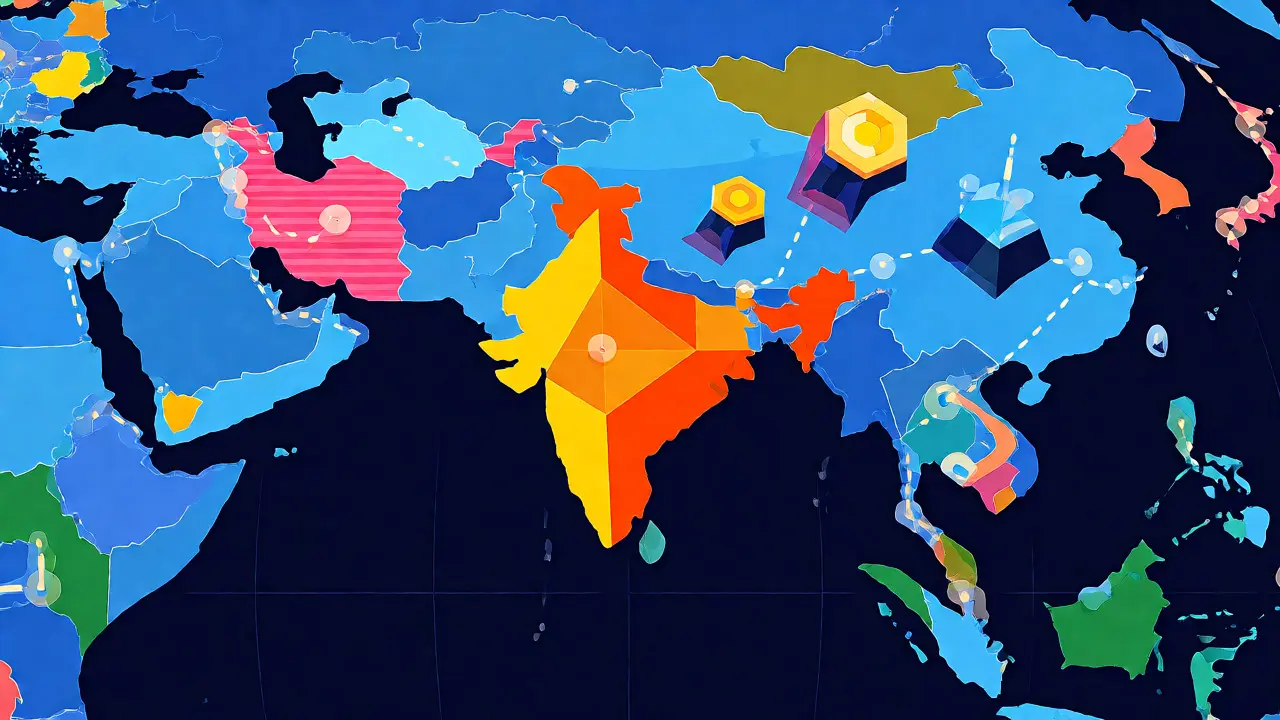
You might assume the US or UK tops the list for cryptocurrency usage. But in 2025, India holds the crown for the third year running. This isn't just about hype; it's a measurable shift in how billions of people interact with money. The Global Crypto Adoption Index is an annual ranking by Chainalysis that measures how widely and intensively ordinary people and institutions use cryptocurrency across 151 countries. If you're trying to figure out where the real action is happening, you need to look beyond the headlines and dive into the data.
Why does this matter? Because adoption isn't uniform. It's driven by local economics, regulatory clarity, and cultural factors. In 2025, the landscape changed dramatically. Institutional money flooded in after Bitcoin ETFs got the green light, shifting the center of gravity from retail speculation to professional integration. At the same time, grassroots adoption in emerging markets continued to surge as people sought hedges against inflation and unstable currencies. This article breaks down who is leading, why they are there, and what the numbers actually tell us about the future of digital assets.
How We Measure Adoption: Methodology Matters
Before we look at the rankings, you have to understand how they're built. Different organizations measure different things. Chainalysis released its sixth annual Global Crypto Adoption Index on September 2, 2025, using on-chain and off-chain data from hundreds of millions of transactions and over 13 billion web visits. They didn't just count wallets; they looked at intensity of use relative to population size and purchasing power parity (PPP). This prevents large countries like China or India from dominating simply because they have more people.
In 2025, Chainalysis made a crucial change. They removed the "retail DeFi" sub-index. Why? Because decentralized finance behavior was too niche and skewed results for smaller nations. Instead, they introduced a new lens for institutional activity, specifically tracking transfers over $1 million. This reflects the post-ETF reality where big banks and asset managers are now major players. The final score combines four pillars:
- On-chain value received by centralized services.
- Retail-sized on-chain value received by centralized services.
- On-chain value received by DeFi protocols.
- Institutional-sized on-chain value received by centralized services.
Other indices exist, too. Henley & Partners introduced the Henley Crypto Adoption Index 2025, which uses 750+ data points to benchmark crypto-friendly countries specifically for investment migration pathways. Their focus is less on daily transactions and more on jurisdictions that welcome crypto wealth. Meanwhile, ApeX Protocol published its own "crypto obsession" rankings based on search activity and population ownership rates. Comparing these gives you a fuller picture: one shows usage volume, another shows policy friendliness, and a third shows public interest.
The Top Countries by Total Adoption Volume
If you look at total adoption intensity, the top five countries in the Chainalysis 2025 Index are surprising if you stick to traditional economic stereotypes. Here is the breakdown:
| Rank | Country | Key Driver | Notable Statistic |
|---|---|---|---|
| 1 | India | Massive user base and low-cost entry | Over 100 million crypto users |
| 2 | United States | Institutional inflows via spot Bitcoin ETFs | Jumped to 2nd place due to regulatory clarity |
| 3 | Pakistan | High remittance needs and inflation hedging | Consistent top-tier performance |
| 4 | Vietnam | Strong gaming and P2P trading culture | Top 5 position maintained for multiple years |
| 5 | Brazil | Financial inclusion and stablecoin usage | Largest market in Latin America |
India’s dominance isn’t an accident. It stems from a perfect storm of high internet penetration, a young demographic, and economic pressures that make traditional banking less appealing for some segments. The United States’ rise to second place is directly linked to the approval of spot Bitcoin ETFs. This legitimized crypto for retirement accounts and corporate treasuries, driving massive institutional volume that counts heavily in the new methodology.
Per-Capita Leaders: Where Everyone Is Using Crypto
Total volume favors big populations. But if you adjust for population size, the map looks completely different. This reveals where crypto is truly mainstream among ordinary citizens. When normalized by per-capita usage, Eastern Europe and parts of the Middle East take the lead.
Ukraine leads the per-capita rankings. This makes sense given the country’s history with currency devaluation and its tech-savvy population. Following Ukraine are Moldova, Georgia, Jordan, and Hong Kong SAR, China. These nations often face economic instability or have specific regulatory frameworks that encourage digital asset holding.
For example, Georgia has positioned itself as a crypto hub with favorable tax laws. Jordan’s high ranking likely reflects the need for efficient cross-border payments in a region with complex banking restrictions. Venezuela also ranks highly in adjusted metrics, reflecting its status as a haven for those escaping hyperinflation. If you’re looking for markets where crypto is a daily utility rather than a speculative bet, look here.

The Obsession Factor: Search Interest and Ownership
Adoption isn’t just about transactions; it’s about attention. Singapore was ranked as the world's most crypto-obsessed nation by ApeX Protocol, with a composite score of 100 driven by 24.4% population ownership and 2,000 crypto-related queries per 100,000 people. Singapore’s ownership rate more than doubled from 11% in 2021 to nearly 25% in 2025. This indicates a highly educated, wealthy population actively researching and engaging with digital assets.
The United Arab Emirates comes in second with a score of 99.7. The UAE boasts the highest global crypto ownership rate at 25.3%. Since 2019, adoption there has grown by 210%. During the 2022 boom, over 34% of the population held crypto. This aligns with the UAE’s strategic push to become a global crypto hub, offering clear regulations and zero capital gains taxes for individuals.
These "obsession" metrics are predictive. High search activity often precedes transaction spikes. If you see search interest rising in a country with loose monetary policy, expect adoption to follow. It’s a leading indicator for investors and policymakers alike.
Regional Trends: Asia-Pacific Leads the Charge
The Asia-Pacific region demonstrated remarkable growth in 2025, leading globally with a 69% year-on-year surge in crypto transaction value. This isn't just about India and Vietnam. Southeast Asia, in general, is integrating crypto into daily life faster than the West. Reasons include underbanked populations, high mobile phone penetration, and a cultural comfort with digital-first financial tools.
In contrast, while the US and Europe have strong institutional bases, their retail adoption growth has slowed compared to APAC. Europe remains fragmented, with varying regulatory approaches across member states. The EU’s MiCA regulation provided clarity, but implementation lags behind the rapid innovation seen in Asian markets. Latin America continues to be a stronghold for stablecoins, used primarily for savings and remittances rather than speculation.

Institutional vs. Retail: The Great Divide
The 2025 data highlights a growing split between retail and institutional adoption. Chainalysis’s new institutional metric shows that countries like Ukraine, Moldova, Slovenia, and Estonia score highly on institutional activity relative to their size. This suggests these jurisdictions attract significant professional crypto flows, perhaps through fintech partnerships or specialized licensing regimes.
Meanwhile, retail adoption remains strongest in countries with economic volatility. Nigeria dropped to sixth place in the overall index despite regulatory progress. This illustrates that policy changes don’t instantly translate to measured adoption. Trust takes time to rebuild, especially after previous bans or restrictive measures. For investors, understanding this divide is critical. Institutional money moves slowly and steadily; retail money moves fast and emotionally.
What This Means for You
If you’re building a business, targeting the US means competing with giants and navigating complex securities laws. Targeting India or Brazil offers volume but requires dealing with lower average transaction values and higher competition. If you’re seeking stability and high-value clients, the UAE and Singapore offer mature ecosystems with high ownership rates.
For individuals, the trend is clear: crypto is becoming normal. Global ownership reached 12.4% in 2025, up from 6.8% in 2024. The demographic is broadening too. While still male-dominated (61%), female participation is growing. The largest cohort of owners is aged 25-34, indicating that younger generations view digital assets as a standard part of their portfolio.
Which country has the highest crypto adoption?
According to the Chainalysis Global Crypto Adoption Index 2025, India ranks first for the third consecutive year, driven by over 100 million users. However, when adjusted for population, Ukraine leads in per-capita adoption.
Why did the US jump to second place in 2025?
The US rose to second place largely due to the approval of spot Bitcoin ETFs. This brought significant institutional inflows and clearer regulatory frameworks, which are weighted heavily in the updated 2025 methodology.
What is the difference between Chainalysis and Henley & Partners indices?
Chainalysis measures actual on-chain transaction volume and user intensity across 151 countries. Henley & Partners focuses on investment migration, using 750+ data points to rank countries based on how friendly they are to crypto millionaires seeking residency or citizenship.
Is crypto adoption higher in developed or developing nations?
It depends on the metric. Developing nations like India, Pakistan, and Nigeria lead in total volume and grassroots necessity-driven adoption. Developed nations like the US, Singapore, and the UAE lead in institutional adoption and per-capita ownership among affluent populations.
How many people own cryptocurrency globally in 2025?
Estimates vary, but sources indicate global crypto ownership reached approximately 12.4% in 2025. Triple-A reported 6.8% in 2024, showing steady growth. The largest demographic of owners is aged 25-34.
April MacLean
October 30, 2026 AT 21:27It is heartening to see the data reflect such a diverse range of adoption drivers, from inflation hedging in emerging markets to institutional integration in established economies.
The distinction between total volume and per-capita usage is particularly insightful for those of us trying to understand where the real utility lies versus where the speculative hype resides. We must remember that behind every transaction number is a human story of financial necessity or opportunity.
I appreciate how this analysis moves beyond simple rankings to explain the 'why' behind the numbers, offering a more nuanced perspective on global financial shifts.
Gaurav Sharma
October 31, 2026 AT 11:05The methodology described herein appears fundamentally flawed due to its reliance on PPP adjustments which may obscure actual purchasing power disparities.
Furthermore, the removal of retail DeFi seems arbitrary given its significant role in smaller economies.
One must question whether Chainalysis has sufficiently accounted for gray market activities which are prevalent in many top-ranked nations.
VAGHELA SUMIT
November 1, 2026 AT 01:44Hey everyone, I've been thinking about this a lot lately because it really connects with what we're seeing on the ground here in India, where the energy is just palpable and everyone seems to be talking about digital assets as if they are the next natural evolution of money itself, not just some speculative bubble but a genuine tool for empowerment that allows people who were previously left out of the traditional banking system to finally participate in the global economy with dignity and ease.
What strikes me most is the resilience shown by these communities, especially when you consider the regulatory hurdles that have popped up over the years, yet the adoption keeps climbing because the utility is undeniable for cross-border payments and savings against local currency fluctuations, which makes sense when you look at the economic pressures many families face daily.
I think we should also celebrate the fact that young people are leading this charge, bringing a fresh perspective and technical savvy that older generations might lack, creating a vibrant ecosystem that is both innovative and inclusive, showing the world that technology can bridge gaps rather than widen them.
It's truly inspiring to see how grassroots movements can drive such massive change, proving that sometimes the best innovations come from necessity rather than pure profit motive, and I hope other countries can learn from this model of organic growth and community-driven adoption.
Let's keep supporting these initiatives and sharing knowledge so that everyone can benefit from this financial revolution, no matter where they live or what their background is, because ultimately, financial freedom is a universal right that we should all strive to protect and expand through tools like cryptocurrency.
Anna Smith
November 1, 2026 AT 20:49While the data is interesting, one cannot help but feel that the focus on emerging markets overlooks the sophisticated infrastructure present in places like Switzerland or Singapore, which offer far more stable environments for serious investors.
The obsession metrics seem somewhat reductive, reducing complex financial behaviors to mere search queries, which hardly captures the depth of true institutional engagement.
Perhaps if the authors had consulted with experts in high-net-worth migration patterns, they would realize that 'adoption' means something entirely different to those who move capital across borders for tax efficiency rather than survival.