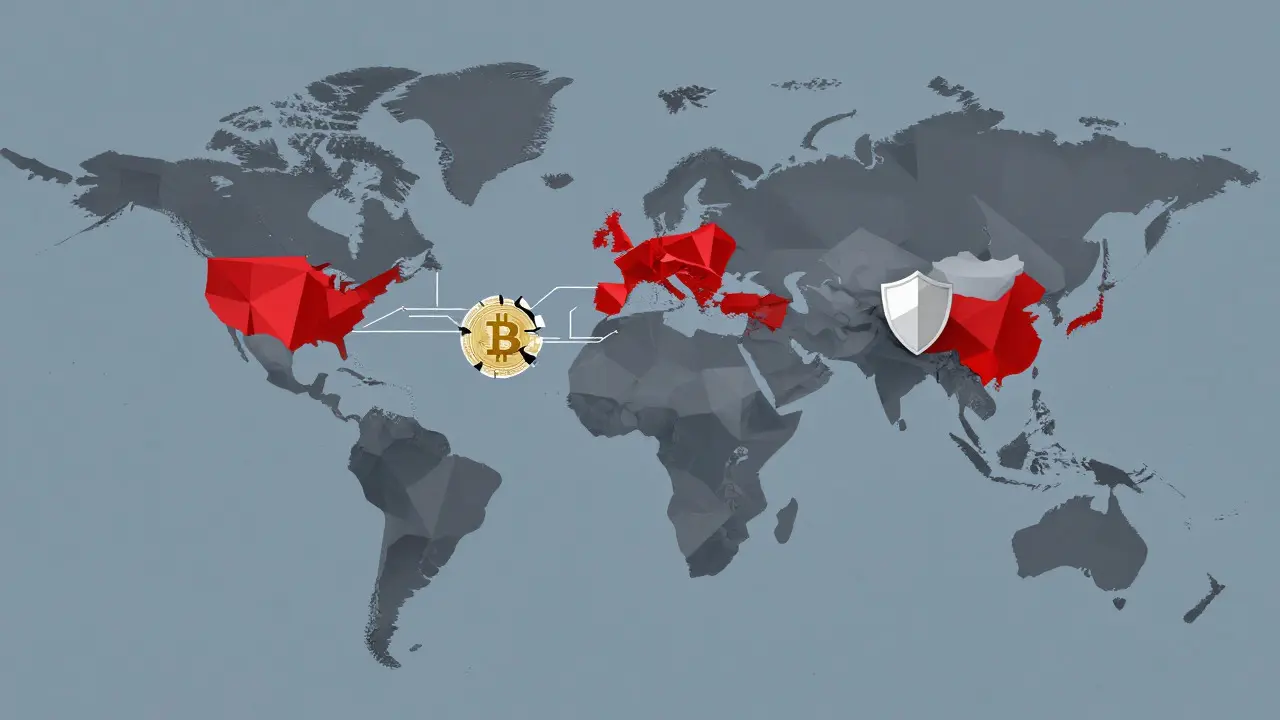
Imagine trying to send money across borders without a bank account, a passport, or permission from anyone in charge. For millions of people living under heavy economic sanctions, this isn't a sci-fi scenario-it’s daily life. But for regulators watching from the sidelines, it looks like something else entirely: a massive loophole for money laundering and terror financing.
This tension sits at the heart of the current global crackdown on cryptocurrency by the Financial Action Task Force (FATF), the intergovernmental body that sets global standards for anti-money laundering and counter-terrorist financing. As of mid-2026, three countries remain on the FATF's dreaded "blacklist": Iran, North Korea, and Myanmar. These nations are classified as high-risk jurisdictions, triggering strict countermeasures from banks and crypto exchanges worldwide. The result? A complex web of bans, blocks, and enhanced due diligence that affects not just state actors, but ordinary users trying to navigate a fractured financial system.
The Three Countries on the FATF Blacklist
To understand why crypto bans are tightening, you first need to know who is being targeted. The FATF blacklist isn't a random list; it represents jurisdictions with strategic deficiencies in their regimes to combat money laundering and terrorist financing. Currently, only three countries hold this status:
- Iran: Subject to renewed calls for countermeasures since February 2020. Its weak anti-money laundering controls clash with explosive domestic crypto adoption driven by economic isolation.
- North Korea (DPRK): The most aggressive threat actor in digital assets. The regime uses sophisticated cyberattacks to steal billions, effectively using crypto as a national revenue source to bypass UN sanctions.
- Myanmar: Placed on the blacklist due to political instability and weak regulatory oversight. While subject to enhanced due diligence, it does not face the same full-scale countermeasures as Iran and North Korea.
These classifications mean that any financial institution-whether a traditional bank or a centralized crypto exchange-must apply heightened scrutiny to transactions involving these regions. In many cases, this translates to outright bans on services for residents of these countries.
North Korea: The Cyber-Crypto Powerhouse
If there is one country turning cryptocurrency into a weapon of war, it is North Korea. Unlike typical criminals who hide in shadows, the DPRK operates state-sponsored hacking units that target virtual asset service providers directly. Their goal is simple: steal stablecoins and Bitcoin, then launder them through mixers and decentralized exchanges to fund nuclear programs and military operations.
The scale of this operation is staggering. In February 2025, North Korean hackers executed a heist against the ByBit cryptocurrency exchange, stealing $1.5 billion in digital assets. This single event highlighted how vulnerable centralized platforms can be when facing well-funded, patient adversaries. According to data from Chainalysis, sanctioned jurisdictions collectively received $15.8 billion in cryptocurrency during 2024. That number represents roughly 39% of all illicit crypto transactions globally.
By the end of 2024, sanctioned jurisdictions accounted for nearly 60% of total sanctions-related activity value. This shift marks a critical change in the landscape. Previously, individual sanctioned entities were the primary concern. Now, entire countries have become hubs for illicit flows. For compliance officers, this means that simply checking if a wallet address belongs to a known terrorist isn't enough. They must also assess whether funds originated from or are destined for high-risk geographic zones.
Iran: Crypto as a Survival Tool
In Iran, the story is different. Here, cryptocurrency isn't primarily about funding weapons; it's about survival. Decades of international sanctions have crippled the Iranian banking sector, making it nearly impossible for citizens to access global financial systems. Enter Bitcoin and other cryptocurrencies. Because they are censorship-resistant and self-custodial, they offer a way out.
During 2024, Iranian centralized exchanges saw a dramatic surge in usage and transaction outflows. Residents used these platforms to move capital abroad, hedging against inflation and preparing for potential emigration. For an Iranian citizen, storing wealth in Bitcoin requires nothing more than a seed phrase-a string of words that can be memorized or written down. If they need to flee the country, their wealth travels with them, invisible to border guards.
This dual nature creates a headache for regulators. On one hand, you have legitimate individuals seeking financial freedom. On the other, you have the Islamic Revolutionary Guard Corps (IRGC) and other state actors using similar channels to evade sanctions. The U.S. Treasury's Office of Foreign Assets Control (OFAC) responded by issuing 13 designations in 2024 that included specific cryptocurrency addresses-the second-highest number in seven years. This signals a move away from broad banking sanctions toward precise targeting of crypto infrastructure.

Myanmar: Instability Breeds Illicit Flows
Myanmar presents a third model: chaos. Following political upheaval and ongoing conflict, the country lacks robust financial oversight. Criminal groups exploit this vacuum, using cryptocurrency to launder proceeds from drug trafficking, human smuggling, and illegal mining. While Myanmar doesn't receive the same level of countermeasure pressure as Iran or North Korea, it remains under intense scrutiny.
The FATF calls for enhanced due diligence regarding Myanmar. This means banks and exchanges must dig deeper into customer backgrounds, verify source of funds, and monitor transactions more closely. For many smaller fintech companies, this cost is prohibitive. It’s easier to ban users from Myanmar entirely than to build the compliance infrastructure needed to manage the risk. Consequently, many global platforms have quietly restricted access for residents of the region.
The Global Compliance Crisis
You might think that banning these countries solves the problem. Unfortunately, it doesn’t. The real issue lies in widespread non-compliance across the rest of the world. As of April 2024, three-quarters of FATF member countries were either noncompliant or only partially compliant with international standards governing virtual assets. This gap creates systemic vulnerabilities that illicit actors exploit.
Criminal networks use mixing services and privacy-focused cryptocurrencies to obscure the trail of stolen funds. When a hacker steals $1.5 billion from ByBit, they don’t keep it in one place. They fragment it, pass it through multiple wallets, and eventually convert it into fiat currency in jurisdictions with lax regulations. This cat-and-mouse game forces regulators to escalate their tactics.
The Financial Crimes Enforcement Network (FinCEN) in the United States has been particularly active. In recent years, FinCEN proposed rules to designate certain groups, like the Huione Group, as primary money laundering concerns. They also pushed for expanded measures to combat crimes enabled by cryptocurrency mixers. Meanwhile, the Independent Community Bankers of America (ICBA) supported these efforts, recognizing that small banks are often the weakest link in the chain when dealing with complex crypto transactions.
| Country | FATF Status | Primary Crypto Threat | Regulatory Response |
|---|---|---|---|
| Iran | High-Risk Jurisdiction | Capital flight, sanction evasion by state actors | Full countermeasures, OFAC address designations |
| North Korea | High-Risk Jurisdiction | State-sponsored hacking, theft of billions | Full countermeasures, targeted cyber-sanctions |
| Myanmar | High-Risk Jurisdiction | Laundering via criminal syndicates | Enhanced due diligence, no full countermeasures |

How This Affects You
If you are a regular user of cryptocurrency, you might wonder why this matters to you. The answer is simplicity: friction. As regulators tighten the screws, exchanges respond by implementing stricter Know Your Customer (KYC) and Anti-Money Laundering (AML) checks. This means longer verification times, more document requests, and occasionally, frozen accounts if your transaction patterns look suspicious.
For businesses operating in the crypto space, the stakes are even higher. Failure to comply with FATF recommendations can lead to hefty fines, loss of banking relationships, or even criminal charges. Many companies now employ dedicated compliance teams that track every major update from the FATF, OFAC, and local financial intelligence units. They use advanced analytics tools to screen transactions in real-time, flagging anything that connects to blacklisted jurisdictions.
However, there is a silver lining. The increased focus on transparency is pushing the industry toward greater maturity. We are seeing the rise of regulated custodians, audited reserves, and clearer legal frameworks. While the path is bumpy, the destination is a more secure and trustworthy financial ecosystem.
Looking Ahead: What Comes Next?
The FATF continues to evolve its approach. In June 2025, the organization updated its lists, adding the British Virgin Islands and Bolivia to the "Jurisdictions Under Increased Monitoring" category while removing Croatia, Mali, and Tanzania. This dynamic nature shows that compliance is not a one-time achievement but an ongoing process.
For Iran, North Korea, and Myanmar, the outlook remains grim. Current countermeasures have not yet achieved the desired compliance levels, suggesting that enforcement actions will continue to escalate. We can expect more targeted sanctions on crypto infrastructure, increased cooperation between law enforcement agencies, and potentially, new technologies designed to trace illicit flows more effectively.
As we move further into 2026, the line between legitimate financial innovation and illicit activity will continue to blur. Regulators are learning, criminals are adapting, and users are caught in the middle. Understanding the role of the FATF blacklist is crucial for anyone navigating this complex landscape. It’s not just about following rules; it’s about understanding the geopolitical forces shaping the future of money.
What is the FATF blacklist?
The FATF blacklist, officially known as "High-Risk Jurisdictions Subject to a Call for Action," identifies countries with significant weaknesses in their anti-money laundering and counter-terrorist financing regimes. Being on this list triggers mandatory countermeasures from other countries, including stricter due diligence or blocking of financial transactions.
Which countries are currently on the FATF blacklist?
As of July 2026, the three countries on the FATF blacklist are Iran, North Korea (DPRK), and Myanmar. These nations are considered the highest-risk jurisdictions for financial crime globally.
Why is North Korea associated with crypto theft?
North Korea uses state-sponsored hacking units to steal cryptocurrency from exchanges and investors. Due to heavy international sanctions, the regime relies on these cyber-heists to generate revenue for its government and military. In 2025 alone, they stole over $1.5 billion from the ByBit exchange.
How does the FATF blacklist affect crypto exchanges?
Exchanges must implement enhanced due diligence for customers from blacklisted countries. Many choose to ban users from these jurisdictions entirely to avoid regulatory penalties. They also invest heavily in monitoring tools to detect and block transactions linked to illicit activities originating from these regions.
Is Bitcoin banned in Iran?
While the Iranian government has issued mixed signals, effectively banning banks from processing crypto transactions, ordinary citizens widely use Bitcoin and other cryptocurrencies to circumvent economic sanctions and preserve wealth. The lack of effective enforcement makes it a popular tool for capital flight.
What is the difference between the FATF blacklist and grey list?
The blacklist is for countries requiring immediate countermeasures due to severe deficiencies. The grey list, or "Jurisdictions Under Increased Monitoring," includes countries that have committed to resolving their deficiencies within an agreed timeframe. Grey-listed countries face less severe restrictions than those on the blacklist.
How much illicit crypto flow comes from sanctioned jurisdictions?
According to Chainalysis data from 2024, sanctioned jurisdictions received $15.8 billion in cryptocurrency, accounting for approximately 39% of all illicit crypto transactions globally. This highlights the significant role these regions play in underground financial networks.
What role does FinCEN play in crypto regulation?
FinCEN (Financial Crimes Enforcement Network) is the U.S. financial intelligence unit responsible for enforcing AML/CFT rules. It works closely with the FATF and issues guidelines, designations, and training programs to help banks and exchanges combat money laundering through virtual assets.