
If you're a US citizen holding cryptocurrency on a foreign exchange, you could be in serious trouble - not because you're breaking the law, but because you might not even know you're supposed to report it. The IRS isn't just watching bank accounts anymore. They're tracking Bitcoin, Ethereum, and every other digital asset held overseas. And if you're sitting on more than $50,000 worth of crypto in a foreign wallet or exchange, you're legally required to tell them - or risk penalties that could cost you tens of thousands of dollars.
What Exactly Is FATCA?
FATCA, or the Foreign Account Tax Compliance Act, was passed in 2010 to stop Americans from hiding money offshore. It forces foreign banks, investment firms, and other financial institutions to report account details of US citizens to the IRS. If they don't, they get hit with a 30% withholding tax on US-sourced payments. That’s a big stick. So foreign institutions play along - and they’ve been forced to start asking customers if they’re US persons. But here’s the catch: FATCA doesn’t just cover traditional bank accounts. It covers specified foreign financial assets. That includes anything held outside the US that has value - stocks, bonds, mutual funds, and now, according to IRS guidance and expert interpretation, cryptocurrency.When Do You Have to Report Crypto Under FATCA?
The reporting threshold depends on where you live and how you file your taxes. If you’re a single US taxpayer living in the US, you must file Form 8938 if your total foreign financial assets exceed $50,000 on the last day of the tax year - or more than $75,000 at any point during the year. For married couples filing jointly, it’s $100,000 or $150,000. If you live abroad, the thresholds are higher: $200,000 on the last day of the year or $300,000 at any time during the year. These numbers aren’t just about cash. They include the fair market value of everything you own overseas - including crypto. So if you have 2 BTC worth $120,000 on Binance, Kraken, or any foreign platform, you’ve hit the threshold. Even if you never sold it. Even if you never converted it to USD. The value is what matters.Is Crypto Really a "Foreign Financial Asset" Under FATCA?
The IRS hasn’t published a clear, official statement saying, "Crypto on foreign exchanges = FATCA reportable." But they don’t need to. The law defines specified foreign financial assets as any financial account maintained by a foreign financial institution (FFI) - and that’s where the ambiguity turns into risk. Most major crypto exchanges - Binance, Kraken, Bitstamp, KuCoin - are based outside the US. They’re not US-registered financial institutions. So they qualify as FFIs under FATCA. If you hold crypto on one of those platforms, you’re holding it through a foreign financial institution. That makes it reportable. Even if you use a non-custodial wallet (like MetaMask) but bought the crypto on a foreign exchange, the IRS may still argue the asset originated from a foreign financial institution. Tax professionals overwhelmingly advise reporting it anyway. Why? Because the penalty for not reporting can be $10,000 per year - and up to $50,000 if the IRS catches you later. The cost of filing is far lower than the cost of getting caught.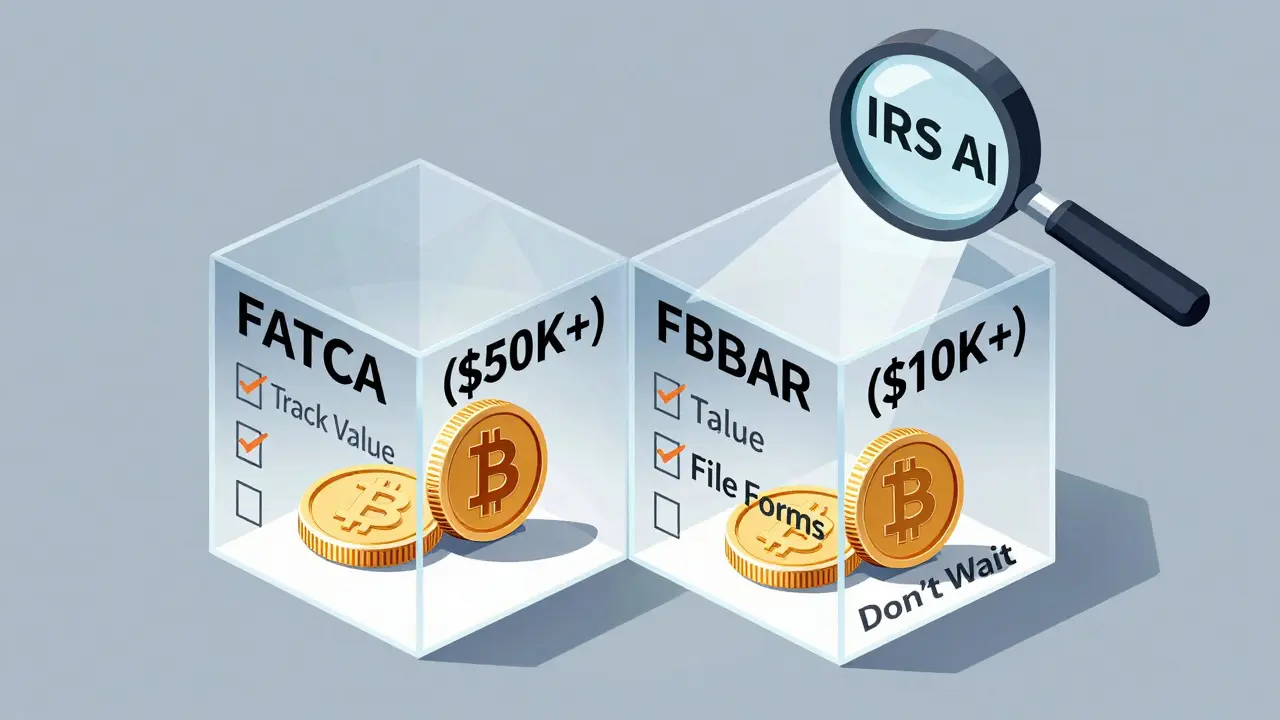
FATCA and FBAR: Two Separate Rules, Double the Trouble
Don’t confuse FATCA with FBAR. They’re two different forms, with two different agencies, and two different thresholds. FATCA uses Form 8938, filed with your tax return. FBAR (FinCEN Form 114) is filed separately with the Financial Crimes Enforcement Network. FBAR has a lower threshold: $10,000 at any time during the year. For years, crypto was excluded from FBAR. But in 2025, FinCEN proposed new rules that would explicitly include foreign cryptocurrency accounts. That means if you had $12,000 in ETH on Binance in June 2025 - even if you sold it in July - you’d have triggered both FATCA and FBAR reporting. You’d need to file Form 8938 and FinCEN Form 114. And you’d need to report the same asset twice. The IRS and FinCEN are working together. They’re sharing data. They’re cross-referencing exchange records. If you’re holding crypto overseas, you’re not invisible anymore.How Do You Report Crypto on Form 8938?
Form 8938 asks for details about each foreign financial asset: the name of the institution, account number, maximum value during the year, and whether you have control over the asset. The problem? Crypto exchanges don’t give you account numbers like a bank does. You don’t get a routing number or a SWIFT code. You get a login and a wallet address. The IRS knows this. Their instructions say you can list the platform name (e.g., "Binance Global") and write "unknown" or "N/A" for account number. You can even list your username or email address if that’s how you access the account. The goal isn’t perfection - it’s disclosure. For value, you report the highest fair market value during the year. That means you need to track your crypto’s price history. If your 5 ETH was worth $8,000 in January and $15,000 in June, you report $15,000. Use a reliable price source - CoinMarketCap, CoinGecko, or your exchange’s historical data. Don’t guess. Don’t use the lowest price. Use the peak.What About Selling or Trading Crypto?
FATCA only asks you to report what you own. But if you sell, trade, or earn crypto, you have separate tax obligations. Every time you sell Bitcoin for USD, trade ETH for SOL, or earn staking rewards, it’s a taxable event. You must report capital gains or income on Form 8949 and Schedule D. The IRS requires FIFO accounting unless you can specifically identify the units sold. This means even if you didn’t trigger FATCA because your holdings were under $50,000, you still have to report every trade. And the IRS can see those transactions through exchange reports, blockchain analysis, and third-party data providers like Chainalysis.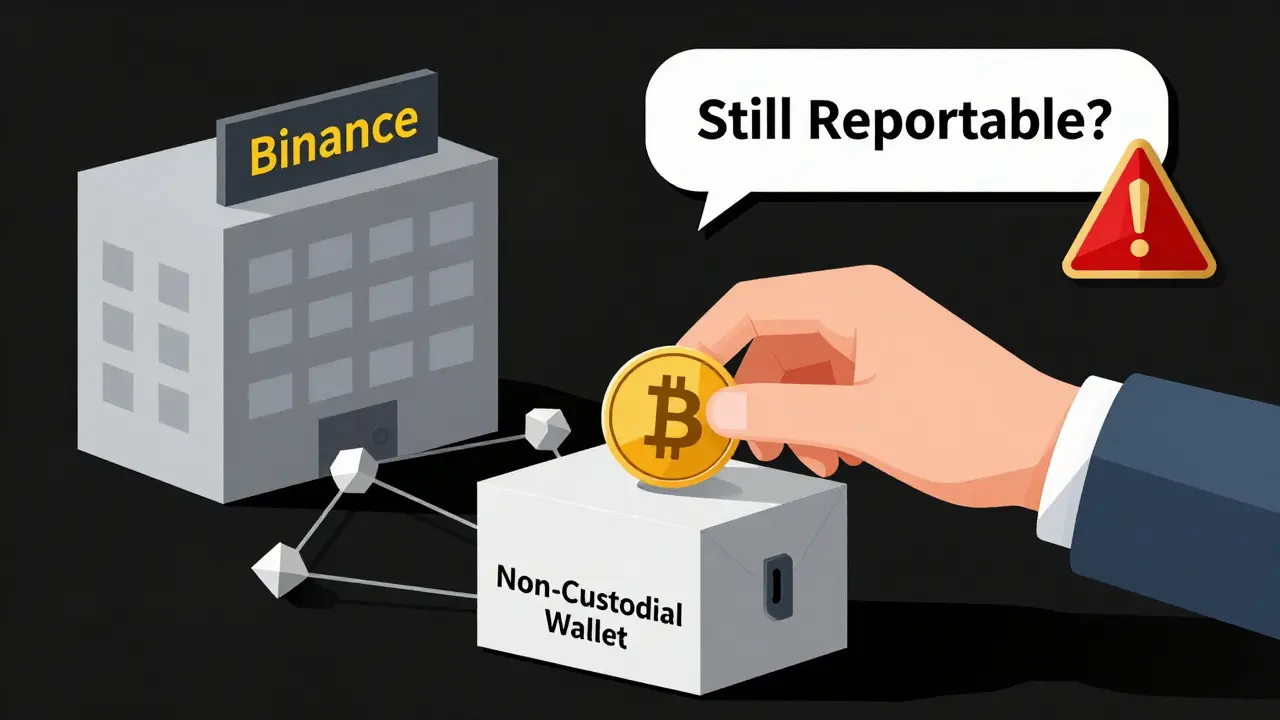
What Happens If You Don’t Report?
The penalties are brutal. For failing to file Form 8938, you face a $10,000 fine. If you still don’t file after being notified by the IRS, you can be hit with another $10,000 per 30 days - up to $50,000. That’s not a typo. That’s $50,000 just for forgetting to check a box. On top of that, you could be audited. The IRS has teams dedicated to crypto compliance. They’re using AI to match wallet addresses, exchange records, and FATCA data. If you’ve been holding crypto overseas for years and never reported, you’re a target. The good news? The IRS has voluntary disclosure programs. If you come forward before they come for you, you can avoid criminal charges and reduce penalties. But you have to act before they notice.What Should You Do Right Now?
Here’s the simple, no-excuse checklist:- If you have more than $50,000 in crypto on any foreign platform, file Form 8938 with your tax return.
- If you had more than $10,000 in crypto on foreign exchanges at any point in 2025, file FinCEN Form 114 (FBAR) - even if the rules aren’t final yet.
- Track the highest value of your crypto holdings during the year. Use exchange records or CoinGecko.
- Report every trade, sale, or income event on Form 8949 and Schedule D.
- If you’re unsure whether a platform is foreign, assume it is. Better safe than fined.
Bottom Line: When in Doubt, Report
The IRS doesn’t care if you’re new to crypto. They don’t care if you didn’t know the rules. They care if you had the assets and didn’t report them. FATCA was never meant for crypto. But crypto is now part of FATCA - whether the law says it or not. The data flows. The penalties exist. The tools to catch you are already in place. If you’re a US citizen holding crypto overseas, you have two choices: get compliant now, or risk losing more than your crypto to the IRS.Do I have to report crypto on FATCA if I never sold it?
Yes. FATCA requires you to report the value of foreign financial assets you own, regardless of whether you sold them. If your crypto holdings on foreign exchanges exceed $50,000 at any point during the year, you must file Form 8938. Holding without selling doesn’t exempt you.
Is crypto on Coinbase US reportable under FATCA?
No. Coinbase US is a US-based financial institution, so it’s not subject to FATCA reporting. Assets held on Coinbase US don’t count as foreign financial assets. But if you hold crypto on Coinbase Europe, Coinbase Australia, or any non-US entity, it’s reportable.
What if my crypto exchange doesn’t provide account details?
The IRS allows you to list the platform name and write "unknown" for account number or address. You can also include your username or email address used to access the account. The goal is to identify the asset and the institution - not to replicate a bank statement.
Can I avoid FATCA by using a non-custodial wallet?
Not if you bought the crypto on a foreign exchange. FATCA looks at where the asset came from and how it’s held. If you acquired crypto through a foreign financial institution (like Binance), even if you moved it to a personal wallet, the IRS may still consider it a reportable foreign asset. The safest approach is to report it.
What’s the difference between FATCA and FBAR for crypto?
FATCA (Form 8938) is filed with your tax return and has higher thresholds ($50,000-$300,000 depending on status). FBAR (FinCEN Form 114) is filed separately with FinCEN and has a $10,000 threshold. As of 2025, proposed rules would make foreign crypto accounts reportable under FBAR - meaning you may need to file both forms for the same holdings.
Pramod Sharma
January 19, 2026 AT 22:26Crypto isn't money, it's math. And math doesn't care about borders. If the IRS wants to track it, they should build a better system, not punish people for using tech they didn't invent.
Christina Shrader
January 20, 2026 AT 20:03I filed my 8938 last year even though I was under the threshold. Better safe than sorry. The anxiety alone isn't worth the risk.
Andre Suico
January 22, 2026 AT 14:23The IRS guidance on crypto under FATCA is intentionally ambiguous because the technology outpaces regulation. Legal scholars agree that holding crypto on a foreign exchange meets the definition of a specified foreign financial asset under IRC §6038D. The 2025 FBAR expansion is merely codifying existing enforcement practice. Compliance isn't optional-it's the only rational path when penalties reach $50,000.
Nishakar Rath
January 24, 2026 AT 10:27Who the hell cares about FATCA you normies its just the government trying to control your digital freedom they dont even know what a wallet is stop being sheep and move your crypto to a non custodial wallet and laugh all the way to the bank
Patricia Chakeres
January 25, 2026 AT 17:02Did you know the IRS contracts with blockchain analytics firms that can trace every transaction back to your identity? Even if you use a mixer, they correlate IP logs, exchange KYC data, and metadata from wallet interactions. This isn't about taxes-it's about total financial surveillance. They're building a digital panopticon and you're helping them by filing forms.
kristina tina
January 26, 2026 AT 14:06I almost lost my mind last year trying to track my ETH values across 3 different exchanges. I cried over spreadsheets. I lost sleep. I felt like a criminal for owning something that should be free. But then I filed. And the weight lifted. If you're reading this and scared-you're not alone. Do it. Breathe. You got this.
Anna Gringhuis
January 27, 2026 AT 23:30So let me get this straight-you’re telling me I have to report my crypto on Binance Global as a foreign asset, but if I buy the same amount on Coinbase US, it’s fine? That’s not tax policy, that’s corporate favoritism disguised as law. The system is rigged, and you’re just helping them collect.
Michael Jones
January 27, 2026 AT 23:40When reporting the maximum value of your crypto holdings, ensure you use the fair market value at the time of the peak, as defined by IRS Publication 525. Do not use average prices, estimated values, or speculative projections. Use official exchange data with timestamps. Accuracy matters-not because you’re being watched, but because you owe it to yourself to do it right.
Lauren Bontje
January 29, 2026 AT 23:21Americans overseas are being targeted because they’re easy prey. If you’re not living in the US, you’re not part of the system. Why are you even filing? Stop subsidizing the welfare state with your digital assets. Move your crypto to a US-based exchange or get the hell out of the system entirely.
Stephanie BASILIEN
January 30, 2026 AT 04:36It is my considered opinion, grounded in both statutory interpretation and administrative precedent, that the IRS's current enforcement posture regarding foreign-held cryptocurrency constitutes an overreach that lacks clear statutory authorization. While one may pragmatically choose to comply in order to avoid punitive measures, one must not confuse compliance with legitimacy. The erosion of financial privacy under the guise of tax compliance is a hallmark of authoritarian governance, and we are witnessing its quiet normalization.