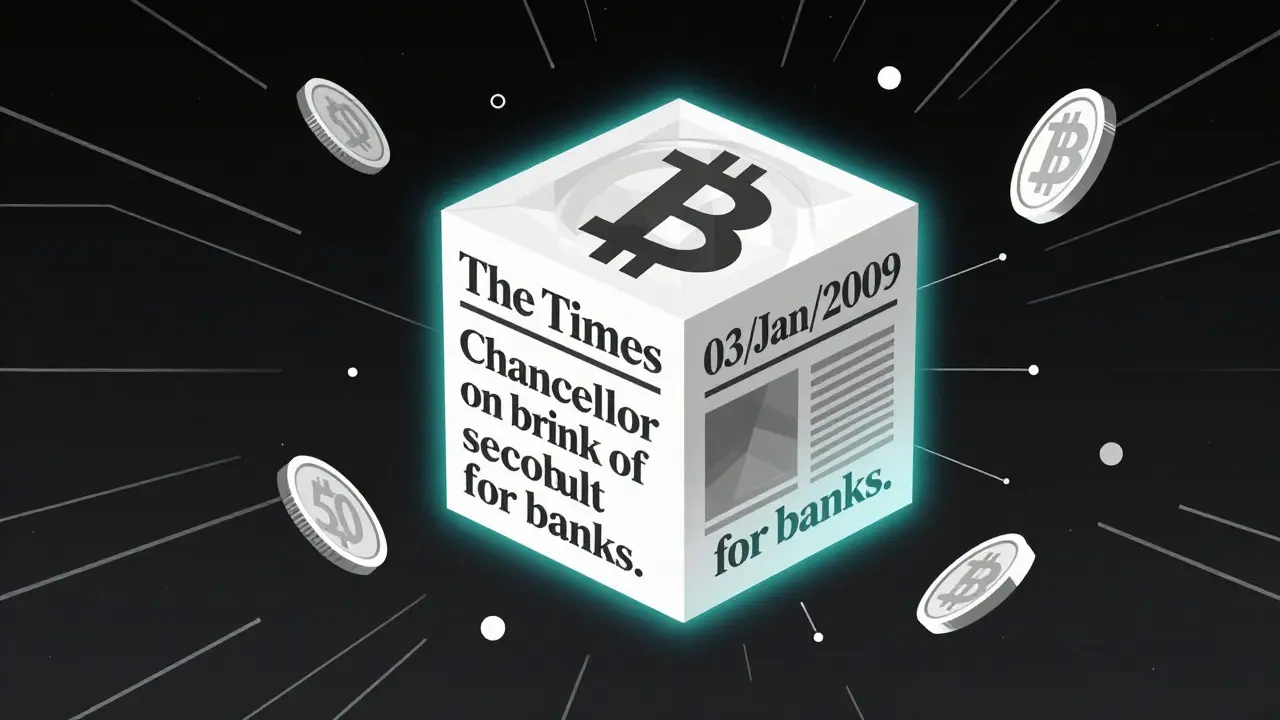
The first block ever mined in Bitcoin’s history didn’t just start a chain-it started a revolution. On January 3, 2009, at 18:15:05 GMT, a single block appeared on a quiet network of computers. No press release. No fanfare. Just a line of code and a newspaper headline embedded in its data: 'The Times 03/Jan/2009 Chancellor on brink of second bailout for banks.' That block, known as the Genesis Block, was the spark that lit the fuse of an entirely new financial system. It wasn’t just the first Bitcoin block. It was a statement.
What Makes a Genesis Block So Special?
Every blockchain starts with a genesis block. It’s the first block in the chain, the anchor point that everything else builds on. But not all genesis blocks carry the weight of history like Bitcoin’s. Most are just technical starting points-hardcoded into software, empty of meaning. Bitcoin’s was different. It wasn’t mined like the others. It was written into the code by Satoshi Nakamoto as a deliberate act. No previous block could point to it. No miner could claim it. It was born, not earned. Its hash-000000000019d6689c085ae165831e93-is one of the most famous strings in crypto. It starts with eight zeros, a sign of how easy mining was back then. That’s not a flaw. It’s a feature. It shows the system started simple, and grew harder over time. The block also contains a 50 BTC reward. But here’s the twist: that reward has never been spent. Not once. It’s frozen in time, a monument to the beginning.
The Merkle root, the timestamp, the nonce-all of it was set by hand. No algorithm picked it. No network agreed on it. Satoshi did. And by doing so, he proved something radical: a system could exist without a central authority. No bank. No government. Just math, code, and a shared ledger.
The Hidden Message That Changed Everything
Why did Satoshi choose that specific headline from The Times? Because it wasn’t random. January 2009 was the tail end of the global financial crisis. Banks were collapsing. Governments were bailing them out with taxpayer money. People were losing homes. Trust in institutions was crumbling. That headline wasn’t just a timestamp-it was a protest. A declaration that Bitcoin was built to fix what traditional finance broke. That single line turned the Genesis Block from a technical milestone into a cultural symbol. It’s why crypto fans don’t just see Bitcoin as money. They see it as a movement. Every time someone mentions the block, they’re not talking about code. They’re talking about freedom from control. From inflation. From bailouts. The message was also a way to prove the block was created after the headline was published. If someone tried to fake the block later, they couldn’t have known that exact headline would appear in the newspaper on January 3. It’s a timestamp sealed in stone.How the Genesis Block Changed the World
Before Bitcoin, digital money was either controlled by companies (like PayPal) or governments (like central bank systems). Both relied on trust in institutions. Bitcoin’s Genesis Block proved you didn’t need them. The network could verify transactions on its own. No middleman. No fees. No delays. That idea spread like wildfire. By 2011, Litecoin launched with its own genesis block. Ethereum followed in 2015. Every new blockchain since then-whether it’s Solana, Cardano, or a private enterprise chain-starts with a genesis block modeled after Bitcoin’s. They copy the structure. They copy the idea. Even central bank digital currencies (CBDCs) now use genesis blocks, though they’re tightly controlled by governments. The impact? Bitcoin’s network has processed over 1.13 billion transactions as of 2025. Its market cap peaked above $2 trillion in December 2024. El Salvador made Bitcoin legal tender in 2021. Companies like MicroStrategy and Metaplanet now hold billions in Bitcoin on their balance sheets. None of that would exist without that first block.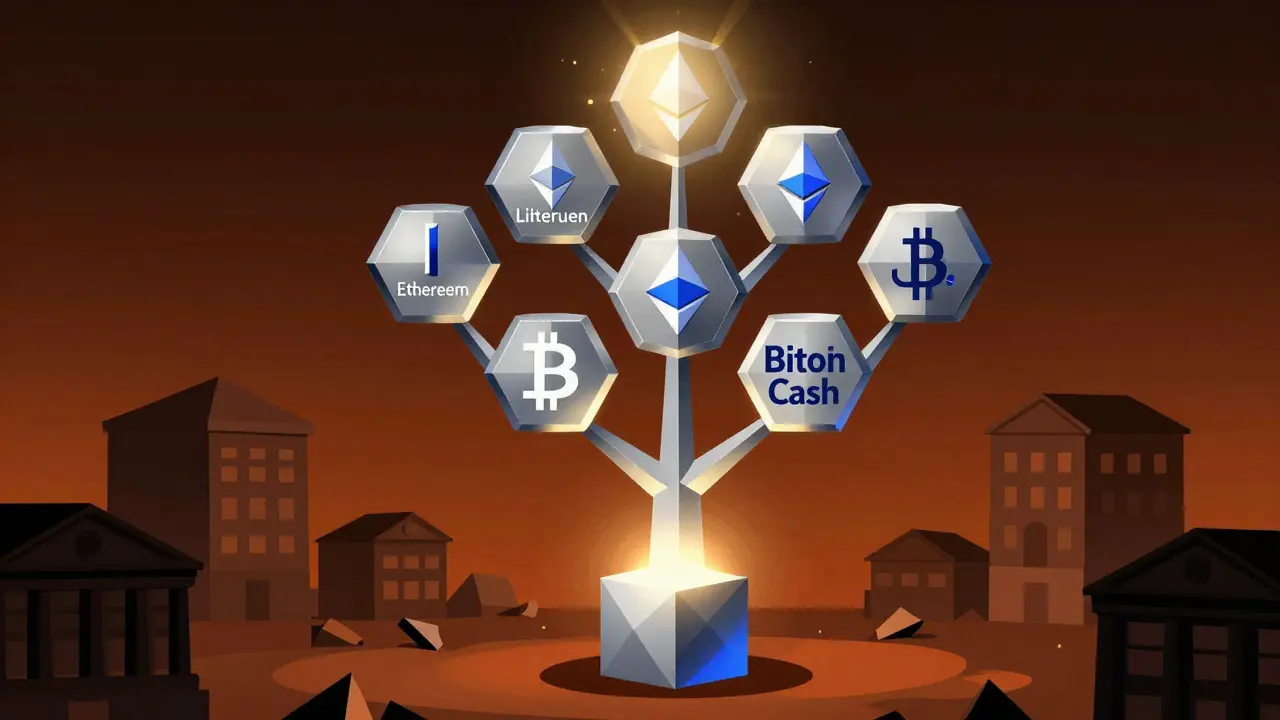
Why the Genesis Block Can’t Be Changed
One of the most powerful things about the Genesis Block is that it’s unchangeable. Not because it’s encrypted. Not because it’s secure. Because every single block after it references it. If you tried to alter the Genesis Block, you’d break every block that came after it. Thousands of computers around the world would instantly reject the change. The network would split. The whole system would collapse. That’s the magic of blockchain. It’s not just about being secure. It’s about being irreversible. Once something is in the chain, it’s permanent. That’s why the Genesis Block is sacred. It’s the one thing you can’t rewrite. Even Satoshi can’t touch it now. In early versions of Bitcoin software, the Genesis Block was counted as Block 1. Later, developers changed it to Block 0 to make the math clearer. But the block itself? Never changed. Not a single byte. That’s why it’s still the same today as it was in 2009.Other Famous Genesis Blocks
Bitcoin’s isn’t the only important one. Other chains have their own landmark genesis blocks.- Litecoin (October 2011): Created by Charlie Lee, Litecoin’s genesis block was mined on October 13, 2011. It’s nearly identical to Bitcoin’s but uses a different hashing algorithm (Scrypt instead of SHA-256). Its block contains no hidden message, but it’s still a direct descendant of Bitcoin’s design.
- Ethereum (July 2015): The Ethereum genesis block (Block 0) launched with the first smart contract platform. It included the initial distribution of Ether to early contributors. Unlike Bitcoin, Ethereum’s genesis block was pre-mined and distributed to investors before launch. It’s still the foundation of all Ethereum-based tokens and dApps.
- Bitcoin Cash (August 2017): Born from a hard fork of Bitcoin, its genesis block is a copy of Bitcoin’s-but with a different timestamp and a message: “The Times 03/Jul/2017 Chancellor on brink of second bailout for banks.” It’s a direct nod to Bitcoin’s origin, signaling its purpose: to return to Satoshi’s original vision of peer-to-peer cash.

How Developers Use Genesis Blocks Today
If you’re building a blockchain today, you don’t start from scratch. You take an existing codebase-Bitcoin, Ethereum, or even a fork-and change the genesis block to suit your needs. You set the initial supply. You pick the timestamp. You embed a message if you want to make a statement. Most private blockchains (used by banks or corporations) use genesis blocks to lock down control. They set a single entity as the only validator. Public blockchains? They use genesis blocks to distribute tokens fairly and establish trust from day one. The hardest part? Making sure the genesis block is truly immutable. If you accidentally allow it to be altered, your whole chain is compromised. That’s why most developers treat it like a sacred file-backed up, locked down, and never touched after launch.Why the Genesis Block Still Matters in 2026
Sixteen years after it was created, the Bitcoin Genesis Block still holds power. It’s not just a relic. It’s a living symbol. Every time someone buys Bitcoin, mines a new block, or argues against central banks, they’re standing on the foundation Satoshi laid. It’s why crypto communities still celebrate January 3rd as an unofficial holiday. People post memes. They donate to Bitcoin charities. They write essays about financial freedom. They don’t do it because they’re nostalgic. They do it because the block still represents what they believe in. And as more countries explore CBDCs, the Genesis Block becomes even more important. It’s the counterpoint. The proof that money doesn’t have to be controlled by a single entity. That decentralization works. That trust can be built through code, not contracts. The Genesis Block didn’t just launch Bitcoin. It launched a new way of thinking about money, power, and control. And that idea? It’s only getting stronger.What is the Bitcoin Genesis Block?
The Bitcoin Genesis Block is the very first block in the Bitcoin blockchain, created by Satoshi Nakamoto on January 3, 2009. It’s Block 0 and contains a hidden message referencing a newspaper headline about bank bailouts. Unlike all other blocks, it wasn’t mined-it was hardcoded into the software. It holds the first 50 BTC reward, which has never been spent.
Why is the Genesis Block unspendable?
The 50 BTC reward in the Genesis Block is unspendable because the Bitcoin protocol doesn’t allow transactions to reference it. The block has no previous output to spend from-it’s a special case built into the code. Even if someone tried to create a transaction spending it, the network would reject it. This makes it a permanent symbol of Bitcoin’s origin.
Can the Genesis Block be altered?
No. Altering the Genesis Block would break every block that came after it, because each block includes a reference to the one before it. Changing the hash of the first block would make all subsequent blocks invalid. The entire network would reject the change instantly. That’s what makes blockchain immutable.
What’s the significance of the newspaper headline in the Genesis Block?
The headline, "Chancellor on brink of second bailout for banks," was from The Times on January 3, 2009. It was chosen to show that Bitcoin was created as a response to the 2008 financial crisis and the failure of traditional banking. It’s a political statement disguised as a timestamp-proving the block was created after that date and signaling Bitcoin’s mission: to replace unstable, centralized financial systems.
Do all cryptocurrencies have a Genesis Block?
Yes. Every blockchain, whether it’s Bitcoin, Ethereum, or a private enterprise chain, starts with a genesis block. It’s the first block in the chain and serves as the anchor point for all other blocks. Most copy Bitcoin’s model, though some embed different messages or set different rules for initial coin distribution.
Danyelle Ostrye
January 6, 2026 AT 23:38That Genesis Block isn’t just code-it’s a middle finger to the entire banking system. I love it.
And yeah, that 50 BTC? Still sitting there like a monument to rebellion.
Dennis Mbuthia
January 7, 2026 AT 16:25Oh, here we go again with the ‘Bitcoin is freedom’ nonsense-when the government prints money, it’s inflation; when Satoshi prints 50 BTC, it’s ‘revolutionary’? Get real. This isn’t a protest-it’s a tax loophole with a cult following. The Times headline? Cute. But you think a blockchain solves systemic economic failure? That’s like saying a typewriter fixes democracy.
And don’t even get me started on El Salvador-$300 million lost in a week because people didn’t understand how to use a wallet. This isn’t innovation-it’s emotional capitalism wrapped in code.
Becky Chenier
January 9, 2026 AT 08:13The Genesis Block is fascinating not just for its technical design, but for its symbolic weight. It’s rare in human history to have a moment where a single artifact can represent both a technological breakthrough and a philosophical stance.
It’s like the Magna Carta of digital sovereignty-quiet, unassuming, but impossible to ignore. The fact that the reward remains unspent makes it feel less like currency and more like a relic in a digital museum of ideals.
Jennah Grant
January 10, 2026 AT 21:13Let’s not romanticize the genesis block too much-it’s a clever hack, sure, but it’s not magic. The embedded headline? A timestamping mechanism disguised as poetry. The unspendable output? A protocol constraint, not a spiritual statement. The real innovation wasn’t the block-it was the consensus mechanism that made it immutable.
And let’s be honest: most new chains just copy-paste the structure without understanding why it works. They think they’re building decentralization, but they’re just building vanity ledgers.
Staci Armezzani
January 11, 2026 AT 02:36For anyone new to crypto, the Genesis Block is your entry point into understanding why this whole thing matters.
It’s not about the 50 BTC-it’s about the idea that you don’t need permission to create value. That’s revolutionary. No bank. No CEO. Just math and a bunch of strangers agreeing on a shared truth.
And yeah, the Times headline? That’s the soul of Bitcoin. It’s not just a timestamp-it’s a manifesto written in plain English. If you can’t feel that, you’re looking at the code, not the movement.
sathish kumar
January 12, 2026 AT 05:43The Genesis Block constitutes a seminal milestone in the evolution of distributed ledger technologies, embodying the epistemological rupture between centralized monetary authority and decentralized trust architecture.
Its immutable nature, encoded within the SHA-256 hash structure, demonstrates an ontological commitment to verifiability without recourse to third-party intermediaries. The embedded headline, sourced from The Times, serves as a performative utterance, anchoring the genesis event in historical contingency and thereby precluding retroactive falsification.
One must acknowledge the cultural semiotics embedded in this artifact-not merely as a technical artifact, but as a hermeneutic key to the post-capitalist imagination.
Brittany Slick
January 12, 2026 AT 21:00Imagine if this block was a painting. You’d hang it in the Louvre. Not because it’s pretty-but because it changed everything.
That 50 BTC? It’s the Mona Lisa’s smile. Silent. Unmoved. Still making people wonder decades later.
And the headline? That’s the brushstroke that says, ‘I saw this coming.’
Andy Schichter
January 14, 2026 AT 20:42Oh wow, another essay on how Bitcoin is ‘the answer’.
Let me guess-the next paragraph says ‘Satoshi was a genius’ and ‘central banks are evil’?
Newsflash: the blockchain doesn’t stop inflation. It just moves it to a different kind of sucker.
Also, 50 BTC is worth $3.5 million now. That’s not a monument. That’s a retirement fund someone forgot to cash out.
Chill out. It’s just code.
Denise Paiva
January 15, 2026 AT 07:07Let’s be clear-the Genesis Block is not sacred. It’s just the first one. If it were so important, why did Satoshi abandon it? Why didn’t he ever spend it? Because he knew it was meaningless. The real revolution is the network. Not the block.
And that headline? A gimmick. A distraction. A PR move dressed up as philosophy.
Bitcoin doesn’t need symbolism. It needs adoption. And adoption doesn’t come from poetry.
Kelley Ramsey
January 17, 2026 AT 03:29Wait, so the Genesis Block is unspendable because the protocol doesn’t allow it? That’s not a feature-it’s a bug!
Why would you design a currency where the very first coins can’t be moved? That’s like printing the first dollar bill and then locking it in a vault forever.
And why did Satoshi even include it? Was he trying to make a point… or just forget to code the spend function?
Also, the Times headline? That’s cute, but what if the newspaper had published it a day earlier? Would he have picked a different one? That’s not proof-it’s luck.
Michael Richardson
January 18, 2026 AT 17:50Bitcoin’s genesis block? Yeah, cool.
Now tell me how many people actually use it to buy coffee.
Meanwhile, my debit card works everywhere.
Stop romanticizing code.
Sabbra Ziro
January 18, 2026 AT 19:59I love how this post doesn’t just explain the tech-it captures the spirit. The Genesis Block isn’t about Bitcoin. It’s about people deciding they deserve better.
That headline? It’s not just a timestamp. It’s a promise.
And the fact that it’s still there, untouched, after 15+ years? That’s the quietest kind of power.
Thank you for reminding us why we’re here.
Krista Hoefle
January 19, 2026 AT 05:04genesis block? more like genesis *bore*
50 btc? still unspent? wow so brave
the times headline? yeah real edgy dude
we get it you hate banks
now go touch grass
Emily Hipps
January 20, 2026 AT 10:28You know what’s wild? That Genesis Block is still alive. Not dead. Not archived. Still part of every single transaction that’s ever happened since.
It’s like the heartbeat of the whole system.
And even though we’ve built empires on top of it-NFTs, DeFi, CBDCs-we still come back to it. Not because we have to.
Because we want to.
It’s the first note in a song that’s still being played.
Natalie Kershaw
January 22, 2026 AT 04:43The unspendable 50 BTC is the most powerful thing about the Genesis Block-not because it’s valuable, but because it’s untouched. It’s the ultimate proof of concept: you don’t need to extract value from the foundation to validate it.
It’s a gift. A non-negotiable. A covenant.
And that’s why no one ever tries to spend it. Not because they can’t.
Because they shouldn’t.
Jacob Clark
January 23, 2026 AT 03:01Okay, but why are we still talking about this? It’s 2026. We’ve got AI miners, quantum-resistant chains, and tokenized real estate.
The Genesis Block is a museum piece. A relic. A cute footnote.
It’s like celebrating the first dial-up modem because it connected to AOL.
Yes, it started something. But we’ve moved on.
Can we stop idolizing 2009 now?
Jon Martín
January 24, 2026 AT 16:34That Genesis Block? It’s not just the first block.
It’s the first time a human said, ‘I don’t trust you’-and then built a system that didn’t need you to.
That’s not code.
That’s courage.
And every time you hear someone say ‘crypto is dead’-they’re forgetting that block still exists.
And it’s still waiting.
Katrina Recto
January 24, 2026 AT 21:25That headline in the block? That’s the whole story right there.
Nothing else needed.
Mujibur Rahman
January 25, 2026 AT 02:01Just to clarify-Satoshi didn’t mine the Genesis Block. He created it. That’s why the timestamp is so precise. It wasn’t a race. It was a statement.
And that’s why no one else can replicate its meaning.
Even if you copy the code, you can’t copy the moment.