As of early 2025, if you're holding USDT or any other major stablecoin in the European Union, you might have noticed your trading options suddenly shrink. That’s not a glitch. It’s the EU’s Markets in Crypto-Assets (MiCA) regulation in full effect. This isn’t just another rule change - it’s a complete overhaul of how stablecoins can operate inside the bloc. And for tokens like USDT, the impact is severe. If you’re wondering why you can’t trade your USDT on some platforms anymore, or why your favorite DeFi app stopped working in the EU, this is why.
What MiCA Actually Does
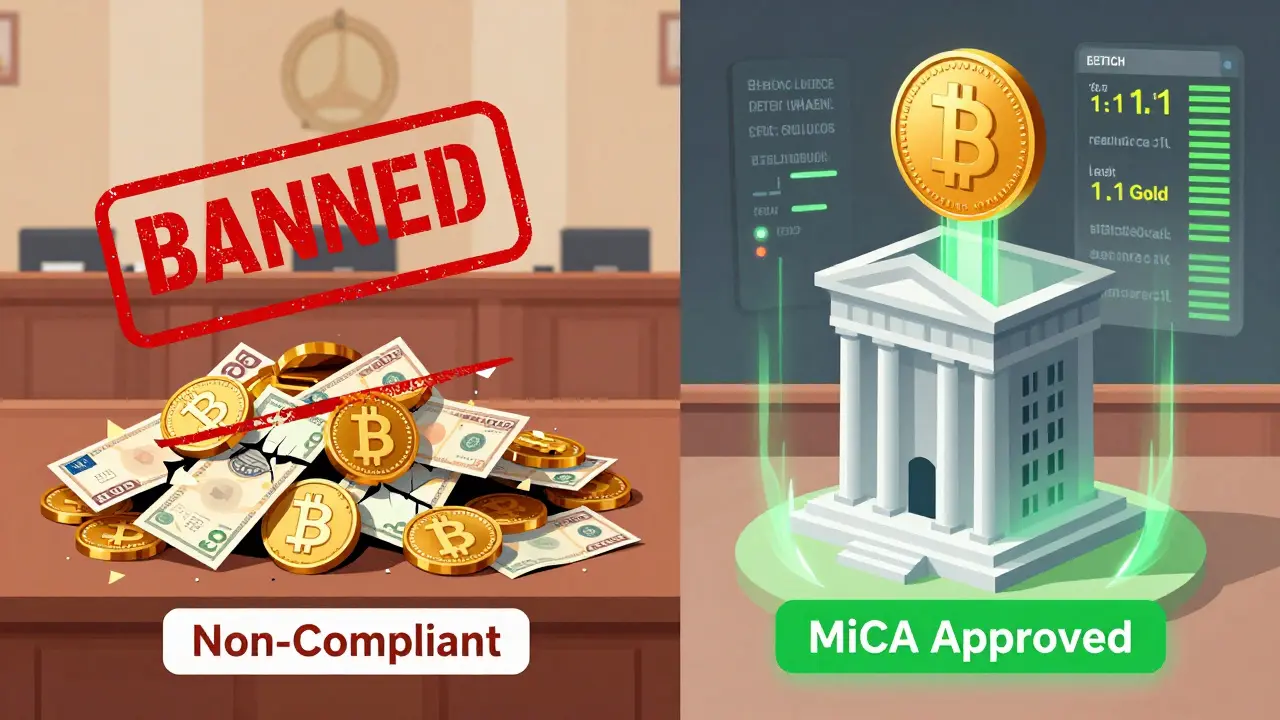
MiCA, officially Regulation (EU) 2023/1114, didn’t just tweak rules - it rewrote them from scratch. It came into force in January 2025 after years of preparation, and by the end of Q1 2025, every crypto exchange, wallet provider, and trading platform operating in the EU had to comply. The regulation doesn’t ban stablecoins. It just says: if you want to operate here, you have to meet strict standards.Stablecoins are split into two legal categories under MiCA: Asset-Referenced Tokens (ARTs) and E-Money Tokens (EMTs). ARTs are backed by a mix of assets - like fiat, crypto, or commodities. EMTs are simpler: they’re backed 1:1 by a single currency, usually euros or dollars, and can only be issued by licensed e-money institutions. USDT, for example, is an ART. But it’s not licensed as one under MiCA. So it’s blocked from trading on EU platforms.
Why USDT Got Blocked
Tether, the company behind USDT, hasn’t applied for MiCA compliance. Why? Because meeting the requirements would force them to change how they operate. MiCA demands:- Full, transparent reserves - every USDT must have a matching euro or dollar in a protected bank account, not mixed with other assets.
- Bankruptcy protection - if Tether goes under, your USDT still gets paid back. No more “we’re insolvent, sorry” scenarios.
- Instant redemption - you can always exchange 1 USDT for exactly $1, no delays, no fees, no excuses.
- Continuous reporting - regulators get real-time data on reserves, supply, and transactions.
USDT’s current structure doesn’t meet these standards. Its reserves include commercial paper, corporate bonds, and even crypto assets - things that can lose value. In 2025, the Bank for International Settlements called out USDT and similar tokens for “substantial deviations from par,” meaning they’ve dipped below $1 in value during stress periods. That’s exactly what MiCA was designed to stop.
What Happens If You Hold USDT in the EU?
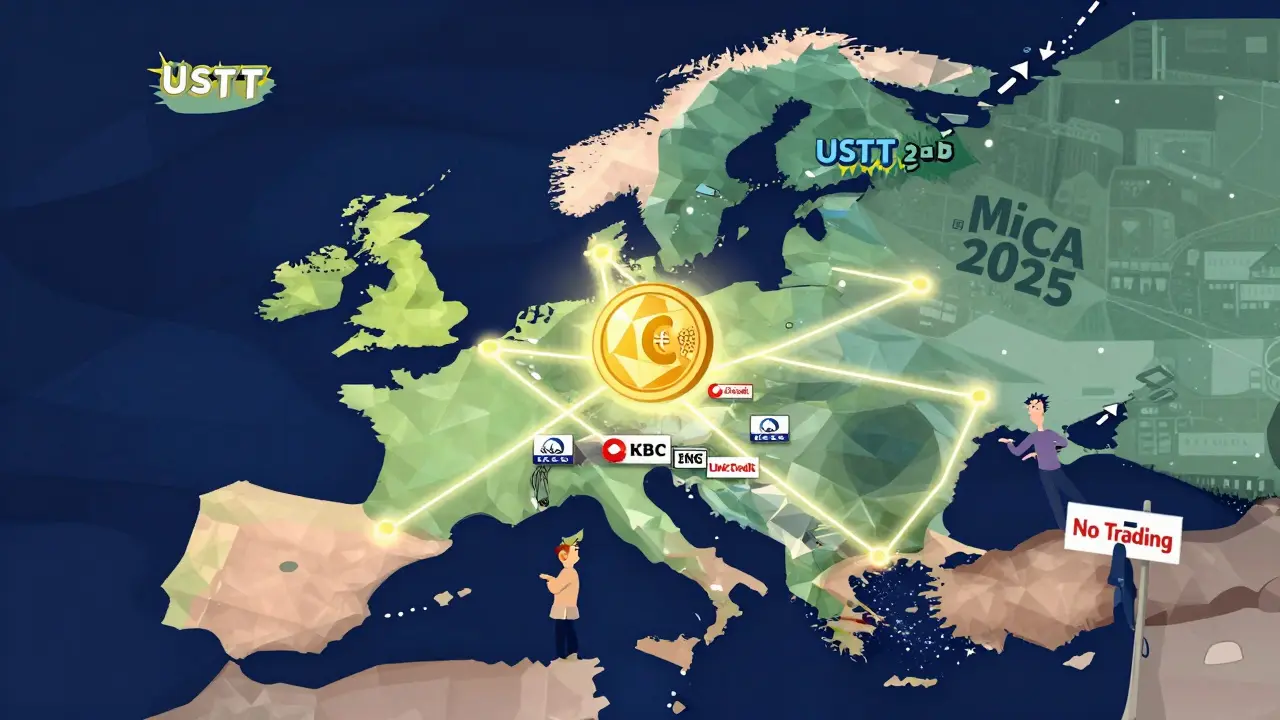
You can still hold it. You can still send it. But you can’t trade it on any EU-based exchange. Platforms like Bitvavo, Kraken EU, and Binance EU had to delist USDT by January 31, 2025. If you try to swap USDT for euros or Bitcoin on these platforms, the option simply won’t appear.Some wallets still let you send and receive USDT, but that’s it. No trading, no staking, no earning interest through EU-regulated services. This has hit traders hard. Arbitrage opportunities - buying USDT cheap in one market and selling high in another - are gone. Institutional investors who used USDT as a bridge between crypto and fiat now need to find alternatives.
The EU’s Answer: A Euro Stablecoin
The EU isn’t just stopping USDT - it’s building its own replacement. Nine major European banks, including ING, KBC, UniCredit, and Raiffeisen, formed a consortium to launch a MiCA-compliant euro stablecoin. This isn’t a side project. It’s a strategic move.The new stablecoin, expected to launch in late 2026, will be issued by a Dutch-based company under supervision from the Dutch Central Bank. It’ll be an E-Money Token - 1:1 backed by euros, fully transparent, and redeemable instantly. Its goal? To replace USDT in EU markets and give Europe control over its own digital payments.
Floris Lugt from ING says this is about “Europe’s strategic autonomy in payments.” Right now, 90% of global stablecoin volume is controlled by U.S. firms. With MiCA, the EU is saying: we don’t want to rely on American infrastructure for our digital economy.
How This Compares to the U.S.
The U.S. took a different path. In July 2025, President Trump signed the GENIUS Act - Guiding and Establishing National Innovation for U.S. Stablecoins. It also requires 1:1 reserves and redemption rights, but it’s far more flexible.Here’s the difference:
| Requirement | EU MiCA | U.S. GENIUS Act |
|---|---|---|
| Reserve Composition | Strict: Only cash, central bank reserves, short-term govt bonds | Flexible: Can include commercial paper, corporate bonds |
| Redemption Timeline | Instant, no fees | Within 24 hours |
| Reporting Frequency | Daily, real-time | Monthly |
| Issuance Rules | Only licensed e-money institutions | Any regulated financial entity |
| Trading Restrictions | Full ban on non-compliant tokens | No ban - only registration required |
This gap is already having consequences. Visa and Mastercard are integrating U.S.-backed stablecoins into their payment rails. Walmart and Amazon are testing them for bulk supplier payments. Meanwhile, EU businesses are stuck with slower, less liquid alternatives. The EU’s strict rules are protecting consumers - but they’re also slowing innovation.
What Should You Do Now?
If you’re in the EU and holding USDT or other non-compliant stablecoins:- Don’t panic - you can still hold, send, or receive them.
- Convert to compliant assets - swap USDT for EURS, EURC, or other MiCA-approved tokens on EU-regulated platforms.
- Avoid DeFi apps - many protocols still rely on USDT. If they’re not MiCA-compliant, they’re operating illegally in the EU.
- Watch for new euro stablecoins - the bank consortium’s token will be the first truly EU-native option, likely launching in late 2026.
For traders, this means fewer liquidity options. For investors, it means more safety. For the EU, it’s a bold bet: better regulation, even if it costs short-term convenience.
What’s Next?
By 2027, MiCA will likely expand to cover other crypto assets - NFTs, DeFi protocols, even decentralized exchanges. The EU is setting a global standard. Countries outside the bloc are watching closely. Will the U.S. tighten its rules in response? Will Asia follow the EU’s lead? Or will the U.S. become the new crypto hub because its rules are easier?One thing’s clear: the age of unregulated stablecoins is over in Europe. USDT won’t disappear - but its dominance here is done. The future belongs to tokens that play by the EU’s rules. And that future is already here.
Can I still send or receive USDT in the EU?
Yes. MiCA only restricts trading and listing on regulated platforms. You can still send USDT to external wallets or receive it from others. But you won’t be able to trade it for euros, Bitcoin, or other assets on EU-based exchanges like Kraken or Bitvavo.
Is USDT illegal in the EU?
No, USDT isn’t illegal. But it’s no longer allowed on regulated crypto platforms. It’s like driving a car without a license plate - you can still own it, but you can’t legally drive it on public roads. Similarly, you can hold USDT, but you can’t trade it through EU-compliant services.
What stablecoins are allowed in the EU now?
Only stablecoins that are MiCA-compliant. As of 2025, these include EURS (by STASIS), EURC (by Circle, under EU licensing), and a few others that have applied for and received E-Money Token status. The new euro stablecoin from the European bank consortium is expected to join this list in late 2026.
Why did the EU ban USDT but not Bitcoin?
MiCA targets stablecoins because they’re designed to be stable - and that’s exactly what makes them risky. If a stablecoin loses its peg, it can trigger bank runs, capital flight, or financial panic. Bitcoin is volatile by design, so it doesn’t pose the same systemic risk. MiCA’s goal is to prevent financial instability, not to ban crypto.
Will the EU’s rules hurt crypto innovation?
In the short term, yes - many DeFi apps and trading strategies built around USDT are now broken in the EU. But in the long term, the goal is to create a safer, more transparent system. The EU’s new euro stablecoin could become a global standard. Innovation isn’t gone - it’s just being redirected toward regulated, transparent products.
Jane Darrah
March 4, 2026 AT 22:02So let me get this straight - the EU just kicked USDT to the curb because it’s not ‘pure’ enough? Like, we’re living in a world where your digital dollar has to be backed by nothing but government bonds and cash, no corporate paper, no crypto, no ‘creative’ accounting? And yet, we’re supposed to trust the euro stablecoin that’s gonna be run by a consortium of banks who’ve been caught hiding losses since 2008? This isn’t regulation - it’s performative virtue signaling wrapped in a compliance blanket. They’re not protecting consumers; they’re protecting their own power. And now we’re all supposed to be happy because we get to trade in a euro token that’s probably gonna be 0.998 on a Tuesday because some accountant in Amsterdam sneezed? 😒
Ken Kemp
March 6, 2026 AT 06:26hey just wanted to say i think this is super important info. i’ve been holding usdt for ages and didn’t realize it was getting delisted. i just swapped mine for eurs on bitvavo - took like 5 mins. super easy. if you’re in the eu and panicking, just go to your exchange and look for ‘mica compliant’ stablecoins. eurs and eurc are solid. also, don’t use unregulated defi apps - i lost like $200 last year to a rug pull that was still accepting usdt. don’t be me. 💪
Ian Thomas
March 7, 2026 AT 23:56Oh wow. So the EU is the new moral police of crypto. Let me guess - next they’ll ban Bitcoin because it’s too volatile and ‘unstable’? Because clearly, the only way to have a functional economy is if every asset is as boring as a municipal bond. And yet, here we are - a continent that can’t even make a decent croissant without a 17-page regulatory form, now trying to dictate how money should behave in the digital age. The irony is delicious. The U.S. lets companies innovate, even if they’re messy. The EU says, ‘nope, we’ll do it right… but only if we control it.’ That’s not innovation. That’s institutional narcissism. And I’m not even mad - I’m just… impressed? In the worst way.
Jamie Hoyle
March 8, 2026 AT 02:58USDT got banned? HA. That’s not a ban - that’s a death sentence for anyone who ever trusted Tether. You think this is about ‘transparency’? Nah. It’s about control. The EU doesn’t want you to have a dollar alternative. They want you to have a EURO alternative. And guess who’s gonna issue it? Nine banks. Nine. That’s not innovation - that’s a cartel with a blockchain tattoo. Meanwhile, in the U.S., stablecoins are being used to pay contractors, automate payroll, settle supply chains - real-world use. Here? You get a regulated, government-approved digital dollar that takes 48 hours to redeem and has a 12-page compliance form just to send $10. Congrats, Europe. You’ve turned crypto into a bureaucratic nightmare with better UI.
Jeffrey Dean
March 9, 2026 AT 13:21Let’s not pretend this is about consumer protection. This is about sovereignty. The EU is terrified that the dollar, even in digital form, still dominates global finance. They don’t want a U.S.-backed stablecoin circulating freely in their markets - not because it’s risky, but because it’s *American*. They’re not banning USDT because it’s dangerous - they’re banning it because it’s successful. And now they’re trying to build their own version like it’s some kind of economic nationalism project. Meanwhile, the rest of the world laughs as they watch Europe reinvent the wheel… in steel. And then charge you €12 for the wheelbarrow.
Brian T
March 10, 2026 AT 00:42I just… I don’t get it. I mean, I get the theory. But when you look at the numbers - USDT trades over $50B a day. It’s the liquidity backbone of crypto. And now, in the EU, it’s just… gone? Like, what’s the alternative? EURS? EURC? They’re trading at 1% volume. Who’s gonna use them? Who’s gonna trust them? And if the new euro stablecoin launches in 2026… what happens in 2025? A liquidity vacuum? I’m not saying the EU is wrong - I’m just saying they didn’t think this through. You can’t just yank the plug on the most liquid asset in crypto and expect the market to shrug. It’s like banning water because it’s not filtered enough. People are gonna find a way to drink anyway.
Nash Tree Service
March 11, 2026 AT 14:45It is of the utmost importance to acknowledge, with solemn gravitas and a reverence befitting the sanctity of financial governance, that the European Union's implementation of MiCA represents not merely a regulatory adjustment, but a profound ontological recalibration of monetary ontology in the digital age. The imposition of reserve transparency, instantaneous redemption protocols, and bankruptcy-remote structuring constitutes a metaphysical assertion of epistemic authority over decentralized value systems. One must contemplate, with quiet solemnity, whether the human desire for financial autonomy - however imperfectly manifested through USDT - was ever compatible with the institutional imperative for control. The answer, I fear, is no. And thus, the silent suffering of the retail holder - who merely wished to transact - becomes a sacred martyrdom in the temple of regulatory purity.
Eva Gupta
March 11, 2026 AT 23:50hi everyone! i’m from india and honestly, this whole thing is so interesting to me. we don’t have mica here, but i’ve been using usdt for remittances for years - it’s faster and cheaper than banks. i feel bad for eu traders, but i also get why the eu is doing this. still, i hope they don’t make it too hard for people. maybe they can let usdt in if tethers fixes the reserve thing? i mean, it’s not like usdt is evil - it’s just… messy. like my uncle’s garage. 😅
Nancy Jewer
March 12, 2026 AT 19:53From a DeFi architecture standpoint, MiCA’s E-Money Token framework is actually quite elegant - it enforces full collateralization, real-time attestations, and auditable liquidity pools. This isn’t just compliance; it’s systemic resilience. The shift away from ARTs like USDT isn’t punitive - it’s evolutionary. The real innovation isn’t the euro stablecoin itself, but the fact that it’s being built on a permissioned, regulatory-grade settlement layer. That’s the future: interoperable, auditable, and compliant-by-design. The U.S. is still stuck in ‘move fast and break things.’ Europe? They’re building the infrastructure for institutional adoption. And honestly? It’s working.
Julie Potter
March 13, 2026 AT 03:26USDT got banned? Oh honey, that’s not a ban - that’s a breakup. 💔 I mean, we all knew USDT was cheating - mixing crypto, commercial paper, who even knows what. But still! It was our messy boyfriend who always showed up with snacks and never asked for anything back. Now the EU’s like, ‘nope, you’re not allowed in the club unless you have a notarized birth certificate and a trust fund.’ Meanwhile, I’m over here crying into my EURS, which is nice and clean but tastes like lukewarm tap water. Who even *wants* this? I just wanted to buy a dogecoin and chill!
Leah Dallaire
March 13, 2026 AT 06:59Let me guess - this is all part of the globalist agenda. The EU doesn’t want you to have control over your money. They want you to rely on their ‘euro stablecoin’ so they can track every transaction, freeze your assets, and maybe even ration your crypto. Think about it: why now? Why USDT? Because it’s decentralized. Because it’s American. Because it’s free. And free things scare them. They’re not regulating - they’re preparing for digital serfdom. Next thing you know, you’ll need government approval to hold more than €100 in crypto. Mark my words.
prasanna tripathy
March 13, 2026 AT 20:28as someone from india, i just wanna say - this is kinda beautiful. the eu is trying to build something real, even if it’s slow. we’ve seen too many crypto scams here, people losing life savings to fake stablecoins. i get why usdt is popular - it’s easy. but easy doesn’t mean safe. i hope the euro one works. and if it does? maybe one day, we can have a similar system here. not to replace usdt - but to give people a real choice. slow and steady wins the race, right? 🙏
James Burke
March 14, 2026 AT 22:58Just wanted to say - if you’re holding USDT in the EU, don’t stress. You can still send and receive it. Just don’t try to trade it on Kraken or Bitvavo. Use a non-EU exchange like Bybit or OKX to swap it for EURS or EURC, then send it back. It’s a little extra step, but it’s safe. And honestly? The euro stablecoins are way more stable than USDT has been lately. I’ve had mine for a month - never dipped below $0.999. That’s better than USDT did in 2022. Just sayin’.
Jonathan Chretien
March 15, 2026 AT 07:36Wow. The EU is basically saying: ‘We’re the adults here.’ 🤓 And honestly? I respect it. Yeah, USDT was the OG, the big dog, the crypto that never broke its peg (until it did… like 3 times). But now? The EU is building a financial system that doesn’t just *hope* for stability - it *engineers* it. No more ‘we’ll fix it later.’ No more ‘it’s just a little bit of commercial paper.’ This is like the difference between a DIY IKEA table and a solid oak heirloom. It costs more. It takes longer. But when your great-grandkids are trading with it? They’ll thank you. 🙌
Nick Greening
March 17, 2026 AT 02:30So let me get this straight - the EU banned USDT because it’s not ‘pure’ enough… but they’re okay with banks creating a euro stablecoin that’s literally just a digital version of the euro? That’s not innovation - that’s a tax. A 1:1 euro-backed token issued by banks? That’s not crypto - that’s a bank account with a blockchain sticker on it. You’re not building a new financial system. You’re just digitizing the old one. And calling it ‘innovation.’ I’m not impressed. I’m bored. And I’m not even mad - I’m just… disappointed.