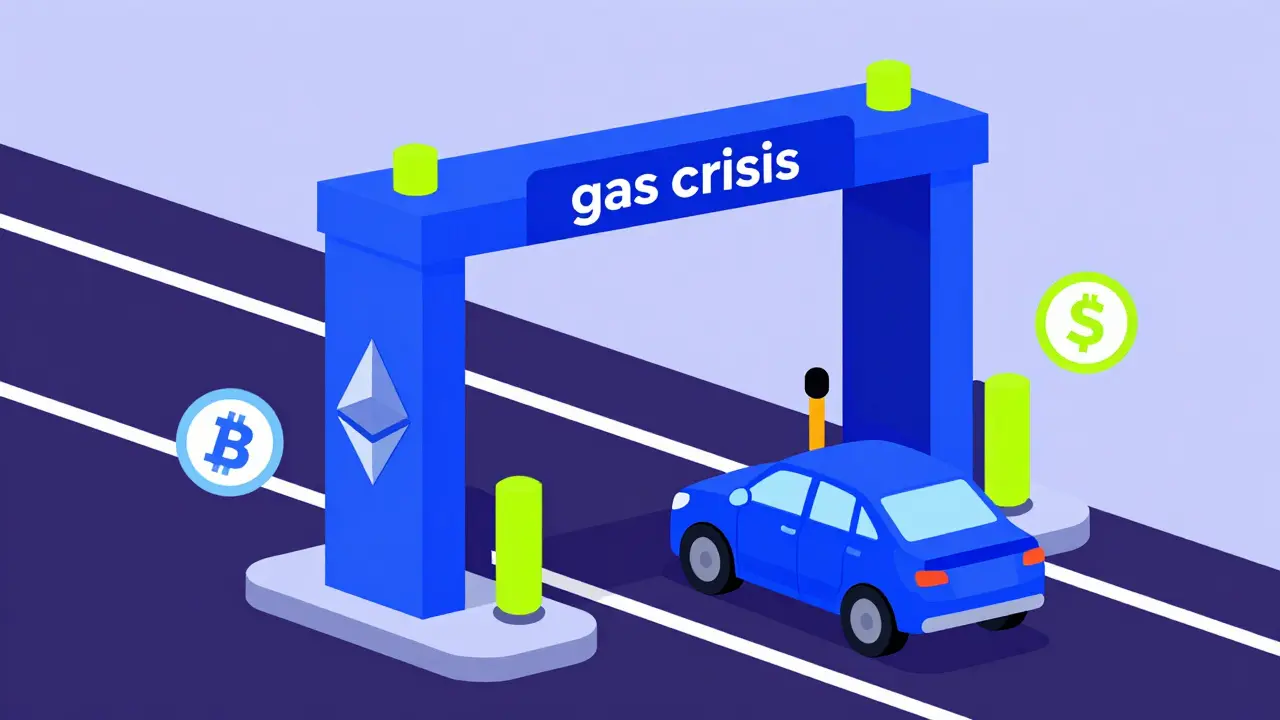
Ever tried to send a few dollars in crypto only to find out the network fee costs more than the actual payment? That was the nightmare scenario for many Ethereum is a decentralized, open-source blockchain with smart contract functionality users for years. It felt like trying to drive a car where the toll booth charged you based on how many other people were on the road at that exact second, regardless of where you were going.
Fast forward to 2026, and the landscape looks completely different. Thanks to a series of massive upgrades, the "gas crisis" that once defined the network has largely vanished. But does this make it the cheapest option available? Not necessarily. While Ethereum has slashed its costs, platforms like Solana and various Layer 2 networks are still fighting for the title of the most affordable chain. If you're trying to figure out where to move your assets to keep your costs low, you need to understand how the current fee structures actually work.
The Reality of Gas Fees in 2026
To understand why your wallet is suddenly happier, we have to talk about the Dencun upgrade. This wasn't just a small patch; it was a seismic shift. Before this, simple token swaps could easily hit $86, and Minting an NFT might set you back $145. Now, those same actions often cost less than a dollar. We're seeing average transaction fees hovering around $0.41, a drop of over 90% compared to the chaos of 2024.
But what exactly is "gas"? Think of Gas as the fuel required to perform any operation on the network. Whether you're sending ETH or interacting with a complex DeFi protocol, you're paying for the computational power used by network validators. The cost is measured in gwei, which is just a tiny fraction of one Ether (0.000000001 ETH). When the network is quiet, gwei prices drop; when everyone is rushing to buy the same coin, they spike.
The system is governed by EIP-1559, a rule set that changed how fees are calculated. Instead of a wild auction where users guessed how much to pay, it introduced a base fee that is automatically burned (destroyed), and a priority fee (a tip) for validators. This makes costs much more predictable, though not entirely immune to spikes.
Breaking Down the Cost Equation
If you want to predict what you'll pay, you don't need to be a math genius, but you do need the formula. The total fee is calculated as: (Base Fee + Priority Fee) × Gas Limit.
- Base Fee: The minimum price to get into the next block, set by the network.
- Priority Fee: Your "tip" to the validator to jump the queue.
- Gas Limit: The maximum amount of units you're willing to spend on a transaction.
For a standard ETH transfer, the network always requires 21,000 gas units. If the gas price is 20 gwei, the math looks like this: 21,000 units × 20 gwei = 420,000 gwei, or roughly 0.00042 ETH. However, if you're interacting with a smart contract-like swapping tokens on Uniswap-the gas limit will be much higher because the computer has to do more work.
| Platform | Avg. Fee (Simple Transfer) | Speed | Security Model |
|---|---|---|---|
| Ethereum Mainnet | $0.40 - $2.00 | Moderate | High (Decentralized) |
| Arbitrum | $0.01 - $0.10 | Fast | Inherited from ETH |
| Optimism | $0.01 - $0.10 | Fast | Inherited from ETH |
| Solana | < $0.01 | Ultra-Fast | Proof of History |
| Polygon | $0.01 - $0.05 | Fast | Sidechain/PoS |
Ethereum vs. The Competition
Is Ethereum finally "cheap"? It depends on who you're comparing it to. If you're looking at Solana, Ethereum is still more expensive. Solana's architecture allows for near-instant transactions at a fraction of a cent. But there's a trade-off: Ethereum's security and decentralization are generally considered the gold standard for high-value transactions.
The real game-changer has been the rise of Layer 2 (L2) solutions. These are networks that sit on top of Ethereum, processing transactions off the main chain and then "settling" the final result back to the main layer. Arbitrum and Optimism have become the go-to choices for anyone who wants Ethereum's security without paying Mainnet prices. They offer 90-99% cost reductions, making them viable for gaming, micro-payments, and frequent DeFi trading.
While the overall costs have plummeted, volatility is still a thing. On February 19, 2025, for example, some swaps spiked back up to $50 during a period of extreme demand. This proves that while the average cost is low, the network can still get congested during major NFT drops or market crashes.
Pro Strategies to Save on Fees
You don't have to just accept whatever price your wallet suggests. If you're not in a rush, you can save 25-40% just by timing your transactions. Historically, the cheapest times to transact are during the weekends and early morning hours (UTC), when global trading volume dips.
Another trick is using gas tracking tools. Instead of guessing, use a real-time gas tracker to see if the gwei price is trending down. If you see it's at 15 gwei but was at 30 gwei an hour ago, you might want to wait a bit longer. Many users in the r/ethereum community report saving up to 50% by simply avoiding the "peak hour's rush."
Be careful with your gas limits, though. If you set your limit too low, your transaction might fail, but you'll still lose the gas you spent trying to process it. If you set it too high, you're just giving the validator a huge tip they didn't need. Most modern wallets, like MetaMask, have gotten much better at estimating these limits, but double-checking the complexity of your transaction is still a smart move.
The Long-Term Outlook for Blockchain Costs
We are moving toward a world where the user doesn't even know they're paying a gas fee. The goal of the Ethereum Foundation and the broader developer community is to make the blockchain invisible. With the continued adoption of L2s and potential future base-layer improvements, the focus is shifting from "how do I afford this fee?" to "how fast can this happen?"
Enterprise adoption is also picking up because the operational costs are finally manageable. Companies that once avoided Ethereum because of the $100 transfer fees are now looking at it as a viable way to handle supply chains or digital identities. As the network becomes more efficient, we'll likely see a surge in DeFi participation from people who previously found the entry cost too high.
Why do gas fees fluctuate so much?
Gas fees act like a supply-and-demand auction. Since there is a limited amount of space in each block, users compete to have their transactions included. When a high-demand event happens-like a popular NFT launch-more people try to transact at once, driving up the gwei price.
Is it better to use Layer 2 or the Mainnet?
For most people, Layer 2 (like Arbitrum or Optimism) is better. You get nearly the same security as the Ethereum Mainnet but with significantly lower fees and faster confirmation times. Use the Mainnet only for extremely high-value transfers or interacting with protocols that aren't available on L2s.
What happens if I set my gas limit too low?
If your gas limit is too low, the transaction will run out of fuel before it completes. The network will cancel the transaction, but the validators still spent computational effort on it, so you will lose the gas you already paid. It's a "failed transaction" that still costs you money.
How did the Dencun upgrade lower fees?
The Dencun upgrade introduced "blobs," a more efficient way to store data on the blockchain. This specifically helped Layer 2 networks reduce the cost of posting data back to the main Ethereum chain, which trickled down as massive fee reductions for the end user.
Can I avoid gas fees entirely?
Generally, no. Every operation on a blockchain requires energy and hardware, and gas fees pay for that. However, some apps use "gasless transactions" where the developer pays the fee on your behalf to make the user experience smoother.
Next Steps for Optimizing Your Costs
If you're still paying high fees, start by moving your active assets to a Layer 2 network. It's a simple process: use a bridge to move your ETH from Mainnet to Arbitrum or Optimism. Once there, you'll notice that the costs for swaps and transfers are almost negligible.
For those managing larger portfolios, start tracking the gwei price during the week. You'll likely find that Sunday mornings are the "golden window" for heavy rebalancing of your DeFi positions. Finally, always double-check your transaction in a wallet like MetaMask-if the estimated fee looks abnormally high, wait 30 minutes and check again. The volatility of 2026 is much lower than before, but a little patience still saves you a lot of money.
Prachi Bhadarge
April 18, 2026 AT 16:49Oh wow, a guide on gas fees in 2026. How revolutionary. I'm sure the three people still using Mainnet for everything are absolutely thrilled by this insight. 🙄
Shannon Kelly Smith
April 19, 2026 AT 22:14This is a great breakdown! 🚀 For anyone just starting out, definitely look into those L2s like Arbitrum. It's the best way to actually use your crypto without draining your wallet! 💎🙌
Michelle Stanish
April 20, 2026 AT 09:06I still think Solana is better.
Abhinav Chaubey
April 20, 2026 AT 16:21Actually, the architectural superiority of the L2 scaling solutions is a testament to the engineering prowess we're seeing globally, though obviously, some regions are adopting this far more efficiently than the US. It's simply a matter of technical literacy.
Shantal Sanjur
April 21, 2026 AT 03:04Sure, the fees are lower, but who actually believes the 'burned ETH' story? It's just a way for the whales to manipulate the supply while we're all distracted by our $0.40 transactions. Follow the money, people. It's all a coordinated play to keep us locked into their ecosystem. 🤡
Trudy Morse
April 21, 2026 AT 14:19Cost is just a physical manifestation of scarcity. By reducing gas, we're essentially shifting the value from the process to the outcome. It's quite poetic, really.
Joshua Salwen
April 23, 2026 AT 10:01Omg why is everyone ignoring the fact that the bridgeing process is literally a NIGHTMARE!! I tried moving funds to Optimism last week and I spent three hours just trying to find the right contract adress because the UI is totaly garbage!! Absolute disaster!!
John and Lauren Busch
April 25, 2026 AT 03:14L2s are just the way to go. No point fighting it.
Mike Kempenich
April 27, 2026 AT 01:25It's all coming together! The friction is disappearing and that's when the real adoption happens. We're finally getting to the point where the tech doesn't get in the way of the utility.
Saurav Bhattarai
April 28, 2026 AT 01:53Imagine thinking $0.40 is 'cheap' when Solana is basically free. The sheer arrogance of Ethereum maximalists is honestly breathtaking. It's like bragging that your gold-plated carriage is now only slightly slower than a jet.
Sandeep Bhoir
April 28, 2026 AT 06:12The Dencun upgrade was a solid move, though calling it a 'seismic shift' is a bit much. It's basically just better data compression. But hey, if it saves people money, I'll take the hype.
Kim Smith
April 28, 2026 AT 18:14I've always felt that the way we perceive value in these digital spaces is so tied to the effort we put in to move them, and its kind of strange how we used to love complaining about those $100 fees back in the day because it made us feel like we were part of some exclusive club of sufferring, but now that the gates are open and the fees are low, we're just looking for the next thing to optimize in our lives without ever stopping to ask if the speed is actually what we need or if the slowness was actually a meditation of sorts in a world that moves too fast for its own good... just a thought i had while bridging my assets today and misspelling a few things in my wallet.
Adedamola Oyebo
April 30, 2026 AT 05:32Base fee + Priority fee... simple enough!!
Kaitlyn Wu
May 1, 2026 AT 18:29Let's keep the discussion focused on the utility of the networks. Comparing speed is fine, but security is where the real conversation needs to happen for institutional money.
nikki krinkin
May 3, 2026 AT 16:39I appreciate the tip about Sunday mornings. I'll definitely try that for my next rebalance.
Gillian Kent
May 4, 2026 AT 17:33I just tried using a bridge and it was so confuseing but the fees were realy low tho
Keri Pommerenk
May 6, 2026 AT 00:30just use the gas trackers and you'll be fine no need to stress over it
Mark Pfeifer
May 6, 2026 AT 03:00Does anyone have a preferred gas tracker that doesn't bombard you with ads? Most of the ones I've seen lately are pretty intrusive.
Jeff Barlett
May 6, 2026 AT 06:58Everyone is acting like L2s are the savior but they just fragment the liquidity! Why is nobody talking about the absolute disaster of having your funds split across five different chains? It's a total mess and people are just pretending it's 'efficient' because the fees are low! Give me one single chain that actually works!
Kevin Lư
May 7, 2026 AT 21:13Honestly, we should be more concerned about the ethics of this whole thing. Who's actually profiting from the 'burned' ETH? It's just another way to mask the wealth gap in the crypto space while we pretend the 'gas crisis' is over. Just my two cents.