
Imagine you are sitting in a branch of National Bank of Egypt, one of the largest state-owned commercial banks in Egypt. You hand over a form for an international wire transfer. The teller looks at it, pauses, and asks a question that has nothing to do with your vacation plans or tuition fees. "What is the exact nature of this transaction?" They aren't just being nosy. They are following strict orders from the Central Bank of Egypt (CBE), the supreme monetary authority responsible for regulating the country's financial system.
If you live in Egypt or deal with its financial system, you know that Egyptian banks and crypto transaction monitoring is not a casual suggestion. It is a rigid, legally enforced reality. Since 2020, the landscape has shifted from vague warnings to hard legal prohibitions. For anyone trying to move money into or out of digital assets, the banking sector acts as the primary gatekeeper-and they are watching every move.
The Legal Wall: Banking Law No. 194 of 2020
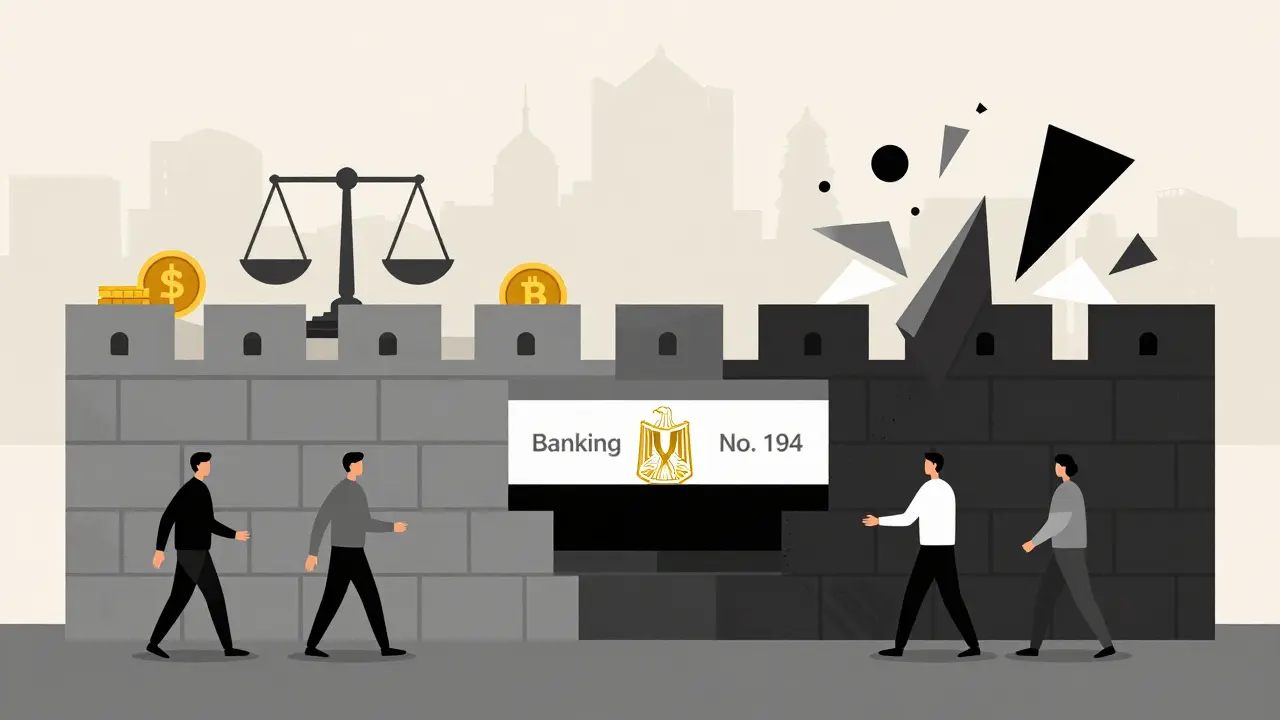
To understand why your bank account might be frozen or your transfer rejected, you have to look at the law. Before 2020, the rules were murky. There were warnings, but no clear criminal penalties for everyday users. That changed with Banking Law No. 194 of 2020, legislation that redefined the legal boundaries for financial institutions and cryptocurrency activities in Egypt.
This law explicitly criminalizes the issuance, trading, and promotion of cryptocurrencies without prior approval from the central bank. For banks, this created a binary choice: comply strictly or face severe penalties. The law does not just say "be careful." It says "do not facilitate." This means Egyptian banks cannot offer direct services related to crypto, such as allowing you to buy Bitcoin directly through their app or holding crypto assets on their balance sheets.
But here is where it gets tricky for you. The law targets the *institution*, but the enforcement falls on the *individual*. If a bank detects a transaction linked to crypto, they must block it. If they fail to detect it, they risk fines. So, the burden of proof often shifts to you. You need to prove your funds are for legitimate purposes-like trade, education, or travel-not for buying unregulated digital tokens.
| Year | Event / Regulation | Impact on Banks & Users |
|---|---|---|
| 2018 | CBE Initial Warnings | Banks began informal scrutiny; no legal framework yet. |
| 2019 | CBE Clarification | Unlicensed trading restricted; ambiguity remained for users. |
| 2020 | Banking Law No. 194 | Criminalized unlicensed crypto activities; mandatory monitoring for banks. |
| March 2023 | CBE Renewed Warning | Reiterated risks; emphasized lack of investor protection. |
| May 2025 | FRA Fresh Warning | Targeted online ads; intensified focus on terrorist financing risks. |
How Banks Actually Monitor Your Transactions
You might wonder how a bank knows if you are sending money to a friend in London or funding a wallet on Binance, a global cryptocurrency exchange platform widely used by Egyptians despite local restrictions. The answer lies in sophisticated transaction monitoring systems. These aren't just human reviewers looking at receipts. They are algorithmic engines designed to spot patterns.
Banks use several methods to detect crypto-related activity:
- Counterparty Analysis: Banks maintain lists of known crypto exchanges, peer-to-peer (P2P) platforms, and mixers. If your transfer destination matches a flagged entity (even indirectly), the system flags it. For example, transferring to a shell company in Cyprus that funnels money to Binance will trigger an alert.
- Behavioral Pattern Recognition: Algorithms look for sequences typical of crypto conversion. This includes rapid small transfers followed by a large withdrawal, or frequent transfers to jurisdictions known for lax crypto regulations.
- Enhanced Due Diligence (EDD): For larger international wire transfers, banks now require detailed explanations. You might be asked to provide invoices, contracts, or proof of relationship. Vague answers like "investment" or "personal use" are red flags.
- Network Screening: Banks screen transactions against global databases of sanctioned entities and known money laundering networks. Crypto is often linked to these databases due to its anonymity features.
The implementation of these systems has been costly. Most major Egyptian banks spent 6 to 12 months upgrading their compliance technology. They rely heavily on international vendors because domestic expertise in crypto pattern recognition was limited. This means the systems are robust, constantly updated, and very sensitive.

The Grey Area: Is It Illegal for You?
Here is the most confusing part for many Egyptians. While banks are forbidden from facilitating crypto, the law does not explicitly make it a crime for an individual to *own* Bitcoin or Ethereum. However, the practical effect is nearly the same. You cannot easily buy them using Egyptian Pounds through local channels. You cannot sell them back into your local bank account without raising alarms.
This creates a "grey area." Many citizens still use international platforms like Bitget, another popular international crypto exchange accessed by Egyptian users or Rain. How? They use workarounds. Some use prepaid cards loaded with foreign currency. Others use P2P trades where cash changes hands locally, and crypto is transferred digitally. But these methods carry significant risk.
If the bank detects that your incoming funds come from a crypto sale-even if you received cash-the source of funds becomes questionable. Under Anti-Money Laundering (AML) laws, banks must report suspicious activities to the Financial Regulatory Authority (FRA), the body responsible for supervising financial markets and enforcing securities laws in Egypt. A "suspicious activity report" can lead to account freezes, audits, and even legal inquiries.
Why the Strict Stance? Economic Stability and Risk
It is easy to see these rules as bureaucratic hurdles. But to understand them, you need to look at the broader economic context. Egypt has faced significant currency pressures in recent years. The Egyptian Pound has experienced volatility, and capital flight is a major concern for policymakers.
The CBE and FRA view cryptocurrencies as a threat to financial stability for three main reasons:
- Lack of Backing: Unlike fiat currency, crypto has no central bank guarantee. If the market crashes, there is no safety net for investors. The FRA has repeatedly warned that investor rights are not protected in this space.
- Terrorist Financing and Crime: The May 2025 warning from the FRA specifically highlighted the risk of crypto being used for terrorist financing. Because blockchain transactions can be pseudonymous, tracking illicit flows is difficult. Banks are under pressure to prevent Egypt from becoming a conduit for such activities.
- Capital Controls: By restricting crypto, the government aims to keep capital within the formal banking system. This allows them to manage liquidity and stabilize the currency. Unchecked crypto adoption could drain reserves and weaken the Pound further.
Religious guidance also plays a role. Institutions like Dar Al-Ifta have stated that Bitcoin and similar assets are not "real" money because they lack intrinsic value and central issuance. This religious perspective influences public opinion and supports the regulatory crackdown.
Real-World Consequences for Users
So, what does this mean for you in daily life? Let’s look at some common scenarios.
Scenario 1: The Freelancer. You work remotely and get paid in US Dollars. You want to convert some to stablecoins (like USDT) to save value. You try to send USD to a crypto-friendly e-wallet. Your bank blocks the transfer. They ask for proof of service. You provide it, but the recipient is a known crypto payment processor. The transfer is declined. You must find a traditional path, losing flexibility.
Scenario 2: The Investor. You bought Bitcoin two years ago. Now you want to cash out. You sell on a P2P platform and receive EGP from a buyer via bank transfer. Suddenly, your account is flagged. The bank sees multiple transfers from different individuals. They suspect money laundering. Your account is frozen pending investigation. You lose access to your funds for weeks while you explain the situation.
Scenario 3: The Traveler. You want to buy crypto to use abroad where it is accepted. You try to fund your exchange account directly. The transaction fails. The bank’s system recognizes the merchant category code associated with crypto exchanges. No amount of explanation helps. The rule is absolute.
These stories are common on forums like Reddit and local financial communities. Users share tips on how to navigate the system, but the consensus is clear: the banks are getting smarter, and the risks are increasing.
What’s Next? The Future of Crypto in Egypt
Will the rules change anytime soon? Current indicators suggest no. In fact, enforcement is tightening. The May 2025 FRA warning targeted online advertisements, showing regulators are moving beyond just banks to curb demand itself. They are cracking down on promoters, influencers, and local agents who facilitate access.
While neighboring Gulf Cooperation Council (GCC) countries explore Central Bank Digital Currencies (CBDCs) and regulated crypto frameworks, Egypt remains conservative. The focus is on prevention, not accommodation. Banks are expected to continue enhancing their monitoring capabilities. Expect more AI-driven tools, deeper integration with global intelligence networks, and stricter KYC (Know Your Customer) procedures.
For now, the message from Cairo is consistent: Cryptocurrency is high-risk, unregulated, and unsupported by the state. If you choose to participate, you do so entirely at your own risk, outside the protection of the banking system.
Is it illegal to own cryptocurrency in Egypt?
Owning cryptocurrency is not explicitly criminalized for individuals under current law. However, buying, selling, or promoting it through licensed financial institutions is prohibited. This creates a practical barrier, as banks cannot facilitate these transactions, making ownership difficult to manage legally.
Can I transfer money from my Egyptian bank account to Binance?
No. Direct transfers from Egyptian bank accounts to known cryptocurrency exchanges like Binance are blocked. Banks monitor destinations and will reject transactions to flagged entities. Attempting to disguise such transfers can lead to account suspension or legal inquiry.
Why did the FRA issue a new warning in May 2025?
The Financial Regulatory Authority issued a fresh warning in May 2025 to address a surge in local online advertisements promoting crypto investments. The FRA highlighted concerns about investor fraud, lack of regulatory protection, and the potential use of crypto for terrorist financing and money laundering.
What happens if my bank suspects I am involved in crypto trading?
If a bank suspects crypto involvement, they may freeze your account, request detailed documentation for recent transactions, and file a Suspicious Activity Report (SAR) with the authorities. This process can take weeks or months, during which you may lose access to your funds.
Are there any safe ways to use crypto in Egypt?
There are no officially "safe" ways recognized by the CBE or FRA. Any engagement with crypto carries regulatory and financial risk. Users who participate typically do so through unofficial channels, accepting the full burden of compliance and potential loss without institutional recourse.