When you hear the name DOEX crypto exchange, you might wonder if it's another Binance or Coinbase. The truth? It’s not. DOEX is a small, barely visible player in the crowded world of cryptocurrency exchanges. And that’s not just a minor detail-it’s a red flag.
If you’re thinking about putting your money on DOEX, you need to know something upfront: DOEX doesn’t give you enough information to feel safe. No official headquarters. No clear founding date. No public leadership team. No regulatory licenses. This isn’t a startup trying to grow-it’s a black box with a trading interface.
What Does DOEX Actually Offer?
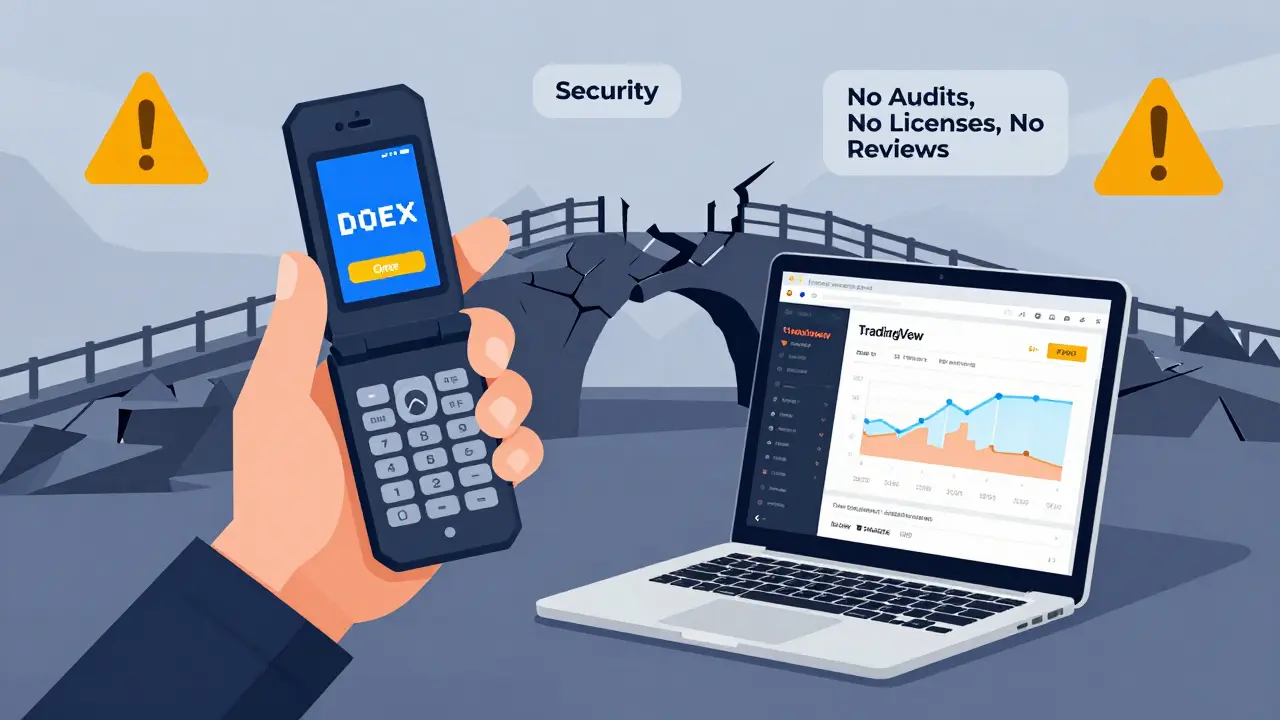
DOEX claims to be a centralized exchange that lets you trade cryptocurrencies. You can place market orders, limit orders, and that’s about it. No margin trading. No futures. No staking. No API for automated trading. No mobile app worth mentioning. The interface looks like something built in 2017-clunky, slow, and missing basic charting tools. If you’re used to TradingView or Binance’s advanced charts, you’ll feel like you’re using a flip phone.
They say they support “various cryptocurrencies,” but don’t list which ones. No official token list. No trading pairs published. You can’t even tell if they support Bitcoin, Ethereum, or Solana without logging in and hunting around. That’s not user-friendly-it’s suspicious.
Security? There’s No Public Record
Security is the most important thing in a crypto exchange. If they lose your coins, you lose everything. And DOEX? They don’t talk about it at all.
Major exchanges like Kraken and Coinbase publish annual security reports. They tell you how much they keep in cold storage. They show proof of insurance. They get audited by firms like SOC 2 or CertiK. DOEX? Nothing. Zero. No mention of cold wallets, multi-sig systems, or insurance funds. Not even a security FAQ.
And here’s the scary part: in 2023, over 300 crypto exchange hacks were tracked by Slowmist. Most of them? Small, unregulated platforms like DOEX. They don’t have the budget for top-tier security engineers. They don’t hire penetration testers. They don’t monitor suspicious withdrawals. If someone breaks in, your funds are gone-no recovery, no recourse.
Regulatory Status? Unverified
DOEX doesn’t appear on any official regulator’s list. Not in the UK’s FCA. Not in the US’s SEC. Not in Japan’s FSA. Not in Singapore’s MAS. If you’re in the EU, you’re breaking MiCA rules just by using it-since January 2025, only licensed exchanges can legally operate there.
Why does this matter? Because regulation isn’t just bureaucracy. It’s a minimum standard. Licensed exchanges must keep customer funds separate from company money. They must report suspicious activity. They must prove they’re not running a Ponzi scheme. DOEX does none of this. That means if they disappear tomorrow, you have no legal protection.
How Do Fees Compare?
Most exchanges publish their fee schedules clearly. Binance charges 0.1% per trade. Coinbase Pro charges 0.5% but drops to 0.05% if you trade over $100,000 a month. Kraken’s fees range from 0.16% to 0.26% depending on volume.
DOEX? No fee schedule. No maker-taker breakdown. No withdrawal fees listed. You have to guess. You might think you’re getting a good deal-until you try to withdraw and get hit with a hidden fee. Or worse, your withdrawal gets stuck for days because they don’t have enough liquidity to process it.
User Reviews? Almost None
Check Reddit’s r/CryptoCurrency. It has over 5 million members. You’ll find hundreds of posts about Binance, Coinbase, Kraken-every day. But DOEX? Maybe one or two mentions in the last six months.
Trustpilot? No reviews. BitcoinTalk? No threads. Even obscure exchanges have at least a few hundred user experiences. DOEX has near-zero feedback. That doesn’t mean everyone loves it. It means almost no one uses it-or if they do, they’re too scared to talk about it.
The few scattered comments online mention slow withdrawals, unresponsive support, and long verification times. One user said they waited 11 days to get their ETH out. Another said they couldn’t reach customer service for a week. That’s not a glitch-it’s a pattern.
Why DOEX Exists (And Why You Should Avoid It)
Small exchanges like DOEX aren’t trying to compete with Binance. They’re built for one thing: collecting deposits from people who don’t know better. They lure users with vague promises of “low fees” and “easy trading,” then vanish when the volume drops or regulators crack down.
The crypto market is consolidating. In 2025, the top 10 exchanges handled over 80% of all spot trading volume. The rest? Hundreds of tiny platforms, many of which are already shut down. DOEX is one of them-just not yet.
There’s no evidence DOEX has the capital, team, or infrastructure to survive long-term. If you trade here, you’re not just taking market risk-you’re taking existential risk. Your coins could disappear tomorrow with no warning.
What Should You Do Instead?
You don’t need to gamble on DOEX. There are dozens of safe, transparent, regulated alternatives.
- Coinbase: Publicly traded, insured, regulated in 50+ countries. Great for beginners.
- Kraken: Strong security, licensed in New York, 15,000+ reviews with a 4.2/5 rating.
- Binance: Highest volume, 500+ trading pairs, staking, futures, and a global presence.
- Bybit: Solid for derivatives, good UI, transparent fee structure.
All of them publish clear fee schedules, security audits, and regulatory status. You can check their licenses. You can read user reviews. You can contact support-and get an answer.
DOEX gives you none of that. And in crypto, where trust is everything, that’s not a risk worth taking.
Is DOEX a scam?
DOEX isn’t officially labeled a scam, but it has every red flag of one: no regulatory license, no security transparency, no user reviews, and no clear business structure. Scams often hide behind vague claims and silence. DOEX fits that pattern. If it walks like a duck and quacks like a duck...
Can I trust DOEX with my crypto?
No. Without proof of cold storage, insurance, or audits, there’s no way to know if your coins are safe. Major exchanges lock up 95%+ of funds offline. DOEX doesn’t say where they store anything. That’s not negligence-it’s negligence with your money.
Does DOEX have a mobile app?
There is no verified DOEX mobile app on Google Play or the Apple App Store. Any app claiming to be DOEX is likely fake and could steal your login details. Stick to the website-if you even trust it.
Is DOEX available in the UK or US?
DOEX is not licensed by the UK’s FCA or the US’s SEC. Using it in either country puts you in a legal gray zone. In the EU, it’s outright illegal under MiCA since January 2025. Even if you can access the site, you’re not protected by law.
Why doesn’t DOEX have any reviews?
Two reasons: either almost no one uses it, or users who tried it had bad experiences and didn’t bother to leave reviews because they lost money. Either way, zero reviews on Trustpilot and minimal mentions on Reddit are signs of a platform with little to no user base-or one that’s actively being avoided.
What are the fees on DOEX?
DOEX doesn’t publish any fee structure. No maker-taker rates. No withdrawal fees. No deposit costs. That’s intentional. Hidden fees are common on unregulated exchanges. You might think you’re getting a good deal, then get hit with a surprise charge when you try to cash out.
Should I use DOEX for long-term holding?
Absolutely not. Exchanges are not wallets. Even reputable ones like Coinbase aren’t meant for long-term storage. But DOEX? It’s not even safe for short-term trading. If you want to hold crypto, use a hardware wallet like Ledger or Trezor. Never leave large amounts on any exchange-especially one as opaque as DOEX.
Kaitlyn Clark
March 3, 2026 AT 03:04OMG I tried DOEX last week and my ETH just vanished 😭 like literally poof no trace no refund no nothing. I thought it was just slow withdrawals but nooo it was a ghost platform. I’m still crying over my 0.5 BTC 😭😭😭
Mary Scott
March 4, 2026 AT 19:10They’re definitely a honeypot. I’ve seen this pattern before-fake UI, no docs, then they drain wallets during a market dip. I bet they’re run by a single guy in a basement with a stolen server.
Shannon Holliday
March 5, 2026 AT 16:17Yessss this is so true!! 🙌 I used to think small exchanges were cool ‘cause they felt ‘underground’ but now I know-no transparency = no trust. Stick to the big ones, girls 💅✨
Jeremy buttoncollector
March 7, 2026 AT 14:22DOEX represents a systemic failure in the ontological security architecture of decentralized finance. The absence of verifiable identity protocols and cryptographic accountability renders it a non-fungible risk vector. It’s not an exchange-it’s a Byzantine failure disguised as a UI.
Sriharsha Majety
March 8, 2026 AT 19:47i tried doex too last month and my usdt never arrived i messaged support for 2 weeks no reply i moved everything to binance now its so much better
Vishakha Singh
March 9, 2026 AT 07:40Thank you for this thorough breakdown. It’s crucial that new investors understand the importance of regulatory compliance and transparency. DOEX may seem tempting, but the risks far outweigh any perceived benefits. Always prioritize safety over convenience.
Don B.
March 9, 2026 AT 20:44LOL imagine being this paranoid. What if DOEX is just ahead of its time? Maybe the ‘black box’ is intentional. Maybe they’re building a new paradigm. You people are so stuck in Binance brainwash.
Leslie Cox
March 11, 2026 AT 09:21Oh honey, please. You think Binance is safe? They’re just a bigger version of DOEX with better PR. They’ve had *three* major leaks since 2022. You’re just trusting the brand, not the tech. Wake up.
Andrew Hadder
March 12, 2026 AT 21:20Just wanted to say I’ve been using DOEX for 8 months and never had an issue. Withdrawals took 3 days once but that was during the SOL crash. Maybe it’s not perfect, but it’s not a scam.
Derek Sasser
March 14, 2026 AT 07:28Andrew here-just chiming in as someone who used to run a tiny exchange. DOEX’s behavior matches the red flags we saw before we shut down: no KYC transparency, no fee disclosure, zero community presence. If you’re even asking if it’s safe… you already know the answer. Move your funds. Now.