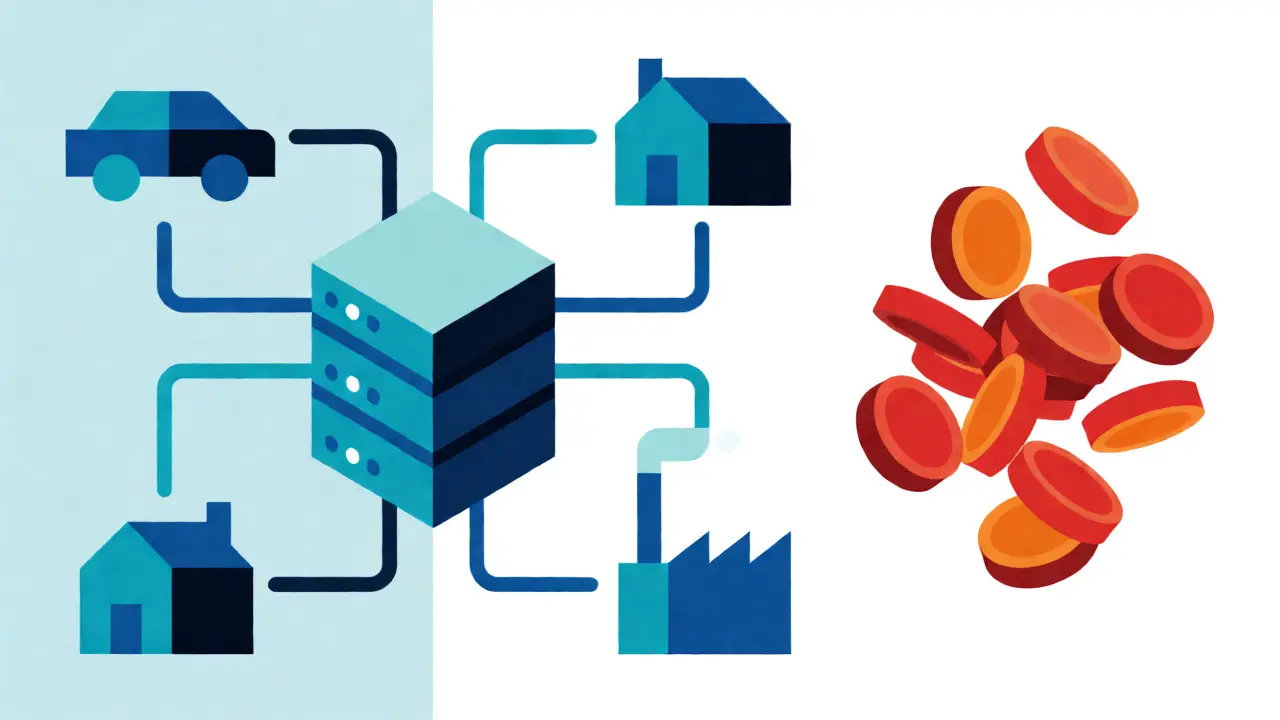
You bought a hotspot. You plugged it in. You waited for the HNT to roll in. But then the price tanked, your earnings vanished, and you were left holding a piece of plastic that cost more in electricity than it paid out. Sound familiar? That’s the trap of bad DePIN token economics. Most people think DePIN is just about deploying hardware and hoping for the best. It’s not. It’s a complex economic engine where supply, demand, and real-world utility have to align perfectly. If they don’t, the network collapses under its own weight.
As of late 2024, the DePIN sector holds over $8.2 billion in market cap across 75+ active projects. Yet, many are struggling. Why? Because most founders copy-paste token models from meme coins without understanding the physical constraints of infrastructure. This guide breaks down how successful networks actually work, why some fail, and what you need to look for before buying into the next big thing.
The Core Problem with Traditional Crypto Models
Traditional crypto projects often suffer from a circular economy problem. Tokens are issued as rewards, sold by miners or providers, and bought by speculators who hope the price goes up. There’s no external money coming in. It’s a closed loop. When hype dies, the loop breaks.
DePIN changes this by introducing external customers. Think Uber or Airbnb. Drivers and hosts earn fees from regular people using the service, not just from other drivers or hosts. In DePIN, companies pay for data storage, wireless coverage, or computing power. This creates a genuine revenue stream. According to Messari’s Q3 2024 report, projects generating real revenue from non-crypto customers show 30-40% less volatility than pure speculative assets. Filecoin is a prime example. During the 2022 crash, its FIL token remained relatively stable because enterprise clients kept paying for storage contracts worth millions quarterly.
Anatomy of Healthy DePIN Tokenomics
Not all token distributions are created equal. A healthy model balances incentives for early adopters, long-term sustainability, and community growth. Here’s what typical successful allocations look like:
- Network Participants (40-50%): These tokens go to users providing hardware, bandwidth, or storage. This is the largest slice because infrastructure is hard to scale without massive participation.
- Team and Advisors (15-20%): Crucially, these should vest over 3-4 years. If the team can dump their tokens in year one, run away. Long vesting locks them in to build the product.
- Treasury and Ecosystem Fund (10-15%): Used for grants, partnerships, and emergency liquidity. This acts as a buffer against market shocks.
- Community Incentives (15-20%): Airdrops, marketing campaigns, and developer bounties. This helps bootstrap adoption before the network is self-sustaining.
Beyond distribution, look at the burn mechanism. IoTeX, for instance, allocates 30% of service revenue to buy back and burn IOTX tokens. Since implementing this in Q1 2023, supply has dropped by 2.1% annually. This deflationary pressure supports token value even if demand fluctuates. Without such mechanisms, inflation dilutes holders’ equity every single day.
Incentive Structures: Paying for What Matters
Rewards must target specific behaviors that strengthen the network. Generic staking yields aren’t enough. Successful DePIN projects use tiered incentive systems.
| Mechanism | Purpose | Example Project | Impact on Network |
|---|---|---|---|
| Proof-of-Coverage | Verifies physical presence and signal quality | Helium | Prevents fraud; ensures real geographic spread |
| Storage Proofs | Confirms data is stored correctly over time | Filecoin | Guarantees reliability for enterprise clients |
| Compute Verification | Ensures GPU/CPU work was done honestly | Render Network | Maintains trust in distributed rendering jobs |
| Governance Staking | Aligns long-term holder interests | IoTeX | Reduces sell pressure; stabilizes voting power |
Notice how each mechanism ties directly to a physical or computational reality. Helium doesn’t just reward you for having a hotspot; it rewards you for proving your hotspot is actually covering an area with a strong, unique signal. This prevents "gaming" the system by stacking dozens of devices in one living room.

The Reality Check: User Experience vs. Hype
Let’s talk numbers. Community feedback from Reddit’s r/DePIN and Discord channels reveals a stark divide between success and failure stories.
One user, u/WirelessWarrior, reported earning $1,842 in HNT after electricity costs since 2021. His secret? He targeted areas with high enterprise IoT demand, not just residential zones. Conversely, u/NodeNovice spent $450 on Render Network hardware but only made $18.50 monthly after GPU power bills. Why? Inconsistent demand. The network had capacity, but not enough jobs.
This highlights a critical flaw in many DePIN pitches: they assume demand will follow supply. Often, it doesn’t. Hardware deployment is slow and expensive. Demand can be volatile. Before joining a network, check their utilization rates. If nodes are idle 80% of the time, your ROI will be negative regardless of token price appreciation.
Regulatory Risks and Transparency Gaps
Here’s the uncomfortable truth: 67 countries still lack specific regulations for DePIN. Chainalysis notes that 78% of jurisdictions treat these tokens ambiguously. Is a Helium hotspot operator running a business? Are they liable for taxes on every micro-transaction?
Furthermore, transparency is inconsistent. Delphi Digital warned in June 2024 that many projects overstate revenue. They found discrepancies between claimed enterprise contracts and actual on-chain payments in three major projects. Always verify revenue claims through block explorers. Look for consistent incoming transactions from known corporate wallets, not just internal swaps.

Future Outlook: Consolidation is Coming
Messari predicts that 70% of current DePIN projects will fail by 2026. This sounds harsh, but it’s healthy. We’re seeing a shift from speculative mania to industrial utility. Projects like Helium migrating to Solana to boost throughput from 10 TPS to 65,000 TPS show that technical scalability is becoming a survival trait.
Galaxy Digital projects a 25% annual growth rate through 2027, driven by Fortune 500 adoption. Currently, 38 such companies use DePIN services, mostly for IoT connectivity. As traditional industries seek cheaper, more resilient alternatives to centralized cloud providers, the winners will be those with transparent, auditable revenue streams.
Key Takeaways
- Revenue is King: Ignore token price charts if the project has no external customer base. Real fiat inflow stabilizes volatility.
- Vesting Matters: Ensure team tokens lock up for at least 3 years to prevent early dumping.
- Verify On-Chain: Don’t trust press releases. Check blockchain data for actual payment flows from enterprises.
- Hardware Costs: Factor in electricity and maintenance. High-performance nodes often eat profits during low-demand periods.
- Regulatory Clarity: Prefer projects operating in jurisdictions with clear crypto infrastructure laws to avoid sudden shutdowns.
What makes DePIN different from traditional crypto mining?
Traditional mining secures a digital ledger through computational puzzles. DePIN provides real-world services like wireless coverage, data storage, or sensor data collection. Miners earn from block rewards and transaction fees within a closed ecosystem. DePIN providers earn from external customers paying for actual utility, creating a bridge between crypto economies and the real world.
Why do some DePIN tokens lose value despite network growth?
This usually happens due to excessive token inflation. If new tokens are issued faster than demand grows, the price drops. Also, if providers immediately sell their rewards to cover hardware costs, constant selling pressure suppresses the price. Healthy projects implement buy-back-and-burn mechanisms or require staking to reduce circulating supply.
Is DePIN suitable for beginners?
It depends on the network. Simple setups like basic sensors may cost under $100 and offer passive income. However, high-yield opportunities often require significant upfront investment ($500-$2,000) and technical knowledge to configure nodes properly. Beginners should start with established networks like Helium or Filecoin, which have robust documentation and community support, rather than experimental new protocols.
How does regulatory uncertainty affect DePIN investments?
Uncertainty can lead to sudden legal challenges or tax complications. For instance, if a jurisdiction classifies DePIN rewards as taxable income upon receipt rather than capital gains, profitability decreases. Investors should monitor local laws and prefer projects with clear compliance frameworks. The risk is highest in regions with ambiguous definitions of utility tokens versus securities.
Can DePIN replace centralized cloud services?
Not entirely, but it offers a compelling alternative for specific use cases. DePIN excels in edge computing, IoT data aggregation, and redundant storage where decentralization adds resilience and lowers costs. Centralized clouds still dominate in high-latency, high-throughput applications requiring guaranteed SLAs. DePIN complements rather than replaces traditional infrastructure, serving niche markets that value censorship resistance and lower overhead.