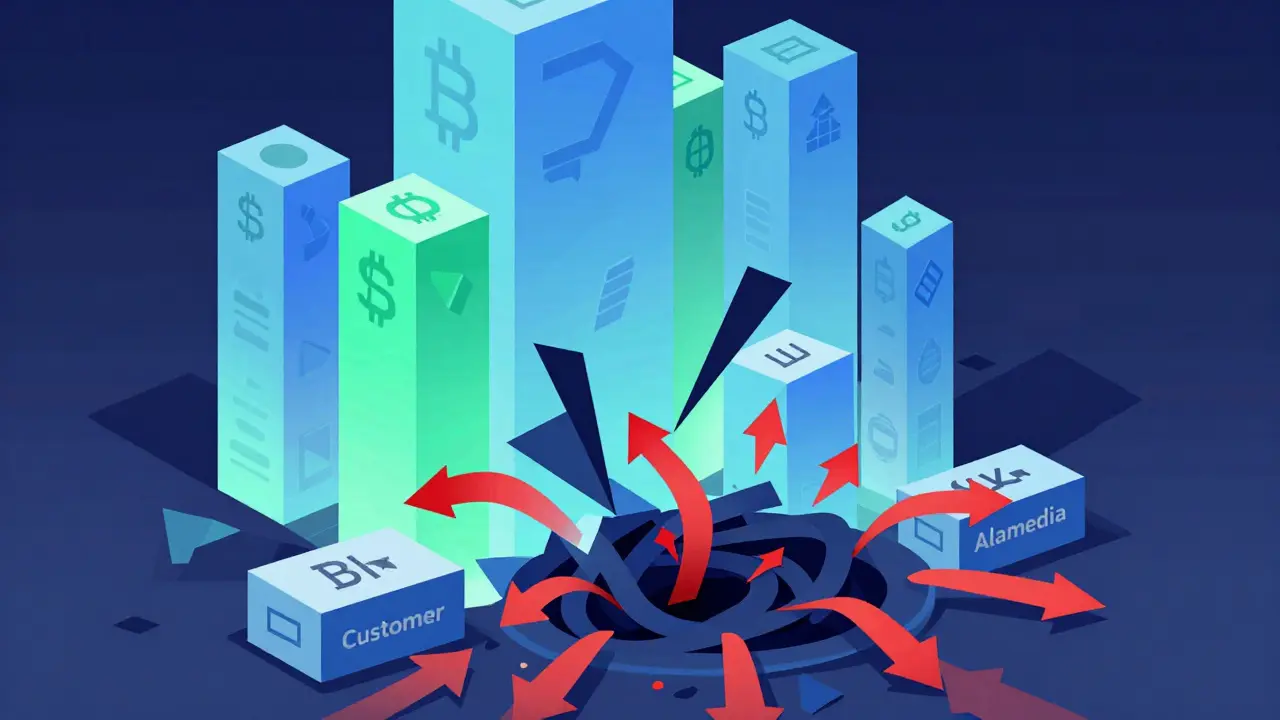
When FTX collapsed in November 2022, it wasn't just a trading platform that failed. It was a catastrophic breakdown of basic financial controls. Billions of dollars in customer assets vanished because they were never truly segregated. They were commingled with the proprietary trading firm Alameda Research, used to cover losses, buy real estate, and fund political campaigns. The lesson was stark: if you don't control your keys, and if the entity holding them has opaque billing practices, you are not an investor. You are an unsecured creditor.
The collapse of FTX, along with earlier failures like Mt. Gox (2014), QuadrigaCX (2019), and Celsius Network (2022), exposed a fundamental flaw in the crypto industry's approach to custody and billing. These weren't isolated hacks; they were systemic failures where custodians acted as banks without bank regulations, hiding risky behaviors behind complex, un-audited internal ledgers. For anyone holding digital assets, understanding these failures is no longer optional-it is essential for survival.
The Anatomy of a Custodian Failure
To understand why so much money was lost, we have to look at how traditional finance handles your money versus how many crypto platforms did. In traditional banking, your deposits are insured, and banks must maintain strict reserves. In the early days of crypto, many exchanges operated on a model called omnibus wallets. This means all customer funds were pooled into a single wallet address. The exchange maintained an internal database (a ledger) saying who owned what.
This creates a massive point of failure. If the exchange’s internal ledger says you own 10 Bitcoin, but the actual wallet only contains 5 Bitcoin, you have no recourse. The blockchain doesn't care about their internal spreadsheet. At FTX, this problem was compounded by a lack of segregation. Customer funds were mixed with Alameda Research’s operating capital. When liquidity dried up, there simply wasn't enough money to pay everyone back.
Research from the Oxford Journal of Financial Regulation highlights that these market failures create significant externalities. When one large custodian fails, it destabilizes related intermediaries, lenders, and even decentralized finance (DeFi) protocols that relied on those assets. The risk isn't contained; it spreads.
Opaque Billing: The Silent Killer
Custody issues are bad, but broken billing systems are often the warning sign that gets ignored. In traditional finance, billing is transparent. You receive a statement showing exactly what fees were charged, when interest was applied, and how your balance changed. In crypto, many platforms hid their revenue models behind opaque fee structures.
Consider the "earn" products offered by platforms like Celsius or BlockFi. Users deposited crypto to earn high interest rates. But how was that interest generated? The platforms lent out the users' assets to hedge funds and other borrowers. The billing statements rarely showed this lending activity clearly. Instead, users saw a growing balance, assuming it was safe principal plus interest. In reality, the principal was often locked up in long-term, illiquid loans.
When these platforms faced redemption requests, they couldn't repay customers because the assets were tied up. The billing system didn't reflect the true risk exposure. At FTX, the situation was even more egregious. Allegations surfaced that Alameda Research had a "secret negative balance"-a line of credit funded by customer deposits that was exempt from normal liquidation rules. This wasn't recorded as a loan to customers; it was hidden in the chaos of poor accounting. Without clear, auditable billing entries, customers had no idea their funds were being used as collateral for someone else's bets.
Legal Ownership vs. Beneficial Interest
A critical distinction emerged from these bankruptcies: who legally owns the crypto? In many cases, users signed terms of service that transferred title of their assets to the platform. This meant the platform could lend, pledge, or rehypothecate those assets. Legally, the user didn't own the Bitcoin anymore; they owned an unsecured promise that the platform would give it back.
Clifford Chance LLP, a global law firm, noted in their analysis of post-FTX litigation that courts struggled to determine if assets were held in trust or as general property. In jurisdictions with weak regulatory frameworks, customers often ended up as general unsecured creditors. Recovery rates for unsecured creditors in major bankruptcies can fall below 20%. Contrast this with a "true custody" arrangement, where the custodian holds assets as a bailee, keeping them separate from their own balance sheet. In true custody, if the custodian goes bankrupt, the assets remain outside the insolvency estate and belong to the client.

The Three Models of Digital Asset Custody
Not all custody is created equal. Understanding the three main models helps you assess your risk:
- Self-Custody: You hold your private keys directly, typically via a hardware wallet like Ledger or Trezor. You have full autonomy and zero counterparty risk. However, you bear the full responsibility for security. If you lose your seed phrase, your funds are gone forever. There is no customer support to call.
- Third-Party Custody (Centralized): An exchange or professional custodian holds your keys. This offers convenience and recovery options but introduces counterparty risk. You must trust their security measures, legal structure, and solvency. This is where FTX, Celsius, and Mt. Gox operated.
- Hybrid/Multi-Party Computation (MPC): A newer model where key material is split into shards distributed across multiple parties or devices. No single entity holds the complete key. This reduces single points of failure but still involves third-party infrastructure. Institutional custodians like Anchorage Digital use MPC combined with Hardware Security Modules (HSMs) to provide regulated, secure storage.
For most retail users, the choice boils down to convenience versus control. The collapses of 2022 proved that convenience often comes with hidden, existential risks.
Regulatory Response: MiCA, SEC, and Global Standards
In the wake of these failures, regulators worldwide moved to close the loopholes. The European Union introduced Markets in Crypto-Assets Regulation (MiCA), which sets strict requirements for crypto-asset service providers, including segregation of client assets and capital reserves. In the United States, the Securities and Exchange Commission (SEC) issued comment letters emphasizing that qualified custodians must maintain segregated accounts and robust internal controls.
The goal is to prevent regulatory arbitrage-the practice of setting up companies in lightly regulated jurisdictions (like the Bahamas, where FTX was headquartered) while serving customers globally. New rules aim to ensure that regardless of where a custodian is based, they meet minimum standards for client asset protection. This includes banning the commingling of funds and requiring regular audits of proof-of-reserves.
Technical Safeguards: HSMs, MPC, and Proof of Reserves
Beyond legal rules, technical safeguards are crucial. Institutional-grade custodians now rely on:
- Hardware Security Modules (HSMs): Physical devices designed to securely generate and store cryptographic keys. They resist physical tampering and software attacks.
- Multi-Party Computation (MPC): A cryptographic technique that allows multiple parties to jointly compute a function over their inputs while keeping those inputs private. In custody, this means no single server or employee can move funds alone. Multiple approvals are required, reducing insider threat risk.
- Real-Time Reconciliation: Systems that continuously match internal ledger balances with on-chain wallet balances. This ensures that the sum of client claims matches the actual assets held on the blockchain at any given moment.
However, technology alone isn't enough. As seen with FTX, sophisticated tools can be undermined by poor governance and lack of independent oversight. Independent audits, such as SOC 1 and SOC 2 reports, are necessary to verify that these controls are actually working.

Non-Custodial Solutions: Eliminating Counterparty Risk
If the core problem is trusting a third party with your keys, the ultimate solution is to remove that trust requirement entirely. This is where non-custodial payment gateways come into play. Unlike exchanges, these services do not hold your funds. They act as a bridge between a buyer and your personal wallet.
For merchants and solo founders, this model is gaining traction because it eliminates the risk of platform insolvency. Consider a service like TxNod. It operates on a non-custodial architecture. Merchants connect their own hardware wallets (via Ledger or Trezor) using extended public keys (xpubs). TxNod derives unique payment addresses for each invoice, but the private keys never leave the merchant's device. Funds settle directly to the merchant's wallet on-chain. There is no platform-side balance, no withdrawal process, and no risk of the gateway freezing assets or going bankrupt with your money.
This approach shifts the burden of custody back to the individual, which is safer for long-term holdings. For businesses, it means no chargebacks, no payout holds, and no account freezes-structural impossibilities because the money never passes through the provider's custody. While this requires a bit more technical setup than depositing coins into an exchange, it aligns perfectly with the lesson from FTX: keep your assets in your control.
Best Practices for Protecting Your Assets
Whether you are an investor or a business accepting crypto, here are actionable steps to mitigate custodian and billing risks:
- Prefer Self-Custody for Long-Term Holdings: Use hardware wallets for assets you do not need to trade daily. Do not leave large sums on exchanges.
- Scrutinize Terms of Service: Look for language regarding "rehypothecation," "lending," or "transfer of title." If a platform can lend your assets, you are not the owner.
- Demand Transparency: Choose custodians that publish regular, independently audited proof-of-reserves and proof-of-liabilities. Ensure their billing statements clearly itemize fees and interest.
- Diversify Custodians: Do not put all your eggs in one basket. Spread assets across different platforms and custody models to reduce single-point-of-failure risk.
- Understand Jurisdictional Risks: Be aware of where your custodian is regulated. Stronger jurisdictions offer better legal recourse in case of insolvency.
- Use Non-Custodial Tools for Commerce: If you are running a business, consider non-custodial gateways that integrate with your existing wallet infrastructure to avoid holding client funds.
Conclusion: Resilience Through Transparency
The failures of FTX, Celsius, and others were not inevitable. They were the result of ignoring basic principles of financial integrity: segregation of assets, transparent billing, and independent oversight. The crypto industry is maturing, with new regulations and technological solutions aiming to restore trust. But the ultimate responsibility lies with the user. By understanding the difference between true custody and mere convenience, and by demanding transparency in how your assets are managed and billed, you can protect yourself from the next inevitable shakeout. In a decentralized world, trust should be verified, not assumed.
What happened to FTX customers' money?
FTX customers' money was largely commingled with the affiliated hedge fund Alameda Research. It was used to cover trading losses, make investments, and fund executive expenses. Because the assets were not properly segregated, customers became unsecured creditors in the bankruptcy proceedings, facing uncertain and potentially low recovery rates.
What is the difference between self-custody and third-party custody?
In self-custody, you hold your own private keys, usually via a hardware wallet, giving you full control and eliminating counterparty risk. In third-party custody, an exchange or custodian holds your keys on your behalf, offering convenience but introducing risks related to the custodian's security, solvency, and potential misuse of assets.
How can I tell if a crypto platform is using my assets without permission?
Read the terms of service carefully. Look for clauses that allow "rehypothecation," "lending," or "transfer of title." If a platform offers high-yield "earn" products, they are likely lending your assets. Transparent platforms will clearly disclose these activities in their billing statements and offer opt-out options for pure custody.
What is Multi-Party Computation (MPC) in crypto custody?
MPC is a cryptographic technique that splits a private key into multiple shards distributed across different devices or parties. No single shard can access the funds alone. To move assets, multiple parties must collaborate, which significantly reduces the risk of theft by hackers or malicious insiders.
Are non-custodial payment gateways safer than exchanges?
Yes, for the purpose of receiving payments, non-custodial gateways are safer because they never hold your funds. Services like TxNod derive payment addresses from your public keys, but the funds settle directly to your personal wallet. This eliminates the risk of the gateway going bankrupt or freezing your assets, though you remain responsible for securing your own private keys.
Abby Sivertsen
June 24, 2026 AT 12:58look, i get the hype about hardware wallets but lets be real for a second. most of us arent crypto bros sitting in basements guarding seed phrases like dragons. we just want to buy coffee without filling out a kyc form and waiting three days for settlement. this article reads like it was written by someone who thinks every user is a security engineer. its annoying because the tech is cool but the barrier to entry is stupid high.
Grace Newman
June 25, 2026 AT 12:22It is absolutely terrifying to consider that the very institutions we are told to trust are actively engaged in a coordinated effort to strip-mine our digital sovereignty. The mention of 'regulatory response' is merely a euphemism for state-sanctioned surveillance infrastructure being built under the guise of consumer protection. They do not want you to have your keys; they want you to have a leash. The entire narrative of 'self-custody' is a trap designed to make you feel responsible for your own enslavement while they watch from behind the glass. Every time you interact with these platforms, you are feeding data into algorithms that predict and manipulate your financial behavior before you even realize you have made a decision. It is not an accident that FTX failed; it was a stress test for the next phase of total financial control. We must remain vigilant against the insidious creep of centralized power disguised as innovation. The truth is hidden in plain sight, obscured by layers of legal jargon and technical obfuscation intended to confuse the average citizen. Do not let them convince you that safety lies in surrendering your autonomy. The system is rigged, and the only way to win is to refuse to play their game entirely.
Annemarie Fitzgerald
June 27, 2026 AT 09:22its so funny how people think money is real lol. its all just vibes and energy really. ftx didnt fail because of bad accounting, it failed because the collective consciousness of the market shifted away from greed towards... whatever the opposite of greed is. i dont know maybe humility? anyway, reading this makes me feel sad for everyone who still believes in ledgers. why bother keeping track of numbers when the universe balances itself eventually? also typos r life 🤷♀️
Benjamin Eisen
June 28, 2026 AT 18:51i totally see where you guys are coming from with the distrust thing. its scary out there right now. but maybe we can find some middle ground? like, what if we just trusted each other more? or at least trusted the auditors? i mean they seem nice enough on paper. sorry if this sounds naive im just trying to keep the peace here. hope everyone has a good day despite the chaos.
Kenneth Riley
June 30, 2026 AT 08:24you idiots are missing the point completely. this isnt about 'trust' or 'vibes'. it is about raw unadulterated incompetence masked as sophistication. saar bangs and his crew thought they were gods because they could move billions in seconds. but they forgot the one rule of finance: liquidity is king. when the music stopped they had no assets just promises. and you know what? those promises are worthless. stop crying about it and start learning how to actually secure your own damn funds. self custody is not a choice it is a necessity if you want to survive in this wild west. anyone leaving coins on an exchange deserves to lose them. simple as that. no excuses.
ravi mahla
July 1, 2026 AT 02:21oh wow another long read about how rich people messed up again. shocking! 😂 seriously though, if you cant handle losing your password then maybe dont buy bitcoin. its not rocket science. txnod looks interesting but i doubt any of you will actually use it because setting up a ledger takes too much effort for most people. stay woke fam! 👋
Mark Brunschwiler
July 2, 2026 AT 22:09i feel so empty inside when i read about all this money disappearing. it reminds me of my ex girlfriend who took my heart and left. why do we keep giving our hearts to people who break them? the blockchain is cold and hard unlike her warm embrace. i miss the days when i could just hold hands without worrying about private keys. does anyone else feel this deep existential dread when looking at a chart? i just want to be held. please tell me i am not alone in this pain.
Terry Hyland
July 3, 2026 AT 00:21this whole crypto thing is a sin. you are gambling with your soul instead of working hard like god intended. ftx collapsed because it was evil. alameda research was wicked. they stole from the poor to feed the greedy. you should all repent and go back to using dollars which are backed by faith and government force. anything else is just witchcraft and devilry. keep your money in the bank where it belongs and pray for forgiveness for your participation in this digital abomination.
Tim Lefebvre
July 3, 2026 AT 07:37hey folks tim here. i work in tech support so i see a lot of this stuff. honestly the best advice is just use a hardware wallet. ledger or trezor doesnt matter much just get one. write down the seeds on paper not phone. put it in safe. dont share with anyone ever. even your mom. i know it sounds paranoid but its true. i helped a guy recover his wallet once after he lost his seed phrase and let me tell you it was not pretty. he cried for hours. dont be him. also check out txnod if you run a business it saves headaches later. hope this helps!
Monica Pathammavong
July 3, 2026 AT 15:51omg did u guys not read the part about rehypothecation?? its literally in the terms of service. if you signed it you agreed to let them lend your money. so dont complain now. its basic contract law 101. you are all victims of your own laziness. i always read the fine print and thats why i never lost a dime. smart people protect themselves dumb people blame the system. fix your lives.
JEVON HALL
July 3, 2026 AT 22:30just nodding along to everything said here. self custody is key 🔑. stay safe out there friends! ✌️