
The Basics: How Liquidity Actually Works
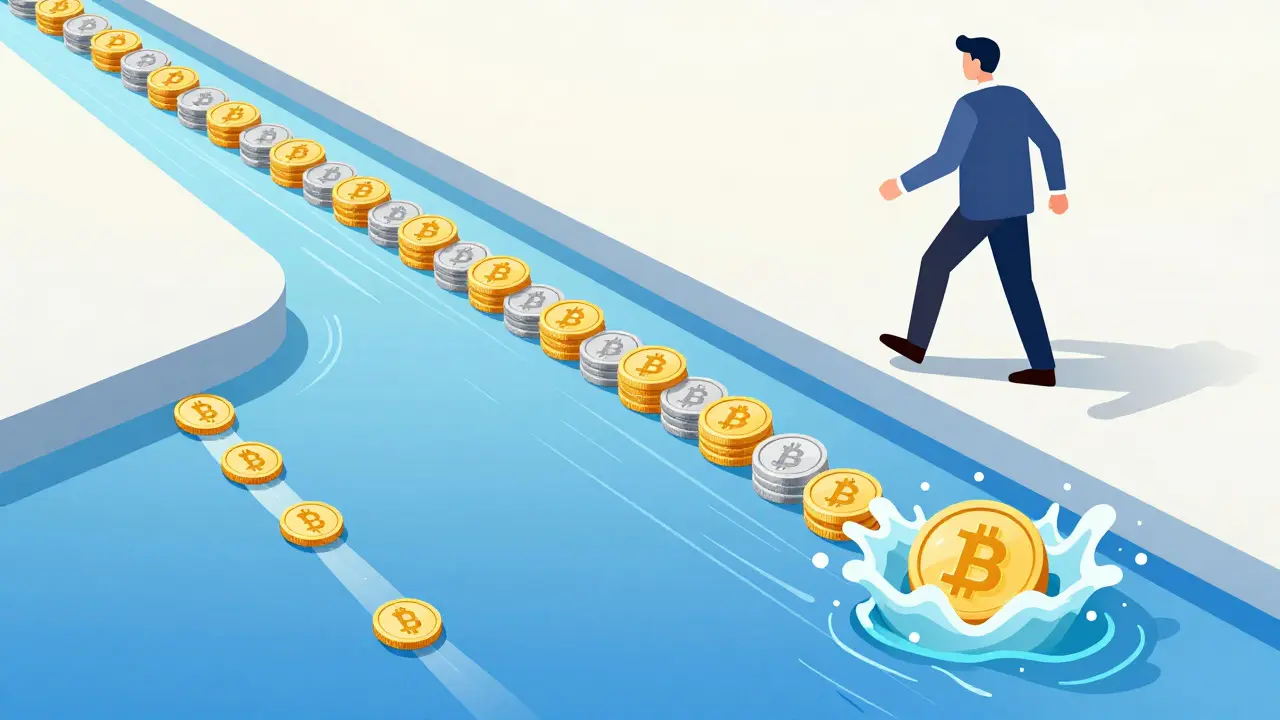
Liquidity isn't just a single number; it's a combination of trading volume and market depth. Trading volume tells you how much of a coin has changed hands in 24 hours. Market depth tells you how many orders are waiting in the books at various price levels. When a market is liquid, there's a tight bid-ask spread the difference between the highest price a buyer is willing to pay and the lowest price a seller is willing to accept . For example, if Bitcoin is being bought at $64,000 and sold at $64,001, the spread is tiny. You can enter and exit positions almost instantly. In contrast, a small-cap token might have a buyer at $1.00 and a seller at $1.10. That 10% gap is a massive hurdle that eats into your profits before you've even started.Why Liquidity is the Difference Between Profit and Loss
Ever heard of slippage the difference between the expected price of a trade and the price at which the trade is actually executed ? This is where liquidity hits your wallet. If you try to buy $10,000 worth of a coin with low liquidity, your order might be so large that it exhausts all the available sellers at the current price. To fill your order, the exchange has to move to the next, higher price level. Suddenly, you've paid an average price much higher than the one you saw on the screen. High liquidity acts as a buffer. It ensures price stability because it takes a much larger amount of money to "move the needle" on the price. For institutional investors who move millions of dollars, liquidity is the only thing that matters. They can't just click "buy" on a random token; they need deep markets to avoid crashing the price of the asset they are trying to accumulate.Centralized vs. Decentralized Liquidity
Where you trade changes how liquidity is handled. On Centralized Exchanges platforms like Binance or Coinbase that act as intermediaries and use traditional order books (CEXs), liquidity is provided by professional market makers and a massive pool of retail users. These platforms are generally very efficient for high-volume assets. However, the rise of Decentralized Finance a blockchain-based form of finance that does not rely on centralized financial intermediaries (DeFi) introduced a completely different model. Since there are no central intermediaries, DeFi uses liquidity pools crowdsourced collections of funds locked in a smart contract that facilitate trading on a decentralized exchange . Instead of waiting for a matching buyer or seller, you trade against the pool. This is managed by an Automated Market Maker a protocol that uses mathematical formulas to price assets automatically based on the ratio of assets in a pool (AMM), such as the one used by Uniswap a leading decentralized exchange protocol on the Ethereum blockchain . This means you can trade 24/7 without needing a specific counterparty to be online at that exact moment.| Feature | Centralized (CEX) | Decentralized (DEX) |
|---|---|---|
| Mechanism | Order Books | Liquidity Pools / AMMs |
| Control | Exchange Managed | Smart Contract Managed |
| Speed | Very High | Depends on Network Congestion |
| Access | KYC/Account required | Wallet connection only |
Becoming a Liquidity Provider
You don't have to just be a trader; you can actually be the one providing the liquidity. This is often called "liquidity mining" or yield farming the practice of staking or lending crypto assets in DeFi protocols to earn rewards . By depositing a pair of tokens (like ETH and USDC) into a pool, you enable others to trade. In return, you earn a slice of the trading fees. It sounds like free money, but there's a catch: impermanent loss. This happens when the price of the assets you deposited changes compared to when you put them in. If one asset skyrockets, the AMM rebalances your pool, and you might end up with less total value than if you had just held the tokens in your wallet.The Roadblocks: What Kills Liquidity?
Several things can cause liquidity to dry up instantly. Market sentiment is the biggest driver. During a panic, liquidity providers often withdraw their funds to avoid losses, creating a "liquidity crunch." This makes the remaining trades even more volatile, leading to a vicious cycle of price drops and slippage. Regulatory shifts also play a huge role. If a major country announces a crackdown on certain types of tokens, institutional players-who bring the most liquidity-will pull out quickly to avoid legal risks. Finally, technical issues like network congestion on Ethereum can make it too expensive (via high gas fees) for small traders to provide liquidity, effectively shrinking the pool.
The Future of Market Depth
We are moving toward a world where liquidity is no longer trapped on a single chain. Cross-chain protocols are being built to allow liquidity to flow from Solana to Ethereum or Avalanche seamlessly. This reduces fragmentation, meaning you won't have to worry if a token is "liquid" on one chain but "dead" on another. We're also seeing the arrival of better institutional custody solutions. When big banks feel safe holding digital assets, they bring billions in liquidity, which will eventually flatten those volatile price spikes we see in smaller tokens. As the market matures, the gap between "crypto liquidity" and "traditional stock market liquidity" will likely close.What is the easiest way to check if a coin has good liquidity?
Look at the 24-hour trading volume on sites like CoinMarketCap or CoinGecko. However, volume can be faked (wash trading). A better way is to check the "Depth" chart on an exchange, which shows how many buy and sell orders exist within 1% or 2% of the current price. If the order book looks thin, expect high slippage.
Is high liquidity always a good thing?
For the average trader and investor, yes. High liquidity means you can enter and exit positions quickly at a fair price. The only people who might dislike high liquidity are those trying to manipulate a price, as it requires significantly more capital to move a liquid asset's price.
How does an AMM differ from a traditional exchange?
A traditional exchange uses an order book where buyers and sellers agree on a price. An Automated Market Maker (AMM) uses a mathematical formula (like x * y = k) to determine the price based on the reserves of tokens in a pool. You trade against a smart contract, not another person.
What is impermanent loss?
Impermanent loss occurs when you provide liquidity to a pool and the price of the tokens changes. Because the AMM must maintain a specific ratio, it sells the rising asset and buys the falling one. If you withdraw your funds, the loss becomes "permanent." If the price returns to the original ratio, the loss disappears, hence the name "impermanent."
Does Bitcoin have the best liquidity in crypto?
Generally, yes. Because it is the most widely adopted and traded asset, Bitcoin typically has the highest volume and deepest order books across almost every platform, resulting in the lowest slippage for large trades.
Sarah Fisher
April 20, 2026 AT 22:18The way liquidity functions really mirrors how we value things in society, it's not just about the asset but the collective agreement on its accessibility.
It's interesting to think about how these digital pools are essentially social contracts written in code.
Benjamin Forg
April 22, 2026 AT 20:07lol typical bait guide... you think these pools are actually crowdsourced but its all market makers and whales manipulating the order books to trap retail... wake up
Robert Mosolygo
April 23, 2026 AT 03:38The mathematical precision of the AMM model is an elegant facade for what is essentially a liquidity trap for the uninitiated. One must consider that the very stability promised by these pools is orchestrated by institutional entities to ensure they can exit their positions while the retail 'liquidity providers' absorb the volatility.
Lisa Camp
April 24, 2026 AT 16:55STOP BEING AFRAID OF SLIPPAGE AND JUST TRADE ALREADY! GET IN THE GAME OR GET LEFT BEHIND!
Hannah Rubia
April 26, 2026 AT 04:06It is imperative to note that for those utilizing decentralized exchanges, the selection of a stablecoin pair is indeed the most prudent method to mitigate the risks associated with impermanent loss. I highly recommend auditing the total value locked in a pool before committing any significant capital.
Mike Krasner
April 27, 2026 AT 08:58honestly the whole cex vs dex debate is just noise everything is manipulated anyway
praveen subbiah
April 28, 2026 AT 05:09My friends, this is such a beautiful explanation! Truly, the brilliance of the digital age is bringing this knowledge to everyone everywhere!
Guy Bianco
April 29, 2026 AT 15:19A very comprehensive overview. It is quite beneficial for newcomers to understand the difference between volume and depth. 🤝
Ali Tate
May 1, 2026 AT 13:31most of you peasants dont even get how deep this rabbit hole goes... the sheer audacity to think a basic chart on coinmarketcap tells the whole story is hilarious
Findlay Duncan Lyon
May 3, 2026 AT 02:19Spot on. Keep it simple.
Alex Wan
May 3, 2026 AT 06:58I totally agree with the point on stablecoin pairs! Its a grate way for beginners to larn without losing their shirt on a bad trade. Lets all help each other out here!!
Greg Reynolds
May 3, 2026 AT 21:37The assertion that Bitcoin possesses the 'best' liquidity is a simplification. While it has the highest volume, the fragmentation across various wrapped versions and different chains creates a distorted view of actual market depth.
jill huyo-a
May 5, 2026 AT 09:41I've been trying to figure out how to avoid that impermanent loss thing, thanks for explaining it in a way that actually makes sense!
Sara Ellis
May 6, 2026 AT 11:31its just vibes and numbers man just follow the flow
Gary Lingrel
May 8, 2026 AT 07:03imagine thinking the 'market' is fair lol 🙄 the house always wins and you're just providing the fuel for their exit strategy
Jennifer Taylor
May 8, 2026 AT 16:52The elites use these pools to hide their movements. If you think a smart contract is safer than a bank, you're just playing into their hands. They want you in the pools so they can drain them.
Doc Coyle
May 9, 2026 AT 14:15It is simply common sense to stick to high-cap assets. There is no reason to gamble on illiquid tokens if you actually care about your capital.
Liz Ariza
May 10, 2026 AT 14:12This is such a sparkling guide! 🌟 Totally helps clear up the fog for anyone feeling overwhelmed by the jargon. Stay safe out there and always double check those depth charts! 🚀