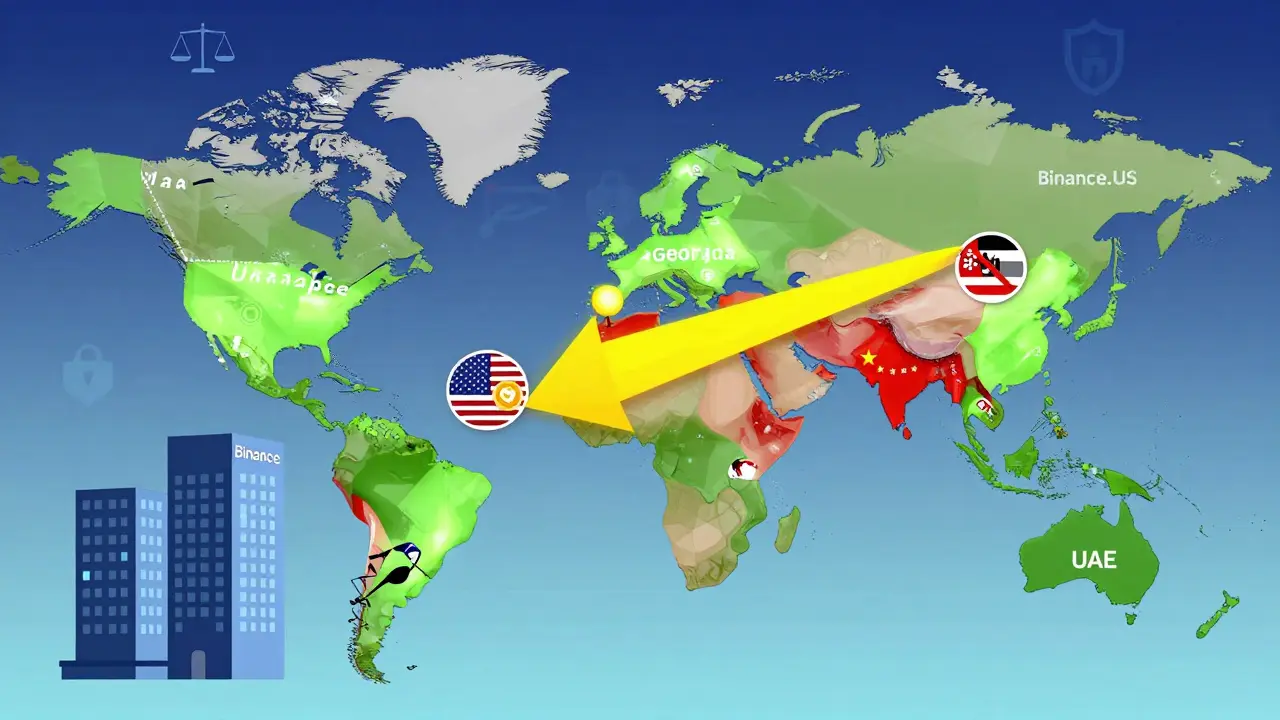
Not all crypto exchanges work everywhere. If you're traveling, moving abroad, or just curious why you can't access your favorite platform, it's not a glitch-it's regulation. The same app that lets you buy Bitcoin in London might block you entirely in New York or Lagos. Why? Because governments control who can operate, what coins you can trade, and how much they monitor your activity. This isn't about technology-it's about law.
Where Crypto Exchanges Are Most Available
Some countries practically invite crypto exchanges to set up shop. Ukraine leads the world in crypto adoption, according to the 2025 Global Crypto Adoption Index. It's not just about people using Bitcoin-it's about how much value flows through centralized exchanges. Moldova and Georgia follow closely, showing that in places with unstable banking systems or inflation, crypto isn't a luxury-it's a lifeline.
Asia has a strong presence too. Hong Kong SAR ranks fifth globally, Singapore is fifteenth, and South Korea is eighteenth. These aren't random rankings. They reflect clear rules. Singapore, for example, licenses exchanges and requires strict KYC. Hong Kong allows retail trading under tight oversight. That means users there get access to Binance, OKX, and Gate.io without legal risk.
Even countries with economic chaos, like Venezuela (9th) and Yemen (12th), show high crypto usage. People there use crypto to buy food, pay rent, or send money home. Exchanges adapt by offering local payment methods and lower fees. In these regions, availability isn't about luxury-it's about survival.
Why the U.S. Is a Hard Market to Crack
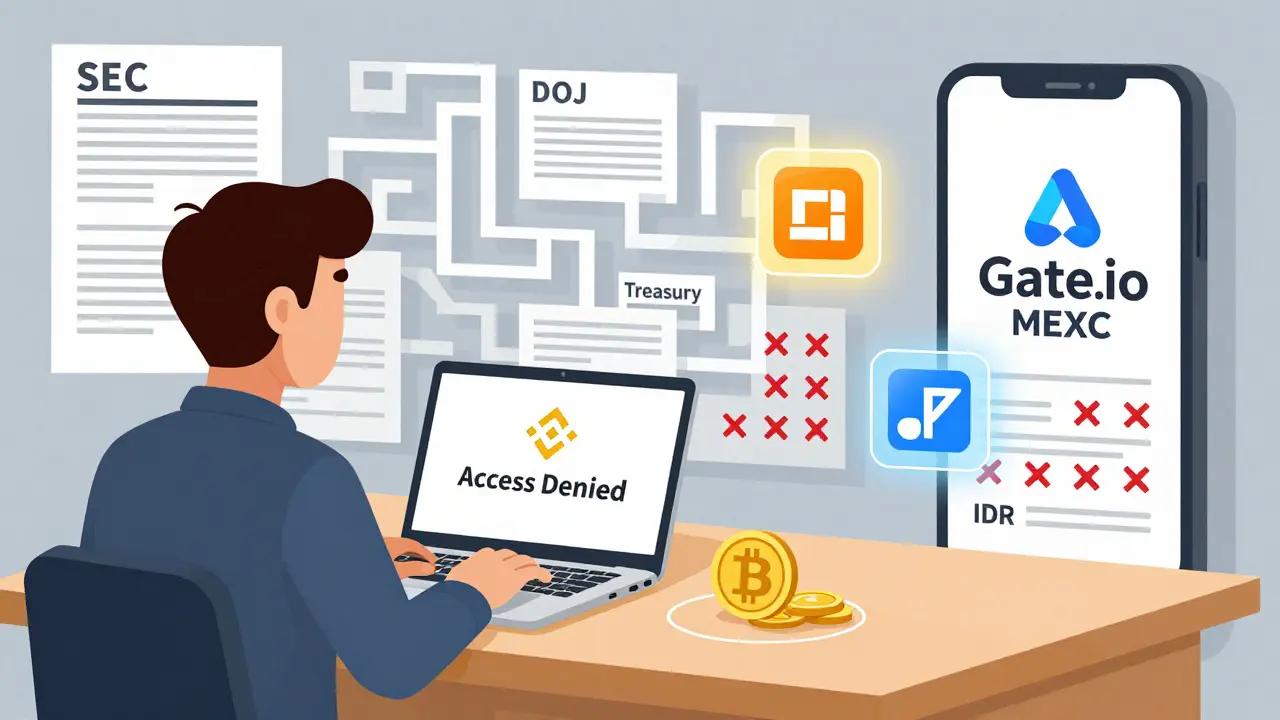
The United States is the biggest crypto market by trading volume, but also the hardest to operate in. Why? Because multiple agencies-SEC, DOJ, Treasury-all claim authority. No single rulebook. Just a maze of overlapping rules.
Binance, the world’s largest exchange with nearly 40% market share, got hit hard. In November 2023, it paid a $4 billion settlement after being accused of failing to prevent money laundering and ignoring crypto theft. Its founder, Changpeng Zhao, pleaded guilty and stepped down. The result? Binance had to fully exit the U.S. market. But it didn’t disappear-it created Binance.US, a separate entity with limited coin offerings, stricter rules, and no derivatives.
Other exchanges face similar pressure. Coinbase and Kraken operate legally because they built compliance teams from day one. But smaller platforms? They either shut down or avoid U.S. users entirely. If you're in the U.S., your options are narrower than you think. You can’t trade Solana futures on Binance. You can’t use leverage on Gate.io. The coins available? Fewer than half of what’s offered elsewhere.
How Regional Platforms Fill the Gaps
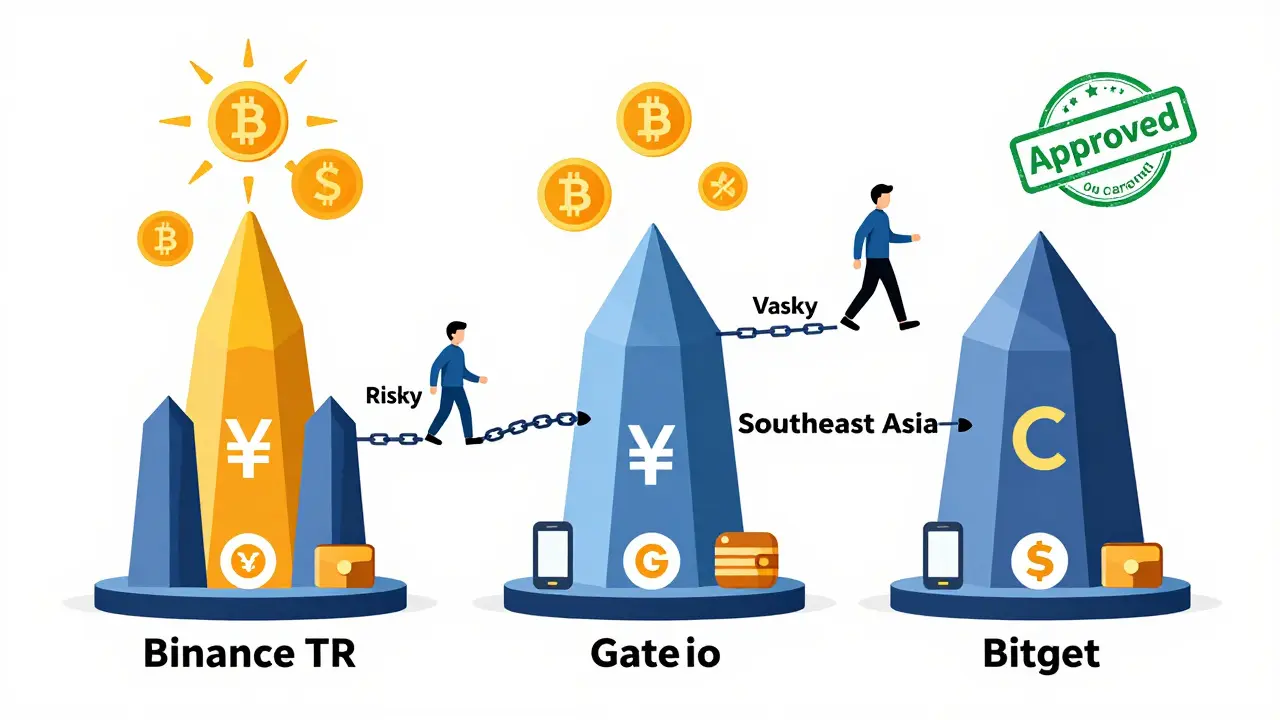
When global giants pull out, local players step in. That’s why Binance TR exists for Turkey, Binance.KR for South Korea, and Gate.io has a dedicated Chinese version-even though China bans crypto trading. These aren’t just translations. They’re legally separate platforms with different coin lists, KYC rules, and payment methods.
Gate.io, the second-largest exchange globally, grew 14.4% month-over-month in April 2025. Why? Because while Binance struggled with U.S. regulators, Gate.io quietly expanded in Southeast Asia, Latin America, and Africa. It added support for local bank transfers, mobile wallets, and even crypto-to-cash kiosks in Nigeria and Brazil.
Bitget and MEXC are also gaining ground. They don’t have Binance’s brand, but they offer lower fees and faster withdrawals in regions where Binance is blocked. In countries like Indonesia, Thailand, and Argentina, these platforms now dominate. Users don’t care about global rankings-they care about whether they can deposit pesos, rials, or naira and withdraw without waiting days.
Spot Trading Rules the Market
Most people aren’t trading futures or perpetual swaps. They’re buying and selling Bitcoin, Ethereum, and a few top coins directly. Spot trading makes up 61.3% of all exchange volume in 2025. That’s because it’s simple: you pay, you get coins. No leverage. No expiration. No complex contracts.
This simplicity makes spot trading the easiest to regulate. Countries that allow crypto usually start with spot trading first. The U.S. lets you buy Bitcoin on Coinbase. The EU lets you trade ETH on Kraken. Even Japan, with its strict rules, allows spot trading under licensing.
But here’s the catch: even spot trading varies. In India, you can only trade Bitcoin and Ethereum on regulated platforms. In the UAE, you can trade hundreds of tokens, including meme coins. In Russia, you can trade-but only if you report every transaction to the tax office. So while spot trading is the most common, what you can trade depends entirely on where you are.
What’s Changing in 2025 and Beyond
The global crypto exchange market hit $48.41 billion in 2025 and is expected to hit $122.63 billion by 2032. But growth won’t be even. Countries with clear rules-like Switzerland, Singapore, and the UAE-will keep attracting exchanges. Places with unclear or hostile laws-like Brazil, Nigeria, or parts of Latin America-will see constant shifts. Exchanges might launch, get banned, then return months later after lobbying.
Mobile apps and AI tools are making trading easier everywhere. But they can’t bypass laws. If your country bans crypto, no app will help. If your bank blocks crypto deposits, even the best exchange won’t work.
Security is improving. Multi-factor authentication, biometric logins, and cold storage are now standard-even in emerging markets. But again, this doesn’t change availability. It just makes trading safer where it’s allowed.
What This Means for You
If you’re trying to access a crypto exchange and it’s blocked, don’t use a VPN. It might get you in-but it also puts you at risk. Exchanges track IP addresses. If they detect you’re bypassing restrictions, they freeze your account. You could lose access to your funds.
Instead, check what’s legally available in your country. Look for exchanges that have official local entities. If Binance doesn’t work, try Gate.io or MEXC. If Kraken is blocked, see if Bitget supports your currency. Always verify: does the platform have a local license? Does it list your country on its website? Does it offer local payment options?
The crypto world is global, but your access isn’t. The rules change every year. What’s allowed today might be banned tomorrow. Stay informed. Don’t assume what works in one country works everywhere.
Can I use Binance in the United States?
No, you cannot use the global Binance platform in the U.S. After its $4 billion settlement in 2023, Binance fully exited the U.S. market. However, Binance.US operates as a separate, U.S.-regulated platform with fewer coins, no margin trading, and stricter KYC. If you're in the U.S., you must use Binance.US-not the main Binance site.
Why is crypto more available in Ukraine than in the UK?
Ukraine leads in crypto adoption because of its economic instability and weak traditional banking infrastructure. People use crypto to protect savings and send remittances. The government has taken a neutral stance, allowing exchanges to operate without heavy restrictions. The UK, while crypto-friendly, has stricter AML rules and requires full licensing. This makes it harder for smaller exchanges to enter, even though major ones like Coinbase and Kraken are available.
Do all exchanges offer the same coins everywhere?
No. Coin availability is heavily regulated. For example, Binance offers over 1,000 tokens globally, but Binance.US only lists around 100. In India, only Bitcoin and Ethereum are allowed on licensed platforms. In the UAE, you can trade meme coins like Dogecoin and Shiba Inu freely. Exchanges tailor their coin lists to local laws-not user demand.
Can I trade crypto if my country bans it?
Technically, yes-using a VPN or peer-to-peer platforms. But legally, no. If your country bans crypto, using an exchange can lead to fines, account freezes, or even criminal charges. Exchanges like Binance and Coinbase actively block users from banned countries. Even if you get in, your funds aren’t protected. You’re operating outside the law, with no recourse if something goes wrong.
Which exchanges are safest to use in emerging markets?
Gate.io, MEXC, and Bitget are the most reliable in emerging markets. They offer local payment options (bank transfers, mobile wallets), low fees, and 24/7 support in multiple languages. They also comply with regional regulations where possible. Unlike global giants, they don’t withdraw when laws change-they adapt. That’s why they’re growing faster in Africa, Southeast Asia, and Latin America.
jack carr
March 6, 2026 AT 23:51Just sayin'.
Brian T
March 8, 2026 AT 22:26And don't even get me started on VPNs. That's not innovation. That's fraud with a side of delusion.
Jonathan Chretien
March 10, 2026 AT 20:50Ukraine’s using crypto because their banks are garbage. The U.S. is using crypto because… well, we have banks, but we also have Wall Street. So we’re just replacing one rigged system with another. Welcome to the future! 🤖💸
Nash Tree Service
March 11, 2026 AT 19:34One cannot reasonably expect market participants to navigate a quagmire of overlapping mandates without substantial cost, risk, and uncertainty.
Jane Darrah
March 12, 2026 AT 18:46Meanwhile, Gate.io is over there in Nigeria doing crypto-to-cash kiosks like it’s 2020 and they’re the only game in town. I’m just saying… maybe the real revolution isn’t happening here. Maybe it’s happening where people actually need it.
Denise Folituu
March 14, 2026 AT 08:05And don’t even get me started on meme coins. Dogecoin? Shiba Inu? They’re not investments. They’re digital lottery tickets. And if you’re buying them because someone on TikTok said ‘to the moon,’ you deserve to lose.
Nancy Jewer
March 15, 2026 AT 03:08What’s clear is that retail users are increasingly voting with their wallets, and the platforms that adapt to local compliance structures-like Gate.io’s regionalized entities-are the ones achieving sustainable growth.
Steven Lefebvre
March 16, 2026 AT 00:42Meanwhile back in Toronto? I can’t even buy a Dogecoin without filling out a 12-page form. So yeah, the U.S. is safe. But is it alive? I don’t know. But Colombia? It’s buzzing.
Issack Vaid
March 17, 2026 AT 23:21So stop pretending the problem is the government. The problem is you. You want freedom? Then obey the rules. Or move. Or stop whining.
Shawn Warren
March 18, 2026 AT 17:11Switzerland Singapore UAE they’re not being nice they’re being smart
Olivia Parsons
March 20, 2026 AT 12:14Works great.
Jackson Dambz
March 22, 2026 AT 01:58Bill Pommier
March 23, 2026 AT 10:08