Germany has built one of the strictest regulatory environments for crypto custody in Europe. If you are looking to hold digital assets with a licensed provider or launch your own custody service here, the rules are not just about filling out forms. They involve a complex interplay between European Union-wide standards and specific national laws that dictate how your keys are managed, how much capital you need, and how your clients' assets are protected during insolvency.
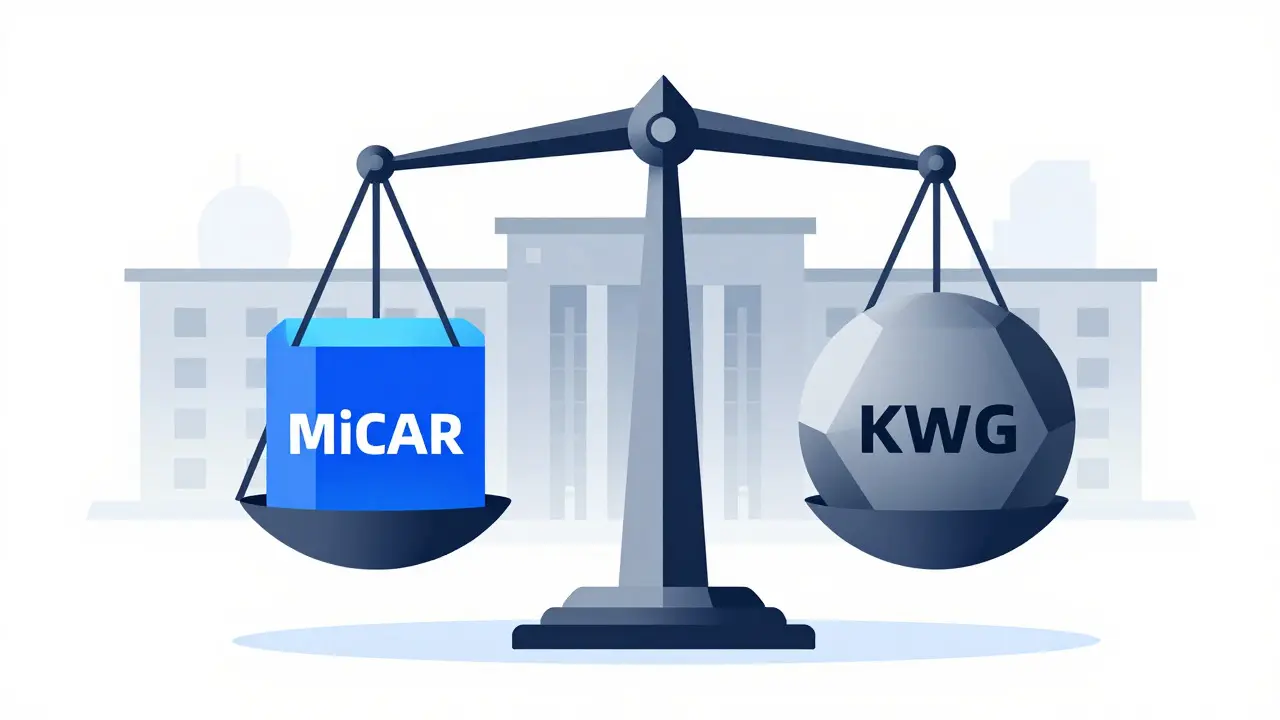
The core tension in the German market right now is the transition from the old national framework to the new EU standard. For years, Germany relied on its Banking Act (KWG) to regulate these services. Now, the Markets in Crypto-Assets Regulation (MiCAR) has taken over, creating a dual-track system that can be confusing if you don't know which bucket your asset falls into. This guide breaks down what actually changes for providers and investors, why the bureaucracy is so heavy, and how to navigate the licensing process without getting stuck in a six-month wait.
The Dual Regulatory Framework: KWG vs. MiCAR
To understand the restrictions, you first need to understand who is watching. The primary regulator is the Federal Financial Supervisory Authority, known as BaFin. It operates under two main legal umbrellas: the national Kreditwesengesetz (KWG) (Banking Act) and the EU's MiCAR (Markets in Crypto-Assets Regulation).
Here is where it gets tricky. Not all crypto assets are treated the same way in Germany. The law draws a sharp line based on whether an asset qualifies as a "security" under civil law.
- Pure Cryptocurrencies: Assets like Bitcoin and Ether generally fall under MiCAR. From January 1, 2025, these are regulated as financial instruments rather than bank products.
- Security Tokens: If a token represents a share in a company or a debt instrument, it often remains under the older MiFID II framework and the KWG. This means custody for these assets might still require a banking license or a specific financial services license, depending on the classification.
This distinction matters because it dictates your entry barrier. A pure-play crypto custodian follows the MiCAR path. An institution holding security tokens for clients might still be navigating the stricter, more expensive KWG requirements. According to the European Banking Authority, this split creates a 25% increase in compliance costs compared to countries that apply MiCAR uniformly, but it provides legal clarity that large institutions value highly.
Licensing Requirements and Capital Thresholds
You cannot provide crypto custody services in Germany without an explicit license from BaFin. There is no simple registration form; it is a full-fledged authorization process. The requirements are designed to ensure that only financially sound entities can handle client assets.
| Requirement | Pure Crypto Custody (MiCAR) | Hybrid/Security Token Custody (KWG/MiFID II) |
|---|---|---|
| Minimum Operational Capital | €125,000 | Up to €730,000 (depending on service scope) |
| Licensing Body | BaFin (under MiCAR/KMAG) | BaFin (under KWG) |
| Processing Time | 6-9 months (standard), ~3 months (accelerated for existing banks) | Varies, often longer due to banking law complexity |
| Key Personnel Requirement | 2 Senior Managers with fitness/propriety certification | Similar, plus additional banking compliance officers |
The capital requirement is a significant hurdle. While €125,000 sounds manageable, it must be available and verified before you start operations. Furthermore, you need at least two senior managers who have passed BaFin's "fitness and propriety" tests. This has created a talent bottleneck; as of mid-2025, there were only about 312 certified crypto custody compliance officers in the entire country serving 87 licensed entities. Finding qualified people is often harder than raising the capital.
One major advantage for traditional banks is the accelerated notification procedure. If you are already a licensed bank under MiFID II, you can use a streamlined process under MiCAR Article 91(2). Deutsche Bank, for example, completed this transition in Q1 2025, cutting their usual processing time from nine months to three. For startups, however, the standard 6-to-9-month timeline is the reality, with an average reported wait of 7.2 months according to recent founder surveys.
Technical and Operational Standards
Getting the license is only half the battle. Maintaining it requires meeting technical standards that go far beyond basic encryption. BaFin’s guidance notes, particularly those updated in early 2025, specify exactly how your infrastructure should look.
The most critical rule is segregation of assets. Client crypto assets must be kept strictly separate from the custodian’s own holdings. This isn't just a suggestion; it is a legal mandate to protect clients in case the custodian goes bankrupt. If the custodian fails, client assets should remain untouched and returnable.
Technically, you are expected to implement:
- Cold Storage Dominance: At least 95% of assets should be held in cold storage (offline wallets).
- Multi-Signature Schemes: Wallets must use multi-signature protocols, typically requiring a 3-of-5 signature scheme to authorize transactions.
- Certification Standards: Hardware wallets must meet Common Criteria EAL 4+ security certification. Software solutions require regular third-party penetration testing, with results submitted to BaFin quarterly.
- Business Continuity: You must have a plan that allows operations to continue for at least 72 hours during a disruption.
These requirements align with the broader Digital Operational Resilience Act (DORA), which sets the tone for tech resilience across the EU. Implementation costs vary wildly. A basic setup for a small firm might cost around €500,000, while enterprise-grade solutions for large banks can exceed €2 million. This high barrier to entry explains why the market is dominated by established players like Finoa, Coinbase Custody, and major German banks.
Market Impact and Investor Protection
Why does Germany insist on such strict rules? The answer lies in investor protection and market stability. The primary goal of the framework is to ensure that client assets remain protected even in insolvency scenarios, a lesson learned from past crypto exchange failures.
The results are mixed. On one hand, institutional adoption is booming. As of Q2 2025, 63% of DAX 30 companies are using licensed German custody providers. Total assets under custody reached €48.7 billion by June 2025, growing by nearly 28% year-over-year. Investors trust the system because they know their assets are legally segregated and monitored by BaFin.
On the other hand, smaller firms struggle. The bureaucratic load is heavy. In 2025, 54% of German crypto firms spent over €250,000 on regulatory compliance alone. There have also been enforcement actions, such as BaFin ordering the wind-down of Ethena GmbH’s USDe stablecoin operations in June 2025, giving holders until August 2025 to redeem assets. These cases show that regulators are willing to step in when procedures aren't followed perfectly.
For end-users, the benefit is peace of mind. Unlike unregulated offshore exchanges, a German-licensed custodian is subject to annual audits, mandatory reporting, and strict capital reserves. If something goes wrong, there is a clear legal recourse and a supervisory body holding the provider accountable.

Future Outlook: DAC 8 and Civil Law Changes
The regulatory landscape is not static. Two major developments will reshape the industry in the coming years.
First, the implementation of DAC 8 (Directive on Administrative Cooperation) reporting requirements takes effect on January 1, 2026. This will force custody providers to report crypto transaction details to tax authorities. Providers must build new technical interfaces by Q4 2025 to comply with the OECD’s Crypto-Asset Reporting Framework. Expect this to add another 15-20% to compliance costs.
Second, Germany is planning to revise its civil securities law by Q2 2026. This change could reclassify many security tokens as formal civil law securities. If this happens, custody for these tokens would trigger banking licenses instead of the current financial services licenses. Analysts predict that 70-80% of security tokens will fall into this new category. This will likely consolidate the market further, favoring large banks that already hold the necessary licenses over specialized crypto-native startups.
Frequently Asked Questions
Do I need a license to hold my own crypto in Germany?
No. Individual investors holding their own private keys do not need a license. The licensing requirement applies to professional service providers who custody assets for others for a fee.
What is the difference between MiCAR and KWG regulation for custody?
MiCAR regulates pure cryptocurrencies like Bitcoin and Ether under EU standards. KWG (the German Banking Act) still governs assets classified as securities or financial instruments. Most providers must navigate both frameworks depending on the asset mix they offer.
How long does it take to get a crypto custody license in Germany?
For new applicants, the standard process takes 6 to 9 months. Existing banks or financial institutions can use an accelerated notification procedure, reducing the time to approximately 3 months.
Are client assets safe if a German custodian goes bankrupt?
Yes, provided the custodian complies with segregation rules. MiCAR and KWG mandate that client assets be kept separate from the custodian's own balance sheet. In insolvency, these assets are excluded from the bankruptcy estate and returned to clients.
What are the minimum capital requirements for a custody provider?
Pure crypto custody providers under MiCAR require a minimum operational capital of €125,000. Providers offering multiple services or handling security tokens may need up to €730,000 under KWG provisions.